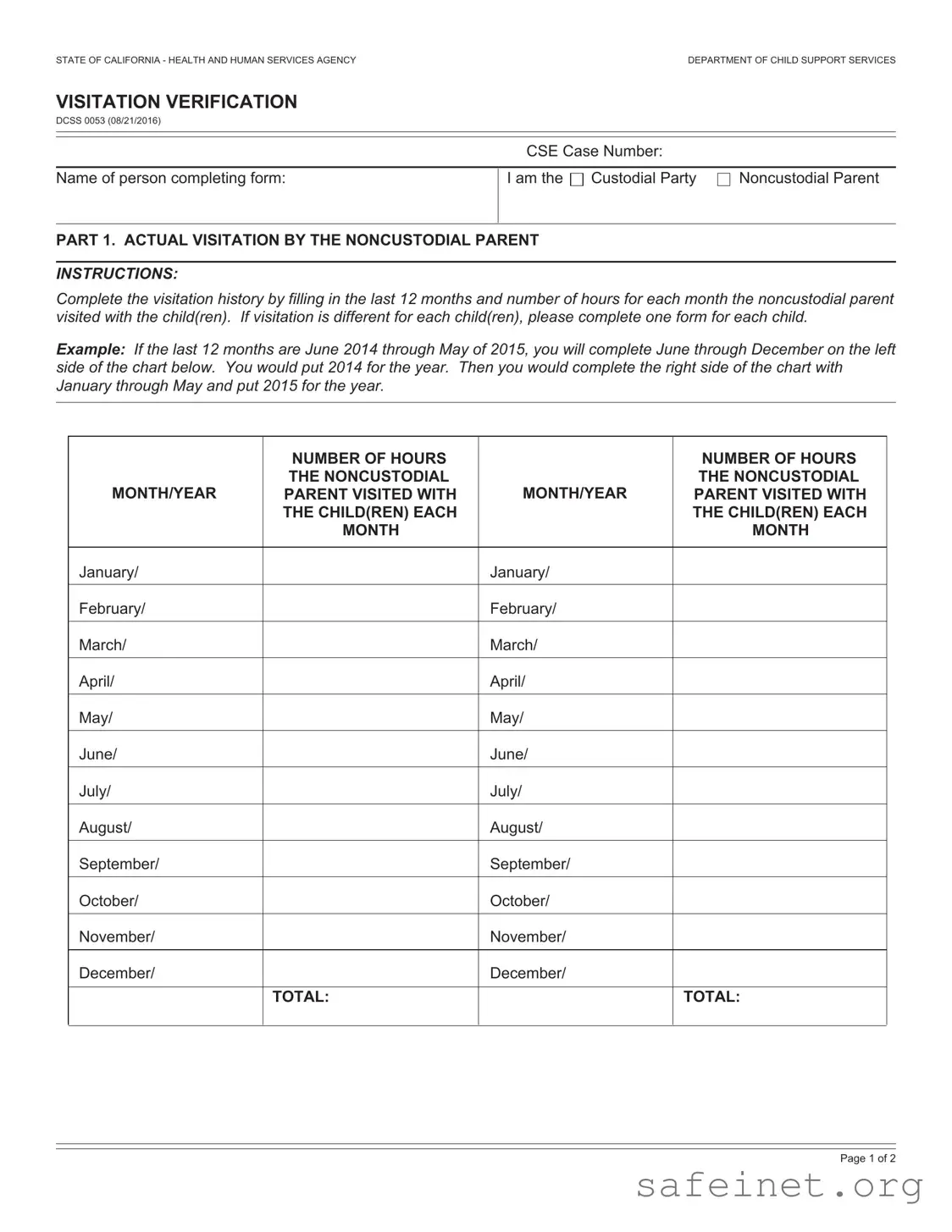
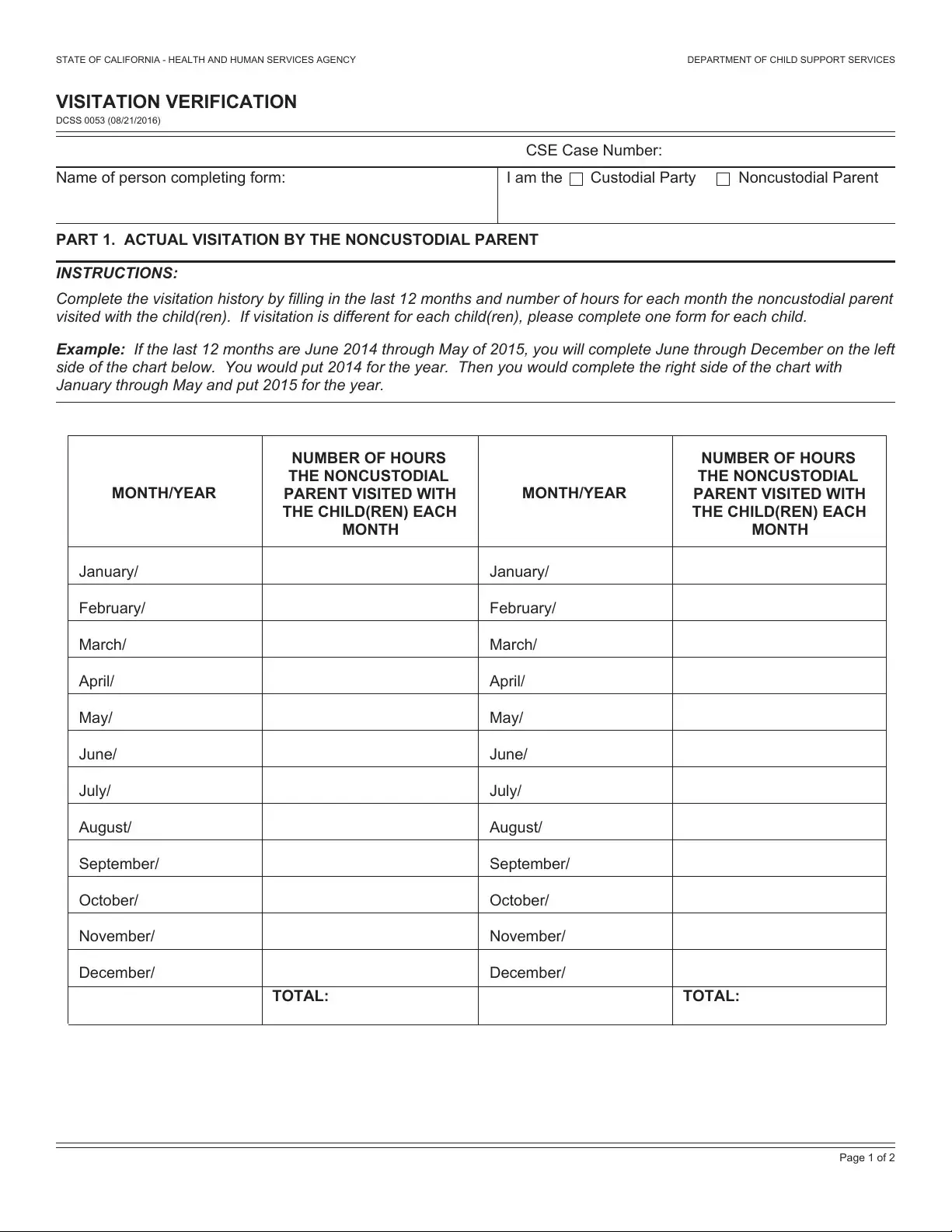
The DCSS 0053 form, officially titled the Visitation Verification form, plays a crucial role in the management of child custody and visitation arrangements in California. Designed for use by both custodial and noncustodial parents, this form facilitates the documentation of visitation history over the past year. Parents are required to detail the actual visitation hours each month, ensuring that accurate records are maintained. The form also includes sections to indicate whether the visitation arrangement is shared custody or visitation only, and it allows for the specification of regular, vacation, summer, and holiday visitation hours. This comprehensive approach ensures that all aspects of the visitation schedule are clearly outlined. Additionally, the form requires a declaration of truthfulness, emphasizing the importance of honesty in these sensitive matters. By filling out the DCSS 0053, parents contribute to a transparent process that can help resolve disputes and promote the best interests of the child.
| Fact Name | Details |
|---|---|
| Form Purpose | The DCSS 0053 form is used to verify visitation between a noncustodial parent and their child(ren). |
| Governing Law | This form is governed by California Family Code Sections 3020-3027 regarding child custody and visitation. |
| Completion Requirements | It must be filled out for each child if visitation differs among them. |
| Time Frame | The form requires a history of visitation for the last 12 months. |
| Shared Custody Options | The form allows for options like shared custody or visitation only, which must be checked accordingly. |
| Declaration of Truth | The person completing the form must declare that the information provided is true and correct. |
Filling out the DCSS 0053 form requires careful attention to detail. This form collects information about visitation between a noncustodial parent and their child or children over the past year. After completing the form, it will need to be submitted to the appropriate agency for processing. Below are the steps to guide you through the completion of the form.
After completing these steps, review the form to ensure all information is correct and clear. Once verified, submit the form to the designated agency for processing.
What is the DCSS 0053 form?
The DCSS 0053 form, also known as the Visitation Verification form, is a document used in California by the Department of Child Support Services. It helps track the visitation history of a noncustodial parent with their child or children over the past 12 months. This form is crucial for establishing visitation patterns and ensuring compliance with custody agreements.
Who should complete the DCSS 0053 form?
The form should be completed by either the custodial party or the noncustodial parent. It is important that the person filling out the form has accurate and up-to-date information regarding visitation to ensure that the data reflects the actual time spent with the child or children.
How is the visitation history recorded on the form?
To record visitation history, the individual completing the form must fill in the number of hours the noncustodial parent visited with the child or children for each month over the last 12 months. If visitation varies for each child, separate forms must be filled out for each child to maintain clarity and accuracy.
What if visitation varies from month to month?
If visitation hours differ from month to month, it is essential to record the specific number of hours for each month accurately. This detailed record helps to provide a clear picture of the visitation pattern, which can be vital in legal proceedings or when addressing custody issues.
Are there different types of visitation that need to be specified?
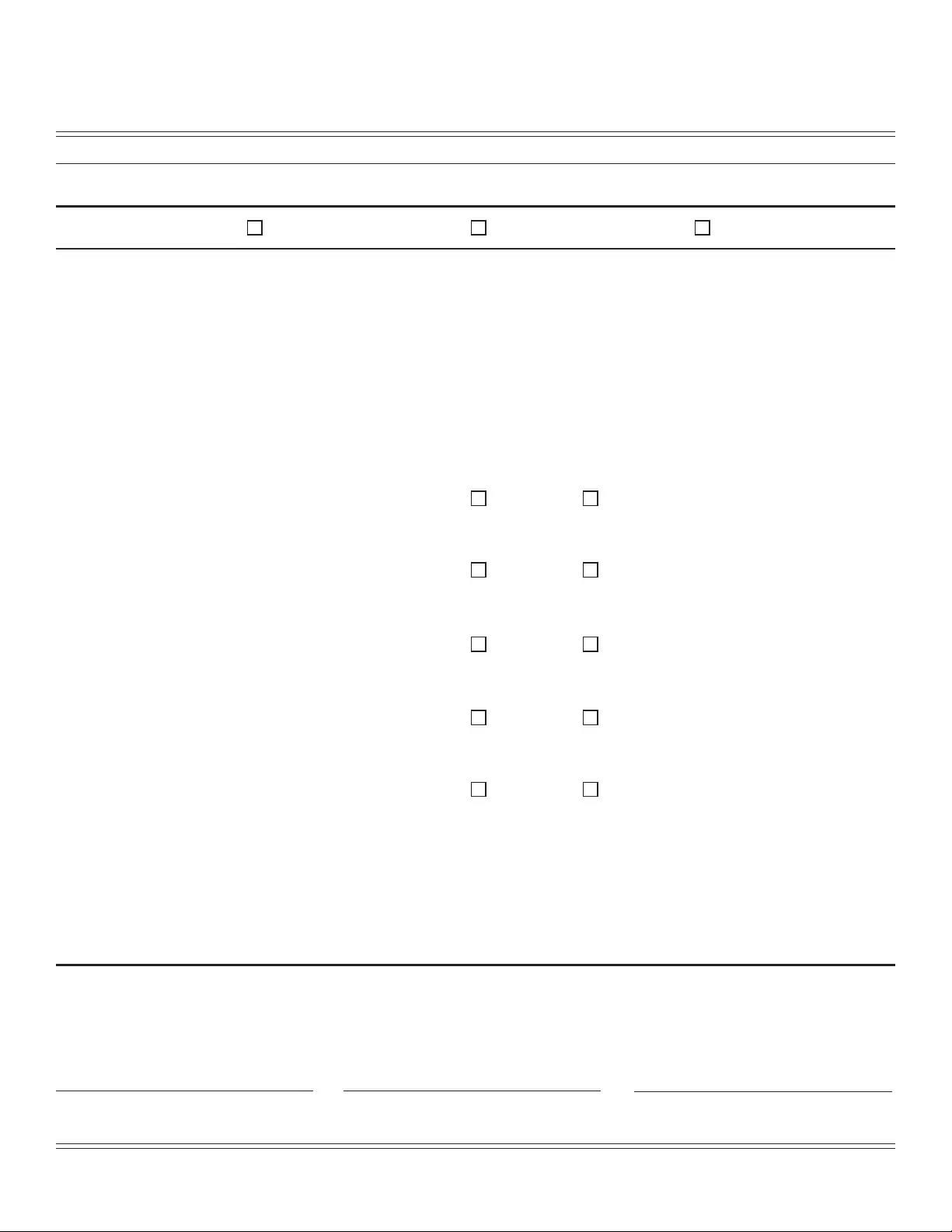
Yes, the form includes sections to specify different types of visitation, such as regular visitation, vacation visitation, summer visitation, holiday visitation, and overnight visitation. Each type has designated areas where the individual must provide details, including specific dates and times.
What does the "Shared Custody" option mean?
The "Shared Custody" option indicates whether both parents share custody of the child or children. If this option is checked, it may affect how visitation is documented and understood. If neither shared custody nor visitation applies, the appropriate box should be checked accordingly.
What declaration is required at the end of the form?
The form concludes with a declaration where the individual completing it affirms that the information provided is true and correct to the best of their knowledge. This declaration emphasizes the importance of honesty and accuracy, as the information may be shared with the other parent for verification.
Is it necessary to provide documentation along with the form?
While the form itself captures visitation history, either party may be required to provide supporting documentation if requested. This could include calendars, logs, or other records that substantiate the visitation claims made on the form.
What should be done if there are discrepancies in visitation records?
If discrepancies arise in visitation records, it is crucial to address them promptly. Both parents should communicate openly to resolve any misunderstandings. If necessary, legal counsel may be sought to navigate disputes regarding visitation and custody arrangements.
Where should the completed DCSS 0053 form be submitted?
The completed form should be submitted to the appropriate local child support agency or court, depending on the specific circumstances of the case. It is advisable to keep a copy of the submitted form for personal records and future reference.
Not filling in the CSE Case Number. This number is essential for identifying the specific case.
Failing to indicate whether the person completing the form is the Custodial Party or the Noncustodial Parent. This distinction is crucial for processing the form correctly.
Leaving the visitation history section incomplete. It is important to fill in the last 12 months accurately, as incomplete data may lead to delays.
Using the wrong format for the months and years. Ensure that the format is consistent and clear to avoid confusion.
Not specifying the number of hours the noncustodial parent visited each month. This information is critical for understanding visitation patterns.
Failing to check the appropriate box in Part 2 for shared custody or visitation only. This indicates the nature of the custody arrangement.
Neglecting to provide details for vacation, holiday, or overnight visitation. Specific dates and times help clarify the visitation schedule.
Not declaring that the information is true and correct. This declaration is necessary for the validity of the form.
Forgetting to sign and date the form. An unsigned form may not be accepted.
Overlooking the requirement to provide additional information if needed. This can include documentation or further details that support the visitation claims.
When navigating the process of child support and visitation in California, various forms and documents may accompany the DCSS 0053 form. Each of these documents serves a specific purpose and is essential for ensuring that all parties have the necessary information for compliance and verification. Below is a list of commonly used forms alongside the DCSS 0053.
Understanding these forms and their purposes can significantly ease the process of managing child support and visitation issues. It is crucial for both parents to be informed and organized, ensuring that the best interests of the child are always prioritized.
The DCSS 0053 form, which verifies visitation between a noncustodial parent and their child, shares similarities with the Child Custody and Visitation Order. This document outlines the specific arrangements agreed upon by both parents or mandated by the court. Like the DCSS 0053, it provides a structured way to document visitation rights, including specific times and dates. Both forms aim to ensure that the child's best interests are prioritized while clarifying the responsibilities of each parent regarding visitation.
Another document that aligns with the DCSS 0053 is the Parenting Plan. This plan is a comprehensive outline of how parents will raise their children after separation or divorce. Similar to the visitation verification form, it details visitation schedules, decision-making authority, and communication methods between parents. Both documents seek to promote a cooperative co-parenting relationship and establish clear expectations for visitation and custody arrangements.
The Affidavit of Parentage is also comparable to the DCSS 0053 form. This legal document establishes the identity of a child’s parents, often used when parents are unmarried. While the DCSS 0053 focuses on visitation history, the Affidavit of Parentage ensures that both parents are recognized legally, which can influence custody and visitation rights. Both documents serve to clarify parental roles and responsibilities in the context of child support and visitation.
The Visitation Log is another document that resembles the DCSS 0053. This log serves as a record of visitation dates, times, and activities between a noncustodial parent and child. Like the DCSS 0053, it helps track the actual visitation that occurs over a specified period. Both documents can be used in court to demonstrate compliance with visitation agreements and provide evidence of a parent’s involvement in their child’s life.
Additionally, the Child Support Worksheet is similar in purpose to the DCSS 0053 form. This worksheet calculates the amount of child support owed based on various factors, including visitation. While the DCSS 0053 focuses on documenting visitation, the Child Support Worksheet takes into account how visitation impacts the financial responsibilities of the noncustodial parent. Both documents play a role in the broader context of child support and custody arrangements.
The Custody Evaluation Report is another related document. This report is typically prepared by a mental health professional and assesses the best interests of the child regarding custody and visitation. Similar to the DCSS 0053, it provides insights into the child’s needs and the suitability of each parent’s home environment. Both documents are used in court to inform decisions about custody and visitation arrangements.
The Mediation Agreement is also comparable to the DCSS 0053. This document outlines the terms agreed upon during mediation sessions between parents. Like the DCSS 0053, it often includes details about visitation schedules and parenting responsibilities. Both documents aim to facilitate cooperation between parents and minimize conflicts regarding child-rearing arrangements.
The Court Order for Visitation is another document that parallels the DCSS 0053. This official court document outlines the visitation rights granted to the noncustodial parent. Similar to the DCSS 0053, it specifies the times and conditions under which visitation can occur. Both documents serve to formalize visitation arrangements and provide a framework for enforcement in case of disputes.
Lastly, the Child Custody Agreement shares similarities with the DCSS 0053 form. This agreement is a mutual understanding between parents regarding custody and visitation arrangements. Like the DCSS 0053, it provides a clear structure for visitation schedules and responsibilities. Both documents are essential in ensuring that the child’s welfare is prioritized and that both parents understand their rights and obligations.
When filling out the DCSS 0053 form, it is important to follow certain guidelines to ensure accuracy and completeness. Here are six things to do and not do:
Understanding the DCSS 0053 form is essential for those involved in child support and visitation arrangements. Here are six common misconceptions about this form:
Being informed about these misconceptions can help ensure that the DCSS 0053 form is used correctly and effectively.
Filling out the DCSS 0053 form is a critical step in documenting visitation between a noncustodial parent and their child(ren). Here are key takeaways to ensure accurate and effective use of this form:
By following these guidelines, you can ensure that the DCSS 0053 form is filled out correctly and serves its intended purpose effectively.