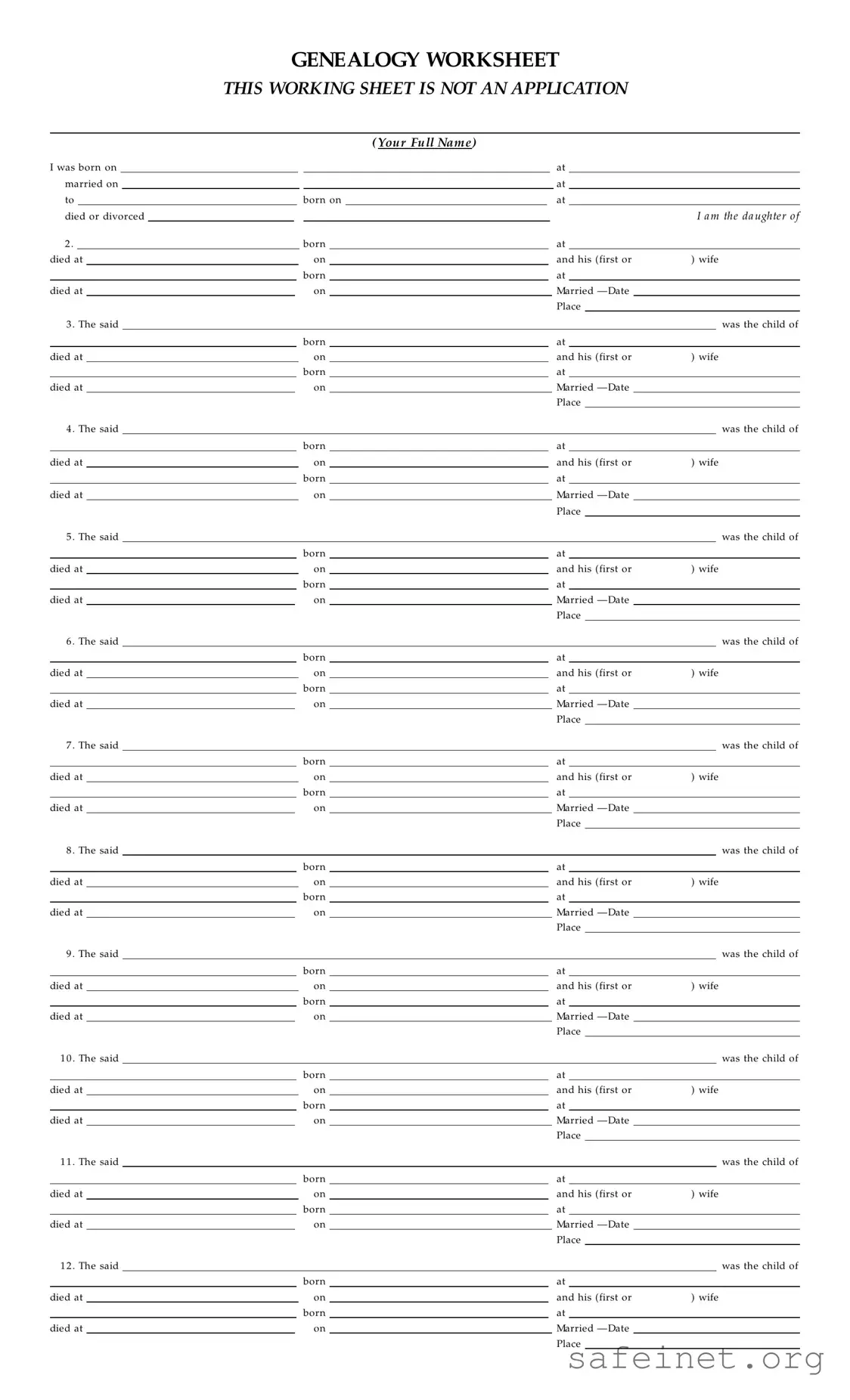
The DAR Genealogy Worksheet is a crucial tool for individuals seeking to trace their lineage, particularly for those who wish to establish a connection to ancestors who served during the American Revolution. This form serves as a working document, not an official application, and is designed to gather detailed information about one's family history. It prompts users to fill in their full name, birth date, marriage details, and information about their parents and grandparents. The worksheet includes sections to document the names, birth and death dates, and places of residence for each ancestor, providing a structured format to trace back through generations. Additionally, it requires information about the ancestor's military service during the Revolutionary War, along with sources that verify this service. The form emphasizes the importance of providing documented proof for each claim, such as birth certificates, marriage licenses, and other official records, rather than relying on family tradition. This meticulous approach ensures that applicants can substantiate their lineage claims effectively.


| Fact Name | Description | Governing Law |
|---|---|---|
| Purpose | The Dar Genealogy Worksheet is designed to assist individuals in documenting their lineage and ancestral connections, particularly for those seeking to establish eligibility for membership in the Daughters of the American Revolution (DAR). | N/A |
| Application Status | This worksheet is explicitly stated to be a working document and not an official application for DAR membership. | N/A |
| Required Documentation | Applicants must provide proof of birth, marriage, and death dates and places, as well as connections between generations. Acceptable documents include official records, wills, and census data. | State-specific laws may apply regarding the collection and submission of vital records. |
| Generational Tracking | The worksheet allows for the documentation of lineage across multiple generations, specifically tracing ancestry back to individuals who participated in the American Revolution. | N/A |
| Prohibited Evidence | Tradition is not considered acceptable evidence for lineage claims. All claims must be substantiated with documented proof. | N/A |
Completing the DAR Genealogy Worksheet is an important step in documenting your lineage. This form gathers essential information about your family history, particularly your connections to ancestors who served during the American Revolution. By filling it out accurately, you will be better prepared to provide the necessary details for your application.
What is the purpose of the DAR Genealogy Worksheet?
The DAR Genealogy Worksheet is a tool designed to help individuals gather and organize their family history information. It serves as a working sheet to collect details about your ancestors, including their birth, marriage, and death dates, as well as any relevant connections between generations. This worksheet is not an application for membership but rather a preliminary step in documenting your lineage for potential DAR membership.
How do I fill out the DAR Genealogy Worksheet?
To complete the worksheet, start by entering your full name, birth date, and marriage details. Then, proceed to document your parents and their respective information, including names, birth and death dates, and marriage details. Continue this process for each generation back to your Revolutionary ancestor. Ensure that you provide as much detail as possible to create a comprehensive family history.
What types of documents are needed to support my claims?
Can I use family traditions as proof of lineage?
Family traditions alone are not acceptable as proof of lineage for the DAR application process. Instead, you should rely on documented evidence to support your claims. This ensures that the information is verifiable and meets the requirements set by the DAR.
What should I do if I don't have all the information for every ancestor?
If you lack certain details for an ancestor, it is best to include as much information as you do have. You can note any missing information in the worksheet and continue your research to fill in the gaps later. The goal is to compile what you know, and you can always update the worksheet as you gather more information.
Is there a specific format for citing sources on the worksheet?
Yes, when citing sources on the worksheet, be sure to include the title, author, publication date, volume, and page number of published works. For unpublished records, include the type of document and any identifying information. This format helps maintain clarity and ensures that your sources can be easily referenced.
What if I have relatives who are already DAR members?
If you have relatives who are already members of the DAR, you should include their National Numbers and relationships to the Revolutionary ancestor on your worksheet. This information can help streamline your application process and may provide additional support for your claims.
How do I submit the completed DAR Genealogy Worksheet?
Once you have completed the worksheet and gathered all necessary documentation, you can submit it according to the guidelines provided by the DAR. Typically, this will involve sending your materials to the appropriate chapter or state organization for review. Be sure to check the specific submission requirements for your area.
Incomplete Personal Information: Failing to provide your full name, birth date, and marriage details can lead to delays. Ensure all fields are filled out completely.
Missing Ancestor Details: Not including the full names, birth and death dates, and places for each ancestor can create confusion. Each ancestor's information is crucial for establishing lineage.
Neglecting to Cite Sources: Forgetting to provide sources for your ancestor’s military service can weaken your application. Always include the author, title, volume, and page number of published records.
Ignoring Proof Requirements: Failing to attach certified copies or photocopies of necessary documents like birth, marriage, and death certificates can result in rejection. Each claim must be backed by appropriate proof.
Overlooking Lineage Connections: Not clearly stating the connections between generations can complicate your application. Be sure to outline how each ancestor is related to you.
Using Unacceptable Evidence: Relying solely on oral tradition or hearsay is a common mistake. Stick to documented evidence such as wills, census records, and official documents to support your claims.
The DAR Genealogy Worksheet is a crucial document for individuals seeking to establish their lineage to ancestors who served during the American Revolution. Several other forms and documents complement this worksheet, providing necessary evidence and details for the application process. Below is a list of these additional documents, each serving a specific purpose in the genealogical research and application process.
Gathering these documents can greatly assist individuals in their quest to establish eligibility for membership in the Daughters of the American Revolution. Each document plays a significant role in validating claims and ensuring accurate lineage tracing.
The DAR Genealogy Worksheet is similar to the Family Group Sheet, which is a tool used to organize family information. This document typically includes details about a family unit, including parents, children, and their respective birth, marriage, and death dates. Just like the DAR Worksheet, the Family Group Sheet emphasizes lineage and connections between generations, making it easier to visualize family relationships. Both documents serve as foundational tools for genealogical research, allowing individuals to compile and present their family history in a structured manner.
Another document that shares similarities with the DAR Worksheet is the Pedigree Chart. This chart focuses on an individual's direct ancestors, typically spanning several generations. It provides a clear visual representation of one's lineage, similar to how the DAR Worksheet organizes familial connections. Both documents require detailed information about names, dates, and places, enabling researchers to trace their ancestry effectively. The Pedigree Chart complements the DAR Worksheet by offering a broader view of an individual's family tree.
The Ancestry Chart also aligns closely with the DAR Genealogy Worksheet. This document is designed to track direct ancestors and their descendants, often highlighting important life events. Like the DAR Worksheet, the Ancestry Chart emphasizes the importance of accurate dates and locations for births, marriages, and deaths. Both tools are essential for genealogists looking to establish a clear and documented lineage, making it easier to apply for membership in heritage organizations.
The Census Record is another document that shares a similar purpose with the DAR Worksheet. While the DAR Worksheet focuses on lineage for specific ancestral claims, census records provide a wealth of information about individuals and families at specific points in time. Both documents require accurate information about family relationships, including names and ages. Researchers often use census records to verify the details submitted in the DAR Worksheet, ensuring that lineage claims are well-supported by official data.
Vital Records, which include birth, marriage, and death certificates, are also akin to the DAR Worksheet. These records provide official documentation of life events and serve as critical evidence for genealogical claims. Just as the DAR Worksheet requests proof of lineage through various documents, vital records offer the necessary verification needed to support claims of ancestry. Both documents aim to establish a clear and documented family history, essential for anyone pursuing genealogical research.
Lastly, the Historical Society Records can be compared to the DAR Genealogy Worksheet. These records often contain information about local families and their contributions to the community, including military service. Similar to the DAR Worksheet, which seeks to document an ancestor's role in the American Revolution, Historical Society Records may provide insights into an ancestor's life and accomplishments. Both resources are invaluable for those researching their family history, helping to paint a fuller picture of ancestral contributions and connections.
When filling out the DAR Genealogy Worksheet form, follow these guidelines to ensure accuracy and completeness.
Here are some common misconceptions about the DAR Genealogy Worksheet form:
When filling out the DAR Genealogy Worksheet form, keep the following key takeaways in mind:
Completing the worksheet accurately and thoroughly is crucial for a successful application. Act promptly to gather the necessary information and documentation.