Homepage > Blank Da 7652 Template
Article Structure

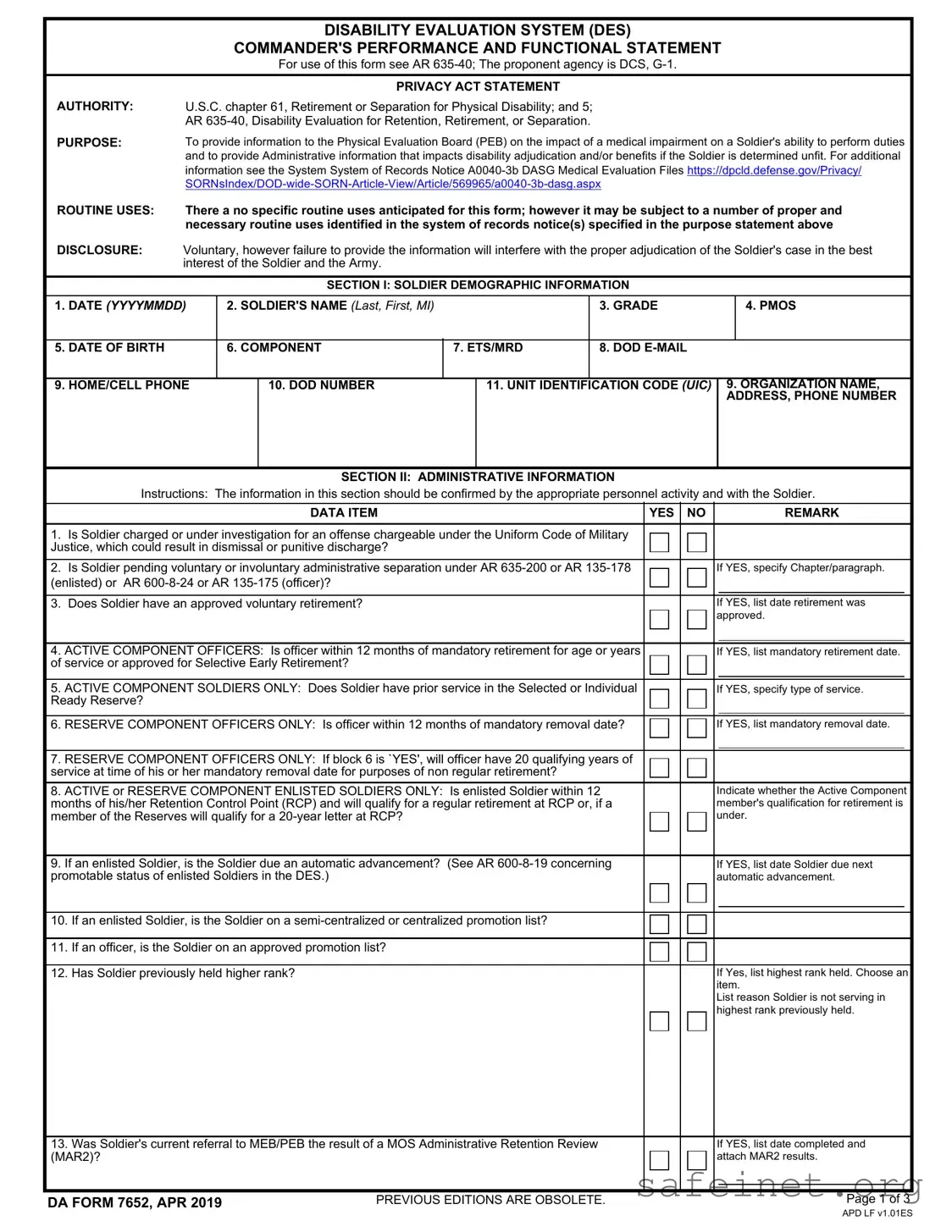
The DA Form 7652 is an essential document used within the military to assess a Soldier's medical condition and its impact on their ability to perform military duties. This form plays a crucial role in the Disability Evaluation System (DES) by providing the Physical Evaluation Board (PEB) with detailed information about a Soldier's health status and administrative background. Key sections of the form include demographic information, administrative details, and a commander’s performance statement. Soldiers must disclose information about their service history, any pending investigations, and retirement status. Additionally, the form requires commanders to evaluate the Soldier's performance, decision-making capabilities, and work relationships in light of their medical conditions. This comprehensive assessment helps determine if a Soldier is fit for duty or if they may require separation or retirement due to medical issues. The completion of this form is vital for ensuring that Soldiers receive appropriate benefits and support based on their medical evaluations.
Form Sample

Page 1 of 3
For use of this form see AR 635-40; The proponent agency is DCS, G-1.
PRIVACY ACT STATEMENT
ROUTINE USES:
Voluntary, however failure to provide the information will interfere with the proper adjudication of the Soldier's case in the best
interest of the Soldier and the Army.
DISABILITY EVALUATION SYSTEM (DES)
COMMANDER'S PERFORMANCE AND FUNCTIONAL STATEMENT
AUTHORITY:
PURPOSE:
SECTION I: SOLDIER DEMOGRAPHIC INFORMATION
SECTION II: ADMINISTRATIVE INFORMATION
Instructions: The information in this section should be confirmed by the appropriate personnel activity and with the Soldier.
DISCLOSURE:
DA FORM 7652, APR 2019
APD LF v1.01ES
1. DATE (YYYYMMDD)
5. DATE OF BIRTH
2. SOLDIER'S NAME (Last, First, MI) 3. GRADE
6. COMPONENT
9. ORGANIZATION NAME,
ADDRESS, PHONE NUMBER
11. UNIT IDENTIFICATION CODE (UIC)9. HOME/CELL PHONE
4. PMOS
7. ETS/MRD 8. DOD E-MAIL
10. DOD NUMBER
U.S.C. chapter 61, Retirement or Separation for Physical Disability; and 5;
AR 635-40, Disability Evaluation for Retention, Retirement, or Separation.
To provide information to the Physical Evaluation Board (PEB) on the impact of a medical impairment on a Soldier's ability to perform duties
and to provide Administrative information that impacts disability adjudication and/or benefits if the Soldier is determined unfit. For additional
information see the System System of Records Notice A0040-3b DASG Medical Evaluation Files
https://dpcld.defense.gov/Privacy/
SORNsIndex/DOD-wide-SORN-Article-View/Article/569965/a0040-3b-dasg.aspx
There a no specific routine uses anticipated for this form; however it may be subject to a number of proper and
necessary routine uses identified in the system of records notice(s) specified in the purpose statement above
1. Is Soldier charged or under investigation for an offense chargeable under the Uniform Code of Military
Justice, which could result in dismissal or punitive discharge?
2. Is Soldier pending voluntary or involuntary administrative separation under AR 635-200 or AR 135-178
(enlisted) or AR 600-8-24 or AR 135-175 (officer)?
If YES, specify Chapter/paragraph.
If YES, list date retirement was
approved.
If YES, list date Soldier due next
automatic advancement.
9. If an enlisted Soldier, is the Soldier due an automatic advancement? (See AR 600-8-19 concerning
promotable status of enlisted Soldiers in the DES.)
12. Has Soldier previously held higher rank?
If Yes, list highest rank held. Choose an
item.
List reason Soldier is not serving in
highest rank previously held.
If YES, list mandatory removal date.
10. If an enlisted Soldier, is the Soldier on a semi-centralized or centralized promotion list?
11. If an officer, is the Soldier on an approved promotion list?
Indicate whether the Active Component
member's qualification for retirement is
under.
8. ACTIVE or RESERVE COMPONENT ENLISTED SOLDIERS ONLY: Is enlisted Soldier within 12
months of his/her Retention Control Point (RCP) and will qualify for a regular retirement at RCP or, if a
member of the Reserves will qualify for a 20-year letter at RCP?
7. RESERVE COMPONENT OFFICERS ONLY: If block 6 is `YES', will officer have 20 qualifying years of
service at time of his or her mandatory removal date for purposes of non regular retirement?
6. RESERVE COMPONENT OFFICERS ONLY: Is officer within 12 months of mandatory removal date?
If YES, specify type of service.
5. ACTIVE COMPONENT SOLDIERS ONLY: Does Soldier have prior service in the Selected or Individual
Ready Reserve?
4. ACTIVE COMPONENT OFFICERS: Is officer within 12 months of mandatory retirement for age or years
of service or approved for Selective Early Retirement?
If YES, list mandatory retirement date.
3. Does Soldier have an approved voluntary retirement?
DATA ITEM YES NO REMARK
PREVIOUS EDITIONS ARE OBSOLETE.
If YES, list date completed and
attach MAR2 results.
13. Was Soldier's current referral to MEB/PEB the result of a MOS Administrative Retention Review
(MAR2)?
Choose the answer that most accurately describes the impact of the Soldier's medical condition in completion of physical tasks/duty completion; decision
making; and work relationships.
If the medical condition is due to an injury, was the injury due to a vehicle accident or other incident requiring a line of duty? If so, was a line of duty
completed (attach the completed LOD or initiate one if not completed)?
DA FORM 7652, APR 2019
Page 2 of 3
APD LF v1.01ES
SECTION III: COMMANDER'S PERFORMANCE INFORMATION
Has difficulties completing tasks and/or duties to standards.
Is unable to complete task and or duties to standards.
D
Is the commander/first line supervisor aware of the Soldier's medical condition? If YES, what job tasks does the medical condition prevent the
Soldier from adequately performing? If NO, please explain.
G
F
Other than medical appointments, approximately how many days of work has the member missed over the past 90-360 days due to this condition?
E
C
Do you believe the member's condition(s) will prevent him/her from serving in their primary MOS/AOC in future assignments? If so, how?
Has the member's duty schedule been modified due to his/her medical condition(s) (i.e., limited duty, half days, no shift work, etc.)? If so, how and
for how long?
B
SECTION III A
This form is a critical document in determining the effects the Soldier's medical condition(s) (both physical and/or mental) have on their military
performance. It is essential to provide accurate information, whether it is from the current or former commanders, NCO leadership, immediate supervisor,
or peers. The Commander's Performance and Functional Statement must be complete and provide an accurate picture of the Soldier's actual functional
limitations and duty performance. The Soldier's commander and leadership team are in a unique position to provide this information. Even if this statement
is difficult to obtain, (e.g., the Soldier or Commander is new to the unit, the Soldier's condition prevents drill attendance, etc.) the statement must be
completed to the maximum extent possible.
You are entering information into a performance-based system. Describe how the Soldier's medical condition(s) (both physical and/or mental) affects
his
or her ability to perform basic Soldier skills; the skills and duties of the primary military occupational specialty (PMOS); and how the Soldier's condition
impacts or affects unit mission readiness. (Note: Performance information is of greater significance for Soldiers with chronic conditions. Severe, acute
physical conditions generally need little performance discussion because the PEB members easily understand the limitations posed by such impairments.)
If a condition prevents the Soldier from executing a task(s) that is required by his/her MOS, please specify what MOS task(s) cannot be executed in
Section III C.
In all cases of Medical Corps officers with a clinical specialty area of concentration and assigned to a clinical position, Sections III and V will be
completed
by the officer's first line clinical supervisor. In all cases of officers of the Judge Advocate General Corps (JAG), Sections III and V will be completed by the
officer's Staff Judge Advocate, Command Judge Advocate, or agency/section legal supervisor.
16. If a drilling USAR or ARNG Soldier (and not on active duty), did the Soldier accept the Career
Status Bonus?
15. Is the Soldier assigned a Warrior Transition Unit or other medical type hold type unit?
If YES, attach the commander's
memorandum used to refer the Soldier
to this unit with this form.
All sections must be completed
1. Physical Task/duty completion: Based on your knowledge and/or understanding of this Soldier's performance of physical duties both within and outside
their MOS, this Soldier:
A
Performs tasks and/or duties to standards.
If YES, specify the reason and date of
the flag.
14. Is the Soldier flagged IAW any provision of AR 600-8-2?
DA FORM 7652, APR 2019
Page 3 of 3
APD LF v1.01ES
SECTION III A (Continued)
A
B
Soldier is unable to perform any significant military tasks or duties because of their medical condition(s); unable to conttibute to the unit's mission.
C
D
4. Performance: Considering Section III A, questions 1-3 above and based on your knowledge and/or understanding of this Soldier's work performance,
choose the most accurate description of the Soldier's medical condition(s) affect(s) on their performance:
Is unable to maintain effective work relationships.
Has effective work relationships with both supervisors and co-workers.
A
B
C
Has difficulty with work relationships, and may be disurptive or cause problems with tasks performance and/or
completion.
3. Work Relationships: Based on your knowledge and/or understanding of this Soldier's interactions with supervisors and co-workers, he/she:
2. Decision Making: Based on your knowledge and/or understanding of the Soldier, he/she:
1. NAME (Last, First, MI)
2. SIGNATURE
2. UNIT
5. PHONE
3. DATE
7. GRADE
4. DOD E-MAIL
6. COMPONENT
Makes reasonable decisions; occasionally makes (or avoids making) unreasonable complex or unfamiliar decisions; makes occasional
decision making mistakes.
D
C
Do you believe the member's condition(s) will prevent him/her from serving in their primary MOS/AOC in future assignments? If so, how?
B
A
Makes reasonable decisions, including complex or unfamiliar ones.
Makes simple decisions but usually not complex or unfamiliar decisions; does not make frequent decision-making mistakes when making simple
decisions.
Choose the answer that most accurately describes the Soldiers ability to deploy. When "No" is chosen, the commander will elaborate in Section III C.
SECTION III B
Yes
Yes
Soldier performs well and the medical condition(s) do not appear to have any negative affects on the performance of his/her duties; medical
conditions do not affect the unit's mission.
Soldier's performance is adequate but it appears that the medical condition(s) may have negative affects on the performance of
his/her duties; medical conditions do not affect the unit's mission.
Soldier's performance is inadequate and it appears that the medical condition(s) have negative affects on the performance of
his/her duties; medical conditions negatively affect the unit's mission
No
No
Can the service member be assigned against a deployable billet?
Do you believe the service member could perform his/her duties in an OCONUS deployed environment without restrictions, limitations,
or work-arounds?
After reviewing Sections II and III A, further clarify an item and/or the selections you have made above and add any additional comments. Please include
examples of the Soldier's general and/or MOS/AOC specific task limitation(s) due to their medical condition(s) (both physical and/or mental).
SECTION III C
SECTION IV: BATTALION COMMANDER'S CONTACT INFORMATION
SECTION V: COMMANDER'S VALIDATION AND SIGNATURE
3. PHONE
6. COMPONENT5. GRADE
4. DOD E-MAIL

Document Specifications

Fact Name Description
Form Purpose The DA 7652 form collects information to evaluate a Soldier's medical condition and its impact on their military performance.
Governing Laws U.S.C. Chapter 61 and AR 635-40 govern the use of this form for disability evaluation and retirement.
Privacy Act Statement Information collected is voluntary, but failure to provide it may hinder the Soldier's case adjudication.
Sections Included The form includes sections for Soldier demographics, administrative information, and performance assessments.
Commander's Role The commander must provide a performance statement that details how medical conditions affect the Soldier's duties.
Automatic Advancements Questions regarding automatic advancements are included, specifically for enlisted Soldiers.
Document Validity As of April 2019, previous editions of the DA 7652 are considered obsolete.

Steps to Filling Out Da 7652

The DA Form 7652 is a critical document used in the evaluation of a Soldier's medical condition and its impact on their military performance. Completing this form accurately is essential for ensuring that the Soldier's case is processed effectively. Below are the steps to fill out the form correctly.

  1. Begin with Section I: Soldier Demographic Information. Enter the date in the format YYYYMMDD.
  2. Provide the Soldier's full name, including last name, first name, and middle initial.
  3. Input the Soldier's grade and primary military occupational specialty (PMOS).
  4. Fill in the Soldier's date of birth.
  5. Indicate the Soldier's component (Active, Reserve, etc.).
  6. List the Soldier's expiration term of service (ETS) or mandatory retirement date (MRD).
  7. Enter the Soldier's Department of Defense (DOD) email address.
  8. Provide the Soldier's home or cell phone number.
  9. Include the Soldier's DOD number.
  10. Fill in the unit identification code (UIC) and organization name, address, and phone number.
  1. Proceed to Section II: Administrative Information. Confirm the data with the appropriate personnel.
  2. Answer the questions regarding the Soldier's status, indicating "Yes" or "No" for each item. If "Yes," provide additional details as required.
  1. Move to Section III: Commander's Performance Information. This section requires input on how the Soldier's medical condition affects their performance.
  2. Choose the most accurate description for physical task completion, decision-making, and work relationships based on your knowledge of the Soldier.
  3. In Section III C, clarify any selections made and provide examples of task limitations due to medical conditions.
  1. Fill out Section IV: Battalion Commander's Contact Information, including name, unit, and contact details.
  2. Complete Section V: Commander's Validation and Signature. Include the name, signature, date, email, phone, component, and grade of the validating commander.

After completing the form, review all entries for accuracy. Ensure that all required sections are filled out and any necessary attachments are included before submission.

More About Da 7652

What is the purpose of the DA 7652 form?

The DA 7652 form is designed to provide essential information to the Physical Evaluation Board (PEB) regarding how a Soldier's medical impairment affects their ability to perform military duties. This information is crucial for determining disability adjudication and any potential benefits if the Soldier is found unfit for service.

Who needs to fill out the DA 7652 form?

The form must be completed by the Soldier, along with input from their commander or leadership team. It is important that the information reflects the Soldier's current medical condition and its impact on their performance and readiness.

What information is required in Section I of the DA 7652 form?

Section I collects demographic information about the Soldier. This includes the Soldier's name, grade, date of birth, component, and contact details. Additionally, it asks for specific dates related to retirement and any prior service, ensuring that all relevant information is available for the evaluation process.

What types of questions are asked in Section II of the DA 7652 form?

Section II contains a series of yes/no questions regarding the Soldier's administrative status. This includes inquiries about any charges under the Uniform Code of Military Justice, pending separations, and retirement status. These questions help assess the Soldier's eligibility for continued service and any necessary actions that may need to be taken.

How does the Commander’s Performance and Functional Statement impact the evaluation?

The Commander's Performance and Functional Statement is vital for illustrating how the Soldier's medical condition affects their daily duties and overall performance. This section requires detailed observations and assessments from the Soldier's leadership, which can significantly influence the outcome of the evaluation.

What happens if the information on the DA 7652 form is incomplete?

Providing incomplete information can hinder the proper adjudication of the Soldier's case. It is essential to complete the form as thoroughly as possible to ensure that the Soldier receives fair consideration regarding their medical condition and potential disability benefits.

Common mistakes

  1. Incomplete Information: Failing to fill out all required sections can lead to delays in processing. Each section must be completed thoroughly.

  2. Incorrect Dates: Entering the wrong dates, such as the Soldier's date of birth or retirement date, can cause significant issues. Always double-check these entries.

  3. Missing Signatures: Not obtaining the necessary signatures from commanders or other relevant personnel can invalidate the form. Ensure all required signatures are present.

  4. Inaccurate Demographic Information: Providing incorrect demographic details, such as the Soldier's name or grade, can lead to confusion. Verify all personal information before submission.

  5. Neglecting to Attach Required Documents: Failing to include necessary attachments, like the commander's memorandum or MAR2 results, can hinder the review process.

  6. Misunderstanding Yes/No Questions: Misinterpreting questions can lead to incorrect answers. Review each question carefully to ensure accurate responses.

  7. Omitting Relevant Medical Information: Not providing a complete picture of the Soldier's medical condition can affect the evaluation. Include all pertinent details about the Soldier's health.

  8. Ignoring Privacy Regulations: Not adhering to privacy guidelines can result in unauthorized disclosures. Be cautious when handling sensitive information.

  9. Failing to Review Before Submission: Submitting the form without a final review can lead to overlooked errors. Always conduct a thorough check before sending it off.

  10. Using Outdated Versions: Filling out an old version of the form can cause complications. Always ensure you are using the most current version of DA Form 7652.

Documents used along the form

The DA Form 7652 is used primarily in the context of the Disability Evaluation System (DES). It collects information about a service member's medical condition and its impact on their military performance. Several other forms and documents are often required alongside the DA Form 7652 to ensure a comprehensive evaluation. Below are five commonly used documents.

  • DA Form 3349: This form is used to document a Soldier's physical profile. It outlines any medical conditions that may affect their ability to perform military duties and helps determine fitness for service.
  • DA Form 2823: Known as the Sworn Statement, this document allows service members to provide a written account of events or circumstances related to their medical condition or performance issues. It serves as a formal record for consideration during evaluations.
  • DA Form 2173: This is the Statement of Medical Examination and Duty Status. It is used to report injuries and illnesses that occur in the line of duty, detailing the nature of the injury and its impact on the Soldier's service.
  • DA Form 7500: This form is the Medical Evaluation Board (MEB) Proceedings. It summarizes the findings and recommendations of the MEB regarding a service member's medical fitness for duty.
  • DD Form 214: This is the Certificate of Release or Discharge from Active Duty. It provides a summary of a service member's military service, including the nature of their discharge and any disability ratings received.

These forms play a crucial role in the evaluation process, ensuring that all necessary information is available to assess a service member's fitness for duty and eligibility for benefits. Proper completion and submission of these documents can significantly influence the outcome of a Soldier's case.

Similar forms

The DA Form 2-1, also known as the Personnel Qualification Record, is similar to the DA 7652 form in that it collects essential information about a soldier's service record. This document includes details such as assignments, training, and qualifications. Like the DA 7652, it serves as a critical resource for evaluating a soldier's capabilities and readiness for various roles within the military. Both forms aim to ensure that accurate and comprehensive data is available for administrative and evaluative purposes.

The DA Form 4856, or Developmental Counseling Form, is another document that shares similarities with the DA 7652. This form is used to document counseling sessions between soldiers and their leaders. It helps track a soldier's performance and development over time. While the DA 7652 focuses on medical and administrative information, both forms are essential for maintaining a soldier's record and ensuring they receive the support needed for their career progression.

The DA Form 3349, known as the Physical Profile, also parallels the DA 7652 in its focus on a soldier's medical conditions. This form outlines any physical limitations or medical issues that may affect a soldier's ability to perform their duties. Like the DA 7652, the DA Form 3349 is used to inform decision-making regarding a soldier's fitness for duty and potential accommodations needed for their service.

The DD Form 214, Certificate of Release or Discharge from Active Duty, is another important document that relates to the DA 7652. It provides a summary of a service member's military career, including their discharge status and reason for separation. While the DA 7652 is used during a soldier's service, the DD Form 214 is crucial for their transition to civilian life, ensuring that all relevant information about their service is accurately captured.

The DA Form 600-9, or Body Composition Program, is similar to the DA 7652 in that it addresses aspects of a soldier's physical readiness. This form is used to assess and document a soldier's body composition and compliance with Army standards. Both forms play a role in evaluating a soldier's overall fitness and readiness for duty, with the DA Form 600-9 focusing specifically on physical standards.

The DA Form 1059, or Academic Evaluation Report, is another document that complements the DA 7652 by providing insights into a soldier's educational achievements and performance. This form is used to evaluate soldiers who have completed training courses. Like the DA 7652, it helps assess a soldier's qualifications and readiness for future assignments based on their performance in educational settings.

The DA Form 67-9, or Officer Evaluation Report, is similar in purpose to the DA 7652, as both documents evaluate a soldier's performance. The DA Form 67-9 focuses specifically on officers, providing a comprehensive assessment of their leadership abilities and contributions to their units. Both forms are vital for ensuring that soldiers receive appropriate evaluations that inform their career progression.

The DA Form 7500, or Soldier's Record Brief, serves as a summary of a soldier's career and qualifications, much like the DA 7652. This document captures key information about a soldier's assignments, training, and awards. Both forms are used to provide a clear picture of a soldier's capabilities and history, which is essential for administrative decisions and evaluations.

The DA Form 2823, or Sworn Statement, is another document that shares similarities with the DA 7652. This form is used to collect statements from soldiers regarding incidents or issues that may impact their service. Like the DA 7652, it serves to gather critical information that can influence a soldier's administrative status or medical evaluation.

Lastly, the DA Form 1506, or Statement of Service, is related to the DA 7652 as it documents a soldier's service history. This form provides a concise overview of a soldier's time in service, including periods of active duty and reserve status. Both forms are important for maintaining accurate records and ensuring that all relevant information is available for administrative purposes.

Dos and Don'ts

When filling out the DA 7652 form, it's important to follow certain guidelines to ensure accuracy and compliance. Here are four key do's and don'ts:

  • Do provide accurate and complete information in all sections. Ensure that all dates and names are correct.
  • Do verify information with the Soldier and relevant personnel before submission. This helps avoid errors.
  • Don't leave any sections blank unless specifically instructed. Missing information can delay the process.
  • Don't submit the form without reviewing it thoroughly. Double-check for any inconsistencies or mistakes.

Misconceptions

Here are seven common misconceptions about the DA 7652 form, along with explanations to clarify them:

  • Misconception 1: The DA 7652 form is only for Soldiers with physical disabilities.
  • This form is used for both physical and mental conditions. It assesses how any medical impairment affects a Soldier's ability to perform their duties.

  • Misconception 2: Filling out the DA 7652 is optional.
  • While some parts of the form may seem voluntary, providing accurate information is crucial. Not completing it can hinder the Soldier's case and benefits.

  • Misconception 3: The form only needs to be filled out by the Soldier.
  • Input from commanders and leadership is essential. They provide valuable insights into the Soldier's performance and limitations.

  • Misconception 4: The DA 7652 form is only relevant for retirement cases.
  • This form is used in various situations, including evaluations for medical separations and disability benefits, not just retirement.

  • Misconception 5: Once submitted, the information on the DA 7652 cannot be changed.
  • Updates can be made if new information arises or if there are changes in the Soldier's condition. It's important to keep the form current.

  • Misconception 6: The DA 7652 is a quick and easy form to complete.
  • While it may seem straightforward, gathering the necessary information and ensuring accuracy can take time. Thoroughness is key.

  • Misconception 7: The DA 7652 form is not confidential.
  • The information provided is protected under privacy regulations. It is used solely for the purpose of evaluating the Soldier's medical condition and its impact on service.

Key takeaways

Key Takeaways for Filling Out and Using the DA 7652 Form:

  • The DA 7652 form is essential for documenting a Soldier's medical condition and its impact on their military duties.
  • Accurate completion of the form is critical for the Physical Evaluation Board (PEB) to assess a Soldier's fitness for duty.
  • All sections of the form must be filled out completely, including demographic and administrative information.
  • Commanders should provide detailed performance information to reflect how medical conditions affect a Soldier's duties.
  • It is important to indicate any prior service or pending administrative actions that may affect the Soldier's retirement eligibility.
  • Disclosures on the form are voluntary, but failing to provide accurate information can hinder the adjudication process.
  • Soldiers should ensure their commanders are aware of their medical conditions to facilitate accurate reporting.
  • Specific comments and examples should be included to clarify the Soldier's limitations and performance issues.
  • Review the form carefully before submission to ensure all required attachments, such as MAR2 results, are included.