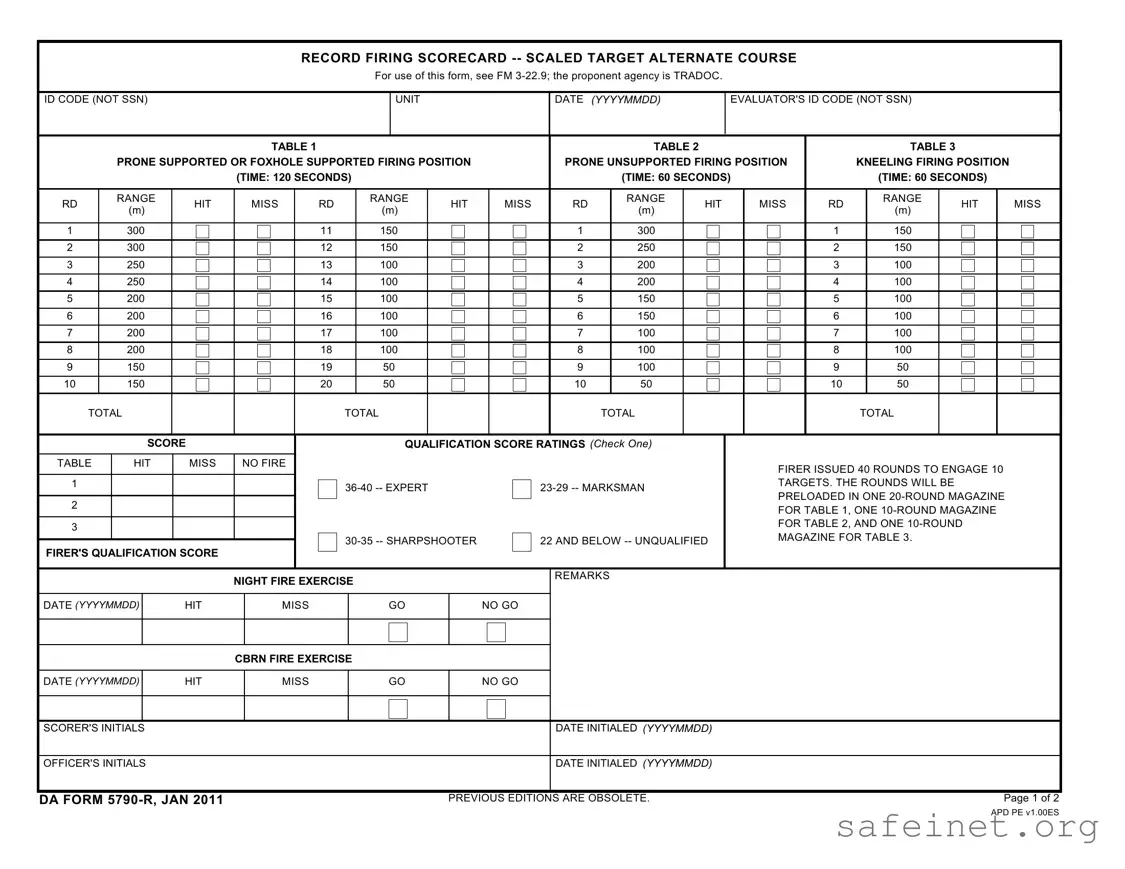
The DA Form 5790 R, also known as the Record Firing Scorecard for Scaled Target Alternate Course, plays a crucial role in assessing a firer's shooting qualifications in various positions. This form is utilized primarily when standard record fire and known distance ranges are unavailable, ensuring that military personnel can still demonstrate their marksmanship skills. It includes multiple tables, each designed for different firing positions: prone supported, prone unsupported, and kneeling. Each table specifies the number of rounds to be fired, the time allowed for each exercise, and the scoring criteria based on hits and misses. The form captures essential information, such as the unit, evaluator's ID, and the date of the qualification. Additionally, it outlines the necessary ammunition load and guidelines for engaging targets in a systematic manner. Understanding the DA Form 5790 R is vital for both evaluators and firers, as it not only documents performance but also contributes to the overall readiness and effectiveness of military operations.
| Fact Name | Description |
|---|---|
| Form Purpose | The DA 5790 R form is a scorecard used to record firing qualifications on a scaled target alternate course. |
| Governing Agency | This form is governed by the U.S. Army Training and Doctrine Command (TRADOC). |
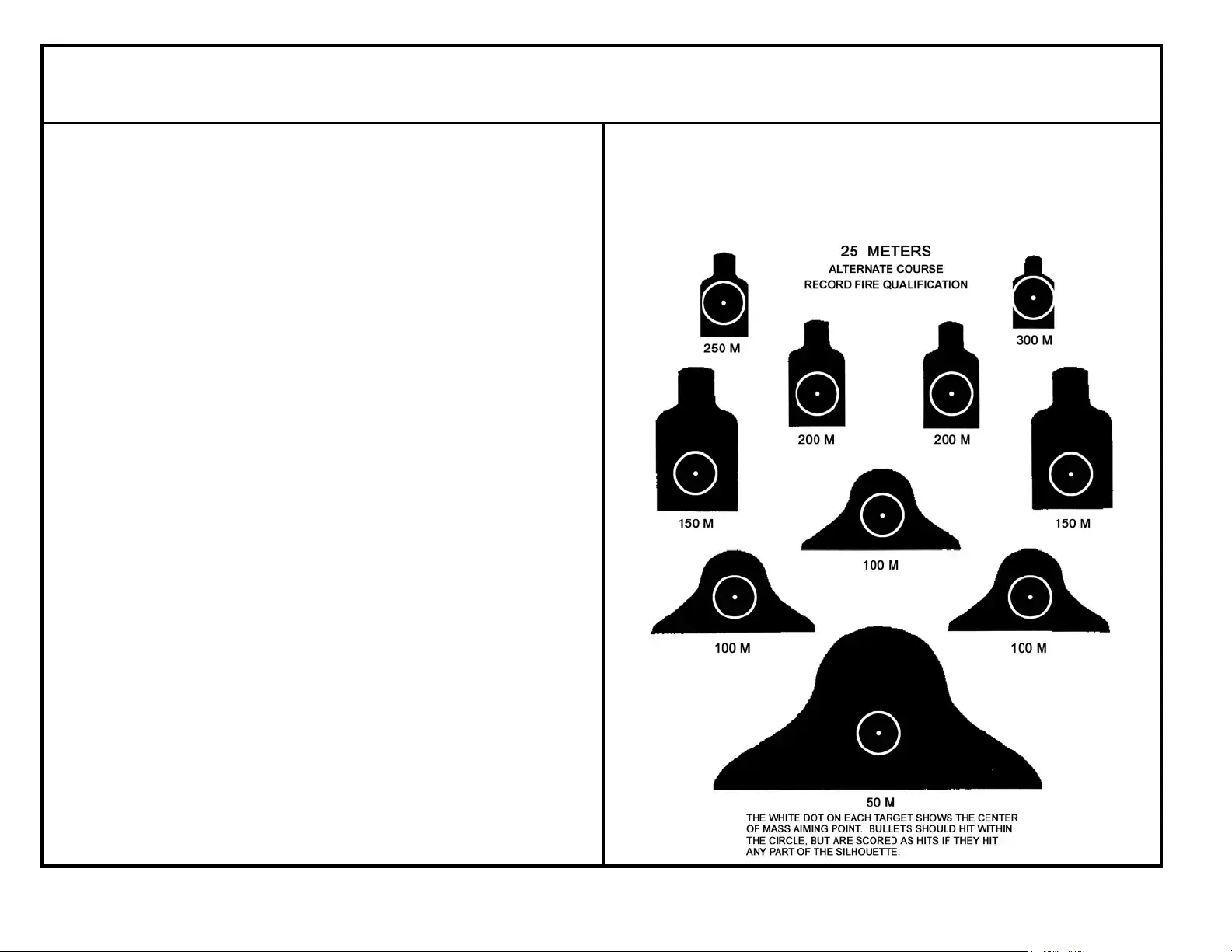
| Target Specifications | The form is used with a 25-meter scaled silhouette target (NSN 6920-01-167-1398). |
| Qualification Conditions | The alternate course is utilized when standard record fire and known distance ranges are unavailable. |
| Magazine Requirements | Firing requires one 20-round magazine and two 10-round magazines for different tables. |
| Firing Positions | Firing positions include prone supported, prone unsupported, and kneeling, each with specific time limits. |
| Scoring Criteria | A maximum of 40 hits can be scored, with specific hit limits per target based on distance. |
| Time Limits | Each firing table has distinct time limits: 120 seconds for Table 1, and 60 seconds for Tables 2 and 3. |
| Record Keeping | Scorers must initial and date the form, ensuring proper documentation of the qualification process. |
Completing the DA 5790 R form requires attention to detail and accuracy. This form is essential for recording firing scores during qualification exercises. To ensure that all information is captured correctly, follow the steps outlined below.
Next, you will complete the scoring tables. Each table corresponds to different firing positions.
After filling out the tables, calculate the totals for each table and enter them in the designated TOTAL fields.
For any additional exercises, record the dates and results for the Night Fire and CBRN Fire Exercises. Be sure to include the scorer's and officer's initials along with the corresponding dates.
Finally, review the form for completeness and accuracy before submission. This ensures that all necessary information is recorded correctly, facilitating the qualification process.
What is the purpose of the DA Form 5790 R?
The DA Form 5790 R is used as a scorecard for record firing qualifications when using a scaled target alternate course. It helps track the performance of shooters during qualification exercises, ensuring they meet required standards. This form is particularly useful when standard record fire and known distance ranges are not available.
What are the different tables included in the DA Form 5790 R?
The form includes three tables:
How is scoring conducted on the DA Form 5790 R?
Scoring is straightforward. Each silhouette hit counts as one point. The maximum score for each qualification table is based on the number of hits allowed per target at varying distances. For example, a maximum of 40 hits can be achieved across all targets, with specific rules for each distance.
What equipment is required to use the DA Form 5790 R?
To use the DA Form 5790 R, shooters need a total of 40 rounds of ammunition, divided into one 20-round magazine for Table 1 and two 10-round magazines for Tables 2 and 3. The rounds should be preloaded into the magazines as specified.
What should be done if zeroing exercises are not performed on the day of record fire?
If zeroing exercises are not conducted, six rounds of training or sustainment ammunition must be fired for 25-meter zero confirmation before starting the qualification course. This step ensures that shooters are properly calibrated before they begin their qualification.
What are the time limits for each firing position in the DA Form 5790 R?
Each table has specific time limits:
Who is responsible for ensuring the qualification process runs smoothly?
The Range Safety Officer (RSO) plays a crucial role in overseeing the qualification process. The RSO ensures that enough time is provided between firing positions and that the qualification tables flow smoothly, allowing shooters to perform to the best of their abilities.
Incorrect ID Code: Many individuals mistakenly enter their Social Security Number (SSN) instead of the required ID code. Always use the designated ID code for accuracy and security.
Missing Unit Information: Failing to fill in the unit information can lead to processing delays. Ensure that the unit field is complete to avoid issues.
Improper Date Format: Dates must be entered in the YYYYMMDD format. Incorrect formats can cause confusion and may result in the form being returned.
Inaccurate Scoring: Some people forget to double-check their scoring for each table. Verify that all hits and misses are accurately recorded to reflect true performance.
Neglecting to Initial: Not providing initials for scorers and officers can lead to questions about the validity of the scores. Always ensure that initials are included where required.
Skipping Required Exercises: Some individuals overlook the zeroing/grouping exercises before qualification. These exercises are crucial for confirming accuracy and should not be skipped.
Failure to Follow Engagement Order: Engaging targets out of the specified order can lead to missed opportunities and disorganization. Adhere to the left-to-right, nearest-to-farthest guideline for optimal performance.
The DA Form 5790 R is essential for documenting firing scores during military training. However, it often accompanies several other forms and documents that provide additional context or fulfill various administrative requirements. Understanding these related documents can streamline processes and ensure compliance with military regulations.
Each of these forms and documents plays a significant role in the training and qualification processes within the military. Ensuring that they are completed accurately and submitted alongside the DA Form 5790 R can enhance accountability and streamline operations. Always prioritize compliance with military regulations to maintain readiness and safety.
The DA Form 705 is a physical fitness test scorecard used by the military to record the results of an individual’s physical fitness assessment. Like the DA 5790 R, it serves as a record-keeping tool, allowing evaluators to track performance over time. The DA Form 705 includes sections for various events, such as push-ups, sit-ups, and a timed run, and it provides a scoring system to determine the overall fitness level of the service member.
The DA Form 2-1 is a personnel record that contains information about a soldier’s assignments, training, and qualifications. Similar to the DA 5790 R, it is used for official documentation and tracking of a soldier's career progression. The DA Form 2-1 is comprehensive and includes details such as military education, awards, and performance evaluations, which help in assessing the soldier’s readiness and capabilities.
The DA Form 4187 is a personnel action request form used to document various administrative actions regarding soldiers. It can be used for requests such as changes in duty assignments or promotions. Like the DA 5790 R, it requires signatures from authorized personnel and serves as an official record of the action taken, ensuring that all changes are properly documented and processed.
The DA Form 5500 is a body fat content worksheet used to assess the body fat percentage of soldiers. This form is similar to the DA 5790 R in that it is part of a qualification process, ensuring that soldiers meet physical standards. It includes sections for measurements and calculations, helping to determine if an individual is within the acceptable body fat limits set by the military.
The DA Form 2823 is a sworn statement form used to collect statements from witnesses or individuals involved in an incident. This form is similar to the DA 5790 R in its role as a record-keeping tool. It captures important information and testimonies that may be relevant to investigations or evaluations, providing a clear account of events as reported by individuals.
The DA Form 1059 is an academic evaluation report used to document the performance of soldiers in military schools or training programs. Like the DA 5790 R, it assesses an individual’s qualifications and achievements. The DA Form 1059 provides a summary of the soldier’s performance, including grades and remarks from instructors, which are important for future assignments and promotions.
The DA Form 31 is a request for leave form used by soldiers to formally request time off from duty. This form is similar to the DA 5790 R in that it requires approval from a supervisor or commanding officer. It serves as an official record of the leave requested and granted, ensuring that all personnel actions are documented and managed appropriately.
The DA Form 2404 is an equipment inspection and maintenance worksheet used to document the condition and maintenance of military equipment. Similar to the DA 5790 R, it is a record-keeping tool that helps ensure accountability and readiness. The DA Form 2404 allows soldiers to track inspections, repairs, and maintenance actions, contributing to overall operational efficiency.
The DA Form 1506 is a statement of service used to document a soldier’s military service history. Like the DA 5790 R, it is an important record that provides a detailed account of an individual’s service, including dates of service, duty stations, and assignments. This form is often used for benefits and retirement purposes, ensuring that all service is accurately recorded.
When filling out the DA 5790 R form, attention to detail is crucial. Here are some important do's and don'ts to keep in mind:
Understanding the DA 5790 R form is crucial for proper record firing qualification. However, several misconceptions persist regarding its use and requirements. Here are ten common misunderstandings:
Addressing these misconceptions is vital for ensuring compliance and successful qualification during firing exercises.
Here are key takeaways regarding the DA Form 5790-R, which is used for record firing scorecards in scaled target alternate courses: