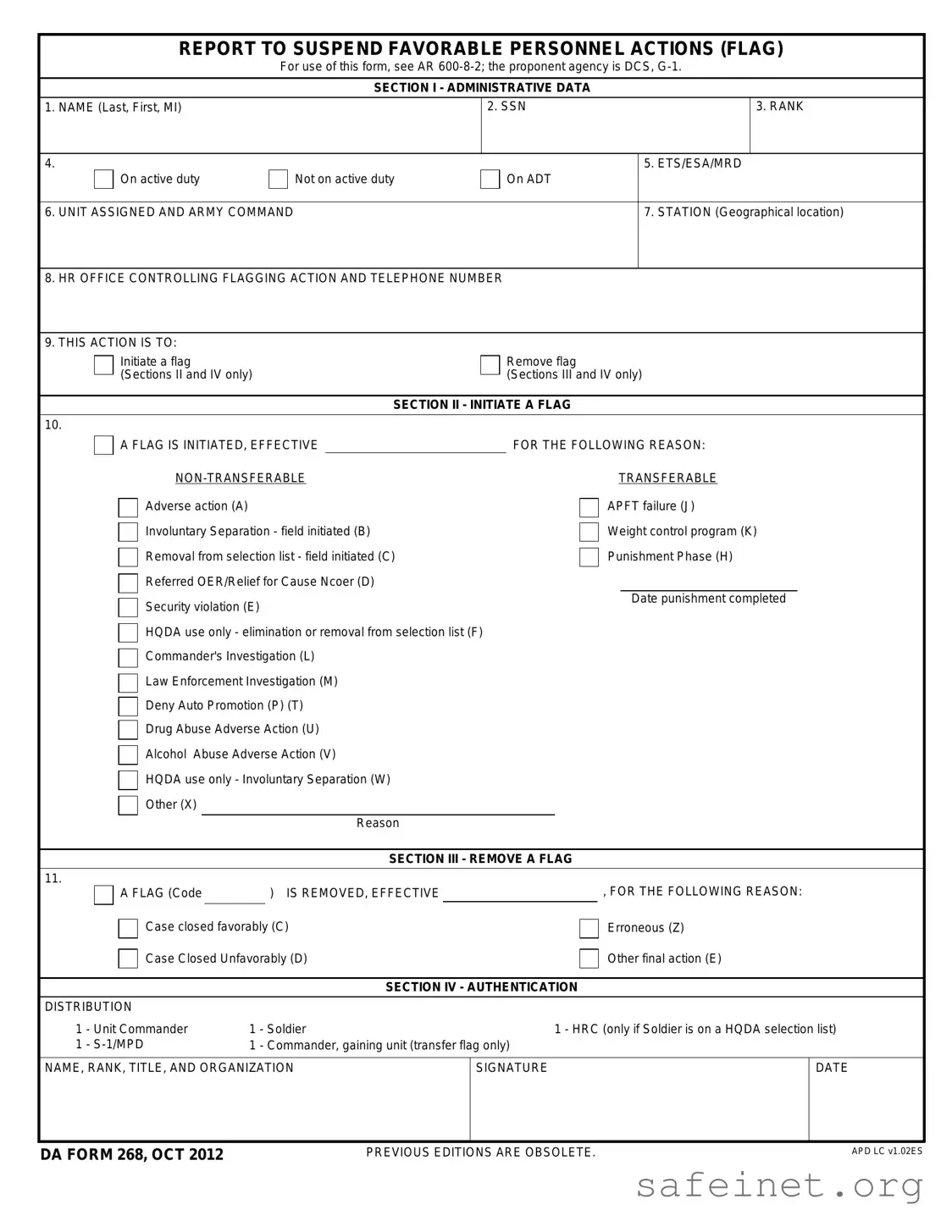
The DA Form 268, also known as the Report to Suspend Favorable Personnel Actions, plays a crucial role in managing personnel actions within the U.S. Army. This form is primarily utilized to initiate or remove flags that impact a soldier's eligibility for certain favorable actions, such as promotions or assignments. The form is divided into several sections, each designed to capture specific information about the soldier, including their name, rank, and unit assignment. Additionally, it outlines the reasons for flagging, which can range from adverse actions and performance failures to investigations and other disciplinary measures. The process of flagging is not taken lightly, as it can significantly affect a soldier's career trajectory. Therefore, understanding the nuances of the DA Form 268 is essential for both personnel administrators and soldiers alike. Proper completion and distribution of this form ensure that all relevant parties, including unit commanders and the Human Resources Command, are informed and able to act accordingly.
| Fact Name | Description |
|---|---|
| Form Purpose | The DA 268 form is used to report and manage personnel actions that involve suspending favorable actions, commonly referred to as "flagging" a soldier. |
| Governing Regulation | This form is governed by AR 600-8-2, which outlines the procedures for personnel actions related to flags. |
| Administrative Data | Section I of the form collects essential administrative data such as the soldier's name, social security number, rank, and unit assignment. |
| Flag Initiation Reasons | Flags can be initiated for various reasons, including adverse actions, APFT failures, and weight control program violations, among others. |
| Flag Removal Reasons | Flags can be removed for reasons such as favorable case closures, erroneous flags, or other final actions, as indicated in Section III. |
| Distribution of Copies | Upon completion, the form is distributed to various parties, including the unit commander, the soldier, and the Human Resources Command (HRC) if applicable. |
Completing the DA 268 form is a straightforward process that requires careful attention to detail. This form is essential for reporting actions related to personnel flags within the military. By following the steps outlined below, you can ensure that the form is filled out correctly and submitted efficiently.
What is the purpose of the DA 268 form?
The DA 268 form is used to report the suspension of favorable personnel actions, commonly referred to as a "flag." This form is essential for documenting reasons for initiating or removing a flag, which can impact a soldier's career, including promotions and assignments.
Who needs to fill out the DA 268 form?
The form must be completed by the unit commander or authorized personnel. It requires specific information about the soldier, such as their name, Social Security Number, rank, and unit assignment. Accurate completion is crucial to ensure proper processing of the flagging action.
What are the reasons for initiating a flag on the DA 268 form?
A flag can be initiated for various reasons, including adverse actions, APFT failures, and involvement in a weight control program. Each reason is categorized as either transferable or non-transferable. Understanding these categories helps determine the implications for the soldier's career.
How is a flag removed using the DA 268 form?
To remove a flag, the DA 268 form must indicate the reason for removal, such as a case being closed favorably or unfavorably. The form provides specific codes to categorize the removal reason, ensuring clarity in the soldier's record. This step is essential for restoring favorable personnel actions.
What happens after the DA 268 form is submitted?
Once submitted, the DA 268 form is distributed to several parties, including the unit commander, the soldier, and the Human Resources Command (HRC) if applicable. This distribution ensures that all relevant parties are informed of the flagging action and its status.
Is there a deadline for submitting the DA 268 form?
While there is no specific deadline mentioned for submitting the DA 268 form, it is crucial to complete it as soon as the need for a flag arises. Timely submission helps ensure that the soldier's record is accurately maintained and that any necessary actions are taken without unnecessary delays.
Incomplete Personal Information: Failing to provide all necessary personal details, such as the full name, Social Security Number (SSN), and rank, can lead to delays. Each section must be filled out completely to ensure accurate processing.
Incorrect Flagging Action: Selecting the wrong action type can cause confusion. It’s important to clearly indicate whether you are initiating or removing a flag, as this affects the entire process.
Misunderstanding the Reasons for Flagging: Not fully grasping the reasons for flagging can lead to selecting the wrong code. Familiarize yourself with the list of reasons to ensure you choose the appropriate one.
Omitting the HR Office Information: Forgetting to include the HR office that is controlling the flagging action can result in miscommunication. Always provide the correct office and their contact number.
Failure to Sign and Date: Not signing or dating the form can halt the entire process. Always ensure that your signature and the date are included before submission.
Incorrectly Filling Out Sections: Each section has specific requirements. For instance, Section II is for initiating a flag, while Section III is for removing one. Mixing these up can lead to processing errors.
Ignoring Distribution Requirements: Failing to distribute copies of the completed form to all required parties can cause confusion later on. Ensure that all necessary individuals and offices receive their copies.
Not Keeping a Copy: After submitting the DA 268 form, it’s crucial to keep a copy for your records. This can help in tracking the status of the flagging action.
Submitting Late: Delaying the submission of the form can lead to complications. Make sure to submit it as soon as the need arises to avoid any issues.
The DA 268 form is an important document used to report and suspend favorable personnel actions. Alongside this form, several other documents are commonly utilized to ensure a smooth process. Below is a list of these documents, each serving a specific purpose.
Each of these documents works together with the DA 268 form to maintain accurate records and facilitate effective communication within the military. Proper handling of these forms is essential for the management of personnel actions.
The DA Form 4187, also known as the Personnel Action form, is similar to the DA 268 in that it is used to document changes in a soldier's status. This form allows for various personnel actions, including promotions, reassignments, and disciplinary actions. Both forms require detailed information about the soldier, such as name, rank, and unit, ensuring that proper records are maintained. The DA 4187 can initiate or remove flags, making it a versatile tool for managing personnel issues.
The DA Form 2166-9, which is the NCO Evaluation Report, shares similarities with the DA 268 in that it addresses performance and conduct. This form evaluates non-commissioned officers and can influence their career progression. Just like the DA 268, the DA 2166-9 may be used to flag a soldier's performance for various reasons, including misconduct or failure to meet standards. Both forms serve as critical documentation that impacts a soldier's future opportunities.
The DA Form 4856, or the Developmental Counseling Form, is another document that aligns with the DA 268 in its focus on soldier development and accountability. This form is used to provide feedback and outline plans for improvement. If a soldier is flagged for performance issues, a DA Form 4856 may be employed to document counseling sessions and the steps taken to address deficiencies. Thus, both forms play a role in maintaining soldier readiness and effectiveness.
The DA Form 1059, which is the Academic Evaluation Report, is similar to the DA 268 in that it tracks a soldier's performance in training environments. This form assesses the soldier’s academic achievements and can affect future assignments and promotions. If a soldier fails to meet training standards, the DA 268 may be utilized to flag them for further action. Both forms emphasize the importance of performance in a soldier's career.
The DA Form 3508, known as the Request for Leave form, has a parallel purpose in managing soldier status. While the DA 268 flags personnel actions, the DA 3508 documents requests for absence from duty. Both forms require administrative data and are essential for maintaining accurate personnel records. The DA 3508 can also reflect on a soldier's overall standing, especially if leave is denied due to flags initiated through the DA 268.
The DA Form 7652, or the Army Substance Abuse Program (ASAP) Referral form, is relevant in cases of substance abuse. It can be used to initiate a flag similar to the DA 268 when a soldier is referred for substance abuse evaluation or treatment. Both forms address serious issues that can impact a soldier's career and require documentation to track progress and outcomes. This ensures that appropriate actions are taken to support the soldier's recovery and readiness.
The DA Form 2-1, which is the Personnel Qualification Record, serves a similar function in documenting a soldier's qualifications and status. This form provides a comprehensive overview of a soldier’s career, including any flags that may be in place. Like the DA 268, the DA Form 2-1 is crucial for personnel management and decision-making within the Army, ensuring that leaders have access to accurate and current information about their soldiers.
The DA Form 31, or Request and Authority for Leave, also parallels the DA 268 in its administrative nature. While the DA 268 flags actions that may prevent a soldier from being promoted or transferred, the DA Form 31 documents requests for leave that could be affected by these flags. Both forms require careful attention to detail and must be processed through appropriate channels to ensure compliance with Army regulations.
The DA Form 2823, known as the Sworn Statement form, is similar to the DA 268 in that it can be used to document incidents that may lead to flags. This form captures eyewitness accounts and can be crucial in investigations that affect a soldier's status. Both documents are essential for maintaining accountability and ensuring that all personnel actions are supported by accurate information.
When filling out the DA 268 form, it is essential to follow specific guidelines to ensure accuracy and compliance. Below is a list of ten recommendations to consider.
By adhering to these guidelines, you can facilitate a smoother process when submitting the DA 268 form.
The DA 268 form, officially known as the Report to Suspend Favorable Personnel Actions (Flag), is a crucial document within the U.S. Army personnel management system. However, several misconceptions surround its use and implications. Here are eight common misconceptions:
Understanding these misconceptions can help soldiers and their families navigate the complexities of personnel actions more effectively.
When filling out and using the DA 268 form, keep the following key points in mind:
Completing the DA 268 form accurately is crucial for maintaining proper personnel action records. Each section must be filled out with attention to detail to avoid delays or complications.