Homepage > Blank Da 2166 9 1 Template
Article Structure

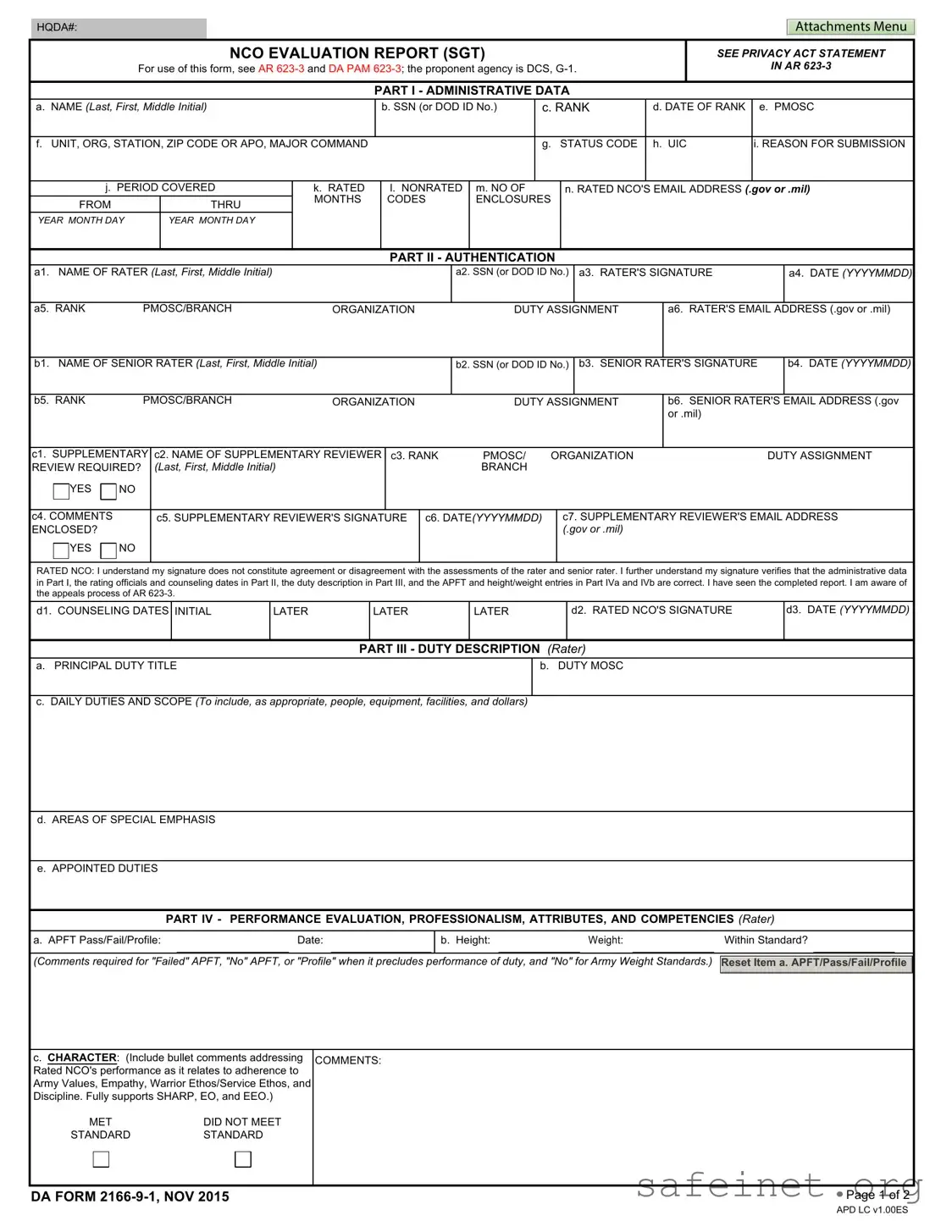
The DA Form 2166-9-1 is a crucial document used in the evaluation of Non-Commissioned Officers (NCOs) within the U.S. Army. This evaluation report specifically targets the rank of Sergeant and serves as a comprehensive assessment of an NCO's performance over a defined period. Key sections of the form include administrative data, which requires personal identification details such as name, Social Security Number (SSN), and unit information. The authentication part necessitates signatures from both the rater and the senior rater, ensuring accountability and accuracy in the evaluation process. The form also emphasizes the importance of duty descriptions and performance evaluations, covering aspects like leadership, professionalism, and attributes that reflect the NCO's adherence to Army values. Furthermore, it includes sections for physical fitness assessments and overall potential ratings, allowing for a holistic view of the NCO’s capabilities and future prospects. Timeliness in submitting this form is essential, as it influences promotions, assignments, and career development opportunities for the rated NCO.
Form Sample

NCO$EVALUATION$REPORT$(SGT)!
For$use$of$this$form,$see$AR#623!3"and$DA#PAM#623!3!"the"proponent"agency "is"DCS,"G!1.!
SEE#PRIVACY#ACT#STATEMENT#
IN#AR#623!3!
PART%I%!!ADMINISTRATIVE+DATA!
a.! NAME%(Last,'First,'Middle'Initial)! b.#SSN#(or#DOD#ID#No.)!
c.#RANK!
d.#DATE#OF#RANK! e.##PMOSC!
f.#! UNIT,&ORG,&STATION,&ZIP&CODE&OR&APO,&MAJOR&COMMAND! g.###STATUS#CODE! h.! UIC! i.#REASON#FOR#SUBMISS IO N!
j.! PERIOD'COVERED!
k.##RATED#
MONTHS!
l.##NONRATED#
CODES!
m.#NO#OF#
ENCLOSURES!
n.#RATED#NCO'S#EMAIL#ADDRESS#(.gov&or&.mil)!
FROM! THRU!
YEAR! MONTH&DAY! YEAR! MONTH&DAY!
PART%II%!!AUTHENTICATION!
a1.$$$NAME$OF$RATER!(Last,'First,'Middle'Initial)!
a2.$SSN$(or$DOD$ID$No.)!
a3.! !"#$!%&'&()*"#+!$!
a4.! DATE%(YYYYMMDD)!
a5.! RANK! PMOSC/BRANCH!
ORGANIZATION! DUTY%ASSIGNMENT!
a6.$$RATER'S$EMAIL$ADDRESS$(.gov$or$.mil)!
b1.$$$NAME$OF$SENIOR$RATER!(Last,'First,'Middle'Initial)!
b2.$SSN$(or$DOD$ID$No.)!
b3.! !"#$%&'&()"&*!'!$+#(),&"! b4.! DATE%(YYYYMMDD)!
b5.! RANK! PMOSC/BRANCH!
ORGANIZATION! DUTY%ASSIGNMENT!
b6.$$SENIOR$RATER'S$EMAIL$ADDRESS$(.gov!
or#.mil)!
c1.$$SUPPLEMENTARY$
REVIEW&REQUIRED?!
YES!
NO!
c2.$NAME$OF$SUPPLEMENTARY$REVIEWER!
(Last,'First,'Middle'Initial)!
c3.$RANK! !PMOSC/! ORGANIZATION! DUTY%ASSIGNMENT%
BRANCH!
c4.$COMMENTS$
ENCLOSED?!
YES! NO!
c5.$SUPPLEMENTARY$REVIEWER'S$SIGNATURE! c6.$DATE(YYYYMMDD)!
c7.$SUPPLEMENTARY$REVIEWER'S$EMAIL$ADDRESS!
(.gov&or&.mil)!
RATED&NCO:&I&understand&my&signature&does& not&constitute&agreement&or&disagreement&with&the&assessments&of&the&rater&and&senior#rater.#I#further#understand#my#signature#verifies#that#the#administrative#data#
in#Part#I,#the#rating#officials#and#counseling#dates$ in$Part$II,$the$duty$description$in$Part$III,$and$the$APFT$and$height/weight$entries$in$Part$IVa$and$IVb$are$correct.$I$have$seen$the$completed$report.$ I$am$aware$of$
the$appeals$process$of$AR$623!3.!
d1.! COUNSELING*DATES!
INITIAL! LATER! LATER! LATER!
d2.! RATED&NCO'S&SIGNATURE!
d3.! DATE%(YYYYMMDD)!
PART%III%!!DUTY%DESCRIPTION! (Rater)!
a.###PRINCIPAL#DUTY#TITLE! b.#! DUTY%MOSC!
c.! DAILY&DUTIES&AND&SCOPE!(To$include,$as$appropriate,$people,$equipment,$facilities,$and$dollars)!
d.! AREAS%OF%SPECIAL%EMPHASIS!
e.! APPOINTED)DUTIES!
PART! IV! !!! PERFORMANCE! EVALUATION,! PROFESSIONALISM,! ATTRIBUTES,! AND! COMPETENCIES!(Rater)!
a.! APFT%Pass/Fail/Profile:! Date:! b.##Height:!
Weight:!
Within&Standard?!
(Comments)required)for)"Failed")APFT,)"No")APFT,)or)"Profile"!when%it%precludes%performance%of%duty,%and%"No"%for%Army%Weight%Standards.)%!
Reset%Item%a.%APFT/Pass/Fail/Profile!
c.! CHARACTER:""(Include"bullet"comments"address in g "
Rated&NCO's&performance&as&it&relates&to&adherence&to&
Army%Values,%Empathy,%Warrior%Ethos/Service(Ethos,(and(
Discipline.*Fully*supports*SHARP,*EO,*and*EEO.)!
MET! DID#NOT#MEET#
STANDARD! STANDARD!
COMMENTS:!
DA#FORM#2166!9!1,#NOV#2015!
Page%1%of%2!
APD$LC$v1.00ES!
Attachments Menu
HQDA#:!
!
RATED&NCO'S&NAME&(Last,'First,'Middle'Initial)!
SSN#(or#DOD#ID#No.)!
THRU%DATE!
PART%IV%!!PERFORMANCE*EVALUATION,*PROFESSIONALISM,*ATTRIBUTES,*AND*COMPETENCIES!(Rater)!
d.##PRESENCE:""(Military"and"profess ion a l"
!"#$%&'()*%+&",,()-.&/%0"&1"()2",%3%"&1"45!
!
MET! DID#NOT#MEET#
STANDARD! STANDARD!
COMMENTS:!
e.##INTELLECT:!!!"#$%&'(&)*'*%+,(-./ $0 (1/0) 2 #$ %, !
!""#$%&'#"()!"&*+,* +- # " % .)&% /&()01,*+&'-*23!
!
MET! DID#NOT#MEET#
STANDARD! STANDARD!
COMMENTS:!
f.! LEADS:""(Leads"others ,"B u ild s"tr u st,"E x te n d s!
influence(beyon d (th e (ch a in (o f(c o mmand,(Leads(b y (
example'Communicates.)!
!
MET! DID#NOT#MEET#
STANDARD! STANDARD!
COMMENTS:!
g.! DEVELOPS:""(Creates"a"positive "c o mmand/!
workplace*environment,*Fosters*esprit*de*corps,*
Prepares'self,'Develops'others,'Stewards'the'
profession.)!
MET! DID#NOT#MEET#
STANDARD! STANDARD!
COMMENTS:!
h.##ACHIEVES:""(Gets"results.)!
!
!
MET! DID#NOT#MEET#
STANDARD! STANDARD!
COMMENTS:!
RATER%OVERALL%PERFORMANCE!
i.##I#currently#rate! NCOs%in%this%grade.%
COMMENTS:!
PART!V!!!! SENIOR! RATER!OVERALL! POTENTIAL!
a.#Select#one#box#representing#Rated#
NCO’s&potential&compared&to&others&in&the&
same%grade%whom%you%have%rated%in%your%
career.&&I&currently&senior&rate!
NCOs%in%this%grade.!
MOST%QUALIFIED%
HIGHLY&QUALIFIED&
QUALIFIED!
NOT$QUALIFIED!
b.#COMMENTS:!
c.#List#two#successive#assignments#and#one#broadening#assignment#(3!5"years).!
Successive(Assignment:((1)!
2)!
Broadening*Assignment:!
DA!FORM! 2166!9!1,! NOV!2015!
Page%2%of%2!
APD$PE$v1.00ES!

Document Specifications

Fact Name Fact Description
Form Purpose The DA 2166-9-1 form is used for NCO Evaluation Reports specifically for Sergeants.
Governing Regulations This form follows the guidelines set forth in AR 623-3 and DA PAM 623-3.
Privacy Act Statement Users should refer to the Privacy Act Statement included in AR 623-3 for guidance on personal information protection.
Administrative Data Part I requires essential information such as name, SSN, rank, and unit details.
Rater Information Part II includes details about the rater and senior rater, including their signatures and email addresses.
Performance Evaluation Part IV evaluates the NCO's performance in various areas, including character, presence, and intellect.
Counseling Dates The form requires documentation of counseling dates to ensure proper feedback is provided.
Overall Potential Assessment Part V allows the senior rater to assess the rated NCO's potential compared to peers.
Signature Requirement The rated NCO must sign to acknowledge understanding of the report, but this does not imply agreement.
Form Validity The DA 2166-9-1 was last updated in November 2015 and is subject to review and updates as necessary.

Steps to Filling Out Da 2166 9 1

Filling out the DA 2166-9-1 form is an important step in the evaluation process for Non-Commissioned Officers (NCOs). This form captures essential information about the rated NCO, their performance, and potential. Follow these steps carefully to ensure accurate completion.

  1. Part I - Administrative Data
    • Enter the rated NCO's name (Last, First, Middle Initial).
    • Provide the Social Security Number (SSN) or DOD ID Number.
    • Fill in the rank of the rated NCO.
    • Indicate the date of rank.
    • Input the Primary Military Occupational Specialty Code (PMOSC).
    • List the unit, organization, station, ZIP code or APO, and major command.
    • Enter the status code.
    • Provide the Unit Identification Code (UIC).
    • State the reason for submission.
    • Fill in the period covered (from and through dates).
    • Indicate the rated months.
    • Fill in non-rated codes.
    • Enter the number of enclosures.
    • Provide the rated NCO's email address (must be .gov or .mil).
  2. Part II - Authentication
    • Enter the name of the rater (Last, First, Middle Initial).
    • Provide the rater's SSN or DOD ID Number.
    • Obtain the rater's signature.
    • Fill in the date (YYYYMMDD).
    • Indicate the rater's rank and PMOSC/branch organization duty assignment.
    • Provide the rater's email address (must be .gov or .mil).
    • Enter the name of the senior rater (Last, First, Middle Initial).
    • Provide the senior rater's SSN or DOD ID Number.
    • Obtain the senior rater's signature.
    • Fill in the date (YYYYMMDD).
    • Indicate the senior rater's rank and PMOSC/branch organization duty assignment.
    • Provide the senior rater's email address (must be .gov or .mil).
    • Enter the name of the supplementary reviewer (if applicable).
    • Indicate if a review is required (Yes or No).
    • Obtain the supplementary reviewer's signature and date.
    • Provide the supplementary reviewer's email address (must be .gov or .mil).
  3. Part III - Duty Description
    • Enter the principal duty title.
    • Provide the duty MOSC.
    • Describe daily duties and scope, including people, equipment, facilities, and dollars.
    • List areas of special emphasis.
    • Indicate any appointed duties.
  4. Part IV - Performance Evaluation
    • Fill in APFT pass/fail/profile information, including date.
    • Enter height and weight, and confirm if within standards.
    • Provide comments for failed APFT or weight standards if applicable.
    • Assess character, presence, intellect, leads, develops, and achieves, providing comments for each area.
    • Complete the overall performance rating.
  5. Part V - Senior Rater Overall Potential
    • Select the appropriate box for the rated NCO’s potential.
    • Provide comments on the rated NCO’s potential.
    • List two successive assignments and one broadening assignment.

More About Da 2166 9 1

What is the DA 2166 9 1 form used for?

The DA 2166 9 1 form is an NCO Evaluation Report specifically designed for Sergeants (SGT). It serves as a comprehensive evaluation tool that assesses the performance and potential of Non-Commissioned Officers (NCOs) within the Army. This form plays a crucial role in documenting an NCO's achievements, areas for improvement, and overall contributions to their unit.

Who is required to complete the DA 2166 9 1 form?

The form must be completed by the rater, who is typically the immediate supervisor of the NCO being evaluated. Additionally, a senior rater is required to review and sign off on the evaluation. Both parties must provide their signatures and relevant information to authenticate the report.

What information is needed to fill out the DA 2166 9 1 form?

To accurately complete the form, you will need several pieces of information. This includes the NCO's name, Social Security Number (or DOD ID), rank, date of rank, and unit information. You will also need to specify the period covered by the evaluation and provide details about the rater and senior rater, including their names and signatures.

What is included in the performance evaluation section of the form?

The performance evaluation section encompasses multiple attributes such as character, presence, intellect, leadership, development, and achievement. Each attribute is assessed and rated as either "met" or "did not meet" the standard. Detailed comments should accompany each rating to provide context and clarity regarding the NCO's performance.

How does the appeals process work for the DA 2166 9 1 form?

The NCO being evaluated has the right to appeal the evaluation if they believe it is unjust or inaccurate. The appeals process is outlined in AR 623-3. It is important for the NCO to understand this process and to act promptly if they wish to contest their evaluation.

What is the significance of the counseling dates on the form?

Counseling dates are critical as they document when the NCO received feedback regarding their performance. This includes initial counseling and any subsequent sessions. These dates help establish a timeline of communication and support between the rater and the NCO, reinforcing the importance of ongoing development.

What happens if the NCO fails to meet the Army's weight standards?

If the NCO does not meet the Army's weight standards, this must be documented in the evaluation. Comments are required to explain the circumstances surrounding the failure. Such documentation is essential for maintaining transparency and accountability in the evaluation process.

Can the DA 2166 9 1 form be amended after submission?

Once the form has been submitted and signed by the rater and senior rater, amendments are generally not permitted. However, if errors are discovered, the NCO may initiate an appeal or request a correction through the appropriate channels. Timeliness is key in these situations.

Where can I find more information about the DA 2166 9 1 form?

Additional information can be found in AR 623-3 and DA PAM 623-3, which provide guidelines and instructions for the evaluation process. It is advisable to review these documents to ensure compliance and a thorough understanding of the evaluation criteria.

Common mistakes

  1. Incorrect Personal Information: Ensure that the name, Social Security Number (SSN), and rank are accurately entered. Mistakes in this section can lead to significant delays in processing.

  2. Missing Required Signatures: All necessary signatures from the rater, senior rater, and supplementary reviewer must be included. Omitting any signature can render the form incomplete.

  3. Inaccurate Dates: The dates for the period covered, counseling, and signatures should be precise. Errors in dates can create confusion about the evaluation period.

  4. Incomplete Duty Description: The duty description should be thorough and cover all relevant responsibilities. A vague description may not accurately reflect the NCO's performance.

  5. Neglecting to Address Performance Standards: Ensure that all performance attributes, such as character and leadership, are evaluated. Leaving these sections blank can misrepresent the NCO’s capabilities.

  6. Failure to Include Email Addresses: The email addresses for the rater and senior rater must be provided. This facilitates communication regarding the evaluation.

  7. Ignoring the Appeals Process: The NCO should acknowledge understanding of the appeals process. Not indicating this may suggest a lack of awareness of rights.

  8. Improperly Documenting APFT Results: Ensure that the APFT results, including pass/fail status and comments, are accurately reported. Incomplete information can affect the evaluation outcome.

  9. Omitting Enclosures: If there are any enclosures to be submitted with the form, they must be clearly listed. Failing to do so can lead to an incomplete submission.

Documents used along the form

The DA Form 2166-9-1, which is used for evaluating non-commissioned officers (NCOs), often requires accompanying documents to provide a comprehensive assessment. Each of these forms plays a crucial role in the evaluation process, ensuring that all necessary information is available for a fair review. Below is a list of commonly used forms and documents associated with the DA Form 2166-9-1.

  • DA Form 4856: This is the Developmental Counseling Form. It is used to document counseling sessions between a leader and a soldier. The form captures the soldier's strengths and areas for improvement, helping to set goals and track progress over time.
  • DA Form 705: This form records the results of the Army Physical Fitness Test (APFT). It is essential for assessing a soldier's physical readiness and overall fitness level, which is a key component of their performance evaluation.
  • DA Form 5500/5501: These forms are used for recording body fat measurements. They are important for ensuring soldiers meet the Army's weight and body composition standards, which directly impact their evaluations.
  • DA Form 67-9: This is the NCO Evaluation Report (NCOER) for higher ranks. It is used for documenting the performance of NCOs in leadership roles and provides a broader context for the evaluations of subordinate NCOs.
  • DA Form 638: This form is utilized for recommending soldiers for awards. It includes details about the soldier’s achievements and contributions, which can positively influence their evaluation.
  • DA Form 2627: This form is the Record of Proceedings Under Article 15, UCMJ. It documents non-judicial punishment and is important for understanding any disciplinary actions that may affect an NCO's evaluation.
  • DA Form 750: This is the Performance Evaluation Report for enlisted personnel. It provides additional insights into the performance of soldiers and can complement the information provided in the DA Form 2166-9-1.
  • DA Form 31: The Request and Authority for Leave form is used when soldiers apply for leave. It can be relevant in evaluations, especially if leave impacts performance or attendance.

These documents collectively enhance the evaluation process, ensuring that all aspects of an NCO's performance and conduct are thoroughly considered. Properly completing and submitting these forms alongside the DA Form 2166-9-1 can lead to more accurate assessments and better support for the professional development of soldiers.

Similar forms

The DA Form 2166-9-1 is similar to the DA Form 67-9, which is the Officer Evaluation Report (OER). Both forms serve the purpose of evaluating personnel within the military. The OER focuses on the performance and potential of officers, while the DA Form 2166-9-1 targets non-commissioned officers (NCOs). Each form includes sections for administrative data, performance evaluation, and authentication by raters and senior raters. This common structure ensures consistency in how evaluations are conducted across different ranks within the Army.

Another comparable document is the DA Form 4856, known as the Developmental Counseling Form. This form is used for counseling sessions that discuss an individual's performance, goals, and areas for improvement. Like the DA Form 2166-9-1, it emphasizes communication between the rater and the rated individual. Both documents require signatures to verify that the information discussed is acknowledged by the parties involved, ensuring accountability and clarity in the evaluation process.

The DA Form 705, which is the Army Physical Fitness Test Scorecard, also shares similarities with the DA Form 2166-9-1. Both forms include sections dedicated to physical fitness assessments. While the DA Form 705 focuses solely on physical performance metrics, the DA Form 2166-9-1 incorporates these metrics as part of a broader evaluation of an NCO’s overall performance. This integration highlights the importance of physical readiness in the context of leadership and duty performance.

The DA Form 638, which is used for recommending awards, also bears resemblance to the DA Form 2166-9-1. Both documents require detailed descriptions of performance and achievements. While the DA Form 638 is aimed at recognizing outstanding service or accomplishments, the DA Form 2166-9-1 evaluates ongoing performance and potential for future assignments. Each form contributes to the professional development of military personnel by documenting their contributions and capabilities.

Another related document is the DA Form 7440, the Army Records Management System (ARMS) Evaluation Report. This form is used to evaluate the performance of Army civilians. Similar to the DA Form 2166-9-1, it assesses performance based on established criteria and requires signatures from evaluators. Both forms aim to ensure that evaluations are fair and consistent, regardless of whether the individual being evaluated is military or civilian personnel.

The DA Form 1059, which is the Academic Evaluation Report, is also similar in nature. This form evaluates the performance of soldiers in academic courses and training. Like the DA Form 2166-9-1, it includes sections for administrative data and performance evaluation. Both forms serve to document achievements and provide feedback, which can influence future assignments and career progression.

Finally, the DA Form 2627, which is used for non-judicial punishment proceedings, shares some structural similarities with the DA Form 2166-9-1. Both forms require details about the individual involved, the circumstances of the evaluation, and the signatures of the reviewing officials. While the DA Form 2627 addresses disciplinary actions, the evaluation form focuses on performance and potential. Nonetheless, both documents play critical roles in maintaining standards and accountability within the Army.

Dos and Don'ts

When filling out the DA 2166-9-1 form, it's essential to follow specific guidelines to ensure accuracy and compliance. Below is a list of things you should and shouldn't do during this process.

  • Do provide complete and accurate personal information, including your name, SSN, and rank.
  • Do ensure that all dates are formatted correctly, using the YYYYMMDD format.
  • Do verify that the email addresses provided for both the rater and senior rater are valid and end with .gov or .mil.
  • Do review the completed form for any errors before submission.
  • Do understand that your signature does not indicate agreement with the evaluations but confirms the accuracy of the administrative data.
  • Don't leave any required fields blank; incomplete forms may lead to delays or rejection.
  • Don't use informal language or abbreviations that may confuse the reader.
  • Don't forget to include any necessary enclosures that support your evaluation.
  • Don't submit the form without ensuring that all signatures are obtained from the rater and senior rater.

Misconceptions

Understanding the DA 2166-9-1 form is crucial for NCO evaluations. However, several misconceptions can lead to confusion. Here are eight common misconceptions explained:

  • It is only for evaluations. Many believe the form is solely for performance evaluations. In reality, it also captures administrative data and duty descriptions.
  • Only the rater's opinion matters. Some think only the rater's assessment counts. The senior rater's input is equally important and provides a broader perspective on the NCO's performance.
  • Signatures imply agreement. A common myth is that signing the form means agreement with the evaluations. The rated NCO’s signature simply verifies that the administrative data is correct.
  • All NCOs must receive the same evaluation. It's a misconception that every NCO in a similar position receives identical evaluations. Each evaluation is tailored to the individual's performance and contributions.
  • Performance evaluations are only about tasks completed. Many people think evaluations focus solely on task completion. However, they also assess attributes like leadership, character, and professionalism.
  • The form is only relevant during promotion periods. Some believe the DA 2166-9-1 is only necessary when promotions are on the horizon. In truth, it is a vital tool for ongoing performance management and development.
  • Only negative comments affect evaluations. There's a misconception that only negative feedback impacts an NCO's evaluation. Positive comments and recognition of achievements are equally significant in the assessment process.
  • The form is static and cannot change. Some think the form cannot be updated once submitted. In fact, corrections can be made if errors are identified after submission, ensuring accuracy in evaluations.

Key takeaways

Here are key takeaways for filling out and using the DA 2166-9-1 form:

  • Accurate Information is Essential: Ensure all personal details, such as name, SSN, and rank, are correct in Part I. Mistakes can delay processing.
  • Complete All Sections: Fill out every required field, including the duty description and performance evaluations. Incomplete forms may be returned.
  • Signatures Matter: Obtain signatures from both the rater and senior rater in Part II. Their signatures confirm the evaluation's validity.
  • Understand Counseling Dates: Document initial and subsequent counseling dates accurately. This reflects ongoing performance discussions.
  • Performance Metrics are Key: Clearly outline performance evaluations in Part IV. Use specific comments to support ratings for each category.
  • Review Before Submission: The rated NCO must review the completed report. Ensure all data is accurate before signing to avoid issues later.