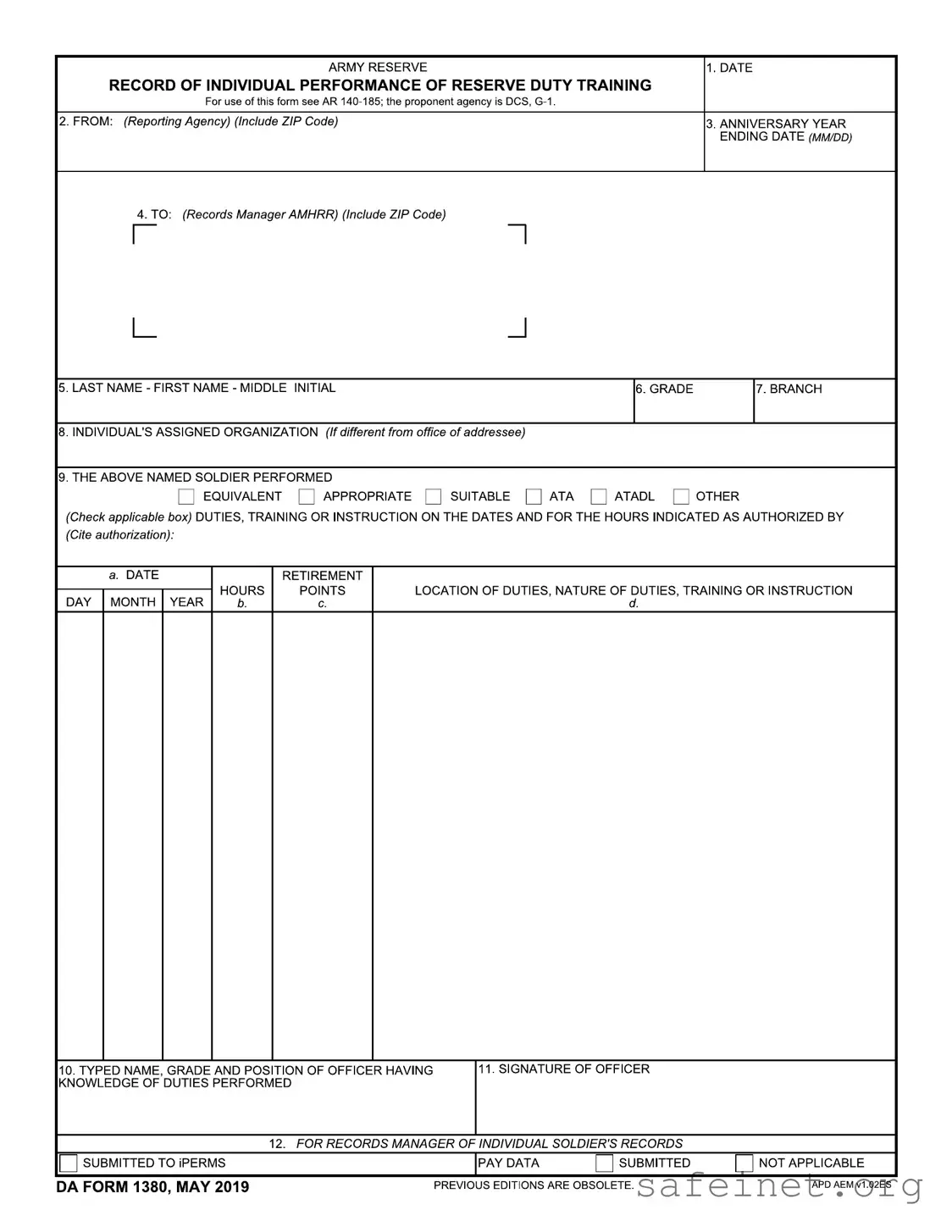
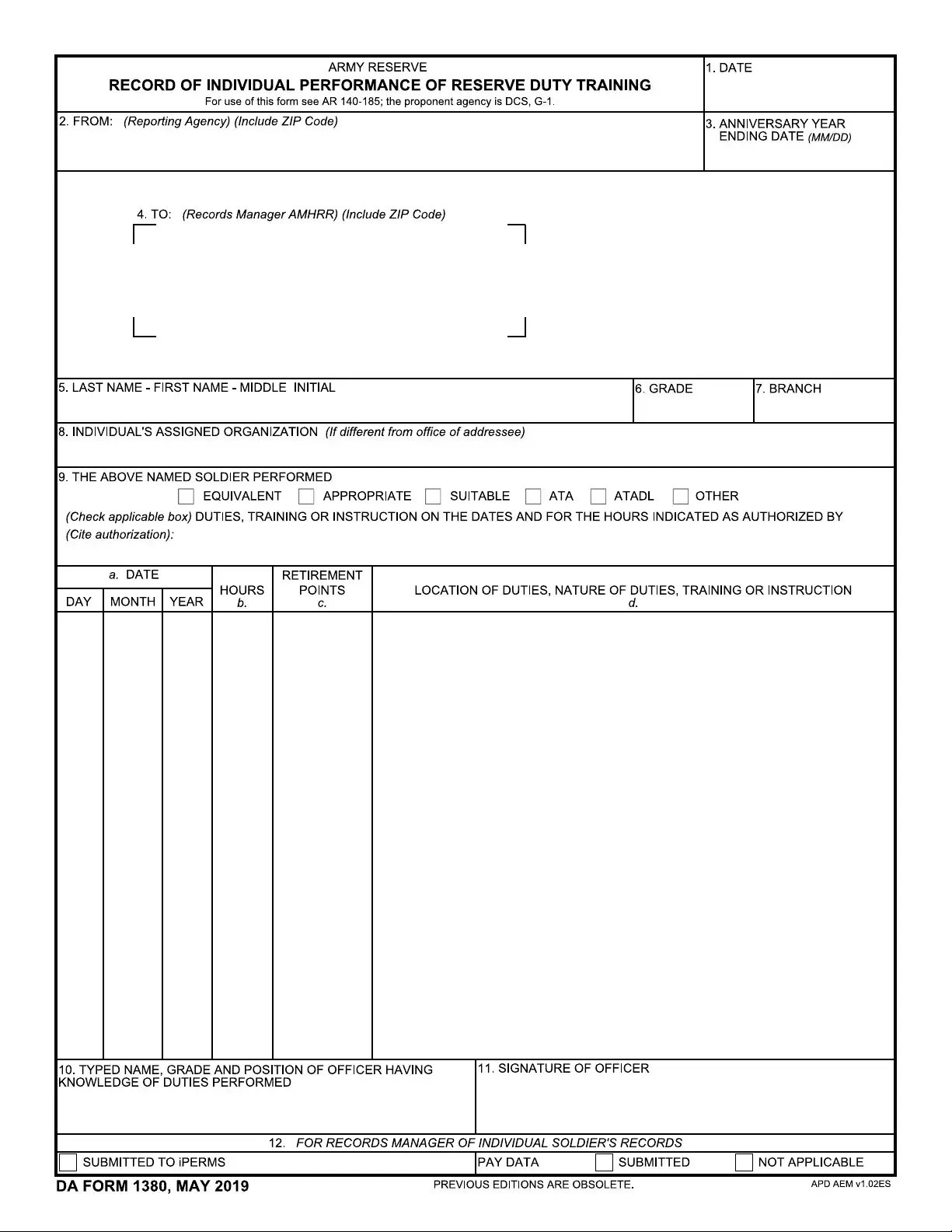
The DA Form 1380 is an essential document used by the Army Reserve to record individual performance during reserve duty training. This form serves multiple purposes, allowing for the accurate tracking of training hours, locations, and the nature of duties performed by soldiers. It is crucial for documenting both paid and non-paid inactive duty training, ensuring that soldiers receive appropriate retirement points for their service. The form must be completed by the last day of each duty month and submitted to the appropriate pay channels or the Army Human Resources Command. Various individuals, including commanding officers and designated military representatives, are responsible for preparing this form, depending on the type of training undertaken. Each section of the form provides specific details, such as the soldier's name, organization, and the dates and hours of training. Proper completion and timely submission of the DA Form 1380 are vital for maintaining accurate records and ensuring that soldiers receive the recognition and benefits they deserve for their dedication and service.
| Fact Name | Details |
|---|---|
| Purpose | The DA Form 1380 is used to record individual performance of Reserve Duty Training for Army Reserve members. |
| Governing Law | This form is governed by AR 140-185, which outlines the rules for Reserve Training and related duties. |
| Preparation Deadline | It must be prepared by the last day of each duty month to ensure timely submission for pay and retirement points. |
| Signature Requirement | The form must be signed by an officer who verifies the duties performed, ensuring accountability and accuracy. |
Filling out the DA 1380 form is an important task for documenting an individual's performance during reserve duty training. This process ensures that the necessary records are maintained for both paid and non-paid training activities. Following the steps below will help you complete the form accurately and efficiently.
What is the purpose of the DA Form 1380?
The DA Form 1380 is used to document the performance of individual Reserve duty training by soldiers in the Army Reserve. It serves as a record for both paid and non-paid training activities, ensuring that soldiers receive appropriate credit for their service and training efforts.
Who is responsible for preparing the DA Form 1380?
The preparation of the DA Form 1380 is typically the responsibility of the officer or designated representative who has knowledge of the duties performed. This may include the chief of the proponent agency for specific training projects, a commanding officer for attached units, or a military representative at professional meetings.
When should the DA Form 1380 be submitted?
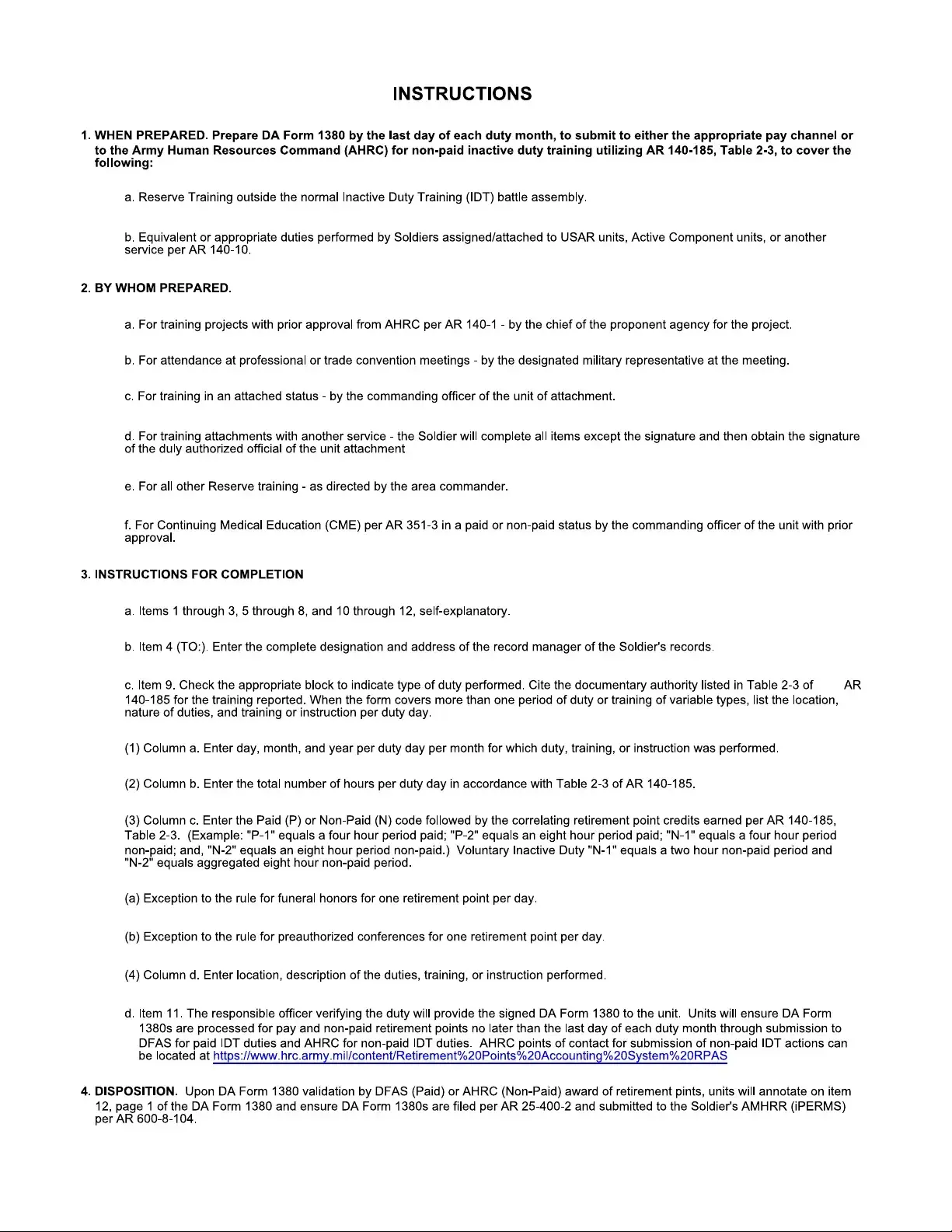
The DA Form 1380 should be prepared by the last day of each duty month. It must be submitted to the appropriate pay channel or to the Army Human Resources Command (AHRC) for non-paid inactive duty training. Timely submission ensures that soldiers receive the correct retirement points and pay for their service.
What information is required on the DA Form 1380?
The form requires various details, including the soldier's name, grade, branch, assigned organization, and specifics about the training performed. This includes dates, hours, location, and nature of the duties. Additionally, it must cite the authorization for the training as specified in Army regulations.
How are retirement points calculated on the DA Form 1380?
Retirement points are calculated based on the type of duty performed. The form includes codes that indicate whether the duty was paid or non-paid, along with the correlating retirement point credits. For example, "P-1" indicates a four-hour paid period, while "N-1" indicates a two-hour non-paid period. Specific exceptions apply for funeral honors and preauthorized conferences.
What should be done with the DA Form 1380 after validation?
Once the DA Form 1380 has been validated by the Defense Finance and Accounting Service (DFAS) for paid duties or AHRC for non-paid duties, it must be annotated and filed according to Army regulations. This includes submitting the form to the soldier's Army Military Human Resource Record (AMHRR) and ensuring proper documentation is maintained.
Are there any previous editions of the DA Form 1380?
Yes, previous editions of the DA Form 1380 are considered obsolete. The current version, dated May 2019, should be used to ensure compliance with the latest Army regulations and guidelines.
What happens if the DA Form 1380 is not submitted on time?
If the DA Form 1380 is not submitted by the deadline, soldiers may not receive the appropriate retirement points or pay for their training activities. This could affect their overall service record and benefits. It is crucial to adhere to submission timelines to avoid any potential issues.
Where can I find additional guidance on completing the DA Form 1380?
Additional guidance on completing the DA Form 1380 can be found in Army Regulation 140-185 and other related Army publications. These resources provide detailed instructions on the preparation, submission, and processing of the form to ensure compliance with Army standards.
Failing to complete all required fields. Each section of the DA 1380 form must be filled out completely. Missing information can lead to delays in processing.
Incorrectly entering dates. The form requires specific date formats (MM/DD). Any deviation from this format can result in confusion and potential rejection.
Omitting the appropriate authorization citation. This citation is essential for validating the duties performed. Without it, the form may be deemed incomplete.
Using incorrect codes for retirement points. Ensure that the codes match the hours worked and the type of duty performed. Misclassification can lead to incorrect retirement point allocation.
Not specifying the correct location of duties. This detail is critical for record-keeping and validation. Providing vague or incomplete location descriptions can hinder processing.
Failing to obtain the necessary signature. The officer verifying the duties must sign the form. Without this signature, the form lacks validation.
Submitting the form after the deadline. The DA 1380 must be prepared and submitted by the last day of each duty month. Late submissions can lead to missed retirement points.
Not checking the appropriate duty type box. It is important to accurately select the type of duty performed. Incorrect selections can result in processing errors.
Neglecting to keep a copy of the submitted form. Retaining a copy is essential for personal records and can be useful in case of disputes regarding duty performed or points earned.
The DA Form 1380 is a crucial document for Army Reserve personnel, capturing individual performance during reserve duty training. Alongside this form, several other documents are often utilized to ensure proper reporting and record-keeping. Below is a list of these accompanying forms and documents, each serving a specific purpose in the administrative process.
Each of these documents plays a significant role in the administrative processes surrounding Army Reserve duty. Proper completion and submission of these forms, in conjunction with the DA Form 1380, are vital for maintaining accurate records and ensuring compliance with Army regulations. Timely and accurate documentation ultimately supports the mission readiness and operational effectiveness of the Army Reserve.
The DA Form 1059, known as the Academic Evaluation Report, serves a similar purpose to the DA Form 1380 in that it documents an individual's performance during training. This form is used to evaluate soldiers who attend formal military schools. Like the DA Form 1380, it captures essential details about the training, including the dates attended and the performance outcomes. Both forms are essential for maintaining accurate personnel records and ensuring that soldiers receive appropriate recognition for their training efforts.
The DA Form 3349, or the Physical Profile, is another document that parallels the DA Form 1380. While the DA Form 1380 records training activities, the DA Form 3349 assesses a soldier's physical capabilities and limitations. This form is crucial for determining a soldier's eligibility for certain duties or training based on their health status. Both documents contribute to a soldier's overall readiness and capability to perform assigned duties effectively.
The DA Form 2-1, or the Personnel Qualification Record, is also similar in function. It provides a comprehensive overview of a soldier's qualifications, including training, education, and duty assignments. Like the DA Form 1380, the DA Form 2-1 is updated regularly to reflect the soldier's current status and accomplishments. This ensures that all records are accurate and up-to-date, which is vital for career progression and evaluations.
The DA Form 4187, known as the Personnel Action Form, is another document that shares similarities with the DA Form 1380. It is used to request changes in a soldier's status, such as promotions, transfers, or training opportunities. While the DA Form 1380 focuses on documenting completed training, the DA Form 4187 initiates actions related to future training and assignments. Both forms are essential in managing a soldier's career and ensuring they receive appropriate opportunities for development.
The DA Form 600-9, or the Army Body Composition Program, also aligns with the DA Form 1380 in terms of tracking performance. This form is used to assess a soldier's body composition and ensure they meet Army standards. While the DA Form 1380 documents training activities, the DA Form 600-9 focuses on physical readiness. Both forms are integral to maintaining a soldier's overall fitness and readiness for duty.
The DA Form 7500, known as the Army Training Requirements and Resources System (ATRRS) Enrollment Form, is another related document. It is used to enroll soldiers in training courses and track their progress. Like the DA Form 1380, it involves the documentation of training activities and ensures that soldiers are properly enrolled in courses that will enhance their skills. Both forms play a crucial role in the training and development of soldiers.
Finally, the DA Form 5019, or the U.S. Army Correspondence Course Completion Certificate, is similar to the DA Form 1380 in that it certifies the completion of training. This form is issued upon successful completion of correspondence courses and is essential for documenting a soldier's educational achievements. Both forms contribute to a soldier's professional development and are necessary for maintaining accurate training records.
When filling out the DA 1380 form, attention to detail is crucial. Here are some important dos and don'ts to keep in mind:
Misunderstandings about the DA Form 1380 can lead to confusion and errors in reporting training and duties. Here are seven common misconceptions:
Understanding these misconceptions can help ensure accurate reporting and compliance with Army regulations.
The DA Form 1380 is an essential document for Army Reserve personnel, specifically for recording individual performance during Reserve Duty Training. Here are seven key takeaways regarding the completion and use of this form: