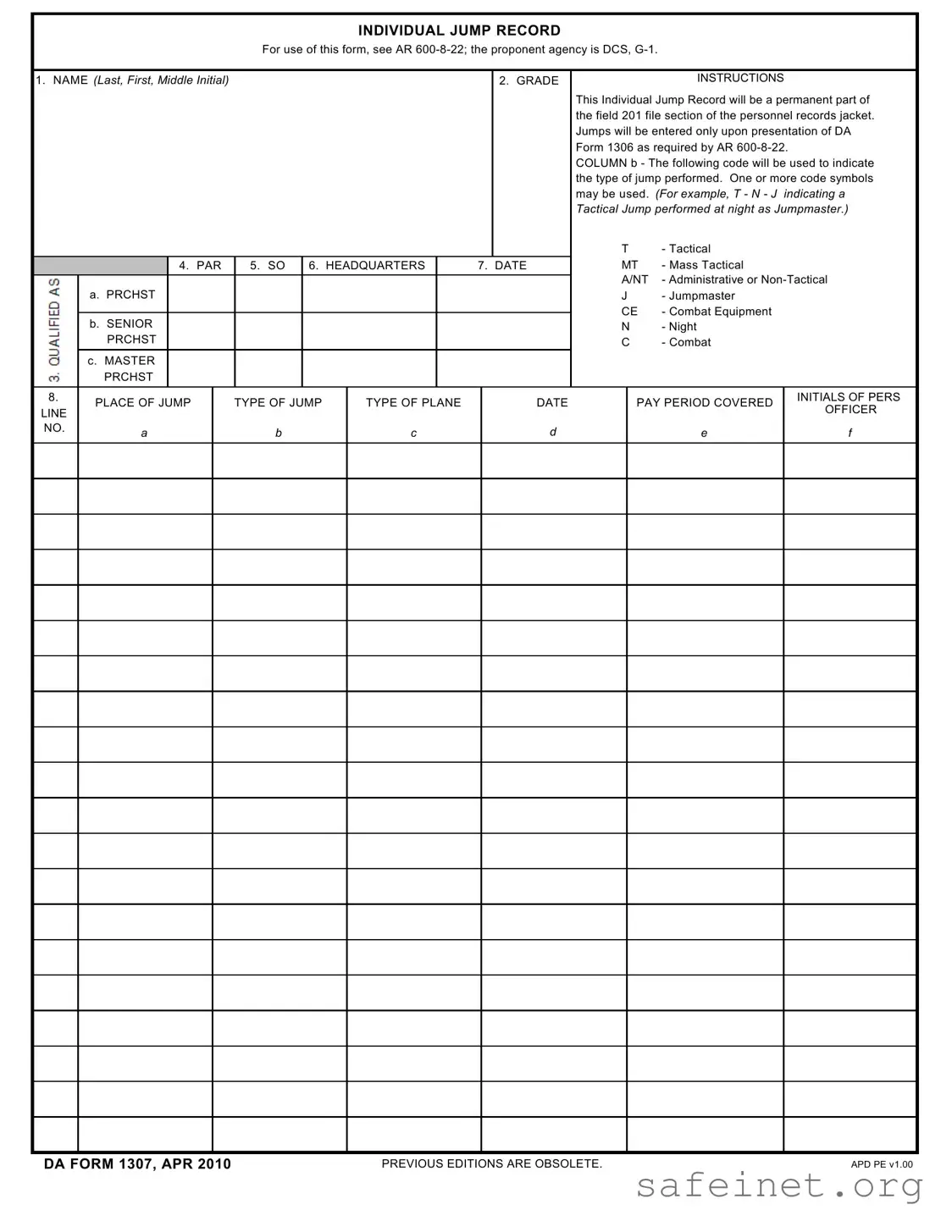
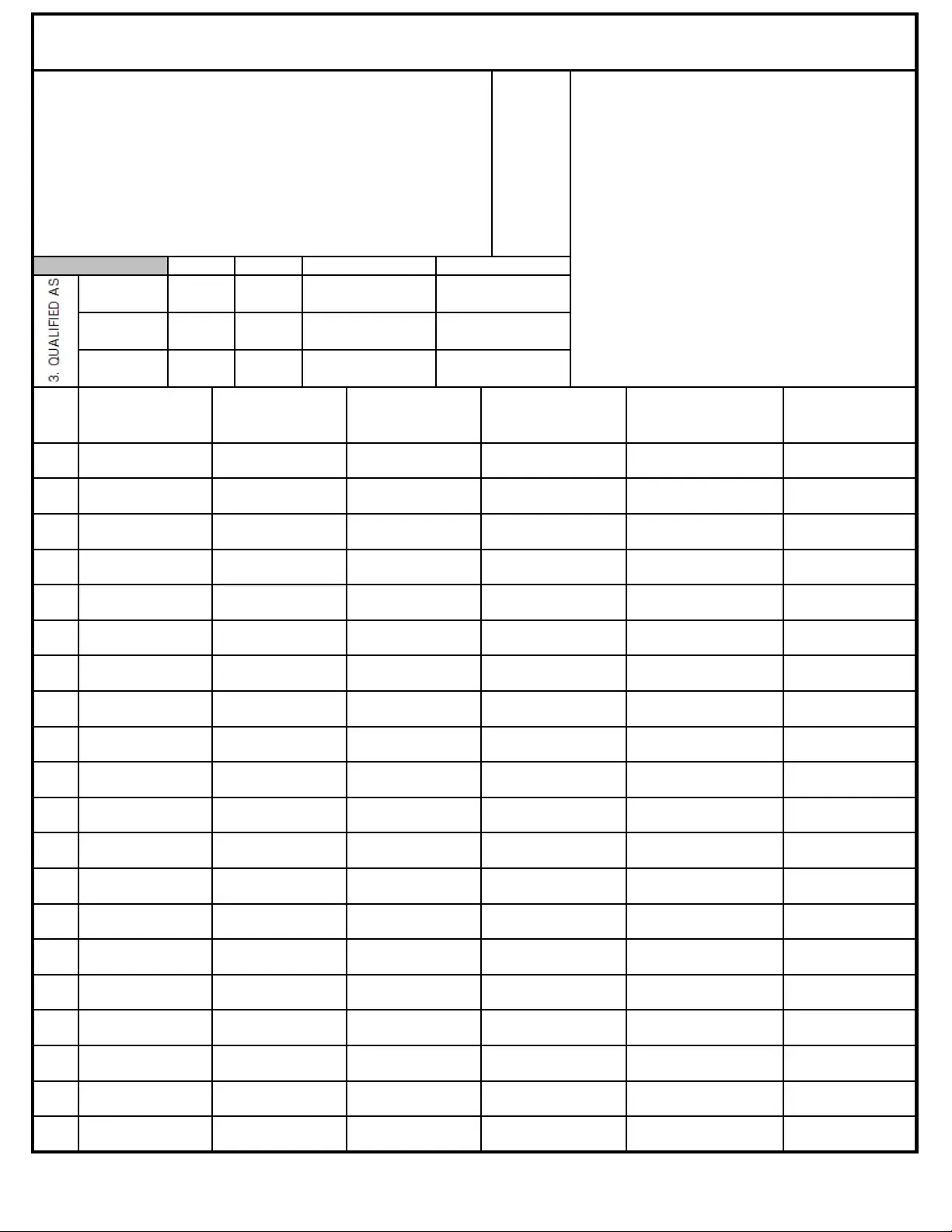
The DA 1307 form, known as the Individual Jump Record, plays a crucial role in documenting parachute jumps for military personnel. This form is essential for maintaining accurate records as it becomes a permanent part of an individual’s field 201 file. Each jump must be recorded only after the presentation of the DA Form 1306, ensuring that all entries are verified and legitimate. The form includes specific fields for the jumper’s name, grade, and details about each jump, including the type and conditions under which it was performed. Various codes are used to classify jumps, such as Tactical (T), Night (N), and Jumpmaster (J), allowing for a comprehensive understanding of the jump's nature. Additionally, the DA 1307 captures vital information such as the place of the jump, type of aircraft used, and the pay period covered. This meticulous record-keeping is vital for both operational readiness and personnel management within the military, ensuring that all jump activities are accounted for and properly documented.
| Fact Name | Details |
|---|---|
| Purpose | The DA 1307 form is used to record individual jump details for military personnel. |
| Governing Law | This form is governed by AR 600-8-22, which outlines the policies for parachutist operations. |
| Permanent Record | The completed form becomes a permanent part of the individual's personnel records. |
| Jump Codes | Specific codes are used to indicate the type of jump, such as T for Tactical and N for Night. |
| Initials Requirement | Initials of the personnel officer must be included to validate the entries on the form. |
Filling out the DA Form 1307 is an essential step for maintaining accurate records of individual jumps. After completing the form, ensure all information is correct before submitting it to the appropriate personnel office.
What is the purpose of the DA 1307 form?
The DA 1307 form, also known as the Individual Jump Record, serves to document a soldier's parachute jumps. This record is a permanent part of the soldier's personnel file and is important for tracking jump qualifications and experience. The information recorded on this form helps ensure that the soldier meets the necessary requirements for airborne operations.
How do I fill out the DA 1307 form?
To complete the DA 1307 form, start by entering your name, grade, and other personal details in the designated sections. Each jump must be recorded upon presentation of the DA Form 1306, which provides verification of the jump. You will need to indicate the type of jump performed using specific codes, such as 'T' for Tactical or 'N' for Night jumps. Ensure all required fields are filled out accurately to maintain the integrity of your jump record.
Who is responsible for maintaining the DA 1307 form?
The responsibility for maintaining the DA 1307 form lies with the individual soldier and their unit. Soldiers must ensure that their jump records are updated accurately and promptly after each jump. Additionally, the personnel officer in the unit will oversee the proper filing and storage of these forms within the soldier's personnel records jacket.
What happens if I lose my DA 1307 form?
If you lose your DA 1307 form, it is important to take immediate action to rectify the situation. You should notify your unit's personnel office as soon as possible. They can assist you in reconstructing your jump record by referencing other documentation, such as the DA Form 1306. Maintaining accurate records is crucial for your airborne qualifications, so addressing the loss quickly is essential.
Can I use the DA 1307 form for jumps conducted in different locations?
Yes, the DA 1307 form can be used to record jumps conducted in various locations. Each jump should be documented separately on the form, indicating the place of jump, type of jump, and other relevant details. This comprehensive documentation helps provide a complete overview of your jump experience, regardless of where the jumps took place.
Not including the full name in the correct format. Ensure you write your last name, first name, and middle initial clearly.
Failing to select the appropriate jump type code. Each jump type has a specific code, and using the wrong one can lead to inaccuracies.
Omitting the date of the jump. This is crucial for record-keeping and must be filled out accurately.
Not providing the correct initials of the personnel officer. This section must be completed to validate the record.
Leaving out the place of jump. This information is essential for tracking and verification purposes.
Using an incorrect pay period. Ensure that the pay period covered is accurate to avoid discrepancies in records.
Neglecting to sign or date the form. Both are necessary to confirm the information is accurate and complete.
Not keeping a copy of the completed form. Always retain a copy for personal records and future reference.
The DA Form 1307, known as the Individual Jump Record, is essential for documenting parachute jumps in military service. When filling out this form, several other documents may also be required to ensure a complete and accurate record. Here’s a list of forms and documents commonly used alongside the DA Form 1307:
Understanding these forms can help ensure that all necessary documentation is in place when completing the DA Form 1307. Keeping accurate records is crucial for both individual soldiers and military operations as a whole.
The DA Form 1306 is closely related to the DA Form 1307. This form serves as a record of individual jumps and is required to document each jump before it can be entered into the Individual Jump Record. The completion of the DA Form 1306 is mandatory for the submission of jump information, ensuring that all jumps are properly verified and recorded. Without this form, the DA Form 1307 cannot be accurately filled out, making it a critical component of the jump record process.
The DA Form 2-1 is another document that shares similarities with the DA Form 1307. It serves as a personnel record that contains vital information about a soldier's career, including assignments, training, and qualifications. Like the DA Form 1307, the DA Form 2-1 is a permanent part of a soldier's official file. Both documents contribute to a comprehensive understanding of a soldier's experience and qualifications, making them essential for evaluations and promotions.
The DA Form 1059 is used to document the completion of military training courses. It is similar to the DA Form 1307 in that it tracks important achievements in a soldier's career. Both forms are used to record specific accomplishments that can impact a soldier’s future assignments and promotions. The DA Form 1059 highlights educational milestones, while the DA Form 1307 focuses on jump qualifications, but both serve to enhance a soldier's personnel record.
The DA Form 4187 is a request for personnel action. This form can be used to request changes in a soldier’s status, such as promotions or reassignments. While it serves a different purpose than the DA Form 1307, both documents play a role in managing a soldier's career progression. The DA Form 4187 may reference the DA Form 1307 when considering a soldier's jump qualifications for promotions or special assignments.
The DA Form 3349 is a medical profile form that indicates a soldier's physical limitations. It is relevant to the DA Form 1307 because a soldier's ability to perform jumps may be affected by their medical status. Both forms are essential for ensuring that soldiers are fit for duty and can safely participate in airborne operations. The DA Form 3349 provides necessary medical information that complements the jump record documented in the DA Form 1307.
The DA Form 7500 is a record of individual awards and decorations. This form is similar to the DA Form 1307 in that it documents significant achievements within a soldier's career. Both forms help to create a complete picture of a soldier's qualifications and accomplishments. Awards and decorations can be influenced by jump qualifications, making the DA Form 7500 relevant to the information recorded in the DA Form 1307.
The DA Form 2823 is a sworn statement form used to gather information during investigations. While its primary purpose is different from the DA Form 1307, both forms can be involved in the evaluation of a soldier's conduct and performance. The DA Form 2823 may be referenced if a soldier's jump record comes into question during an investigation, linking the two documents in the context of accountability.
The DA Form 4856 is a developmental counseling form. This document is used to provide feedback to soldiers about their performance and potential. Like the DA Form 1307, it is part of the ongoing process of soldier development. Counseling sessions may address a soldier's jump qualifications as part of their overall performance, making the DA Form 4856 relevant in conjunction with the DA Form 1307.
The DA Form 600-9 is a weight control form that tracks a soldier's weight and body fat. This document is important for ensuring that soldiers meet physical fitness standards. While the focus is different from the DA Form 1307, both forms are used to ensure that soldiers are ready for duty and capable of performing their roles, including airborne operations. A soldier's ability to jump may be affected by their physical condition, linking the two forms in the context of readiness.
The DA Form 7425 is a record of training and experience for soldiers in the Army. It is similar to the DA Form 1307 in that it documents specific skills and qualifications. Both forms contribute to a soldier's overall record and can impact future assignments and promotions. The DA Form 7425 may include jump qualifications as part of a soldier's training history, making it relevant to the information captured in the DA Form 1307.
When filling out the DA 1307 form, attention to detail is essential. Here are some important dos and don’ts to keep in mind:
Following these guidelines will help ensure that your DA 1307 form is filled out correctly and efficiently. Taking the time to review your submission can prevent unnecessary issues down the line.
Misconceptions about the DA 1307 form can lead to confusion regarding its purpose and use. Here are eight common misconceptions:
When filling out the DA 1307 form, keep these key takeaways in mind: