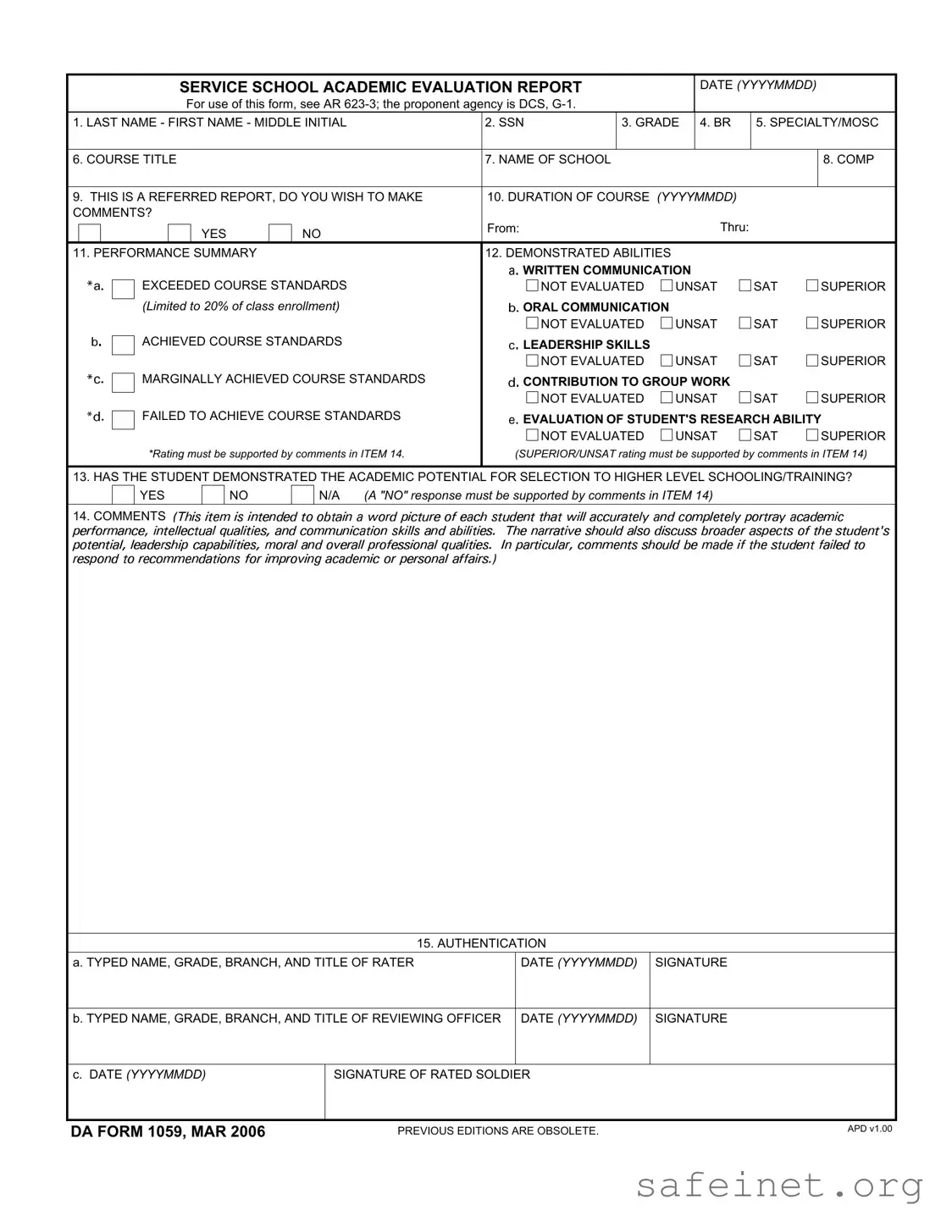
The DA Form 1059, formally known as the Service School Academic Evaluation Report, serves a critical role in the evaluation of military personnel who have completed various educational courses within the U.S. Army. This form encapsulates key information such as the soldier's name, Social Security Number, grade, and specialty, providing a comprehensive overview of their academic journey. It records essential details like the course title, the name of the school attended, and the duration of the course, all of which contribute to a soldier's professional development. Importantly, the form includes performance summaries that assess a range of competencies, from written and oral communication to leadership skills and group contributions. Evaluators are tasked with rating these abilities, which can significantly impact a soldier's future opportunities for advancement and further training. The DA Form 1059 not only reflects academic performance but also poses critical questions regarding the soldier's potential for higher-level schooling. This evaluation is authenticated by both the rater and a reviewing officer, ensuring that the assessments are credible and supported by detailed comments. Thus, the DA Form 1059 is not merely a document; it is a pivotal tool that shapes the trajectory of a soldier's career within the military framework.
| Fact Name | Description |
|---|---|
| Form Purpose | The DA 1059 form is used for academic evaluation reports in military service schools. |
| Governing Regulation | This form is governed by AR 623-3. |
| Proponent Agency | The proponent agency for this form is DCS, G-1. |
| Student Information | It requires personal details such as last name, first name, middle initial, and SSN. |
| Course Details | Information about the course title, school name, and duration must be included. |
| Performance Summary | Evaluators must provide a performance summary and ratings for various skills. |
| Rating Criteria | Ratings include UNSAT, SAT, and SUPERIOR, with specific criteria for support. |
| Comments Requirement | Comments are required for ratings of SUPERIOR or UNSAT to provide context. |
| Authentication Section | The form includes sections for signatures of the rater, reviewing officer, and the rated soldier. |
Filling out the DA 1059 form requires careful attention to detail. Once completed, the form will provide a comprehensive evaluation of the student’s performance in a military school setting. Follow these steps to ensure accuracy and completeness.
What is the purpose of the DA 1059 form?
The DA 1059 form, also known as the Service School Academic Evaluation Report, is used to evaluate a soldier's performance during a specific course of study. This form provides a structured way to assess various competencies, including written and oral communication, leadership skills, and contributions to group work. It is essential for documenting a soldier's academic achievements and potential for further training or schooling.
Who is required to complete the DA 1059 form?
The DA 1059 form must be completed by the rater, who is typically the instructor or course leader, and reviewed by a designated reviewing officer. The soldier undergoing evaluation also has a role in the process, as they must sign the form to acknowledge their evaluation. This collaborative effort ensures that evaluations are fair and comprehensive.
What information is included in the DA 1059 form?
The form collects essential details such as the soldier's name, Social Security Number (SSN), grade, specialty, course title, and the name of the school. It also includes a performance summary that rates various skills and abilities, as well as a section for comments that supports the ratings given. This structured format helps maintain clarity and consistency in evaluations.
How are performance ratings determined on the DA 1059 form?
Performance ratings on the DA 1059 are categorized into several levels: UNSAT (unsatisfactory), SAT (satisfactory), and SUPERIOR. Raters must provide supporting comments for any SUPERIOR or UNSAT ratings in the comments section. This requirement ensures that evaluations are not only based on subjective impressions but are backed by specific observations and evidence of performance.
What does it mean if a report is marked as "referred" on the DA 1059 form?
A "referred" report indicates that the soldier has the option to provide comments or dispute the evaluation. This feature is crucial for maintaining transparency and allowing soldiers to express their perspectives on their performance. The soldier can choose to make comments, which may be taken into consideration during future evaluations or assessments.
How does the DA 1059 form impact a soldier's career?
The evaluations documented on the DA 1059 form can significantly influence a soldier's career trajectory. Positive evaluations may enhance opportunities for promotions, advanced schooling, or specialized training. Conversely, negative evaluations can have implications for a soldier's career advancement. Therefore, it is important for soldiers to understand the evaluation process and strive to meet or exceed course standards.
Incorrect Personal Information: Failing to accurately enter the last name, first name, and middle initial can lead to confusion and processing delays.
Missing Social Security Number: Omitting the SSN is a common mistake that can hinder identification and record-keeping.
Inaccurate Course Title: Entering the wrong course title can affect the validity of the evaluation and future opportunities.
Not Indicating a Referred Report: Failing to mark whether the report is referred can lead to misunderstandings about the evaluation's intent.
Incomplete Performance Summary: Neglecting to provide ratings or comments in the performance summary section can result in an unclear assessment of abilities.
Missing Comments for Ratings: Ratings marked as 'SUPERIOR' or 'UNSAT' must be supported by comments. Failing to do so can invalidate the evaluation.
Not Signing the Form: Forgetting to sign the form can cause delays in processing and may lead to the report being deemed incomplete.
Failure to Review Before Submission: Not double-checking the entire form for accuracy and completeness can lead to multiple errors that could have been easily fixed.
The DA 1059 form, also known as the Service School Academic Evaluation Report, is a crucial document used to assess a soldier's performance during their academic training. Alongside this form, several other documents may be necessary to provide a comprehensive overview of a soldier's training and evaluation. Below is a list of these forms, each accompanied by a brief description.
Each of these forms plays a vital role in the evaluation and development of soldiers. Together, they provide a well-rounded view of a soldier's training, performance, and potential for future responsibilities. Proper completion and submission of these documents can significantly impact a soldier's career progression and opportunities for advancement.
The DA Form 1059, Service School Academic Evaluation Report, shares similarities with the DA Form 1058, which is the Academic Evaluation Report for Reserve Component Soldiers. Both forms assess the academic performance of military personnel in educational settings. They include sections for personal information, course details, and performance ratings. Like the DA Form 1059, the DA Form 1058 also requires evaluators to provide comments that support their ratings, ensuring a comprehensive evaluation of the individual’s capabilities.
The DA Form 67-9, Officer Evaluation Report, is another document that parallels the DA Form 1059. This form evaluates the performance of officers and includes ratings on various competencies. Both forms require evaluators to comment on the individual’s performance, leadership skills, and potential for future roles. The emphasis on qualitative feedback in both documents aims to provide a well-rounded view of the individual’s abilities and achievements.
Similar to the DA Form 1059, the DA Form 2166-9, Noncommissioned Officer Evaluation Report, evaluates the performance of noncommissioned officers. This form assesses leadership, training, and overall contributions to the unit. Both forms require a clear summary of the individual’s performance and potential, with evaluators providing specific examples to support their assessments. The structured format of both documents ensures that evaluations are consistent and thorough.
The DA Form 4856, Developmental Counseling Form, also resembles the DA Form 1059 in its focus on individual performance and development. This form is used for counseling sessions and outlines a soldier’s strengths and areas for improvement. Like the DA Form 1059, the DA Form 4856 includes space for comments from both the counselor and the soldier, fostering open communication about performance and future goals.
The DA Form 1050, which is the Army Physical Fitness Test Scorecard, shares a focus on performance evaluation. While it specifically measures physical fitness, it also includes personal information and performance metrics. Both forms aim to provide a standardized assessment of an individual's capabilities, whether in academics or physical readiness, ensuring that evaluations are consistent across the board.
The DA Form 7425, which is the Army Family Team Building Program Evaluation, is similar in that it assesses the effectiveness of training programs. It gathers feedback on the training experience and outcomes, much like the DA Form 1059 evaluates academic performance. Both forms emphasize the importance of feedback and continuous improvement, highlighting the role of training in professional development.
The DA Form 7000, which is the Army Training Requirements and Resources System (ATRRS) Enrollment Form, also shares similarities with the DA Form 1059. While it focuses on enrollment in training programs, it includes personal information and course details. Both documents play a crucial role in tracking an individual’s educational journey and ensuring that their training aligns with military standards.
The DA Form 11-2, which is the Army Regulation for Training and Evaluation, is another document that relates to the DA Form 1059. This form outlines the training and evaluation processes for soldiers. Both documents aim to ensure that individuals meet established standards and provide a framework for assessing performance and potential within the military context.
Lastly, the DA Form 10-1, which is the Army Commander's Evaluation Report, is similar in its purpose of evaluating personnel. It assesses leadership and effectiveness within a command structure. Both forms require detailed evaluations and comments from supervisors, ensuring that assessments are thorough and reflective of the individual’s contributions to the military.
When filling out the DA 1059 form, it's essential to ensure accuracy and clarity. Here are some key dos and don'ts to guide you through the process.
By following these guidelines, you can help ensure that your evaluation is both effective and comprehensive.
The DA Form 1059 is an important document used in military education, yet several misconceptions about it persist. Understanding these misconceptions can help clarify its purpose and usage.
This form is not solely for documenting poor performance. It is designed to provide a comprehensive assessment of a soldier's academic achievements, including positive attributes and areas of strength.
While the instructor plays a significant role in filling out the form, the rated soldier also has a part to play. The soldier's comments and signature are essential components of the evaluation process.
The evaluation criteria on the DA Form 1059 are standardized. They include specific performance categories, ensuring that assessments are consistent and based on established benchmarks.
While a "Superior" rating reflects exceptional performance, it does not automatically lead to promotion or selection. Other factors, such as overall performance and availability of positions, also play a crucial role.
In fact, the DA Form 1059 is a key document in a soldier's record. It can influence future assignments, promotions, and opportunities for advanced training.
Here are key takeaways for filling out and using the DA 1059 form: