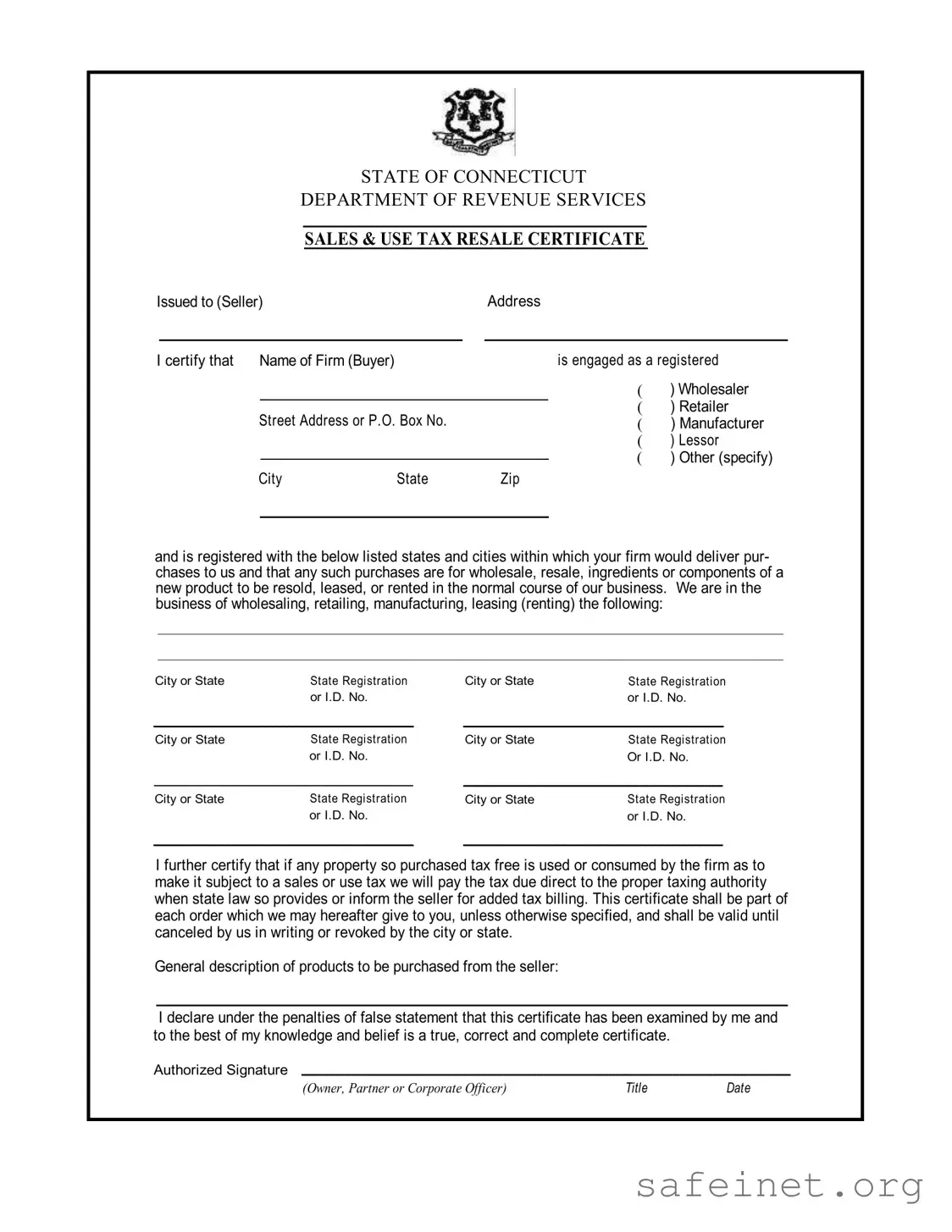
The Connecticut Resale Certificate form is an essential tool for businesses engaged in wholesale, retail, manufacturing, or leasing activities. This form allows buyers to purchase goods without paying sales tax, provided those goods are intended for resale or use in creating a new product. By completing the form, buyers certify their status as registered wholesalers, retailers, manufacturers, or lessors, and they must include their state registration or ID numbers. The certificate also requires a detailed description of the products being purchased, ensuring clarity for both the buyer and seller. Importantly, the buyer agrees to pay any applicable sales or use tax if the purchased items are used in a manner that does not qualify for tax exemption. The form remains valid until it is canceled or revoked, making it a straightforward and efficient means of facilitating tax-exempt transactions. Additionally, the authorized signature of an owner, partner, or corporate officer attests to the accuracy of the information provided, reinforcing the importance of compliance with state tax laws.
| Fact Name | Description |
|---|---|
| Purpose | The Connecticut Resale Certificate allows businesses to purchase goods tax-free for resale. |
| Eligibility | Only registered wholesalers, retailers, manufacturers, and lessors may use this certificate. |
| Governing Law | This form is governed by Connecticut General Statutes §12-408 and §12-411. |
| Validity | The certificate remains valid until canceled in writing or revoked by the state or city. |
| Usage | It must accompany each order unless specified otherwise by the buyer. |
| Tax Responsibility | If goods are used for non-resale purposes, the buyer must pay the applicable sales tax. |
| Required Information | Buyers must provide their business name, address, and registration ID numbers for all relevant states. |
| Signature Requirement | An authorized signature from an owner, partner, or corporate officer is required to validate the certificate. |
| Product Description | A general description of the products to be purchased must be included on the form. |
Completing the Connecticut Resale Certificate form is essential for businesses engaged in wholesale or retail activities. This form allows buyers to purchase goods without paying sales tax, provided the items are intended for resale. Below are the steps to accurately fill out the form.
After completing the form, ensure that all information is accurate. Retain a copy for your records and provide the original to the seller as part of the purchasing process. This certificate remains valid until it is canceled in writing or revoked by the relevant authority.
What is the purpose of the Connecticut Resale Certificate?
The Connecticut Resale Certificate serves as a crucial document for businesses engaged in wholesale, retail, manufacturing, or leasing. It allows a buyer to purchase goods without paying sales tax, provided those goods are intended for resale or as components of a new product that will ultimately be sold. By presenting this certificate to the seller, the buyer certifies that the transaction is for business purposes, thus exempting the buyer from the immediate tax burden. It is important for businesses to understand that this certificate is only valid if the goods are genuinely intended for resale or incorporation into products for resale.
Who is eligible to use the Connecticut Resale Certificate?
Eligibility to use the Connecticut Resale Certificate is typically limited to registered wholesalers, retailers, manufacturers, lessors, or other specified businesses. To qualify, the buyer must be actively engaged in a business that involves the sale of goods or services. Additionally, the buyer must possess a valid registration or identification number from the state, which demonstrates their compliance with state regulations. This ensures that the certificate is used appropriately and only by those who are legitimately in the business of reselling products.
What are the consequences of misusing the Connecticut Resale Certificate?
Misusing the Connecticut Resale Certificate can lead to serious repercussions. If a business uses the certificate to purchase items for personal use or consumption rather than for resale, it may be held liable for unpaid sales tax. The state can impose penalties, interest, and back taxes on the business. Furthermore, the seller who accepted the certificate may also face scrutiny for not collecting sales tax on the transaction. Therefore, it is essential for both buyers and sellers to ensure that the certificate is used correctly to avoid potential legal and financial consequences.
How long is the Connecticut Resale Certificate valid?
The Connecticut Resale Certificate remains valid until it is canceled in writing by the buyer or revoked by the state or city. This means that businesses should keep accurate records of their certificates and ensure they are updated as necessary. It is advisable for buyers to periodically review their status and the validity of their certificates to ensure compliance with state laws. If a business ceases operations or changes its structure, it must also update or revoke the certificate accordingly to prevent misuse.
Incomplete Seller Information: Failing to fill out the seller's name and address can lead to confusion. Ensure that all details are accurate and complete.
Incorrect Buyer Classification: Selecting the wrong category, such as wholesaler instead of retailer, can result in issues. Make sure to choose the classification that accurately reflects your business.
Missing State Registration Numbers: Not providing the necessary state registration or ID numbers can invalidate the certificate. Always include this information for each relevant state.
Failure to Specify Product Type: Leaving out a general description of the products to be purchased can create misunderstandings. Clearly state what items you intend to buy.
Unsigned Certificate: Forgetting to sign the certificate is a common mistake. An authorized signature is essential for the document to be valid.
The Connecticut Resale Certificate form is an essential document for businesses engaged in wholesale, retail, manufacturing, or leasing. Alongside this form, several other documents are commonly used to facilitate transactions and ensure compliance with state tax regulations. Below is a list of these documents, each serving a unique purpose in the resale process.
Understanding these documents and their purposes can help businesses navigate the complexities of sales transactions and ensure compliance with state regulations. Proper documentation not only streamlines operations but also protects both buyers and sellers in the resale process.
The Sales Tax Exemption Certificate is similar to the Ct Resale Certificate in that both documents allow businesses to purchase goods without paying sales tax. This certificate is typically used by organizations that are exempt from sales tax, such as non-profits or government entities. Like the Ct Resale Certificate, it requires the buyer to provide information about their business and the nature of their purchases. Both documents serve to inform sellers that the buyer is authorized to make tax-exempt purchases, ensuring compliance with state tax laws.
The Wholesale Certificate is another document that shares similarities with the Ct Resale Certificate. This certificate is issued to wholesalers, allowing them to purchase goods for resale without incurring sales tax. Both certificates require the buyer to declare their business type and provide a registration number. The primary purpose of the Wholesale Certificate is to facilitate transactions between wholesalers and retailers, ensuring that tax is only applied at the final point of sale.
The Manufacturer’s Exemption Certificate functions in much the same way as the Ct Resale Certificate. Manufacturers use this document to purchase raw materials or components that will be incorporated into finished products. Both certificates require the buyer to certify that the items purchased will be used in a manner that qualifies for tax exemption. This helps streamline the purchasing process for manufacturers and ensures that they are not taxed on materials that will ultimately be sold as part of a finished product.
The Direct Pay Permit is another document that has a similar purpose to the Ct Resale Certificate. This permit allows businesses to pay sales tax directly to the state rather than to the seller at the time of purchase. Like the Ct Resale Certificate, it requires the buyer to provide their business information and tax registration details. The Direct Pay Permit is particularly useful for businesses that make frequent purchases and want to simplify their tax reporting process.
The Tax Exempt Organization Certificate is akin to the Ct Resale Certificate, as both documents are used by entities that qualify for tax exemption. Non-profit organizations often use this certificate to purchase goods and services without paying sales tax. Both certificates require the buyer to provide proof of their tax-exempt status, ensuring that sellers are aware of the buyer's eligibility for tax-free transactions.
The Agricultural Exemption Certificate is similar to the Ct Resale Certificate in that it allows farmers and agricultural businesses to purchase supplies without paying sales tax. This certificate is specifically designed for those in the agricultural sector, allowing them to buy equipment, seeds, and other necessary items for their operations tax-free. Both documents require the buyer to certify the intended use of the purchased items, ensuring compliance with tax regulations.
Finally, the Resale Certificate in other states functions similarly to the Ct Resale Certificate. Many states have their own versions of resale certificates that allow businesses to purchase goods intended for resale without paying sales tax. While the specific requirements may vary by state, the fundamental purpose remains the same: to facilitate tax-exempt purchases for businesses engaged in resale activities. Buyers must provide their business information and registration details, just as they do with the Ct Resale Certificate.
When filling out the Connecticut Resale Certificate form, it’s important to be meticulous and accurate. Here are ten things you should and shouldn’t do:
Taking these steps will help ensure that your Resale Certificate is processed smoothly and that you remain compliant with state regulations.
Misconceptions about the Connecticut Resale Certificate form can lead to confusion. Here are seven common misunderstandings:
Understanding these misconceptions can help ensure proper use of the Connecticut Resale Certificate form.
When filling out and using the Connecticut Resale Certificate form, keep the following key points in mind:
By following these guidelines, you can effectively utilize the Connecticut Resale Certificate for your business transactions.