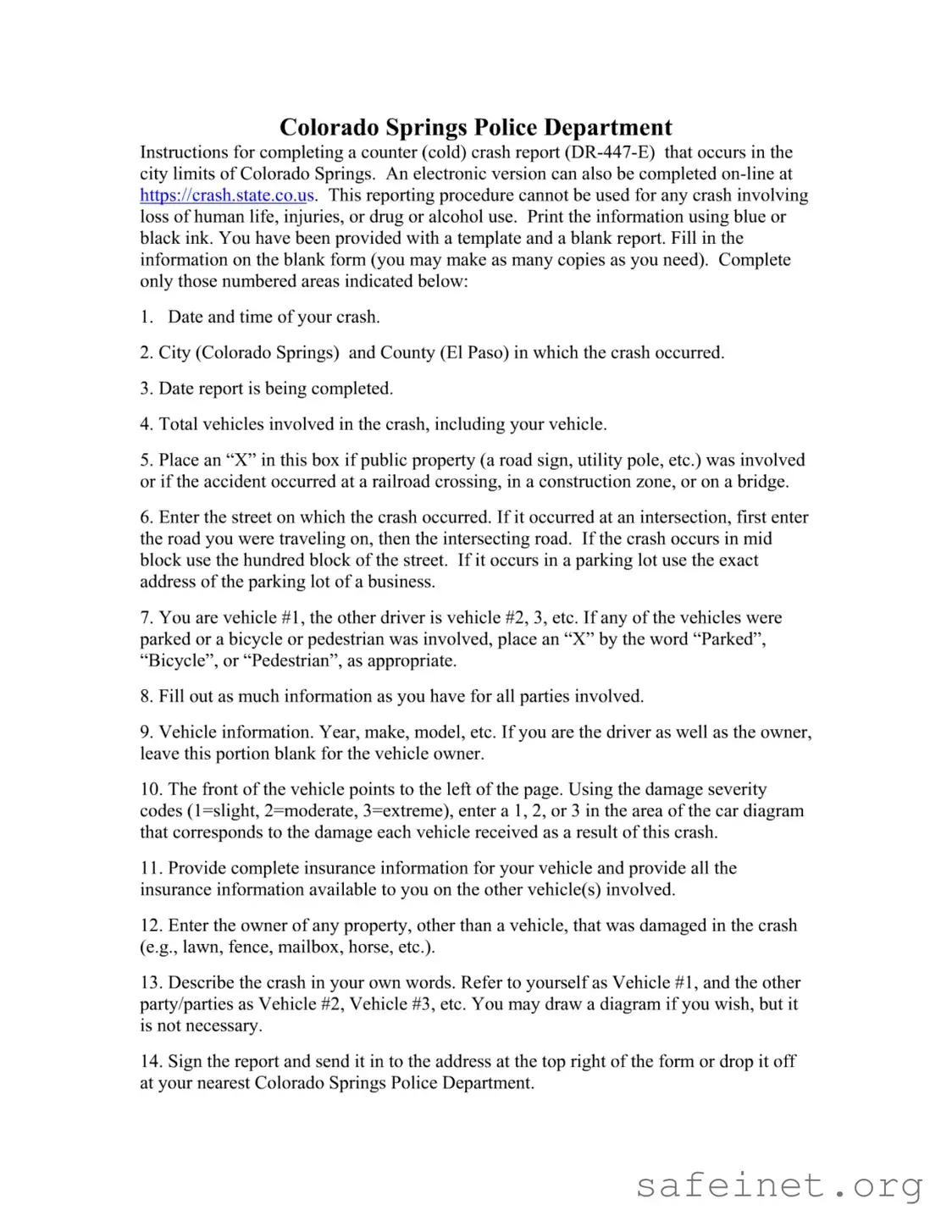
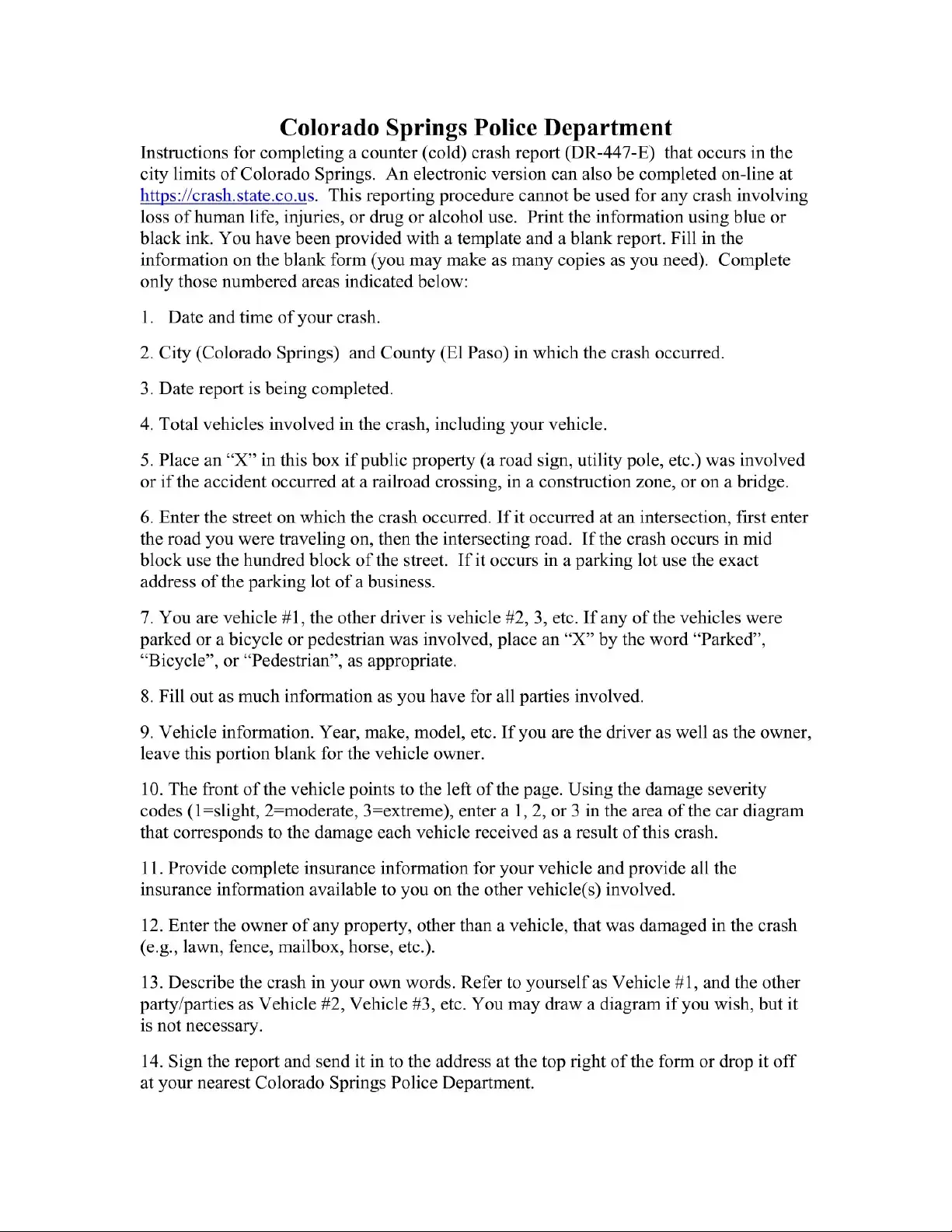
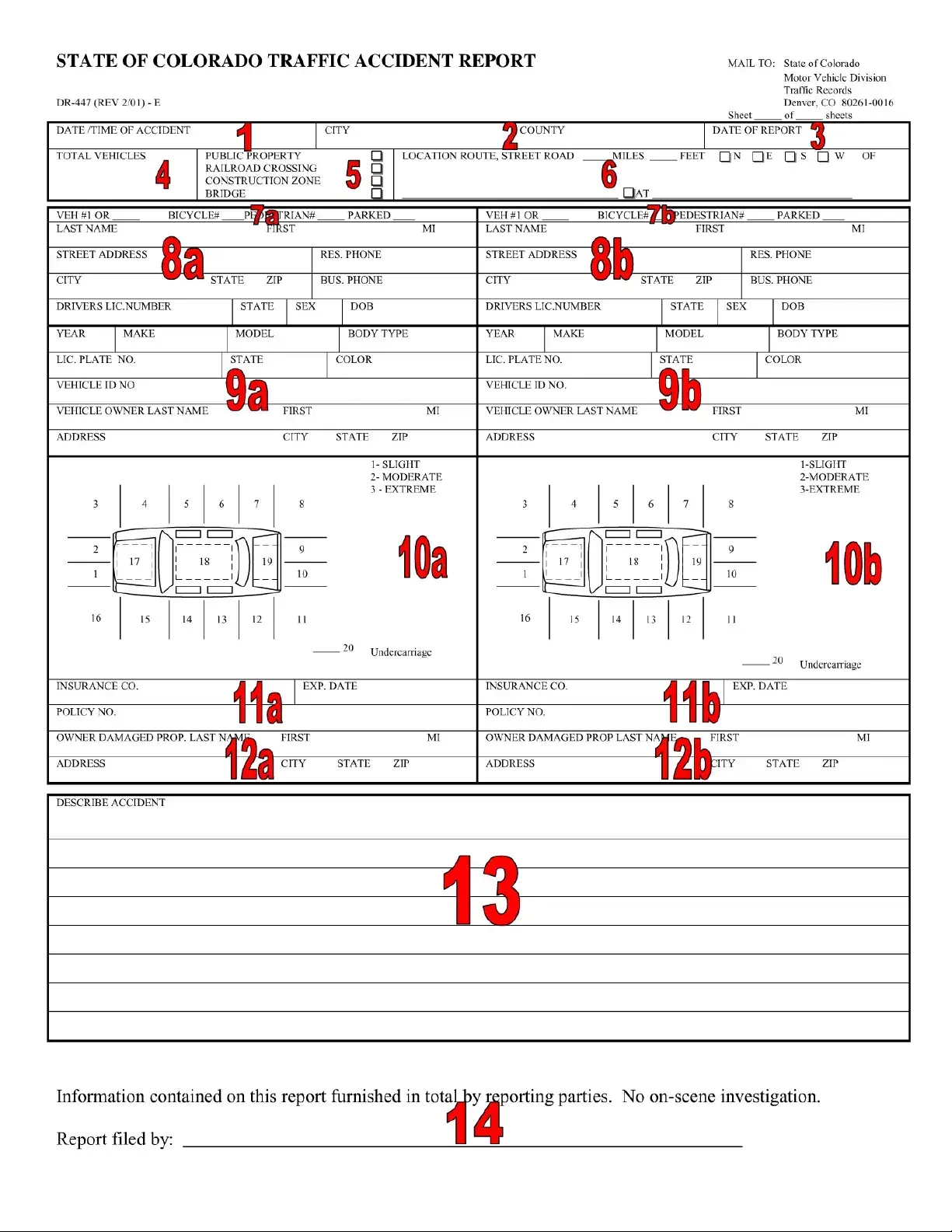
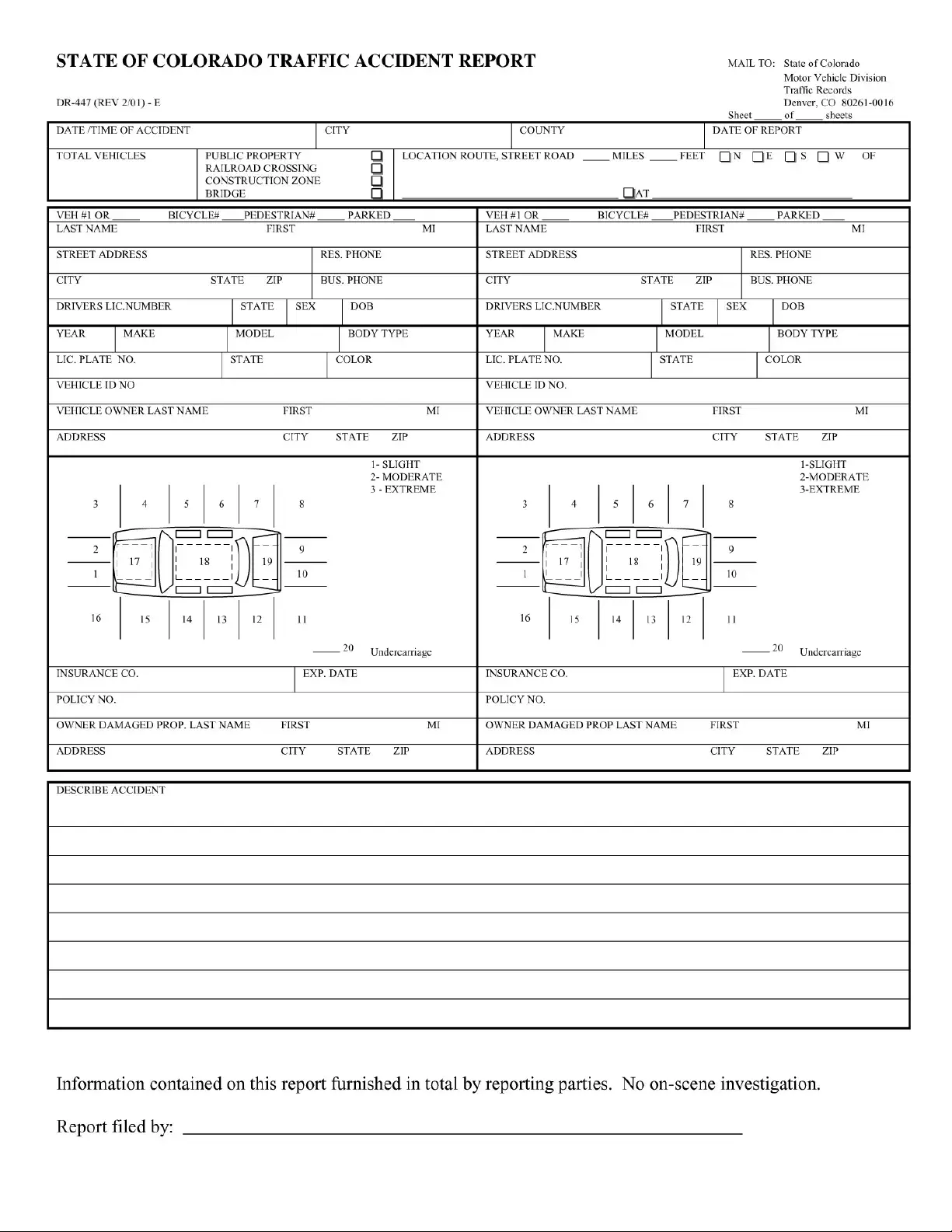
The Colorado Springs Police Department (CSPD) Accident Report form, officially known as the DR-447-E, is a crucial document for anyone involved in a motor vehicle crash within the city limits of Colorado Springs. This form is designed specifically for reporting counter (cold) crashes that do not involve injuries, fatalities, or substance-related incidents. It can be filled out electronically online, providing convenience for users. When completing the report, individuals must use blue or black ink and ensure that they provide accurate details in the designated sections. Key aspects include recording the date and time of the accident, identifying the location, and detailing the vehicles involved. The form requires users to indicate if public property was damaged and to describe the crash in their own words. Additionally, it collects insurance information and allows for a diagram of the accident scene, if desired. Completing this form accurately is essential for proper documentation and any potential follow-up with insurance companies or law enforcement. Once finished, the report can be submitted by mail or delivered in person to the nearest CSPD office.
| Fact Name | Fact Description |
|---|---|
| Form Title | The form is officially titled the Colorado Springs Police Department Counter (Cold) Crash Report (DR-447-E). |
| Electronic Submission | An electronic version of the report can be completed online at https://crash.state.co.us. |
| Usage Restrictions | This reporting procedure is not applicable for crashes involving human fatalities, injuries, or drug/alcohol use. |
| Ink Color Requirement | Report information must be printed using blue or black ink. |
| Information Required | Key information includes date and time of the crash, total vehicles involved, and location details. |
| Damage Severity Codes | Damage severity is categorized using codes: 1 for slight, 2 for moderate, and 3 for extreme. |
| Property Damage Reporting | Report any damage to property other than vehicles, such as fences or mailboxes. |
| Submission Instructions | After completing the report, it must be signed and submitted to the Colorado Springs Police Department. |
After completing the CSPD Accident Report form, you will need to submit it to the Colorado Springs Police Department. You can either mail it to the address listed on the form or drop it off in person at your nearest police station. Ensure all information is accurate and legible to avoid any delays in processing your report.
What is the purpose of the CSPD Accident Report form?
The CSPD Accident Report form is designed to document non-injury vehicle accidents that occur within the city limits of Colorado Springs. It serves as an official record of the incident for insurance purposes and for the Colorado Springs Police Department's records. This form should not be used for accidents involving injuries, fatalities, or incidents involving drug or alcohol use.
How do I complete the CSPD Accident Report form?
To complete the form, use blue or black ink and fill in the required information in the numbered areas provided. Key details include the date and time of the accident, the location, the number of vehicles involved, and a description of the crash. You may also include diagrams if necessary. Once completed, the report can be mailed or dropped off at a designated Colorado Springs Police Department location.
Can I complete the report online?
Yes, an electronic version of the CSPD Accident Report form can be completed online at the Colorado State crash reporting website: https://crash.state.co.us. This option allows for easier submission and may streamline the reporting process.
What should I do if the accident involved public property?
If the accident involved public property, such as a road sign or utility pole, you should indicate this by placing an "X" in the designated box on the form. Additionally, provide details about the type of public property affected and its location in your description of the crash.
What information do I need to provide about other parties involved in the accident?
When filling out the report, you must provide as much information as possible about all parties involved. This includes names, addresses, phone numbers, vehicle information, and insurance details. If any vehicles were parked or if a bicycle or pedestrian was involved, mark the appropriate boxes on the form.
How should I describe the accident in the report?
Your description of the accident should be clear and concise. Refer to yourself as Vehicle #1 and the other parties as Vehicle #2, Vehicle #3, etc. Include relevant details about the sequence of events leading up to the crash. A diagram may be included if it helps clarify the situation, but it is not mandatory.
What if I do not have all the information required for the report?
While it is important to provide as much information as possible, you should fill out the form with the details you do have. If certain information is unavailable, leave those sections blank. It is better to submit an incomplete report than to delay submission altogether.
What should I do with the completed report?
Once the report is completed and signed, you have two options for submission. You can mail it to the address provided at the top right of the form, or you can drop it off at your nearest Colorado Springs Police Department location. Ensure that you keep a copy for your records.
Neglecting to provide the correct date and time of the crash. This information is crucial for accurate record-keeping and legal purposes.
Failing to indicate the correct city and county. Ensure that you specify Colorado Springs and El Paso County, as this is essential for jurisdictional reasons.
Not filling in the date when the report is completed. This date is important for tracking the timeline of events.
Overlooking the total number of vehicles involved. Include all vehicles, even if they were parked or involved in a minor way.
Forgetting to mark if public property was involved. This can affect liability and insurance claims, so be sure to check the box if applicable.
Incorrectly describing the location of the accident. Use the exact street name, and if at an intersection, list both roads accurately.
Not identifying vehicles correctly. Remember to label yourself as Vehicle #1 and the other parties as Vehicle #2, #3, etc.
Providing incomplete insurance information. Make sure to include all available details for both your vehicle and the other vehicles involved.
Failing to describe the crash adequately. Use clear and concise language to explain what happened, referring to yourself and others by vehicle number.
When involved in a vehicle accident, several forms and documents may accompany the Colorado Springs Police Department (CSPD) Accident Report form. Each document serves a specific purpose in ensuring a comprehensive understanding of the incident and facilitating the necessary follow-up actions. Below is a list of commonly used forms and documents that individuals may encounter in this context.
Each of these documents plays a vital role in the aftermath of a vehicle accident, aiding in the resolution of claims and ensuring that all parties involved receive appropriate support. Understanding the purpose and importance of these forms can help individuals navigate the complexities of post-accident procedures more effectively.
The Cspd Accident Report form shares similarities with the police report form used in various jurisdictions across the United States. Much like the Cspd form, these reports require detailed information about the incident, including the date, time, and location of the accident. Officers often fill out these forms on-site, documenting witness statements and any other relevant evidence. The goal is to create an official record that can be used in legal proceedings, insurance claims, or further investigations. Both forms aim to provide a clear and accurate account of the events surrounding a crash.
Another document that resembles the Cspd Accident Report is the insurance claim form. When individuals file a claim after an accident, they must provide specific details about the incident, including the parties involved, the extent of damages, and any injuries sustained. Similar to the Cspd form, the insurance claim form requires accuracy and thoroughness to ensure that the claim is processed efficiently. Both documents serve as essential tools in establishing liability and facilitating compensation for damages incurred during the accident.
The DMV accident report form is another comparable document. This form is typically required by state Departments of Motor Vehicles after an accident occurs. It collects similar information, such as the date, time, and location of the crash, along with details about the vehicles and drivers involved. Like the Cspd form, it is used for record-keeping and can be referenced in future legal or insurance matters. Both forms emphasize the importance of providing accurate information to assist in the investigation of the accident.
The incident report form used by employers in workplace accidents also shares key similarities with the Cspd Accident Report. This document captures details about the incident, including the time, location, and nature of the accident, as well as any injuries sustained by employees. Just as the Cspd form is crucial for law enforcement and insurance purposes, the workplace incident report is vital for employers to ensure safety compliance and address any liability issues that may arise from the accident.
In addition, the medical report generated after an accident can be likened to the Cspd form. Medical reports document injuries and treatment received by accident victims, providing critical information about the impact of the accident on individuals' health. Both documents serve as official records that can be used in legal proceedings or insurance claims, establishing the extent of injuries and the necessity for medical care.
The witness statement form is another document that parallels the Cspd Accident Report. Witnesses to an accident often provide written accounts of what they observed, detailing the events leading up to the crash. This form, much like the Cspd report, aims to capture accurate and unbiased information that can help clarify the circumstances surrounding the incident. Both documents are essential for creating a comprehensive understanding of the accident.
The property damage claim form also bears resemblance to the Cspd Accident Report. This document is used by individuals seeking compensation for damages to their property resulting from an accident. It typically requires similar information about the incident, including the parties involved and the extent of the damage. Both forms emphasize the importance of documenting the specifics of the accident to support claims for reimbursement or repair costs.
The police blotter, which records daily incidents reported to law enforcement, is another document that resembles the Cspd form. While it may not provide as much detail as an accident report, the police blotter includes essential information about the nature of incidents, including accidents. Both documents serve as official records that can be referenced for legal or investigative purposes, helping to maintain transparency and accountability within law enforcement.
Lastly, the traffic citation form issued to drivers involved in an accident can be compared to the Cspd Accident Report. When law enforcement determines that a driver violated traffic laws leading to an accident, they may issue a citation. This form includes information about the incident and the specific violations committed, similar to the Cspd report, which aims to document the crash comprehensively. Both documents play a role in enforcing traffic regulations and ensuring accountability among drivers.
When filling out the Colorado Springs Police Department (CSPD) Accident Report form, it's essential to follow specific guidelines to ensure accuracy and completeness. Below is a list of things to do and avoid.
Misconceptions about the Colorado Springs Police Department (CSPD) Accident Report form can lead to confusion and errors during the reporting process. Below are six common misconceptions, along with clarifications to help individuals better understand the form and its requirements.
Understanding these misconceptions can help ensure that individuals complete the CSPD Accident Report form accurately and efficiently. Proper completion of the form is essential for record-keeping and may assist in any future proceedings related to the accident.
When filling out the Colorado Springs Police Department (CSPD) Accident Report form, there are several important points to consider to ensure accurate and effective reporting. Here are key takeaways to keep in mind:
By adhering to these guidelines, individuals can create a thorough and effective accident report that can assist in any subsequent insurance claims or investigations.