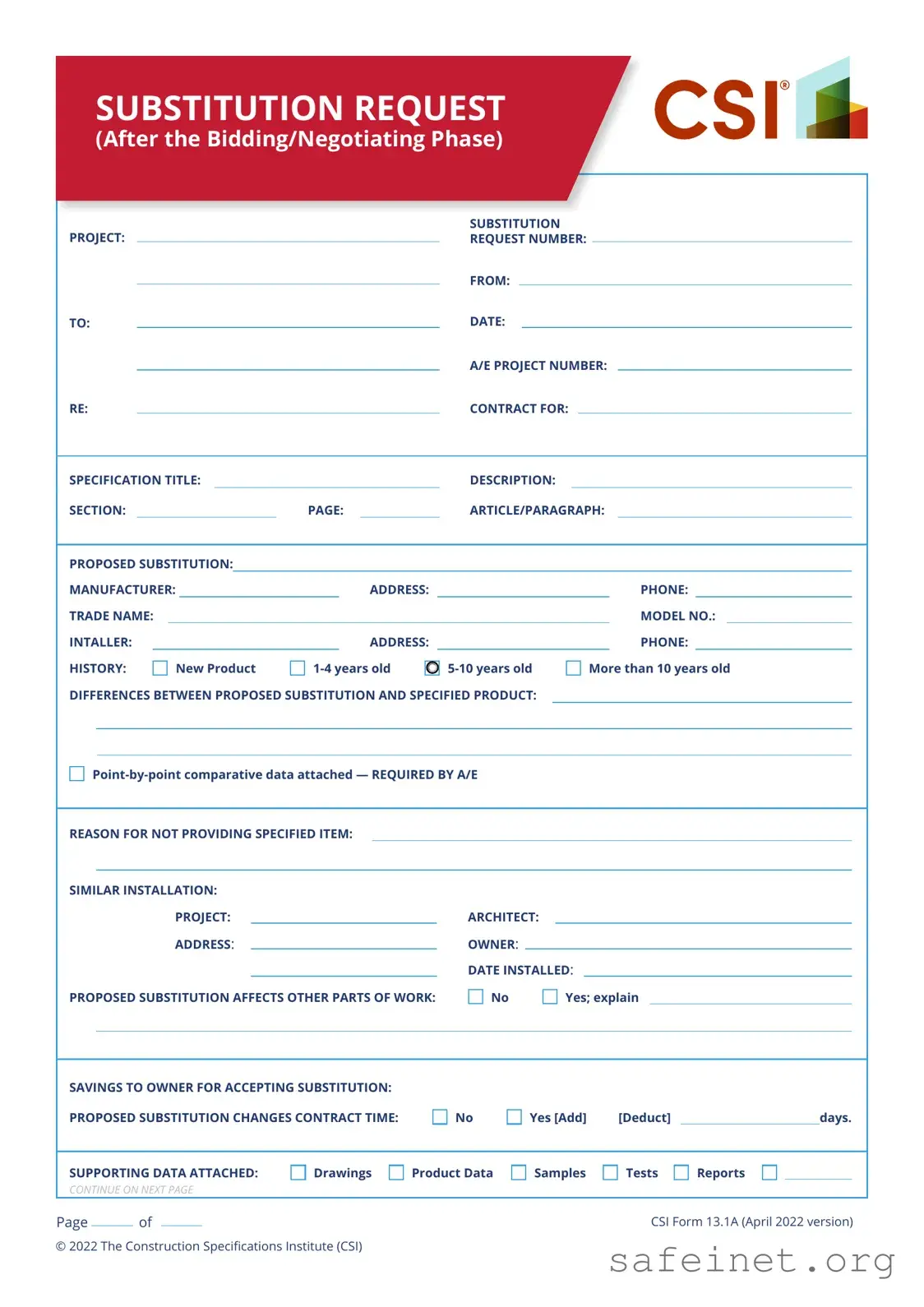
The Csi 13 1A form serves as a critical tool in the construction industry, particularly during the substitution request phase after bidding or negotiating has concluded. This form is designed to facilitate communication between contractors, architects, and owners regarding proposed changes to specified products in a construction project. At its core, the Csi 13 1A form includes essential details such as the project name, substitution request number, and the parties involved. It prompts users to provide comprehensive information about the proposed substitution, including the manufacturer, trade name, and model number. Additionally, it requires a history of the product, ensuring that stakeholders understand the age and reliability of the alternative option. One of the key components is the section dedicated to outlining the differences between the proposed substitution and the originally specified product, which must be supported by comparative data. This form also addresses the implications of the substitution on the overall project, such as potential savings for the owner and any changes to the contract timeline. By including sections for supporting data like drawings and product samples, the Csi 13 1A form ensures that all relevant information is readily available for informed decision-making.
| Fact Name | Description |
|---|---|
| Form Purpose | This form is used to request substitutions after the bidding or negotiating phase of a construction project. |
| Governing Law | The use of this form is governed by the laws applicable in the state where the project is located, typically following the Uniform Commercial Code (UCC) and local construction regulations. |
| Required Attachments | Point-by-point comparative data is mandatory and must be attached for the Architect/Engineer (A/E) to review the proposed substitution. |
| History of Product | The form requires the proposer to indicate the age of the product, ranging from new to over ten years old. |
| Impact on Contract | The proposed substitution may affect the contract time, with options to add or deduct days specified on the form. |
| Owner Savings | Proposers must indicate any potential savings to the owner if the substitution is accepted, providing a clear financial incentive. |
Completing the Csi 13 1A form is an essential step in the process of requesting a substitution after the bidding or negotiating phase of a project. This form requires specific information about the proposed substitution, including details about the product and its manufacturer. Following the steps below will help ensure that the form is filled out accurately and completely.
What is the purpose of the CSI 13 1A form?
The CSI 13 1A form is used to request a substitution for a specified product after the bidding or negotiating phase of a construction project. This form allows contractors to propose alternatives that may better meet the project's needs, whether due to availability, cost, or other factors. It ensures that all parties involved can evaluate the proposed changes systematically.
What information is required to complete the form?
To fill out the CSI 13 1A form, you will need to provide several details. This includes the project name, substitution request number, the names of the parties involved, and the date. Additionally, you must specify the contract details, including the specification title, section, and specific article or paragraph related to the substitution. Information about the proposed substitution, such as the manufacturer, trade name, and model number, is also necessary. Lastly, you must indicate whether the proposed substitution affects other parts of the work and provide any supporting data.
How does the substitution process affect the project timeline?
The proposed substitution may impact the contract time. The form includes a section where you can indicate whether the substitution will add or deduct days from the project timeline. This is crucial for project planning and must be clearly communicated to all stakeholders to avoid delays.
What supporting data should be attached to the form?
When submitting the CSI 13 1A form, it is essential to attach supporting data to justify the substitution. This may include drawings, product data sheets, samples, test results, or reports. Providing comprehensive supporting documentation helps the architect or engineer evaluate the proposed substitution effectively and ensures transparency in the decision-making process.
What happens if the proposed substitution is accepted?
If the proposed substitution is accepted, it may lead to savings for the owner, which should be documented on the form. Acceptance may also require adjustments to the contract terms, including any changes in project timeline or costs. Clear communication and documentation of these changes are vital to maintain project integrity and ensure all parties are aligned.
What should I do if my substitution request is denied?
If your substitution request is denied, you should review the feedback provided by the architect or engineer to understand their reasoning. It may be beneficial to discuss the denial directly with them to explore alternative solutions or to clarify any misunderstandings. If necessary, you can consider submitting another request with additional supporting information or seek a different product that meets the project's specifications.
Incomplete Information: Failing to fill out all required fields can lead to delays. Ensure that every section, including project details and substitution specifics, is thoroughly completed.
Missing Attachments: Not providing the necessary supporting documents, such as comparative data or product samples, can result in the request being rejected. Always double-check that all required attachments are included.
Incorrect Contact Information: Providing outdated or incorrect contact details for manufacturers or installers can hinder communication. Verify all phone numbers and addresses before submission.
Neglecting to Explain Differences: Simply stating that a substitution is proposed without detailing how it differs from the specified product can lead to confusion. Include a clear, point-by-point comparison.
Not Addressing Impact on Other Work: If the proposed substitution affects other parts of the project, it’s crucial to indicate this. Ignoring this aspect can complicate project timelines and costs.
Failure to Specify Savings: Not providing an estimated savings amount for the owner can make the substitution less appealing. Clearly state any potential financial benefits associated with the substitution.
Ignoring Contract Time Changes: If the substitution alters the contract timeline, it must be noted. Failing to indicate whether the change adds or deducts days can lead to misunderstandings later.
Overlooking History of the Product: Not indicating the age of the proposed substitution can raise concerns about reliability. Be sure to select the appropriate age category for the product.
The Csi 13 1A form is a substitution request used in construction projects after the bidding or negotiating phase. It helps project teams propose changes to specified products. Along with this form, several other documents are commonly utilized to ensure a smooth process. Below is a list of these documents, along with brief descriptions of each.
These documents work together with the Csi 13 1A form to facilitate effective communication and decision-making throughout the construction process. Each plays a vital role in ensuring that all parties are informed and that the project proceeds smoothly.
The Csi 13 1A form is akin to the Change Order form, which is used to document changes in the scope of work after a contract has been signed. Both documents facilitate communication between parties involved in a construction project. A Change Order specifies the alterations to the original contract, including adjustments in cost and time, similar to how the Csi 13 1A outlines proposed substitutions and their implications. Each form aims to ensure that all parties are on the same page regarding modifications, thereby minimizing disputes and confusion.
Another document that shares similarities with the Csi 13 1A is the Request for Information (RFI). An RFI is often submitted when a contractor needs clarification on project specifications or details. Just as the Csi 13 1A seeks to clarify the substitution of materials, an RFI aims to clarify uncertainties in the project. Both documents serve as formal means of communication, ensuring that any changes or requests are documented and addressed by the architect or owner, fostering transparency throughout the project.
The Submittal form is also comparable to the Csi 13 1A. Submittals are documents that contractors provide to verify that the materials and products they plan to use meet project specifications. Like the Csi 13 1A, which requires details about the proposed substitution, Submittals require specific information about the materials being proposed. Both forms are essential for quality control, ensuring that the project adheres to the standards set forth in the contract documents.
Another related document is the Product Data Sheet. This sheet provides detailed information about a product, including specifications, performance data, and installation instructions. Similar to the Csi 13 1A, which requires manufacturers' information and product comparisons, a Product Data Sheet serves to inform the project team about the characteristics of a proposed substitution. Both documents aim to provide a clear understanding of the products being used, helping stakeholders make informed decisions.
Lastly, the Certificate of Substantial Completion has a connection with the Csi 13 1A form, as both are integral to the project’s lifecycle. The Certificate of Substantial Completion indicates that a project is sufficiently complete to be used for its intended purpose. While the Csi 13 1A focuses on proposed changes during the construction phase, both documents ultimately contribute to the successful completion and acceptance of the project. They ensure that any modifications are documented and approved, allowing for a smooth transition to project completion.
When filling out the Csi 13 1A form, attention to detail is crucial. Here are some guidelines to follow and avoid:
Following these guidelines can help ensure a smoother process for your substitution request.
Here are four common misconceptions about the CSI 13 1A form, along with clarifications to help you understand its purpose and use.
Many believe the CSI 13 1A form is limited to new products. In reality, it can also be used for products that are 1-4 years old, 5-10 years old, or even more than 10 years old. This flexibility allows for a broader range of substitutions.
Some think that submitting the form guarantees approval. However, the architect or engineer must review each request. They will consider how the proposed substitution aligns with the project's specifications and requirements.
It's a common belief that supporting data can be skipped. In fact, attaching the necessary documentation, like comparative data, is required by the architect or engineer. This helps them make informed decisions about the substitution.
Many assume that using the CSI 13 1A form has no impact on project timelines. However, if a proposed substitution changes contract time, it must be clearly indicated on the form. This ensures that everyone is aware of any potential delays or adjustments.
When filling out and using the Csi 13 1A form, there are several important points to consider. Here are some key takeaways: