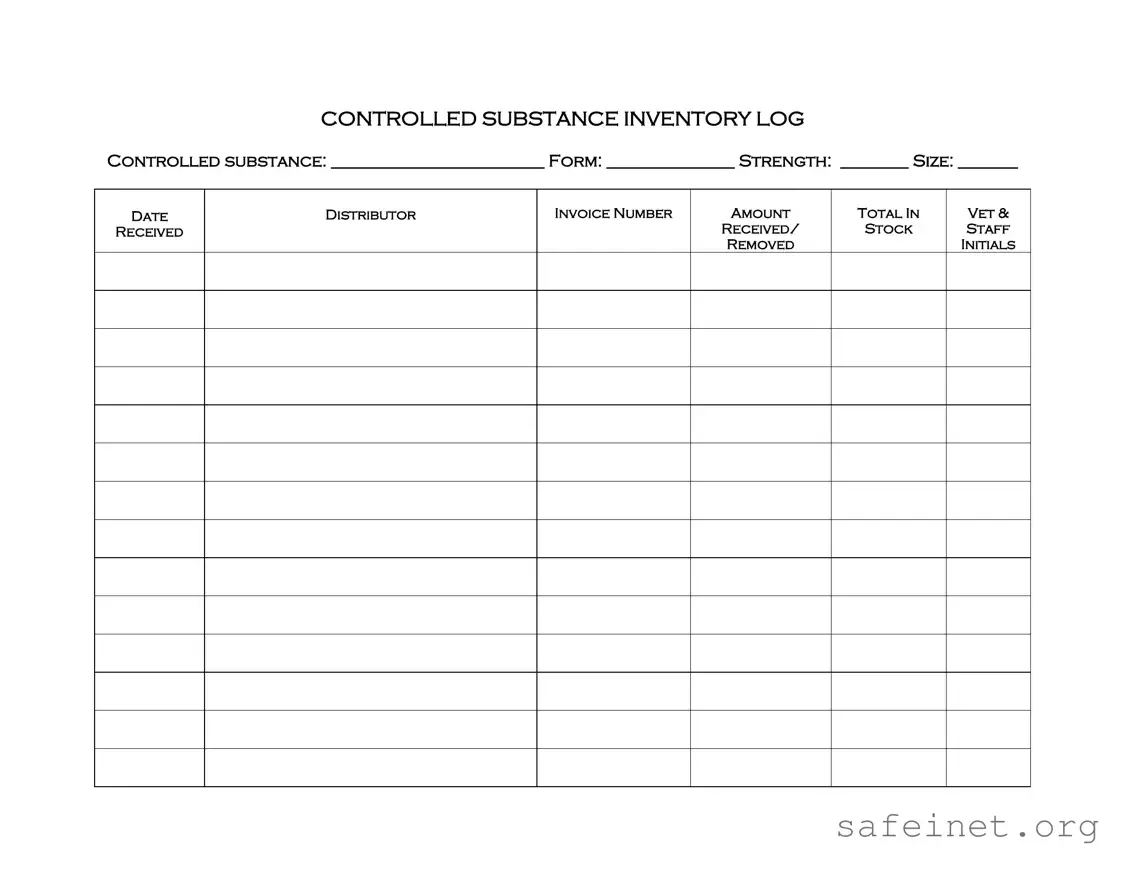
The Controlled Drug Log form serves as an essential tool for managing and tracking controlled substances within various settings, particularly in veterinary practices and healthcare facilities. This form captures critical information about each controlled substance, including the name of the drug, its specific form, strength, and size. Additionally, it records the date the substance was received, the distributor from whom it was obtained, and the corresponding invoice number. The log also tracks the amount received and the total stock available, ensuring that facilities maintain accurate inventory levels. Each entry requires the initials of the staff member responsible for the removal of the substance, promoting accountability and compliance with regulatory standards. By maintaining a thorough record through this log, organizations can enhance their oversight of controlled substances, thereby supporting safety and legal compliance in their operations.
| Fact Name | Description |
|---|---|
| Purpose | The Controlled Drug Log form tracks the inventory of controlled substances in a facility. |
| Required Information | It must include the controlled substance name, form, strength, size, and other relevant details. |
| Date Entry | Each entry must include the date the substance was received or removed from stock. |
| Distributor Information | The form requires the name of the distributor and the corresponding invoice number. |
| Amount Tracking | The amount received and the total stock must be clearly documented. |
| Staff Initials | Staff members must initial the log when substances are received or removed. |
| Regulatory Compliance | This log helps ensure compliance with federal and state regulations governing controlled substances. |
| State-Specific Forms | Some states may have specific forms or additional requirements for tracking controlled substances. |
| Governing Laws | Controlled substances are regulated under the Controlled Substances Act (CSA) and state laws. |
| Retention Period | Records must typically be retained for a specified period, often 2-5 years, depending on state law. |
Filling out the Controlled Drug Log form is straightforward. This form helps track the use and distribution of controlled substances in your facility. Follow these steps to ensure accurate documentation.
What is the purpose of the Controlled Drug Log form?
The Controlled Drug Log form is designed to help healthcare facilities, such as veterinary clinics or hospitals, track the inventory of controlled substances. This ensures that all drugs are accounted for, helping to prevent misuse and ensuring compliance with regulations.
What information is required on the form?
The form requires several key pieces of information: the name of the controlled substance, its form (e.g., liquid, tablet), strength, size, date of receipt, distributor information, invoice number, amount received, and the initials of the staff member who received and removed the drug. This detailed tracking helps maintain accurate records.
Who is responsible for filling out the Controlled Drug Log?
How often should the Controlled Drug Log be updated?
What should be done if there is a discrepancy in the log?
If a discrepancy is discovered, it is essential to investigate immediately. Review the log for accuracy, check for any missed entries, and verify with the staff involved. Document any findings and corrective actions taken. Depending on the severity of the discrepancy, it may also be necessary to report it to the appropriate regulatory authorities.
Is the Controlled Drug Log form a legal document?
How long should records from the Controlled Drug Log be kept?
Can the Controlled Drug Log be maintained electronically?
Failing to accurately record the controlled substance name can lead to discrepancies in inventory. This mistake can complicate audits and compliance checks.
Not including the invoice number when documenting a receipt may create challenges in tracing the source of the drugs. This oversight can hinder accountability.
Omitting the date of receipt is another common error. Without a proper date, it becomes difficult to track the timeline of drug usage and ensure proper management.
Neglecting to have the staff initials recorded can lead to confusion regarding who handled the substances. This lack of clarity can affect responsibility and oversight.
The Controlled Drug Log form is essential for tracking the use and distribution of controlled substances. However, it is often accompanied by several other forms and documents that help maintain compliance and ensure accurate record-keeping. Below is a list of these important documents.
Each of these documents plays a critical role in the responsible management of controlled substances. Keeping accurate and complete records not only fulfills legal obligations but also enhances patient safety and trust in healthcare practices.
The Controlled Substance Inventory Log serves a similar purpose to the Medication Administration Record (MAR). Both documents track the administration and inventory of medications, ensuring accurate records are kept for patient safety. The MAR focuses on documenting when and how medications are given to patients, while the Controlled Substance Inventory Log emphasizes the management and accountability of controlled substances specifically.
Another document that shares similarities is the Prescription Record. This record details the prescriptions written for patients, including the type of medication, dosage, and quantity. Like the Controlled Drug Log, it requires careful tracking to prevent misuse and to ensure compliance with regulations. Both documents are essential for maintaining the integrity of medication management within healthcare settings.
The Inventory Management Log also aligns closely with the Controlled Drug Log. This log helps organizations keep track of all medications, including controlled substances. It records when stock is received, how much is used, and when it needs to be reordered. Both documents aim to ensure that medication supplies are adequately monitored and maintained.
Similar to the Controlled Substance Inventory Log is the Drug Utilization Review (DUR) report. The DUR evaluates the appropriateness of prescribed medications based on patient history and current prescriptions. While the Controlled Drug Log focuses on inventory management, the DUR assesses the effectiveness and safety of medication use, ensuring that patients receive the best possible care.
The Incident Report can also be compared to the Controlled Substance Inventory Log. This document records any discrepancies or issues related to medication administration or inventory. Both documents are crucial for identifying and addressing potential problems, ensuring that healthcare providers can maintain safe and effective practices.
Another related document is the Medication Reconciliation Form. This form is used during patient transitions, such as hospital admissions or discharges, to ensure that all medications are accounted for. Like the Controlled Drug Log, it helps prevent medication errors and ensures that patients receive the correct medications throughout their care journey.
The Drug Accountability Record is another document that bears resemblance to the Controlled Drug Log. This record tracks the receipt, administration, and disposal of controlled substances within a facility. Both documents serve to enhance accountability and transparency in medication management, reducing the risk of misuse or diversion.
The Supply Chain Management Log also parallels the Controlled Drug Log. This log tracks the flow of medications through a healthcare facility, from ordering to administration. Both documents ensure that proper procedures are followed and that controlled substances are monitored throughout their lifecycle.
The Audit Trail Report is another document that aligns with the Controlled Drug Log. This report provides a detailed history of all transactions involving controlled substances, including who accessed them and when. Both documents are vital for compliance and accountability, helping organizations maintain high standards in medication management.
Lastly, the Compliance Checklist can be compared to the Controlled Drug Log. This checklist is used to ensure that all procedures related to controlled substances are being followed correctly. While the Controlled Drug Log focuses on inventory specifics, the Compliance Checklist provides a broader overview of adherence to regulations and best practices within the organization.
When filling out the Controlled Drug Log form, it's essential to be meticulous and follow best practices to ensure compliance and accuracy. Here are some important dos and don'ts to keep in mind:
Misconceptions about the Controlled Drug Log form can lead to confusion and improper handling of controlled substances. Here are four common misconceptions, along with clarifications to enhance understanding:
This is incorrect. The Controlled Drug Log form is required for all controlled substances, regardless of their specific classification. Proper documentation ensures accountability and compliance with regulations.
In reality, all staff members involved in the handling, administration, or disposal of controlled substances must participate in the logging process. This collective responsibility promotes safety and transparency.
This is misleading. The Controlled Drug Log form should be completed immediately upon receipt or administration of the drug. Timely documentation helps maintain accurate records and reduces the risk of errors.
Contrary to this belief, regular reviews of the log are essential. Periodic checks can identify discrepancies and ensure that all entries are accurate, fostering a culture of accountability and compliance.
When managing controlled substances, accuracy and diligence are essential. The Controlled Drug Log form is a critical tool in tracking these substances. Here are some key takeaways to consider when filling out and using this form:
By following these guidelines, you can effectively manage controlled substances and maintain compliance with regulatory requirements.