Homepage > Blank Contract For Deed Template
Article Structure

The Contract For Deed serves as a pivotal document in real estate transactions, particularly when traditional financing options may not be accessible. This agreement outlines the terms under which a seller agrees to convey property to a purchaser while allowing the latter to make payments over time, rather than requiring a lump sum at the outset. Central to this contract are several key components: the sale of property, which details the specific location and description of the real estate involved; the purchase price and terms, which stipulate the total cost and the payment structure—whether through monthly installments or a balloon payment; and the essential clause that emphasizes the importance of timely payments, ensuring that all parties adhere to the agreed-upon schedule. Additionally, the contract addresses the maintenance responsibilities of the purchaser, the condition of the property at the time of sale, and the obligations regarding taxes and insurance. This comprehensive approach protects both the seller's interests and the purchaser's rights, establishing a clear framework for ownership transfer while outlining the responsibilities associated with property upkeep and financial commitments.

Form Sample

- 1 -
Contract for Deed
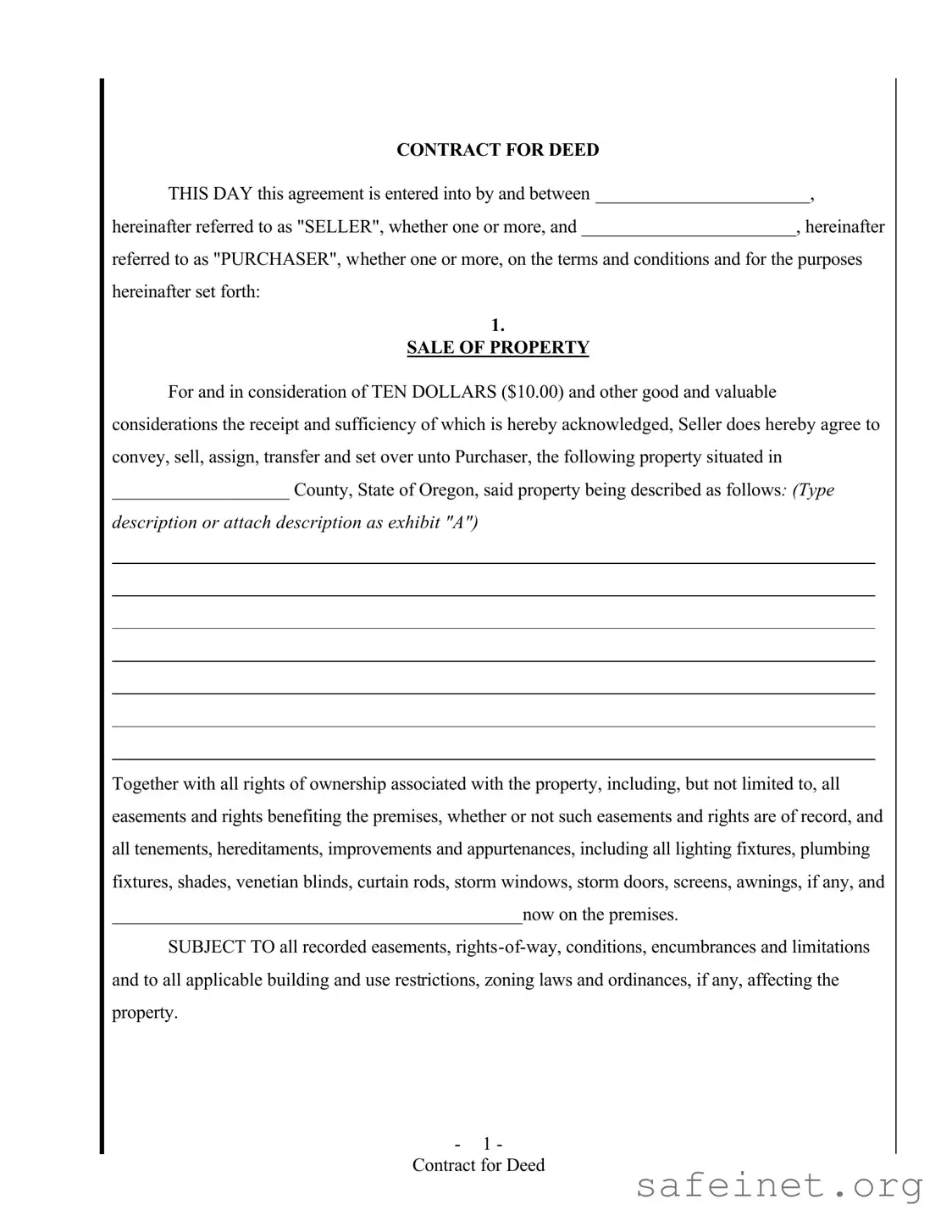
CONTRACT FOR DEED
THIS DAY this agreement is entered into by and between _______________________,
hereinafter referred to as "SELLER", whether one or more, and _______________________, hereinafter
referred to as "PURCHASER", whether one or more, on the terms and conditions and for the purposes
hereinafter set forth:
1.
SALE OF PROPERTY
For and in consideration of TEN DOLLARS ($10.00) and other good and valuable
considerations the receipt and sufficiency of which is hereby acknowledged, Seller does hereby agree to
convey, sell, assign, transfer and set over unto Purchaser, the following property situated in
___________________ County, State of Oregon, said property being described as follows: (Type
description or attach description as exhibit "A")
Together with all rights of ownership associated with the property, including, but not limited to, all
easements and rights benefiting the premises, whether or not such easements and rights are of record, and
all tenements, hereditaments, improvements and appurtenances, including all lighting fixtures, plumbing
fixtures, shades, venetian blinds, curtain rods, storm windows, storm doors, screens, awnings, if any, and
____________________________________________now on the premises.
SUBJECT TO all recorded easements, rights-of-way, conditions, encumbrances and limitations
and to all applicable building and use restrictions, zoning laws and ordinances, if any, affecting the
property.
- 2 -
Contract for Deed
2.
PURCHASE PRICE AND TERMS
The purchase price of the property shall be $____________________. The purchaser does
hereby agree to pay to the order of the Seller the sum of ___________________ Dollars
($_______________) upon execution of this agreement, with the balance of $__________________
being due and payable as follows:(Select one)
(a) Balance payable in __________ (_______) monthly installments of ______________
Dollars ($_________) each, with the first installment being due and payable on the ____ day of
_______________, 20____ and a like payment on the first day of each month thereafter until the
______ day of ________________, 20____, when the final payment shall be due. No interest.
(b) Balance payable, together with interest on the whole sum that shall be from time to time
unpaid at the rate of _______ per cent, per annum, payable in the amount of $____________
dollars per month beginning on the _____ day of ____________, 20____ and continuing on the
same day of each month thereafter until fully paid.
(c) Balance payable, together with interest on the whole sum that shall be from time to time
unpaid at the rate of _______ per cent, per annum, payable in the amount of
_____________________ dollars per month beginning on the ________ day of
_______________, 20____, and continuing on the same day of each month thereafter until the
______ day of _______________, 20____, when all remaining principal and interest shall be
paid. (Balloon payment)
If interest is charged, interest shall be computed monthly and deducted from payment and the
balance of payment shall be applied on principal.
3.
TIME OF THE ESSENCE
Time is of the essence in the performance of each and every term and provision in this agreement
by Purchaser.
- 3 -
Contract for Deed
4.
SECURITY
This contract shall stand as security of the payment of the obligations of Purchaser.
5.
MAINTENANCE OF IMPROVEMENTS
All improvements on the property, including, but not limited to, buildings, trees or other
improvements now on the premises, or hereafter made or placed thereon, shall be a part of the security
for the performance of this contract and shall not be removed there from. Purchaser shall not commit, or
suffer any other person to commit, any waste or damage to said premises or the appurtenances and shall
keep the premises and all improvements in as good condition as they are now.
6.
CONDITION OF IMPROVEMENTS
Purchaser agrees that the Seller has not made, nor makes any representations or warranties as to
the condition of the premises, the condition of the buildings, appurtenances and fixtures locate thereon,
and/or the location of the boundaries. Purchaser accepts the property in its "as-is" condition without
warranty of any kind.
7.
POSSESSION OF PROPERTY
Purchaser shall take possession of the property and all improvements thereon upon execution of
this contract and shall continue in the peaceful enjoyment of the property so long as all payments due
under the terms of this contract are timely made. Purchaser agrees to keep the property in a good state of
repair and in the event of termination of this contract, Purchaser agrees to return the property to Seller in
substantially the same condition as it now exists, ordinary wear and tear excepted. Seller reserves the
right to inspect the property at any time with or without notice to Purchaser.
8.
TAXES, INSURANCE AND ASSESSMENTS
Taxes and Assessments: During the term of this contract:(Select one)
- 4 -
Contract for Deed
(a) Purchaser shall pay all taxes and assessments levied against the property.
(b) Seller shall pay all taxes and assessments levied against the property. In the event that
Seller pays the taxes and insurance, Purchaser shall reimburse Seller for same upon 30 days
notice to purchaser.
Content Insurance: Purchaser shall be solely responsible for obtaining insurance of the
contents, insuring contents owned by Purchaser. Seller shall be solely responsible for obtaining
insurance on all contents owned by Seller.
Liability and Hazard Insurance: Liability insurance shall be maintained by Purchaser during
the term of this contract naming Seller as an additional insured, in the amount of not less than
$________________.
Fire, Hazard and Windstorm insurance: Fire, hazard and windstorm insurance shall be
maintained as follows: (Select one)
(a) Purchaser shall obtain fire, hazard and windstorm insurance in the amount not less than
$_______________, on a policy of insurance naming Seller as additional insured.
(b) Seller shall obtain and pay for hazard, fire and windstorm insurance in an amount not less
than $ _________________. In the event Seller elects this option, Purchaser shall repay the
amount so paid by Seller within thirty (30) days of demand for same by Seller.
Should the Purchaser fail to pay any tax or assessment, or installment thereof, when due, or keep
said buildings insured, Seller may pay the same and have the buildings insured, and the amounts thus
expended shall be a lien on said premises and may be added to the balance then unpaid, or collected by
Seller, in the discretion if Seller with interest until paid at the rate of the ______________ per cent per
annum.
In case of any damage as a result of which said insurance proceeds are available, the Purchaser
may, within sixty (60) days of said loss or damage, give to the Seller written notice of Purchaser’s
election to repair or rebuild the damaged parts of the premises, in which event said insurance proceeds
shall be used for such purpose. The balance of said proceeds, if any, which remain after completion of
said repairing or rebuilding, or all of said insurance proceeds if the Purchaser elects not to repair or
rebuild, shall be applied first toward the satisfaction of any existing defaults under the terms of this
contract, and then as a prepayment upon the principal balance owing. No such prepayment shall defer
the time for payment of any remaining payments required by said contract. Any surplus of said proceeds
- 5 -
Contract for Deed
in excess of the balance owing hereon shall be paid to the Purchaser.
- 6 -
Contract for Deed
9.
DEFAULT
If the Purchaser shall fail to perform any of the covenants or conditions contained in this contract
on or before the date on which the performance is required, the Seller shall give Purchaser notice of
default or performance, stating the Purchaser is allowed fourteen (14) days from the date of the Notice to
cure the default or performance. In the event the default or failure of performance is not cured within the
14 day time period, then Seller shall have any of the following remedies, in the discretion of Seller:
(a) give the Purchaser a written notice specifying the failure to cure the default and informing
the Purchaser that if the default continues for a period of an additional fifteen (15) days after
service of the notice of failure to cure, that without further notice, this contract shall stand
cancelled and Seller may regain possession of the property as provided herein; or
(b) give the Purchaser a written notice specifying the failure to cure the default and informing
the Purchaser that if the default continues for a period of an additional fifteen (15) days after
service of the notice of failure to cure, that without further notice, the entire principal balance and
unpaid interest shall be immediately due and payable and Seller may take appropriate action
against Purchaser for collection of same according to the laws of the State of
____________________.
In the event of default in any of the terms and conditions or installments due and payable under
the terms of this contract and Seller elects 9(a), Seller shall be entitled to immediate possession of the
property.
In the event of default and termination of the contract by Seller, Purchaser shall forfeit any and all
payments made under the terms of this contract including taxes and assessments as liquidated damages,
Seller shall be entitled to recover such other damages as they may be due which are caused by the acts or
negligence of Purchaser.
The parties expressly agree that in the event of default not cured by the Purchaser and termination
of this agreement, and Purchaser fails to vacate the premises, Seller shall have the right to obtain
possession by appropriate court action.
- 7 -
Contract for Deed
10.
DEED AND EVIDENCE OF TITLE
Upon total payment of the purchase price and any and all late charges, and other amounts due
Seller, Seller agrees to deliver to Purchaser a Warranty Deed to the subject property, at Seller’s
expense, free and clear of any liens or encumbrances other than taxes and assessments for the current
year.
11.
NOTICES
All notices required hereunder shall be deemed to have been made when deposited in the U. S.
Mail, postage prepaid, certified, return receipt requested, to the Purchaser or Seller at the addresses
listed below. All notices required hereunder may he sent to:
Seller:
Purchaser:
and when mailed, postage prepaid, to said address, shall be binding and conclusively presumed to be
served upon said parties respectively.
12.
ASSIGNMENT OR SALE
Purchaser shall not sell, assign, transfer or convey any interest in the subject property or this
agreement, without first securing the written consent of the Seller.
- 8 -
Contract for Deed
13.
PREPAYMENT
Purchaser to have the right to prepay, without penalty, the whole or any part of the balance
remaining unpaid on this contract at any time before the due date.
14.
ATTORNEY FEES
In the event of default, Purchaser shall pay to Seller, Seller's reasonable and actual attorneys'
fees and expenses incurred by Seller in enforcement of any rights of Seller. All attorney fees shall be
payable prior to Purchaser's being deemed to have corrected any such default.
15.
LATE PAYMENT CHARGES
If Purchaser shall fail to pay, within fifteen (15) days after due date, any installment due
hereunder, Purchaser shall be required to pay an additional charge of five (5%) percent of the late
installment. Such charge shall be paid to Seller at the time of payment of the past due installment.
16.
CONVEYANCE OR MORTGAGE BY SELLER
If the Seller's interest is now or hereafter encumbered by mortgage, the Seller covenants that
Seller will meet the payments of principal and interest thereon as they mature and produce evidence
thereof to the Purchaser upon demand. In the event the Seller shall default upon any such mortgage or
land contract, the Purchaser shall have the right to do the acts or make the payments necessary to cure
such default and shall be reimbursed for so doing by receiving, automatically, credit to this contract to
apply on the payments due or to become due hereon.
The Seller reserves the right to convey, his or her interest in the above described land and such
conveyance hereof shall not be a cause for rescission but such conveyance shall be subject to the terms
of this agreement.
- 9 -
Contract for Deed
The Seller may, during the lifetime of this contract, place a mortgage on the premises above
described, which shall be a lien on the premises, superior to the rights of the Purchaser herein, or may
continue and renew any existing mortgage thereon, provided that the aggregate amount due on all
outstanding mortgages shall not at any time be greater than the unpaid balance of the contract.
17.
ENTIRE AGREEMENT
This Agreement embodies and constitutes the entire understanding between the parties with
respect to the transactions contemplated herein. All prior or contemporaneous agreements,
understandings, representations, oral or written, are merged into this Agreement.
18.
AMENDMENT WAIVERS
This Agreement shall not be modified, or amended except by an instrument in writing signed by
all parties.
No delay or failure on the part of any party hereto in exercising any right, power or privilege
under this Agreement or under any other documents furnished in connection with or pursuant to this
Agreement shall impair any such right, power or privilege or be construed as a waiver of any default or
any acquiescence therein. No single or partial exercise of any such right, power or privilege shall
preclude the further exercise of such right, power or privilege, or the exercise of any other right, power
or privilege. No waiver shall be valid against any party hereto unless made in writing and signed by the
party against whom enforcement of such waiver is sought and then only to the extent expressly specified
therein.
19.
SEVERABILITY
If any one or more of the provisions contained in this Agreement shall be held illegal or
unenforceable by a court, no other provisions shall be affected by this holding. The parties intend that in
the event one or more provisions of this agreement are declared invalid or unenforceable, the remaining
- 10 -
Contract for Deed
provisions shall remain enforceable and this agreement shall be interpreted by a Court in favor of
survival of all remaining provisions.
20.
HEADINGS
Section headings contained in this Agreement are inserted for convenience of reference only,
shall not be deemed to be a part of this Agreement for any purpose, and shall not in any way define or
affect the meaning, construction or scope of any of the provisions hereof.
21.
PRONOUNS
All pronouns and any variations thereof shall be deemed to refer to the masculine, feminine,
neuter, singular, or plural, as the identity of the person or entity may require. As used in this agreement:
(1) words of the masculine gender shall mean and include corresponding neuter words or words of the
feminine gender, (2) words in the singular shall mean and include the plural and vice versa, and (3) the
word "may" gives sole discretion without any obligation to take any action.
22.
JOINT AND SEVERAL LIABILITY
All Purchasers, if more than one, covenants and agrees that their obligations and liability shall be
joint and several.
23.
PURCHASER’S RIGHT TO REINSTATE AFTER ACCELERATION
If Purchaser defaults and the loan is accelerated, then Purchaser shall have the right of
reinstatement as allowed under the laws of the State of Oregon, provided that Purchaser: (a) pays Lender
all sums which then would be due under this agreement as if no acceleration had occurred; (b) cures any
default of any other covenants or agreements; and (c) pays all expenses incurred in enforcing this
agreement, including, but not limited to, reasonable attorneys' fees, and other fees incurred for the
purpose of protecting Seller's interest in the Property and rights under this agreement. Seller may require
that Purchaser pay such reinstatement sums and expenses in one or more of the following forms, as

Document Specifications

Fact Name Description
Definition A Contract for Deed is an agreement where the seller finances the purchase of property, allowing the buyer to make payments directly to the seller.
Parties Involved The agreement involves two main parties: the Seller and the Purchaser, who may be individuals or entities.
Purchase Price The total purchase price is specified in the contract, along with the payment terms, which can include monthly installments or a balloon payment.
Security Interest The contract serves as security for the Purchaser's payment obligations, meaning the Seller retains a claim to the property until paid in full.
Property Condition The Purchaser accepts the property "as-is," indicating that the Seller makes no warranties regarding the condition of the property.
Possession Rights The Purchaser gains possession of the property upon signing the contract but must maintain timely payments to retain this right.
Taxes and Insurance The contract outlines responsibilities for taxes and insurance, specifying whether the Purchaser or Seller will bear these costs.
Governing Law This form is governed by the laws of the state where the property is located, such as Oregon law for properties in Oregon.

Steps to Filling Out Contract For Deed

Once the Contract for Deed form is completed, it should be signed by both the Seller and Purchaser. This document will serve as a legally binding agreement outlining the terms of the property sale. Make sure all information is accurate and complete before finalizing the document.

  1. Fill in the Seller's Name: Write the full name of the Seller(s) in the designated space.
  2. Fill in the Purchaser's Name: Write the full name of the Purchaser(s) in the designated space.
  3. Property Description: Provide a detailed description of the property being sold, or attach an exhibit labeled "A" with the description.
  4. Purchase Price: Enter the total purchase price of the property in the designated space.
  5. Initial Payment: Specify the amount of the initial payment to be made upon signing the contract.
  6. Balance Payment Terms: Choose one of the payment options (a, b, or c) and fill in the relevant details, including payment amounts and due dates.
  7. Time of the Essence: Acknowledge that timely payments are essential by noting this in the agreement.
  8. Security Clause: Understand that this contract serves as security for the payment obligations of the Purchaser.
  9. Maintenance Obligations: Agree to maintain the property and improvements in good condition.
  10. Condition of Property: Acknowledge that the property is accepted in "as-is" condition without any warranties from the Seller.
  11. Possession Clause: Note that the Purchaser will take possession of the property upon execution of the contract.
  12. Tax and Insurance Responsibilities: Select who will be responsible for paying taxes and insurance, and fill in the required amounts.
  13. Signatures: Both the Seller and Purchaser should sign and date the document to finalize the agreement.

More About Contract For Deed

What is a Contract for Deed?

A Contract for Deed is an agreement between a seller and a buyer where the seller finances the purchase of a property. Instead of the buyer getting a mortgage from a bank, the buyer makes payments directly to the seller. Once the buyer pays off the total amount, the seller transfers the title of the property to the buyer.

What are the key components of a Contract for Deed?

The main components include the sale of the property, purchase price and terms, maintenance responsibilities, and conditions regarding taxes and insurance. It also outlines the rights and obligations of both the seller and buyer throughout the agreement.

How is the purchase price determined in a Contract for Deed?

The purchase price is agreed upon by both parties and is typically specified in the contract. The buyer usually pays a portion upfront and then makes monthly payments until the total price is paid off. The contract may also specify whether interest will be charged on the remaining balance.

What happens if the buyer fails to make payments?

If the buyer fails to make payments, the seller may have the right to terminate the contract. This means the seller can reclaim the property, and the buyer may lose any money already paid. It's crucial for buyers to understand their payment obligations clearly.

Can the buyer make improvements to the property?

Yes, the buyer can make improvements to the property. However, the buyer must keep the property in good condition and cannot remove any improvements once made. The property serves as security for the contract, meaning it protects the seller's interests until the buyer fully pays for it.

What does "as-is" condition mean in a Contract for Deed?

When a property is sold in "as-is" condition, it means the seller does not make any promises about the property's condition. The buyer accepts the property with all its flaws and issues. This clause emphasizes the importance of thorough inspections before signing the contract.

Who is responsible for property taxes and insurance?

The contract specifies whether the buyer or seller is responsible for property taxes and insurance. Often, the buyer pays these costs, but the seller may cover them in some cases. If the seller pays, the buyer typically must reimburse the seller after receiving notice.

What rights does the seller have during the contract period?

The seller retains certain rights, including the right to inspect the property and ensure it is well-maintained. The seller also has the right to reclaim the property if the buyer defaults on the contract terms.

How does a buyer obtain the title to the property?

The buyer receives the title to the property once all payments are made according to the contract. Until that point, the seller holds the title as security. This means the buyer has possession and can use the property, but does not own it outright until the contract is fulfilled.

What should buyers consider before entering into a Contract for Deed?

Buyers should carefully review the contract terms, including payment amounts, interest rates, and maintenance responsibilities. It is also wise to assess the property's condition and consider potential risks, such as the possibility of losing the property if payments are missed. Consulting with a real estate professional or attorney can provide valuable guidance.

Common mistakes

  1. Incomplete Property Description: One common mistake is failing to provide a complete and accurate description of the property. This description should be clear and may require an attachment as specified in the form.

  2. Incorrect Purchase Price: Entering the wrong purchase price can lead to misunderstandings. Ensure that the amount is accurately filled in and matches any prior agreements.

  3. Missing Payment Terms: Not selecting or clearly stating the payment terms can create confusion. Be sure to choose one of the options provided for payment structure and fill in the necessary details.

  4. Ignoring Time Requirements: Time is of the essence in this agreement. Failing to adhere to deadlines for payments can result in penalties or contract termination.

  5. Neglecting Maintenance Responsibilities: Purchasers must understand their obligation to maintain the property. Not acknowledging this responsibility can lead to disputes later on.

  6. Overlooking Insurance Obligations: It's essential to specify who will obtain insurance for the property and its contents. Failing to do so can expose either party to financial risk.

  7. Not Addressing Taxes and Assessments: Not clearly stating who is responsible for taxes and assessments can lead to unexpected financial burdens. Make sure this section is completed accurately.

  8. Forgetting to Sign: Finally, one of the simplest yet most critical mistakes is neglecting to sign the document. Both parties must sign for the contract to be valid.

Documents used along the form

When entering into a Contract for Deed, several additional forms and documents may be necessary to ensure a clear understanding and protection for both the seller and the purchaser. These documents help outline the terms of the agreement, clarify responsibilities, and address potential issues that may arise during the transaction. Below is a list of commonly used documents associated with a Contract for Deed.

  • Disclosure Statement: This document provides essential information about the property, including any known defects or issues. It ensures that the purchaser is fully informed before finalizing the agreement.
  • Promissory Note: This is a written promise from the purchaser to pay a specified amount to the seller, detailing the payment terms and conditions. It serves as a formal acknowledgment of the debt incurred through the purchase.
  • Deed of Trust: This document secures the loan by placing a lien on the property, which protects the seller's interest. It outlines the rights and responsibilities of both parties regarding the property until the debt is paid in full.
  • Title Insurance Policy: This insurance protects the purchaser and lender against any potential claims or disputes over property ownership. It ensures that the title is clear and free from encumbrances.
  • Property Inspection Report: Conducting a property inspection can reveal any issues that may need to be addressed before the sale. This report provides a detailed assessment of the property's condition.
  • Insurance Certificates: These documents confirm that the required insurance policies are in place, protecting both the seller and the purchaser from potential liabilities associated with the property.

Having these documents in place can significantly enhance the security and clarity of the transaction. It is advisable for both parties to carefully review each document to ensure a mutual understanding of the terms and obligations involved. This proactive approach can help prevent disputes and foster a smoother transaction process.

Similar forms

The first document similar to a Contract for Deed is a traditional mortgage. Both documents involve a loan secured by real property, where the borrower agrees to repay the lender over time. In a mortgage, the borrower retains title to the property while the lender holds a lien. This means that if the borrower defaults, the lender can foreclose on the property. In contrast, a Contract for Deed allows the seller to retain title until the buyer completes all payments, providing a different structure for ownership and risk management.

A lease-purchase agreement also shares similarities with a Contract for Deed. In both cases, the buyer has the option to purchase the property after a certain period. However, a lease-purchase typically involves renting the property for a set time before the purchase occurs, with a portion of the rent often credited toward the purchase price. This arrangement allows the buyer to live in the home while working toward ownership, unlike the immediate transfer of possession in a Contract for Deed.

An installment sale agreement is another document akin to a Contract for Deed. Both involve a seller financing the sale of a property, where the buyer makes regular payments over time. In an installment sale, the buyer usually receives title upon full payment, while in a Contract for Deed, the seller retains title until all payments are completed. This distinction affects the buyer's rights and the seller's ability to reclaim the property in case of default.

A land contract is closely related to a Contract for Deed, as both are used for the sale of real estate with seller financing. In a land contract, the buyer makes payments directly to the seller and gains equitable title, allowing them to use and improve the property. However, the seller retains legal title until the contract is fulfilled. This arrangement provides the buyer with some rights to the property while also protecting the seller's interests.

A seller-financed mortgage is another document that bears resemblance to a Contract for Deed. In this arrangement, the seller acts as the lender, allowing the buyer to make payments directly to them rather than a traditional bank. While both documents facilitate seller financing, a seller-financed mortgage typically involves a formal mortgage document that grants the seller a lien on the property, whereas a Contract for Deed keeps the title with the seller until full payment is made.

Finally, a quitclaim deed can be considered similar in that it involves the transfer of property rights. However, a quitclaim deed does not involve financing or payment terms like a Contract for Deed. Instead, it serves to transfer whatever interest the grantor has in the property, without any guarantees or warranties. While both documents deal with property ownership, the quitclaim deed is often used to clear up title issues rather than facilitate a sale.

Dos and Don'ts

When filling out the Contract For Deed form, it is essential to approach the process with care and attention to detail. Here are five key things to do and avoid:

  • Do: Ensure all names and addresses are accurately filled in for both the Seller and Purchaser.
  • Do: Clearly describe the property being sold, including any relevant details or attachments.
  • Do: Specify the purchase price and payment terms clearly to avoid confusion later.
  • Do: Review the entire contract for completeness before signing to ensure all sections are properly addressed.
  • Do: Keep a copy of the signed contract for your records after execution.
  • Don't: Leave any sections blank, as this may lead to misunderstandings or disputes.
  • Don't: Assume that verbal agreements are sufficient; everything must be documented in the contract.
  • Don't: Rush through the process; take the time needed to understand each term and condition.
  • Don't: Ignore local laws or regulations that may affect the contract; consult legal advice if needed.
  • Don't: Forget to discuss any specific concerns with the Seller prior to signing.

Misconceptions

Here are five common misconceptions about the Contract For Deed form:

  • It guarantees ownership immediately. Many believe that signing a Contract For Deed means they own the property right away. In reality, ownership is transferred only after all payments are made.
  • There are no risks involved. Some think this arrangement is risk-free. However, if the buyer fails to make payments, the seller can terminate the contract and reclaim the property.
  • It is the same as a traditional mortgage. People often confuse a Contract For Deed with a mortgage. While both involve payments for property, a mortgage typically involves a bank, whereas a Contract For Deed is a direct agreement between buyer and seller.
  • The seller must make repairs. Buyers may assume the seller is responsible for property repairs. However, the buyer usually accepts the property "as-is" and is responsible for its maintenance.
  • Interest is always included. Some believe that all Contracts For Deed include interest. In fact, the terms can vary, and some agreements may specify a no-interest option.

Key takeaways

When filling out and using the Contract For Deed form, keep these key takeaways in mind:

  • Understand the Terms: Clearly outline the purchase price and payment terms. Specify whether payments will be made in installments or as a balloon payment.
  • Condition of Property: The property is sold "as-is." Be aware that the seller makes no warranties regarding the condition of the property or its boundaries.
  • Responsibilities: Determine who is responsible for taxes, insurance, and maintenance. Ensure these responsibilities are clearly defined in the contract.
  • Possession and Repairs: The purchaser takes possession upon signing. They must maintain the property and return it in good condition if the contract ends.