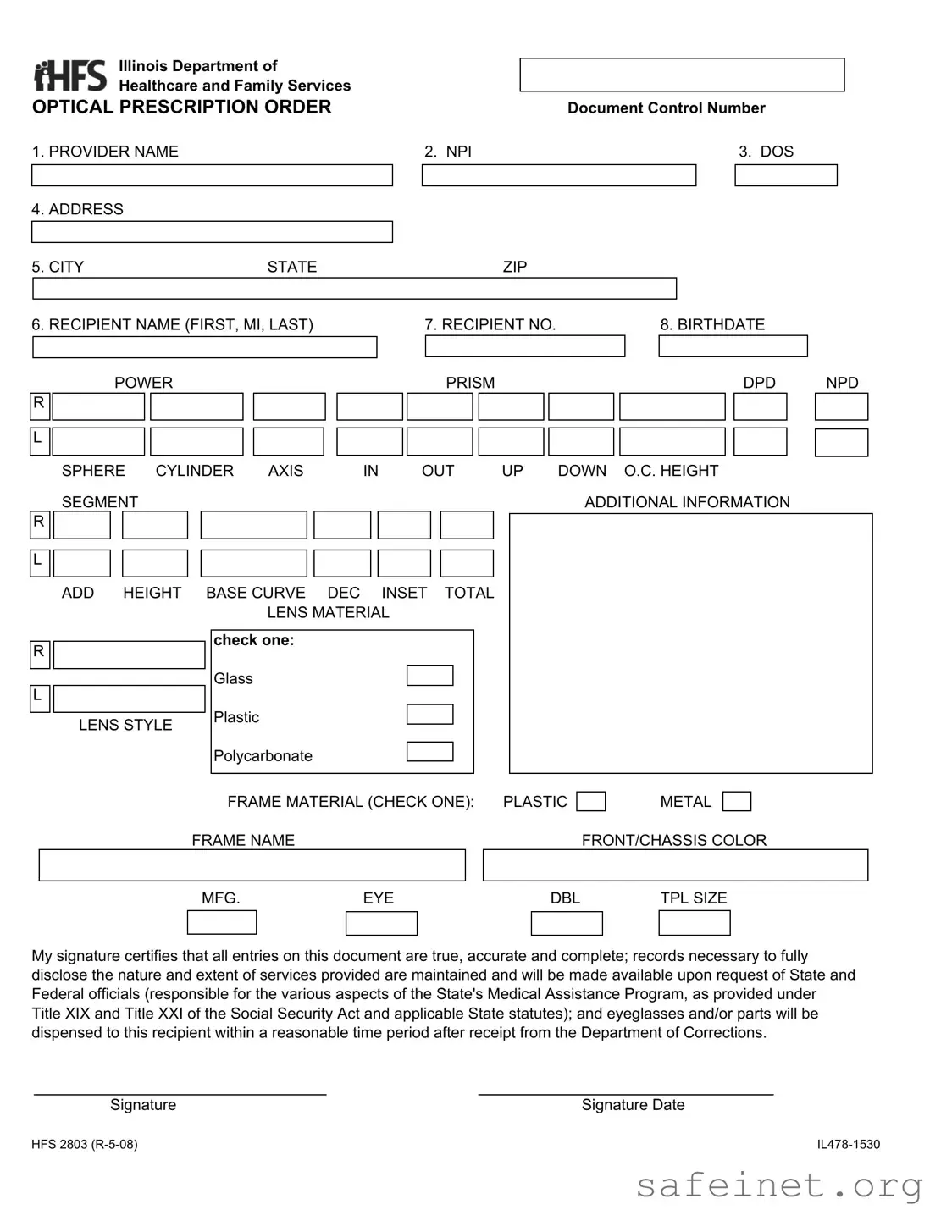
The Contact Lens Prescription form is a crucial document for individuals requiring corrective lenses. It serves multiple purposes, including ensuring that patients receive the correct lenses tailored to their specific vision needs. Key components of the form include the provider's name and National Provider Identifier (NPI), which establish the credentials of the healthcare professional issuing the prescription. Additionally, the form captures essential details about the recipient, such as their name, date of birth, and unique recipient number. Vision parameters are specified, including power, prism, and various measurements like distance between pupils (DPD) and near pupillary distance (NPD), which are vital for accurate lens fitting. The prescription also outlines the specifications for each lens, including sphere, cylinder, and axis measurements for both the right and left eyes. Further sections address lens material options, frame materials, and additional preferences such as frame color and size. To ensure compliance and accountability, the prescriber must sign the form, certifying the accuracy of the information provided and acknowledging the responsibility to maintain records for state and federal review. This comprehensive approach not only facilitates the proper dispensing of contact lenses but also aligns with regulations governing medical assistance programs.
| Fact Name | Description |
|---|---|
| Provider Information | The form requires the provider's name and National Provider Identifier (NPI) for identification purposes. |
| Date of Service | The Date of Service (DOS) must be included to indicate when the prescription was issued. |
| Recipient Details | It is essential to provide the recipient's full name, recipient number, and birthdate for proper record-keeping. |
| Prescription Measurements | Specific measurements such as power, prism, and distances (DPD, NPD) are required for accurate lens fitting. |
| Lens Specifications | The form includes sections for specifying lens material and style, ensuring that the appropriate options are selected. |
| Frame Information | Providers must select the frame material and provide details such as the frame name and color. |
| Signature Requirement | A signature is mandatory, certifying the accuracy of the information provided and compliance with relevant laws. |
| Governing Laws | This form is governed by Title XIX and Title XXI of the Social Security Act and applicable Illinois statutes. |
| Document Control Number | The form includes a Document Control Number for tracking and reference purposes. |
| Compliance with State Programs | Records must be maintained to disclose the nature and extent of services for state medical assistance programs. |
Completing the Contact Lens Prescription form is a straightforward process that requires attention to detail. Each section must be filled out accurately to ensure that the prescription is valid and can be used effectively. Follow the steps below to complete the form correctly.
What is the purpose of the Contact Lens Prescription form?
The Contact Lens Prescription form is used to document the specific requirements for a patient’s contact lenses. It ensures that the lenses prescribed meet the individual's vision needs and complies with healthcare regulations. This form is essential for both healthcare providers and patients to ensure accurate and safe dispensing of contact lenses.
What information do I need to provide on the form?
You will need to fill in several key pieces of information. This includes your provider's name, their National Provider Identifier (NPI), the date of service, and your personal details such as your name, recipient number, and birthdate. Additionally, you will provide specific measurements related to your vision, such as power, prism, and other lens specifications.
Can I use this form for both glasses and contact lenses?
No, this form is specifically designed for contact lenses. If you need a prescription for eyeglasses, a different form should be used. Each type of vision correction has its own requirements and specifications, so it’s important to use the correct documentation.
How do I know if my prescription is accurate?
Your prescription should be verified by your eye care provider before being submitted. They will ensure that all entries are correct and that the prescription meets your individual needs. It's crucial to double-check the measurements and specifications to avoid issues with your contact lenses.
What happens if my prescription is incorrect?
If your prescription is incorrect, it can lead to discomfort or vision problems. You should contact your eye care provider immediately to discuss the issue. They can review your prescription and make any necessary adjustments. It’s important to address this promptly to ensure your eye health and comfort.
Is my signature required on the form?
Yes, your signature is required. By signing the form, you certify that all information provided is true and accurate. This signature also indicates that you understand the terms related to the services provided and that the necessary records will be maintained for review by state and federal officials.
How long does it take to receive my contact lenses after submitting the form?
The timeframe for receiving your contact lenses can vary. Typically, lenses should be dispensed within a reasonable period after the form is submitted. If there are delays, your provider should keep you informed about the status of your order.
What should I do if I have further questions about the form?
If you have additional questions, it’s best to reach out to your eye care provider. They can provide clarification on any part of the form or the prescription process. You can also consult the Illinois Department of Healthcare and Family Services for more information regarding the regulations and requirements.
Failing to include the provider's name and NPI number. This information is essential for verifying the prescription and ensuring it is processed correctly.
Not specifying the lens style or frame material. This oversight can lead to delays in obtaining the correct lenses and frames.
Inaccurate measurements for power, prism, or pupil distance (PD). Such mistakes can result in discomfort or ineffective vision correction.
Omitting the recipient's birthdate or address. These details are crucial for identifying the patient and ensuring proper record-keeping.
The Contact Lens Prescription form is a crucial document for individuals seeking to obtain contact lenses. However, several other forms and documents are often used in conjunction with it to ensure a comprehensive understanding of the patient's needs and the provider's obligations. Below is a list of these associated documents.
These documents collectively enhance the process of obtaining contact lenses, ensuring that patients receive the appropriate care and that providers meet regulatory and professional standards. Each form plays a vital role in the overall experience, contributing to patient satisfaction and safety.
The Contact Lens Prescription form shares similarities with a Medical Prescription form. Both documents serve as official orders from healthcare providers to dispense specific medical items or treatments. In the case of a Medical Prescription, the focus is typically on medications, detailing the drug name, dosage, and administration instructions. Like the Contact Lens Prescription, it requires the provider's information, the patient's details, and a signature to validate the order. Both forms ensure that patients receive the correct treatment based on their unique medical needs.
Another document similar to the Contact Lens Prescription is the Eyeglass Prescription. This document also includes specific measurements and specifications for lenses, such as sphere, cylinder, and axis. Just like the Contact Lens Prescription, it requires the provider's name, the patient's information, and a signature. The Eyeglass Prescription is tailored for glasses rather than contact lenses but shares the same purpose of ensuring proper vision correction for the patient.
The Optical Dispensing Order is another document that resembles the Contact Lens Prescription. This order is used by optical dispensers to provide eyewear based on prescriptions. It includes details about the frame and lens specifications, similar to the Contact Lens Prescription's focus on lens type and fit. Both documents require the provider’s endorsement to confirm that the specifications meet the patient's needs.
A Vision Therapy Prescription is also akin to the Contact Lens Prescription. This document outlines specific therapeutic interventions designed to improve visual skills and processing. Like the Contact Lens Prescription, it requires the provider's details, patient information, and a signature. Both documents are essential for ensuring that patients receive appropriate care tailored to their visual requirements.
The Low Vision Evaluation Report is another document that shares characteristics with the Contact Lens Prescription. This report assesses a patient's visual capabilities and recommends aids or therapies to enhance their vision. Both documents require detailed patient information and provider signatures. They serve to document the patient's condition and the recommended course of action to improve visual function.
Similarly, a Hearing Aid Prescription can be compared to the Contact Lens Prescription. This document specifies the type and specifications of hearing aids required for a patient. Like the Contact Lens Prescription, it includes the provider's information and patient details. Both documents aim to provide necessary medical devices that cater to the individual needs of the patient.
Lastly, the Orthotic Prescription is comparable to the Contact Lens Prescription. This document is used to order custom orthotic devices for patients with specific foot or mobility issues. It includes details about the patient and the required specifications for the orthotic device, similar to how the Contact Lens Prescription outlines lens specifications. Both documents are crucial for ensuring that patients receive the appropriate aids to improve their quality of life.
When filling out the Contact Lens Prescription form, attention to detail is crucial. Below are some important dos and don'ts to keep in mind.
Understanding the Contact Lens Prescription form is essential for anyone seeking to obtain contact lenses. However, several misconceptions can lead to confusion. Here are four common misunderstandings:
By clarifying these misconceptions, individuals can better navigate the process of obtaining a contact lens prescription and ensure they receive the appropriate care for their vision needs.
Filling out a Contact Lens Prescription form is an important task that requires attention to detail. Here are some key takeaways to ensure you complete it accurately and effectively:
By keeping these points in mind, you can navigate the process of completing the Contact Lens Prescription form with confidence. Attention to detail will not only help in compliance but also in providing the best care for the recipient.