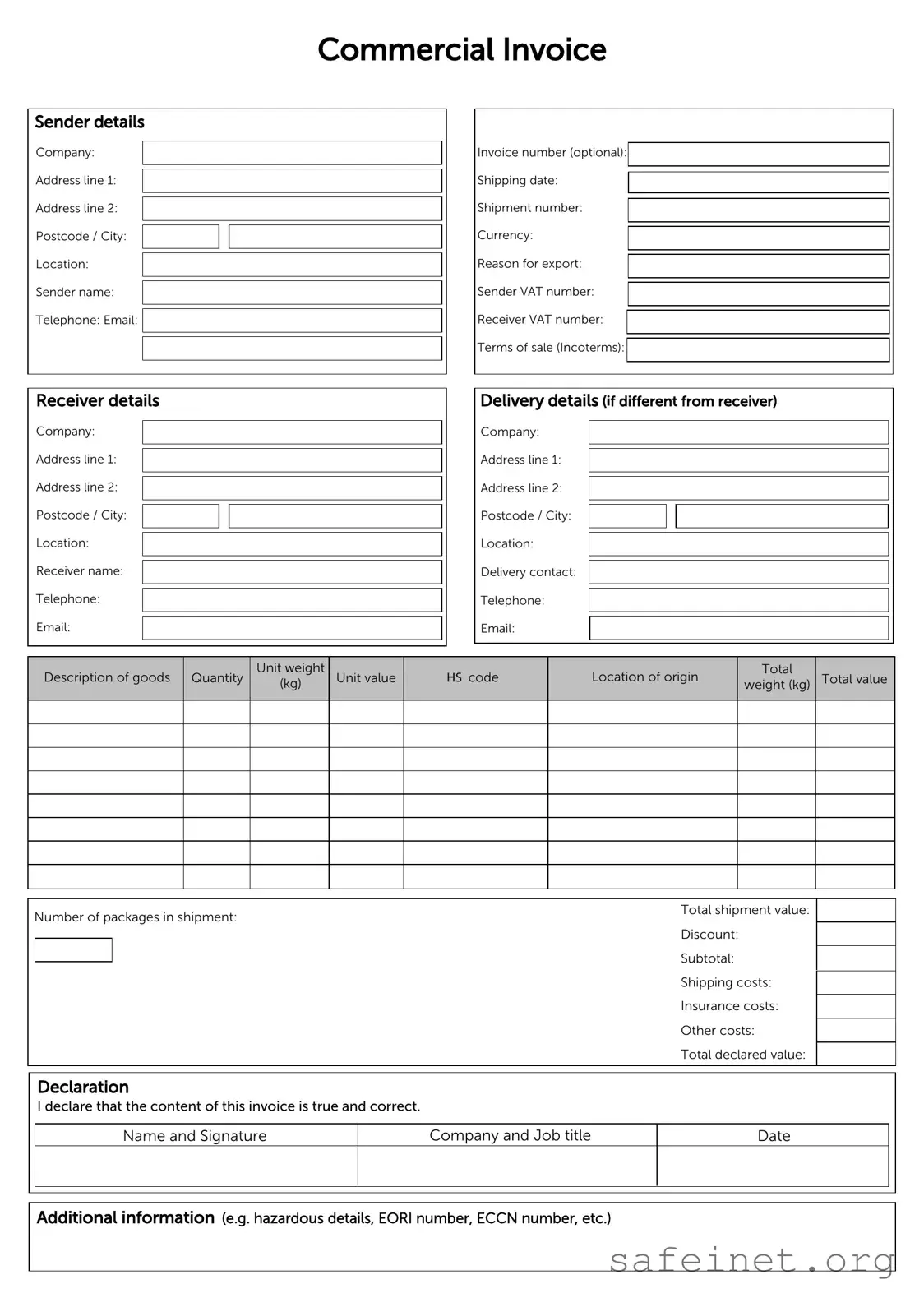
The Commercial Invoice form serves as a crucial document in international trade, facilitating the exchange of goods across borders. This form not only outlines the details of the transaction but also provides essential information about the parties involved, including the buyer and seller. Key components of the Commercial Invoice include a description of the goods being shipped, their value, and the terms of sale. Additionally, it often specifies the country of origin, which can impact tariffs and duties. Accurate completion of this form is vital for customs clearance, as it helps authorities assess the legitimacy of the transaction and determine any applicable taxes. Furthermore, the Commercial Invoice may include shipping details, such as the method of transport and the destination address, ensuring that the goods reach their intended location without unnecessary delays. Overall, understanding the intricacies of the Commercial Invoice is essential for businesses engaged in global commerce, as it not only aids in compliance with legal requirements but also enhances the efficiency of the shipping process.
| Fact Name | Description | Governing Law |
|---|---|---|
| Purpose | A Commercial Invoice is used for international trade. It details the goods sold, their value, and terms of sale. | Uniform Commercial Code (UCC) |
| Required Information | The form must include the seller's and buyer's information, item descriptions, quantities, and prices. | International Commercial Terms (Incoterms) |
| Currency | Invoices should specify the currency used for the transaction. This helps avoid confusion in payment. | Federal Trade Regulations |
| Legal Significance | A Commercial Invoice serves as a legal document for customs clearance and may be used in disputes. | U.S. Customs and Border Protection Regulations |
Filling out a Commercial Invoice form is an essential step in the shipping process. This document serves as a detailed record of the transaction between the seller and buyer, outlining the goods being shipped. After completing the form, it will be used for customs clearance, ensuring that all necessary information is available for a smooth shipping experience.
What is a Commercial Invoice?
A Commercial Invoice is a document that provides a detailed account of the goods being sold. It is used primarily for customs purposes when shipping internationally. This invoice includes information such as the buyer and seller's contact details, a description of the goods, their value, and the terms of sale. It acts as a receipt for the buyer and is essential for the seller to receive payment and for customs authorities to assess duties and taxes.
Why is a Commercial Invoice important?
The Commercial Invoice is crucial for several reasons. First, it ensures that both the buyer and seller have a clear understanding of the transaction. Second, it is required by customs authorities to determine the duties and taxes applicable to the shipment. Without it, shipments can be delayed or even rejected at customs. Furthermore, it serves as a legal document that can be used in case of disputes regarding the transaction.
What information should be included on a Commercial Invoice?
When filling out a Commercial Invoice, it is important to include specific information. This includes the names and addresses of both the buyer and seller, a detailed description of the goods, the quantity, the value of each item, and the total value of the shipment. Additionally, you should include the terms of sale, payment terms, and any relevant shipping details. Accurate and complete information helps to ensure smooth processing at customs.
How do I complete a Commercial Invoice?
Completing a Commercial Invoice involves filling out the required fields with accurate information. Start by entering the seller's and buyer's details at the top of the form. Then, provide a detailed description of each item being sold, including the quantity and unit price. Make sure to calculate the total value of the goods. Lastly, review the invoice for accuracy and ensure that all necessary signatures are included before sending it with your shipment.
Can I use a Commercial Invoice for personal shipments?
Yes, a Commercial Invoice can be used for personal shipments, especially if you are sending goods internationally. Even if the items are not for resale, customs authorities may still require this document to assess any applicable duties and taxes. It is important to accurately describe the items and their value, regardless of whether the shipment is personal or commercial.
What should I do if I make a mistake on the Commercial Invoice?
If you notice a mistake on the Commercial Invoice after it has been completed, it is best to correct it immediately. If the invoice has not yet been submitted to customs, you can simply make the correction and reprint the invoice. However, if it has already been submitted, you may need to contact customs to explain the error and provide a corrected invoice. Timely communication can help prevent delays in the shipment process.
Incorrect Item Description: Failing to provide a clear and accurate description of the goods can lead to confusion. Each item should be described in detail, including its nature and use.
Missing Values: Not including the value of each item can result in delays. Ensure that the total value for all items is clearly stated.
Improper Currency: Using the wrong currency can complicate transactions. Always specify the currency used for the transaction, whether it’s USD, EUR, or another currency.
Incorrect Quantity: Listing the wrong quantity of items can lead to shipping errors. Double-check the quantities against your packing list.
Omitting Shipping Information: Failing to include the correct shipping address can cause significant delays. Ensure that the recipient's address is complete and accurate.
Not Including Contact Information: Leaving out the contact details for both the sender and recipient can hinder communication. Always provide phone numbers and email addresses.
Neglecting to Sign: Forgetting to sign the invoice can render it invalid. A signature is often required to confirm the authenticity of the document.
Ignoring Regulatory Requirements: Different countries have specific regulations regarding imports and exports. Not adhering to these can lead to customs issues. Research the requirements for the destination country.
A Commercial Invoice is a vital document used in international trade. It serves as a bill for the goods sold and includes essential details such as the buyer and seller's information, product descriptions, quantities, and prices. Alongside the Commercial Invoice, several other documents are often required to ensure smooth shipping and customs clearance. Below are five commonly used forms and documents that complement the Commercial Invoice.
These documents work together to provide a comprehensive overview of the transaction, ensuring that all parties involved have the necessary information for a successful exchange. Properly preparing and submitting these forms can significantly reduce delays and complications during shipping and customs processes.
The Proforma Invoice serves as a preliminary bill of sale. It outlines the details of a transaction before the goods are shipped or services are rendered. This document includes the estimated costs and terms of sale, similar to a Commercial Invoice, but it is not a demand for payment. Instead, it provides the buyer with an understanding of the expected charges, facilitating planning and budgeting.
The Packing List is crucial for logistics and shipping. It details the contents of a shipment, including quantities and descriptions of each item. While the Commercial Invoice focuses on the financial aspects of the transaction, the Packing List ensures that all items are accounted for during transit and upon delivery. This document is essential for both the sender and receiver to verify that the correct items have been shipped.
The Bill of Lading is a legal document between the shipper and carrier. It serves as a receipt for the goods and outlines the terms of transportation. Like the Commercial Invoice, it includes details about the shipment, but its primary purpose is to document the transfer of goods and provide proof of ownership. This document is critical for facilitating the movement of goods across borders.
The Certificate of Origin certifies the country in which the goods were manufactured. This document is often required for customs clearance and is similar to the Commercial Invoice in that it provides essential information about the shipment. It helps determine the applicable tariffs and trade regulations, ensuring compliance with international trade laws.
The Customs Declaration is a document submitted to customs authorities that provides details about the goods being imported or exported. It includes information such as the value, quantity, and nature of the goods. Like the Commercial Invoice, it is vital for calculating duties and taxes, ensuring that all legal requirements are met during the shipping process.
The Export License is required for certain goods being shipped out of the country. This document authorizes the export of specific items and often includes details similar to those found in a Commercial Invoice. It ensures that the shipment complies with national regulations and international agreements, preventing illegal trade practices.
The Sales Agreement outlines the terms and conditions of a sale between the buyer and seller. While the Commercial Invoice serves as a record of the transaction, the Sales Agreement provides a comprehensive overview of the obligations of both parties. It includes payment terms, delivery schedules, and warranties, ensuring that both parties are clear on the expectations of the transaction.
The Receipt is a document that acknowledges payment for goods or services. It is similar to a Commercial Invoice in that it provides proof of a transaction. However, the Receipt is typically issued after payment has been made, while the Commercial Invoice may be issued before payment is due. Both documents serve as important records for accounting and tax purposes.
When filling out the Commercial Invoice form, it is essential to follow specific guidelines to ensure accuracy and compliance. Below is a list of important do's and don'ts:
Here are ten common misconceptions about the Commercial Invoice form, along with clarifications for each:
When filling out and using the Commercial Invoice form, keep these key takeaways in mind:
By following these guidelines, you can ensure a smoother shipping process and compliance with international trade regulations.