When buying or selling a tractor in Colorado, having a well-documented transaction is essential for both parties involved. The Colorado Tractor Bill of Sale form serves as a crucial tool in this process, providing a clear record of the sale. This document typically includes vital information such as the names and addresses of both the buyer and seller, the tractor's make, model, and Vehicle Identification Number (VIN), and the sale price. Additionally, it may outline any warranties or conditions agreed upon during the transaction. By using this form, both buyers and sellers can ensure that their rights are protected, and that the transfer of ownership is officially recognized. Proper completion of the bill of sale can also simplify future transactions, as it provides proof of ownership and can be referenced in case of any disputes. Understanding how to fill out this form accurately is key to a smooth and successful sale.
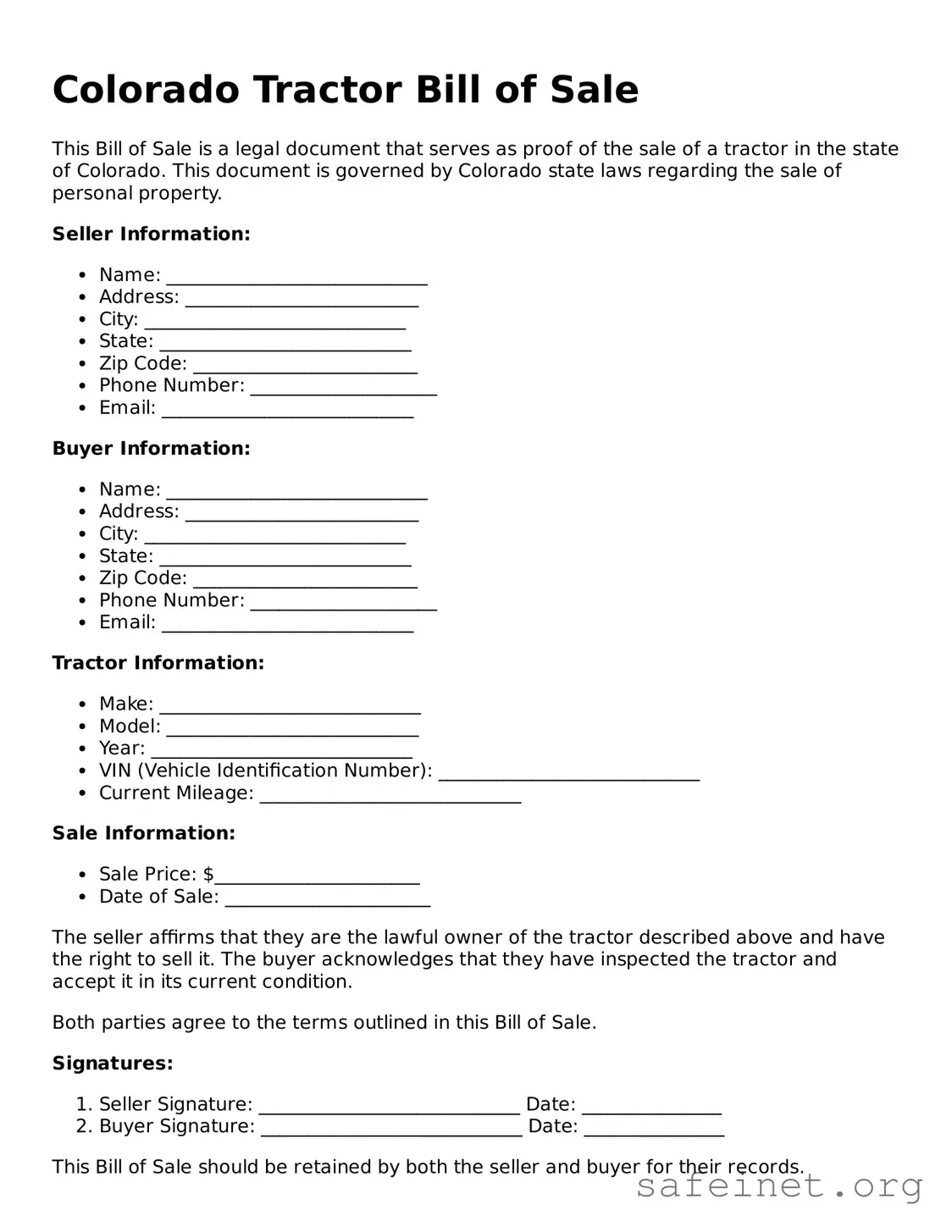
Colorado Tractor Bill of Sale
This Bill of Sale is a legal document that serves as proof of the sale of a tractor in the state of Colorado. This document is governed by Colorado state laws regarding the sale of personal property.
Seller Information:
Buyer Information:
Tractor Information:
Sale Information:
The seller affirms that they are the lawful owner of the tractor described above and have the right to sell it. The buyer acknowledges that they have inspected the tractor and accept it in its current condition.
Both parties agree to the terms outlined in this Bill of Sale.
Signatures:
This Bill of Sale should be retained by both the seller and buyer for their records.
| Fact Name | Details |
|---|---|
| Purpose | The Colorado Tractor Bill of Sale form serves as a legal document to transfer ownership of a tractor from one party to another. |
| Governing Law | This form is governed by Colorado state law, specifically the Colorado Revised Statutes Title 42. |
| Required Information | Essential details include the buyer's and seller's names, addresses, and signatures, along with the tractor's make, model, year, and Vehicle Identification Number (VIN). |
| Notarization | While notarization is not mandatory, it can add an extra layer of protection and authenticity to the transaction. |
| Use in Registration | The completed form is often required for registering the tractor with the Colorado Department of Revenue. |
| Tax Implications | Sales tax may apply to the transaction, and it is the buyer's responsibility to pay any applicable taxes when registering the tractor. |
| Record Keeping | Both parties should retain a copy of the Bill of Sale for their records to prove ownership and for any future disputes. |
| Conditional Sales | If the sale involves financing, a conditional Bill of Sale may be necessary to outline the terms of payment and ownership rights. |
| Availability | The Colorado Tractor Bill of Sale form can be obtained online or through local government offices and is typically available for free. |
Completing the Colorado Tractor Bill of Sale form is an essential step in the process of transferring ownership of a tractor. This document serves as proof of the transaction between the buyer and the seller, ensuring that both parties have a clear record of the sale. After filling out the form, it will need to be signed by both parties and may require additional steps for registration or titling.
What is a Colorado Tractor Bill of Sale?
A Colorado Tractor Bill of Sale is a legal document that records the sale and transfer of ownership of a tractor in the state of Colorado. This form provides essential details about the transaction, including the buyer's and seller's information, the tractor's description, and the sale price. It serves as proof of ownership and can be useful for registration purposes.
Who needs a Tractor Bill of Sale?
Both buyers and sellers of tractors in Colorado should use a Tractor Bill of Sale. Sellers need it to confirm the sale and transfer of ownership, while buyers require it for registration and proof of purchase. This document protects both parties in case of disputes regarding the transaction.
What information is included in the form?
The Colorado Tractor Bill of Sale typically includes the following information: the names and addresses of the buyer and seller, a detailed description of the tractor (including make, model, year, and VIN), the sale price, the date of the transaction, and any warranties or conditions of the sale. Both parties should sign the document to validate it.
Is the Tractor Bill of Sale required for registration?
Yes, a Tractor Bill of Sale is often required for registering the tractor with the Colorado Department of Revenue. The document acts as proof of ownership and helps facilitate the registration process. It is advisable to keep a copy for personal records as well.
Can I create my own Tractor Bill of Sale?
Yes, you can create your own Tractor Bill of Sale as long as it includes all necessary information. However, using a standardized form is recommended to ensure that all required elements are included and that it complies with Colorado state laws. Templates are often available online for convenience.
Do I need to have the form notarized?
Notarization is not typically required for a Tractor Bill of Sale in Colorado, but it can add an extra layer of security and authenticity to the document. If either party feels more comfortable having it notarized, they may choose to do so.
What if there are liens on the tractor?
If there are liens on the tractor, the seller must disclose this information to the buyer before the sale. It is essential to clear any outstanding liens to ensure the buyer receives a clear title. The Tractor Bill of Sale should reflect any existing liens to avoid future complications.
How long should I keep the Tractor Bill of Sale?
It is advisable to keep the Tractor Bill of Sale for as long as you own the tractor. Once you sell the tractor, retain a copy for your records. This documentation may be needed for tax purposes or if any disputes arise regarding the sale.
What if I lose the Tractor Bill of Sale?
If you lose the Tractor Bill of Sale, you may need to contact the seller to request a duplicate or create a new document reflecting the original transaction. Having a record of the transaction, such as payment receipts or emails, can help in recreating the necessary documentation.
Where can I find a Colorado Tractor Bill of Sale template?
You can find a Colorado Tractor Bill of Sale template online through various legal websites or state government resources. Many templates are free to download and can be customized to fit your specific transaction needs. Ensure that the template complies with Colorado state requirements.
Incorrect Vehicle Identification Number (VIN): One of the most common mistakes is entering an incorrect VIN. The VIN is unique to each tractor and must match the one on the vehicle. A small error can lead to complications in registration.
Missing Signatures: Both the buyer and seller must sign the bill of sale. Failing to obtain one or both signatures can render the document invalid. Always double-check for all necessary signatures before finalizing the sale.
Incomplete Buyer or Seller Information: It is crucial to provide complete names, addresses, and contact information for both parties. Missing details can create confusion or legal issues down the line.
Failure to Include Sale Price: The sale price must be clearly stated on the form. Omitting this information can lead to disputes regarding the transaction and may affect tax obligations.
When completing a transaction involving a tractor in Colorado, several forms and documents may be necessary in addition to the Colorado Tractor Bill of Sale. These documents help ensure that the sale is legally binding and that both parties are protected. Below is a list of commonly used forms.
Using these documents in conjunction with the Colorado Tractor Bill of Sale can help facilitate a smooth transaction and protect the interests of both the buyer and the seller. Always ensure that all necessary paperwork is completed accurately and retained for future reference.
The Colorado Vehicle Bill of Sale is similar to the Tractor Bill of Sale in that both documents serve as proof of a transaction involving a vehicle. This document includes details such as the buyer's and seller's information, vehicle identification number (VIN), and the sale price. It helps protect both parties by providing a record of the sale, which can be useful for registration and tax purposes. Just like the Tractor Bill of Sale, it can also help resolve disputes over ownership and transaction details.
The Colorado Boat Bill of Sale is another document that shares similarities with the Tractor Bill of Sale. This form is used when buying or selling a boat, and it captures essential information such as the boat's make, model, year, and hull identification number. Both documents aim to provide a clear record of the transaction, ensuring that the buyer has a legitimate claim to the property and that the seller has proof of the sale. This reduces the risk of misunderstandings or legal issues down the line.
The Colorado Motorcycle Bill of Sale is comparable to the Tractor Bill of Sale in its purpose and format. It documents the sale of a motorcycle, including details like the VIN, sale price, and information about the buyer and seller. Both forms are essential for transferring ownership legally and can be required for registration with the state. They serve to protect the interests of both parties involved in the transaction.
The Colorado RV Bill of Sale functions similarly to the Tractor Bill of Sale, as it is used for the sale of recreational vehicles. This document includes pertinent information such as the RV's make, model, year, and VIN. Like the Tractor Bill of Sale, it provides a record of the transaction, which can be crucial for registration and ownership verification. Both documents help ensure that the sale is conducted fairly and transparently.
The Colorado Snowmobile Bill of Sale is another document that mirrors the Tractor Bill of Sale in its function. It is specifically designed for the sale of snowmobiles and includes details such as the snowmobile's make, model, year, and VIN. Both documents serve to establish proof of ownership and protect the rights of both buyers and sellers. They also facilitate the registration process with the appropriate state authorities.
Lastly, the Colorado ATV Bill of Sale is akin to the Tractor Bill of Sale in that it documents the sale of all-terrain vehicles. This form captures essential information about the ATV, including its make, model, year, and VIN. Both documents aim to provide a clear and legal record of the transaction, ensuring that ownership is properly transferred. They also help mitigate potential disputes regarding the sale and ownership of the vehicle.
When filling out the Colorado Tractor Bill of Sale form, it is important to be careful and thorough. Here are some guidelines to help you navigate the process effectively.
Following these steps can help ensure a smooth transaction. Pay attention to detail, and remember that clear communication is key.
Understanding the Colorado Tractor Bill of Sale form is essential for anyone involved in buying or selling a tractor. However, several misconceptions can lead to confusion. Here are six common misunderstandings about this important document:
This is not true. The Tractor Bill of Sale is required for both new and used tractors. It serves as proof of ownership regardless of the tractor's age.
In fact, both the buyer and seller should sign the form. This mutual agreement solidifies the transaction and protects both parties.
Even informal transactions benefit from a Bill of Sale. Having a written record helps avoid disputes and provides legal protection.
While changes should be avoided, they can be made if both parties agree. Amendments should be documented and signed to maintain clarity.
Although related, they are not the same. The Bill of Sale documents the sale, while the title transfer officially changes ownership with the state.
Requirements can vary by state. Colorado has specific guidelines that must be followed, so it’s important to familiarize yourself with local laws.
By clearing up these misconceptions, you can ensure a smoother transaction when buying or selling a tractor in Colorado.
When dealing with the Colorado Tractor Bill of Sale form, it's important to keep several key points in mind. This document serves as a legal record of the sale and transfer of ownership for a tractor. Here are some essential takeaways:
By following these guidelines, you can ensure a smooth transaction when buying or selling a tractor in Colorado.