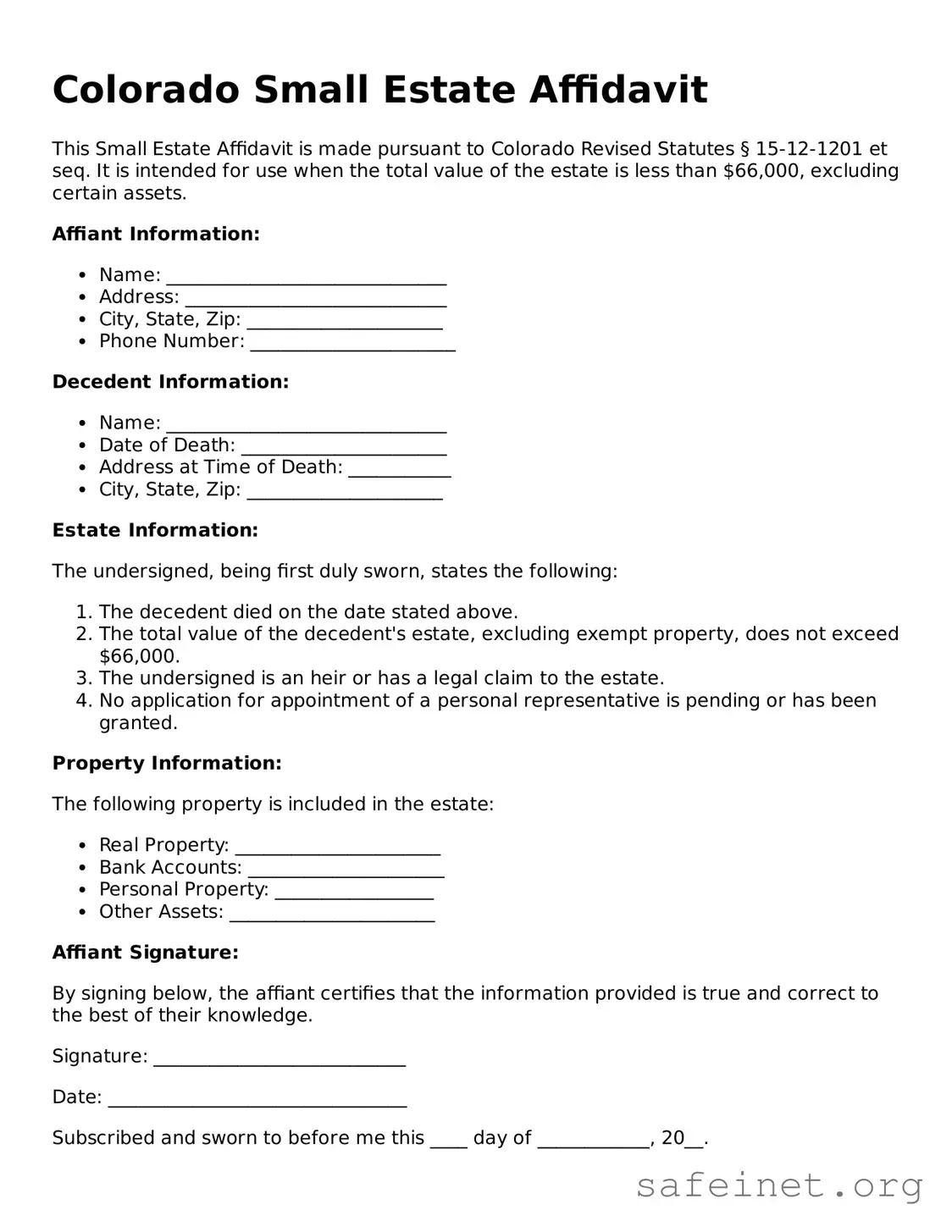
The Colorado Small Estate Affidavit form serves as a practical tool for individuals dealing with the estate of a deceased person whose assets fall below a certain threshold. This form simplifies the process of transferring property and assets without the need for formal probate proceedings. By using the Small Estate Affidavit, heirs can claim personal property, bank accounts, and other assets directly, provided the total value does not exceed $74,000, excluding certain types of property. The form requires specific information, including the decedent's details, a description of the assets, and a statement affirming the relationship between the affiant and the deceased. Additionally, it must be signed in front of a notary public to ensure its validity. This streamlined process can save time and reduce costs for families navigating the aftermath of a loved one's passing, making it a valuable resource in Colorado estate management.
Colorado Small Estate Affidavit
This Small Estate Affidavit is made pursuant to Colorado Revised Statutes § 15-12-1201 et seq. It is intended for use when the total value of the estate is less than $66,000, excluding certain assets.
Affiant Information:
Decedent Information:
Estate Information:
The undersigned, being first duly sworn, states the following:
Property Information:
The following property is included in the estate:
Affiant Signature:
By signing below, the affiant certifies that the information provided is true and correct to the best of their knowledge.
Signature: ___________________________
Date: ________________________________
Subscribed and sworn to before me this ____ day of ____________, 20__.
Notary Public: _________________________
My Commission Expires: ________________
| Fact Name | Description |
|---|---|
| Purpose | The Colorado Small Estate Affidavit allows individuals to claim assets of a deceased person without going through the formal probate process, simplifying the transfer of property. |
| Eligibility | This affidavit can be used when the total value of the deceased person's estate is $66,000 or less, excluding certain types of property such as real estate. |
| Governing Law | The Small Estate Affidavit is governed by Colorado Revised Statutes, specifically §15-12-1201 through §15-12-1205. |
| Filing Requirements | To use the affidavit, the claimant must provide a completed form, a certified copy of the death certificate, and proof of identity. |
| Limitations | While the Small Estate Affidavit streamlines the process, it cannot be used for estates that include real property or for certain debts that must be settled. |
| Time Frame | The affidavit must be filed within one year of the deceased person's passing, ensuring timely access to the estate's assets. |
Completing the Colorado Small Estate Affidavit form is a straightforward process that allows individuals to claim assets of a deceased person without going through the full probate process. After filling out the form, it will be necessary to submit it to the appropriate financial institutions or entities holding the deceased's assets. This will help facilitate the transfer of those assets to the rightful heirs or beneficiaries.
Once the form is completed and notarized, it can be submitted to the relevant institutions to initiate the process of asset transfer. Be prepared to provide additional documentation if requested.
What is a Small Estate Affidavit in Colorado?
A Small Estate Affidavit is a legal document that allows individuals to claim assets of a deceased person without going through the lengthy probate process. In Colorado, this option is available when the total value of the deceased person's assets does not exceed a specific threshold, which is currently set at $74,000 for personal property and $1,000,000 for real property. This process simplifies the transfer of assets to the rightful heirs or beneficiaries, making it easier for families to manage their loved one's estate during a difficult time.
Who is eligible to use a Small Estate Affidavit?
To be eligible to use a Small Estate Affidavit, you must be an heir or a beneficiary of the deceased person. You should also ensure that the total value of the estate falls within the limits set by Colorado law. Additionally, you must wait at least 30 days after the death of the individual before filing the affidavit. This waiting period allows time for any potential creditors to make claims against the estate. If you meet these criteria, you can proceed with the affidavit process.
How do I complete and file a Small Estate Affidavit?
Completing a Small Estate Affidavit involves filling out a specific form that includes details about the deceased person, their assets, and the heirs or beneficiaries. You can obtain this form from the Colorado Judicial Branch website or your local court. Once you have filled it out, you will need to sign the affidavit in front of a notary public. After notarization, you can file the affidavit with the appropriate county court. It's important to keep copies of the filed affidavit and any supporting documents for your records.
What happens after I file the Small Estate Affidavit?
After filing the Small Estate Affidavit, the court will not actively oversee the process as it does in a traditional probate case. However, the affidavit serves as a legal document that allows you to claim the deceased person's assets. You may need to present the affidavit to financial institutions, title companies, or other entities holding the deceased's assets. Once they verify the affidavit, they can release the assets to you. This process can take some time, so patience is key as you navigate through it.
Incomplete Information: Many individuals fail to provide all required details. Missing names, addresses, or dates can lead to delays or rejection of the affidavit.
Incorrect Valuation of Assets: Underestimating or overestimating the value of the estate can cause issues. Accurate appraisals are essential to ensure compliance with state laws.
Not Meeting Eligibility Requirements: Some applicants overlook the eligibility criteria. It's crucial to confirm that the estate meets Colorado's small estate limits before proceeding.
Failure to Sign and Notarize: A common mistake is neglecting to sign the affidavit or get it notarized. Both steps are necessary for the document to be legally valid.
When dealing with a small estate in Colorado, several forms and documents may be necessary to ensure a smooth process. Each of these documents serves a specific purpose and helps clarify the estate's administration. Below is a list of commonly used forms alongside the Colorado Small Estate Affidavit.
Gathering these documents can simplify the process of settling a small estate. Having everything in order will help facilitate a smoother transition and provide peace of mind during a challenging time.
The Colorado Small Estate Affidavit is similar to a Last Will and Testament. Both documents serve to distribute a deceased person's assets. However, a will requires probate, which can be time-consuming and costly. In contrast, the Small Estate Affidavit allows for a more straightforward transfer of assets, provided the estate falls below a certain value threshold. This makes it a quicker option for heirs to access their inheritance without the need for court involvement.
Another document akin to the Small Estate Affidavit is the Trust. A trust allows for the management and distribution of assets during a person's lifetime and after their death. Like the Small Estate Affidavit, a trust can bypass probate. However, creating a trust typically involves more planning and legal assistance upfront, while the Small Estate Affidavit is a simpler solution for smaller estates.
The Declaration of Informal Probate is also similar. This document can initiate a simplified probate process for estates that do not require extensive court oversight. Both the Declaration and the Small Estate Affidavit aim to streamline the transfer of assets. However, the Declaration still involves some court procedures, whereas the Small Estate Affidavit allows heirs to claim assets directly without court intervention.
A Power of Attorney can also be compared to the Small Estate Affidavit. While a Power of Attorney allows someone to act on behalf of another person during their lifetime, the Small Estate Affidavit comes into play after death. Both documents empower individuals to manage assets, but they serve different purposes and timelines. The Small Estate Affidavit specifically addresses the distribution of assets post-mortem.
The Affidavit of Heirship shares similarities with the Small Estate Affidavit as well. Both documents help establish the rightful heirs of a deceased person's estate. The Affidavit of Heirship is often used when there is no will, while the Small Estate Affidavit is utilized when the estate qualifies for a simplified process. Each document helps clarify ownership and facilitate the transfer of assets, albeit in different contexts.
Lastly, a Family Settlement Agreement can be compared to the Small Estate Affidavit. This agreement is used when heirs come together to settle an estate without going through probate. Like the Small Estate Affidavit, it aims to simplify the distribution of assets. However, the Family Settlement Agreement requires consensus among heirs, while the Small Estate Affidavit can be completed unilaterally by an heir, provided they meet the necessary conditions.
When filling out the Colorado Small Estate Affidavit form, it is important to follow certain guidelines to ensure accuracy and compliance. Below is a list of things to do and avoid.
Understanding the Colorado Small Estate Affidavit can be confusing. Here are ten common misconceptions about this form, clarified for better comprehension.
This is not true. The Small Estate Affidavit is designed for estates that fall below a certain value threshold, making it accessible for many individuals, not just the wealthy.
Actually, the affidavit is limited to specific types of assets, such as bank accounts and personal property. Real estate typically requires a different process.
While there are steps involved, the process is generally straightforward. Many people successfully complete it without legal assistance.
This is a misconception. Only the person filing the affidavit needs to sign it, although it’s wise to communicate with other heirs.
These are not the same. A will is a legal document that outlines how assets should be distributed, while the affidavit is a tool for claiming assets without going through probate.
In most cases, you do not need to appear in court. The affidavit can be submitted directly to the financial institution or entity holding the assets.
This is misleading. While it’s best to file it promptly after the individual’s passing, there is no strict deadline for submitting the affidavit.
This is not entirely accurate. While debts should be addressed, the affidavit allows for the transfer of assets even if some debts remain unpaid.
This is incorrect. If additional assets come to light after the initial affidavit is filed, you can file another one for those assets.
While legal advice can be helpful, it is not a requirement. Many people fill out and submit the affidavit without professional help.
By clearing up these misconceptions, individuals can better navigate the Small Estate Affidavit process in Colorado.
Filling out and using the Colorado Small Estate Affidavit can simplify the process of settling a deceased person's estate when the total value is below a certain threshold. Here are key takeaways to consider:
Understanding these key points can help ensure a smoother experience when handling small estates in Colorado.