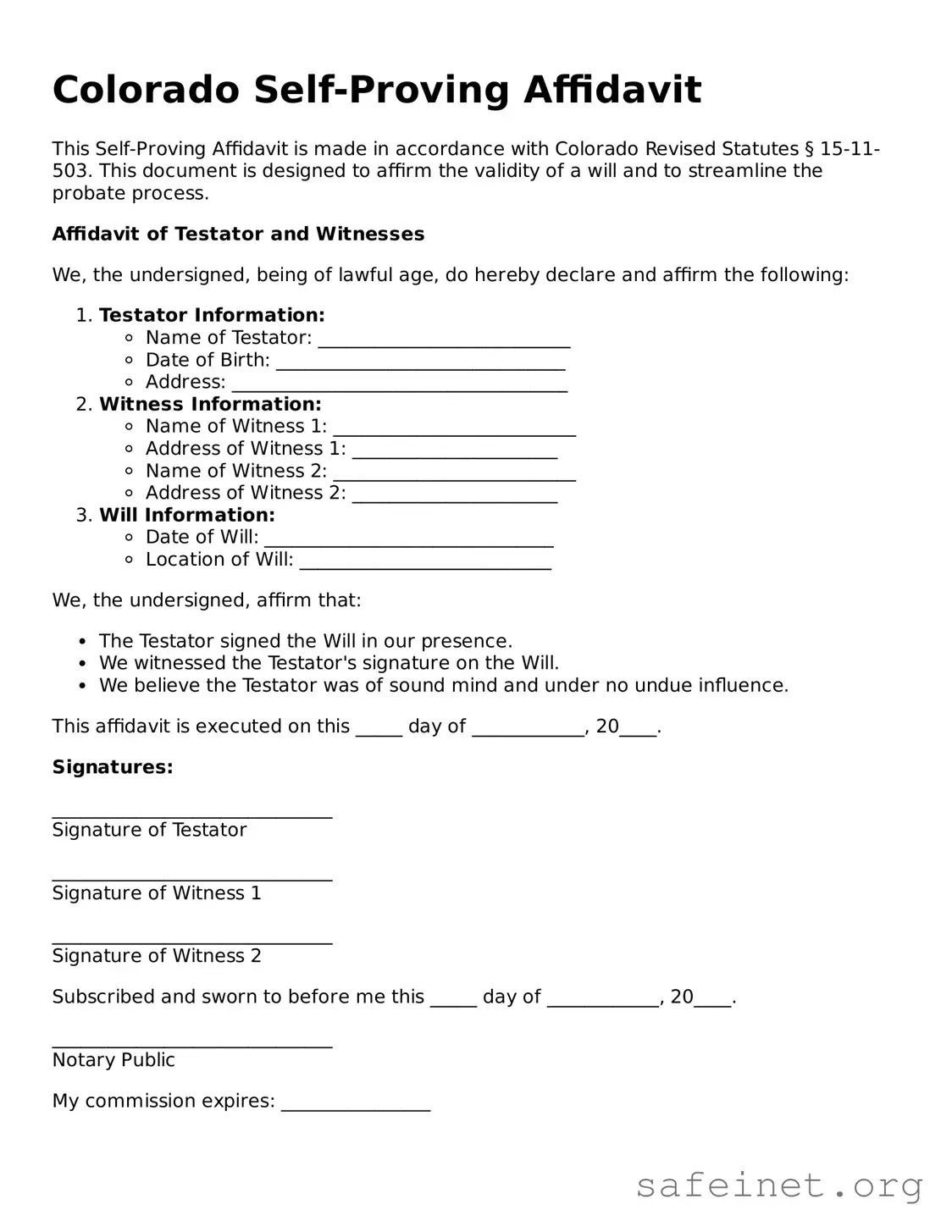
The Colorado Self-Proving Affidavit is an important legal document that simplifies the process of validating a will after a person has passed away. By using this form, testators can provide assurance that their will was executed properly, which can help reduce disputes among heirs and streamline probate proceedings. This affidavit typically includes the signatures of the testator, who is the person making the will, and witnesses who can attest to the signing of the document. Notably, the form allows for the affidavit to be signed at the same time as the will, making it easier for all parties involved. Additionally, it serves to confirm that the testator was of sound mind and not under any undue influence at the time of signing. By including this affidavit with the will, families can save time and potentially lower legal costs during the probate process, ensuring that the testator's wishes are honored with minimal complications.
Colorado Self-Proving Affidavit
This Self-Proving Affidavit is made in accordance with Colorado Revised Statutes § 15-11-503. This document is designed to affirm the validity of a will and to streamline the probate process.
Affidavit of Testator and Witnesses
We, the undersigned, being of lawful age, do hereby declare and affirm the following:
We, the undersigned, affirm that:
This affidavit is executed on this _____ day of ____________, 20____.
Signatures:
______________________________
Signature of Testator
______________________________
Signature of Witness 1
______________________________
Signature of Witness 2
Subscribed and sworn to before me this _____ day of ____________, 20____.
______________________________
Notary Public
My commission expires: ________________
| Fact Name | Description |
|---|---|
| Definition | The Colorado Self-Proving Affidavit is a legal document that allows a will to be validated without the need for witness testimony after the testator's death. |
| Governing Law | This form is governed by Colorado Revised Statutes, specifically § 15-11-503. |
| Purpose | The primary purpose of the affidavit is to simplify the probate process by affirming the authenticity of the will. |
| Requirements | The affidavit must be signed by the testator and witnessed by at least two individuals who are present at the same time. |
| Notarization | While notarization is not required, it is recommended to enhance the document's credibility. |
| Revocation | A self-proving affidavit can be revoked if the testator executes a new will or a codicil that does not include the affidavit. |
| Storage | The affidavit should be stored with the will in a safe place, such as a safe deposit box or with an attorney. |
| Validity | The self-proving affidavit remains valid as long as it meets the statutory requirements at the time of execution. |
| Effect on Probate | Using a self-proving affidavit can expedite the probate process by reducing the need for witness testimony. |
| Accessibility | The form is available through various legal resources, including state websites and legal aid organizations. |
After gathering the necessary information, you are ready to fill out the Colorado Self-Proving Affidavit form. This process involves providing specific details about the will and the individuals involved. Follow these steps to ensure that the form is completed accurately.
What is a Colorado Self-Proving Affidavit?
A Colorado Self-Proving Affidavit is a legal document that allows a will to be validated without the need for witnesses to testify in court. This affidavit is typically signed by the testator (the person who created the will) and witnesses, affirming that they witnessed the signing of the will and that the testator was of sound mind at the time.
Why should I use a Self-Proving Affidavit?
Using a Self-Proving Affidavit can simplify the probate process. It eliminates the need for witnesses to appear in court, which can save time and reduce complications. This can be particularly beneficial if witnesses are unavailable or cannot be located after the testator's passing.
Who can sign the Self-Proving Affidavit?
The Self-Proving Affidavit must be signed by the testator and at least two witnesses. All parties must be present at the same time when signing the affidavit. It is important that the witnesses are not beneficiaries of the will to avoid potential conflicts of interest.
When should I complete the Self-Proving Affidavit?
The Self-Proving Affidavit should be completed at the same time the will is signed. Doing so ensures that the affidavit is contemporaneous with the will, which strengthens its validity and usefulness during the probate process.
Can I add a Self-Proving Affidavit to an existing will?
Yes, you can add a Self-Proving Affidavit to an existing will, but it must be executed in accordance with Colorado law. It is advisable to consult with a legal professional to ensure that the affidavit is properly drafted and executed to avoid any issues during probate.
Is notarization required for the Self-Proving Affidavit?
Yes, in Colorado, the Self-Proving Affidavit must be notarized. The notary public will verify the identities of the signers and witness the signing of the affidavit. This adds an additional layer of authenticity to the document.
What happens if I do not use a Self-Proving Affidavit?
If a Self-Proving Affidavit is not used, witnesses may need to testify in court to validate the will. This can lead to delays and complications, especially if witnesses are unavailable or if there are disputes regarding the will's validity.
Can I revoke a Self-Proving Affidavit?
A Self-Proving Affidavit can be revoked by revoking the will itself or by creating a new will that does not include the Self-Proving Affidavit. It is important to follow proper legal procedures to ensure that the revocation is effective.
Where can I find a Colorado Self-Proving Affidavit form?
Colorado Self-Proving Affidavit forms can be found online through legal websites, or you may consult with an attorney who specializes in estate planning. It is crucial to ensure that the form complies with current Colorado laws.
Is there a fee associated with filing a Self-Proving Affidavit?
There is typically no fee for filing a Self-Proving Affidavit itself, as it is part of the will. However, there may be fees associated with notarization or legal assistance if you choose to seek help from an attorney.
Incorrect Signatures: One common mistake is failing to have the required signatures. All witnesses must sign the affidavit in the presence of the testator. If even one signature is missing, the affidavit may not be valid.
Not Including Necessary Information: Some individuals overlook the importance of filling in all required fields. Missing details, such as the date or the names of witnesses, can render the affidavit ineffective.
Improper Notarization: A frequent error occurs when the affidavit is not properly notarized. The notary must witness the signing of the affidavit. If this step is skipped, the document may not hold up in court.
Using Outdated Forms: People sometimes use outdated versions of the Self-Proving Affidavit form. Always check for the most current version to ensure compliance with state laws.
The Colorado Self-Proving Affidavit serves as a valuable tool in the estate planning process, providing a means to affirm the authenticity of a will. However, it is often used in conjunction with several other important documents that help ensure a smooth transition of assets and wishes after an individual passes away. Below is a list of related forms and documents commonly utilized alongside the Self-Proving Affidavit in Colorado.
Understanding these documents and their functions can greatly assist individuals in creating a comprehensive estate plan. Each plays a unique role in ensuring that a person's wishes are honored and that their loved ones are supported during a difficult time.
The Colorado Self-Proving Affidavit form shares similarities with the Affidavit of Execution. This document is used to confirm that a will was properly signed and witnessed according to the legal requirements. Both forms serve to validate the authenticity of a will, but the Affidavit of Execution specifically focuses on the witnessing process, while the Self-Proving Affidavit provides a broader affirmation that the testator was of sound mind and free from undue influence at the time of signing.
Another document that resembles the Self-Proving Affidavit is the Will Contest Affidavit. This affidavit is filed when someone disputes the validity of a will. Like the Self-Proving Affidavit, it aims to provide evidence regarding the circumstances surrounding the will’s creation. However, the Will Contest Affidavit is often used in litigation, while the Self-Proving Affidavit is a proactive measure taken to prevent disputes from arising in the first place.
The Affidavit of Witnesses also bears a resemblance to the Colorado Self-Proving Affidavit. This document is signed by individuals who witnessed the signing of a will. Similar to the Self-Proving Affidavit, it helps to confirm that the will was executed properly. However, the Affidavit of Witnesses focuses specifically on the witnesses' observations, whereas the Self-Proving Affidavit includes additional assurances regarding the testator's mental state and the absence of coercion.
The Durable Power of Attorney is another document that shares some characteristics with the Self-Proving Affidavit. Both documents involve the affirmation of an individual’s intentions and mental capacity. However, the Durable Power of Attorney grants someone the authority to act on another's behalf in legal matters, whereas the Self-Proving Affidavit is specifically related to the validation of a will.
The Living Will can also be compared to the Self-Proving Affidavit in terms of its intent to clarify an individual's wishes. A Living Will expresses a person's healthcare preferences, especially in situations where they cannot communicate. While both documents aim to ensure that a person’s wishes are respected, the Self-Proving Affidavit focuses on the distribution of assets after death, rather than healthcare decisions.
The Revocable Trust Agreement is similar in that it is a legal document used to manage assets. Both the Revocable Trust and the Self-Proving Affidavit serve to protect the interests of the individual. However, a Revocable Trust allows for the management of assets during a person's lifetime and can avoid probate, while the Self-Proving Affidavit is specifically a tool to streamline the probate process for a will.
The Affidavit of Heirship is another document that bears resemblance to the Self-Proving Affidavit. This affidavit is often used to establish the heirs of a deceased person, particularly when no will exists. Both documents aim to clarify the distribution of an estate, but the Affidavit of Heirship is primarily concerned with identifying rightful heirs, while the Self-Proving Affidavit confirms the legitimacy of a will.
The Certificate of Trust is similar in that it provides evidence of a trust’s existence and terms. Both documents serve to clarify intentions and provide legal backing. However, the Certificate of Trust is specifically related to trusts, while the Self-Proving Affidavit is focused on wills. Each document serves its purpose in ensuring that the intentions of the individual are honored and respected.
Lastly, the Probate Petition shares some characteristics with the Self-Proving Affidavit. Both documents are part of the probate process, which involves the legal validation of a will. The Probate Petition initiates the court's involvement in the distribution of an estate, while the Self-Proving Affidavit is a tool that can simplify this process by affirming the validity of the will without the need for witnesses to appear in court.
When filling out the Colorado Self-Proving Affidavit form, it is important to follow certain guidelines to ensure that the process goes smoothly. Here are some things to do and avoid:
Understanding the Colorado Self-Proving Affidavit form is crucial for individuals involved in estate planning and the execution of wills. However, several misconceptions can lead to confusion. Below are four common misconceptions about this important legal document.
This belief is inaccurate. The Self-Proving Affidavit can be beneficial for any estate, regardless of size. It simplifies the probate process by confirming the validity of the will, which can save time and reduce complications for heirs.
While notarization is a common practice, it is not a requirement for a Self-Proving Affidavit in Colorado. The affidavit must be signed by the testator and witnesses, but the presence of a notary is not essential for its validity.
This is misleading. The Self-Proving Affidavit should be executed at the same time as the will, or shortly thereafter, to ensure its effectiveness. Delaying this process can lead to challenges in proving the will's validity during probate.
This statement is not entirely correct. The Self-Proving Affidavit does not replace the need for witnesses when signing the will. Instead, it serves as a tool that confirms the witnesses' signatures and their understanding of the testator's intentions.
When filling out and using the Colorado Self-Proving Affidavit form, consider the following key takeaways: