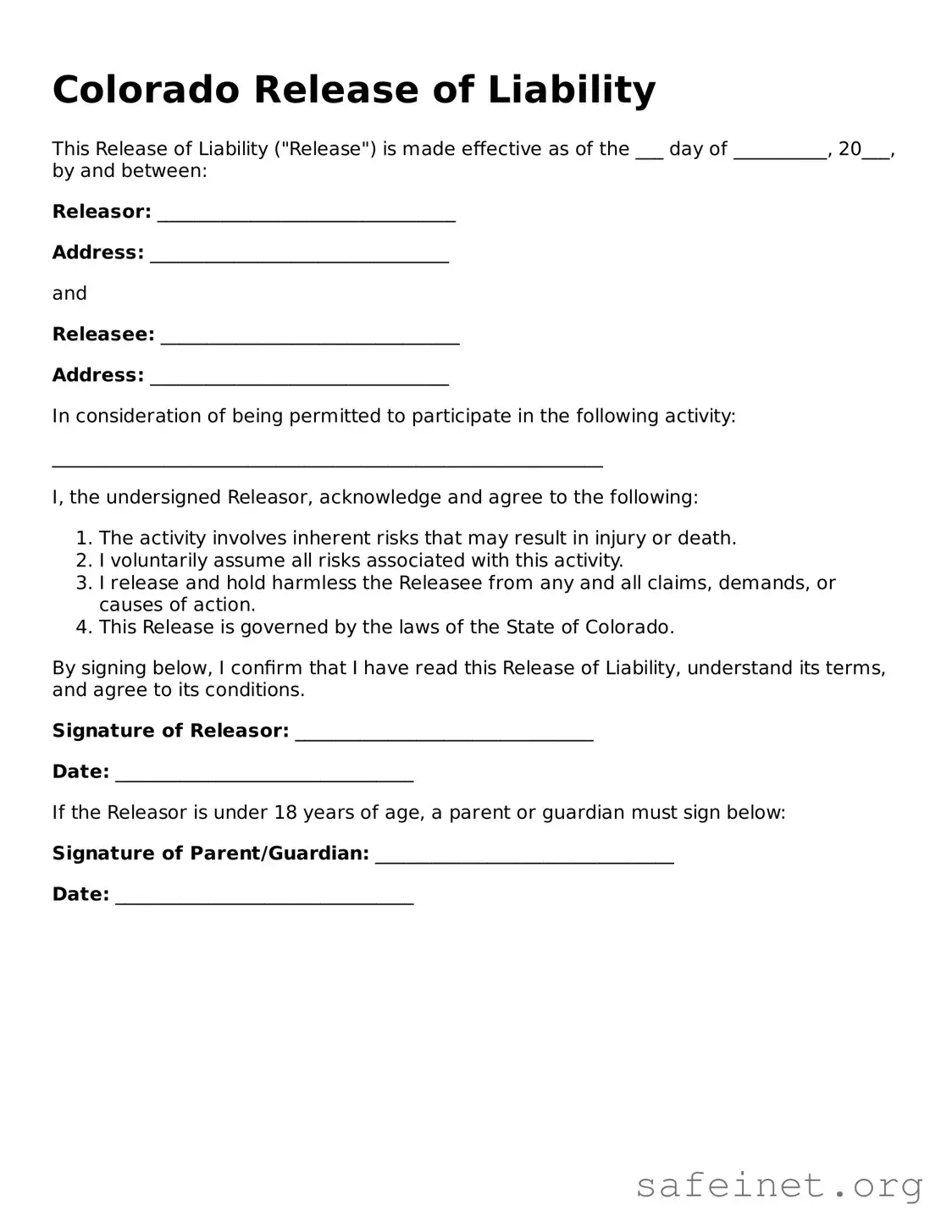
In Colorado, the Release of Liability form serves as a crucial document for individuals and organizations seeking to protect themselves from legal claims that may arise during various activities. This form is particularly relevant in contexts such as recreational sports, outdoor adventures, and other activities where there is a risk of injury. By signing this document, participants acknowledge the inherent risks involved and agree to waive their right to sue for any injuries sustained while engaging in the activity. The form typically outlines the specific activities covered, the potential risks associated with those activities, and the rights being relinquished by the participant. It is designed to ensure that all parties are aware of the risks and responsibilities involved, fostering a clearer understanding of the legal landscape surrounding recreational and adventure activities. Additionally, the form may require signatures from both participants and guardians in cases involving minors, emphasizing the importance of informed consent. Ultimately, the Release of Liability form not only aims to protect organizations from liability but also encourages participants to make informed decisions about their involvement in potentially hazardous activities.
Colorado Release of Liability
This Release of Liability ("Release") is made effective as of the ___ day of __________, 20___, by and between:
Releasor: ________________________________
Address: ________________________________
and
Releasee: ________________________________
Address: ________________________________
In consideration of being permitted to participate in the following activity:
___________________________________________________________
I, the undersigned Releasor, acknowledge and agree to the following:
By signing below, I confirm that I have read this Release of Liability, understand its terms, and agree to its conditions.
Signature of Releasor: ________________________________
Date: ________________________________
If the Releasor is under 18 years of age, a parent or guardian must sign below:
Signature of Parent/Guardian: ________________________________
Date: ________________________________
| Fact Name | Description |
|---|---|
| Purpose | The Colorado Release of Liability form is used to protect individuals and organizations from legal claims resulting from injuries or damages that may occur during an activity. |
| Governing Law | This form is governed by Colorado state law, particularly under the Colorado Revised Statutes. |
| Voluntary Participation | Participants must voluntarily sign the form, indicating their understanding of the risks involved in the activity. |
| Scope of Release | The release typically covers various types of claims, including negligence, but may not protect against gross negligence or intentional misconduct. |
| Minors | If a participant is a minor, a parent or legal guardian must sign the form on their behalf. |
| Enforceability | The enforceability of the release may depend on the clarity of the language used and the circumstances under which it was signed. |
| Retention | Organizations should retain signed forms for a specified period to ensure compliance with legal requirements and for reference in case of disputes. |
After obtaining the Colorado Release of Liability form, you are ready to fill it out. Ensure you have all necessary information at hand, such as your personal details and any relevant event or activity information. Follow the steps below to complete the form accurately.
What is a Colorado Release of Liability form?
The Colorado Release of Liability form is a legal document that allows individuals to waive their right to hold another party responsible for any injuries or damages that may occur during a specific activity. This form is often used in recreational activities, sports, and events where there is a risk of injury. By signing this document, participants acknowledge the risks involved and agree not to pursue legal action against the organizers or facilitators of the activity.
Who should use a Release of Liability form?
This form is typically used by businesses, organizations, or individuals who host activities that involve potential risks. Examples include adventure sports companies, event organizers, and recreational facilities. Participants in these activities should also be encouraged to sign the form to protect both parties from liability claims.
Is the Colorado Release of Liability form legally binding?
Yes, when properly executed, the Colorado Release of Liability form is generally considered legally binding. However, its enforceability can depend on various factors, such as the clarity of the language used, the specific circumstances surrounding the signing, and whether the participant was fully informed of the risks involved. Courts may evaluate these factors if a dispute arises.
Can a minor sign a Release of Liability form?
Minors cannot legally sign contracts, including a Release of Liability form. However, a parent or legal guardian can sign on behalf of the minor. This signature indicates that the parent or guardian understands the risks and agrees to release the organization from liability for any injuries that may occur to the minor during the activity.
What should be included in a Colorado Release of Liability form?
A comprehensive Release of Liability form should include several key elements. These may consist of a clear description of the activity, acknowledgment of risks, a statement of waiver of liability, and the signatures of participants or their guardians. It is also beneficial to include a date and contact information for the organization or individual hosting the activity.
How can individuals ensure they understand the Release of Liability form before signing?
Individuals should take the time to read the entire form carefully before signing. If any part of the document is unclear, they should ask the organizer for clarification. It may also be helpful to consult with a legal professional if there are concerns about the implications of signing the form.
What happens if someone is injured despite signing the Release of Liability form?
Even with a signed Release of Liability form, there may be circumstances where a participant can still pursue legal action. If negligence or misconduct is proven on the part of the organization or individual, the waiver may not be enforceable. Each case is unique, and the specifics will determine the outcome if an injury occurs.
Failing to read the entire form thoroughly. Many individuals rush through the document, missing critical information that could affect their rights.
Not understanding the scope of the release. People often overlook what activities or risks they are actually waiving their rights against.
Inaccurate or incomplete personal information. It's essential to provide correct details, such as name, address, and contact information, to avoid complications later.
Not signing or dating the form. A signature is a crucial element that signifies acceptance of the terms; without it, the release may not be valid.
Ignoring age requirements. Minors cannot legally sign such forms without a parent or guardian’s consent, which is often overlooked.
Assuming the release applies universally. Some individuals mistakenly believe that signing a release protects them in all situations, which is not always the case.
Neglecting to seek legal advice when needed. Consulting a legal professional can clarify any doubts and ensure that the form is filled out correctly.
When engaging in activities that may involve risks, it's essential to have the right documentation in place. The Colorado Release of Liability form is often accompanied by several other forms and documents that help clarify responsibilities and protect all parties involved. Here’s a list of some commonly used documents:
Having these documents in place not only protects individuals and organizations but also fosters a culture of safety and responsibility. Always ensure that participants are aware of and understand these forms before engaging in any activities.
The Waiver of Liability form is similar to the Colorado Release of Liability form in that both documents aim to protect an organization or individual from legal claims. Participants in activities or events sign these waivers to acknowledge the risks involved and agree not to hold the organizers responsible for any injuries or damages that may occur. This mutual understanding helps to clarify the responsibilities of both parties, ensuring that participants are aware of the potential hazards associated with the activity.
The Hold Harmless Agreement is another document that shares similarities with the Colorado Release of Liability form. This agreement typically involves one party agreeing to take responsibility for any losses or damages incurred by another party. Like the Release of Liability, it is designed to minimize legal exposure and protect the party being held harmless from lawsuits arising from specific activities or situations. Both documents emphasize the importance of informed consent and risk acknowledgment.
An Indemnity Agreement is akin to the Colorado Release of Liability form in that it provides a framework for one party to compensate another for certain damages or losses. This agreement often accompanies contracts and requires one party to cover the costs associated with claims made against the other. Both documents focus on risk management and the allocation of responsibility, helping to prevent disputes and clarify expectations between parties.
The Participant Agreement is similar to the Colorado Release of Liability form as it outlines the terms and conditions under which an individual participates in an event or activity. This document typically includes a waiver of liability clause, where participants agree to assume the risks involved. By signing, individuals acknowledge their understanding of the risks and agree not to pursue legal action against the organizers, mirroring the intent of the Release of Liability.
The Assumption of Risk form is another document that parallels the Colorado Release of Liability. This form explicitly states that individuals understand and accept the inherent risks associated with an activity. By signing, participants acknowledge their awareness of potential dangers and agree not to hold the organizers liable for any injuries. Both documents serve to inform participants and protect organizations from legal repercussions.
The Safety Acknowledgment form can also be compared to the Colorado Release of Liability form. This document requires participants to confirm that they have received safety instructions and understand the risks involved in an activity. By signing, individuals agree to follow safety guidelines and accept responsibility for their actions. Both forms aim to enhance safety awareness and reduce the likelihood of accidents or injuries.
The Liability Release for Minors form is similar to the Colorado Release of Liability, specifically when it comes to activities involving children. This document requires a parent or guardian to sign on behalf of a minor, acknowledging the risks and releasing the organization from liability. Both forms emphasize the importance of informed consent, ensuring that guardians are aware of the potential hazards their children may face.
The Event Participation Agreement is akin to the Colorado Release of Liability form as it outlines the terms under which individuals may participate in an event. This agreement often includes a waiver of liability, where participants agree to assume responsibility for any risks involved. Both documents serve to clarify expectations and responsibilities, helping to protect organizers from potential legal claims.
The Volunteer Waiver of Liability form is similar to the Colorado Release of Liability form in that it is designed to protect organizations from claims made by volunteers. This document requires volunteers to acknowledge the risks associated with their activities and agree not to hold the organization liable for any injuries. Both forms emphasize the importance of understanding and accepting risks before participating in any capacity.
When filling out the Colorado Release of Liability form, it’s important to follow certain guidelines to ensure the document is valid and effective. Here are five things you should and shouldn't do:
This is not entirely true. While the form does limit liability for certain activities, it does not absolve a party from all responsibility, especially in cases of gross negligence or intentional harm.
This is misleading. Although the form may restrict your ability to sue for certain claims, it does not prevent you from pursuing legal action in all circumstances, particularly if the release was signed under duress or if the activity was illegal.
While it is commonly used for high-risk activities, any organization or business can use a Release of Liability to protect against claims arising from ordinary activities.
This is incorrect. A Release of Liability does not provide financial coverage for damages or injuries. It simply serves to inform participants of the risks and limit the liability of the provider.
While it is possible to draft a form independently, consulting with a legal professional is advisable. They can ensure that the document is enforceable and tailored to your specific needs.
Children typically cannot sign contracts, including a Release of Liability. However, a parent or guardian can sign on their behalf, acknowledging the risks involved.
This is not necessarily true. While notarization can add a layer of authenticity, it is not a requirement for the form to be legally binding in Colorado.
This is a common misconception. Each form can vary significantly based on the specific activity, the risks involved, and the jurisdiction, making it essential to customize the document accordingly.
While these forms can be difficult to challenge, there are circumstances where a release may be deemed unenforceable, such as if it is found to be unconscionable or if the signer did not fully understand the terms.
This is not accurate. The form generally protects against claims related to inherent risks of the activity but may not shield against claims arising from negligence or misconduct that falls outside the scope of the release.
When filling out and using the Colorado Release of Liability form, it is important to keep several key points in mind. This form is designed to protect individuals and organizations from liability claims. Here are some essential takeaways:
By following these guidelines, individuals and organizations can effectively use the Colorado Release of Liability form to minimize legal risks.