The Colorado Employment Verification form plays a crucial role in the hiring process, ensuring that employers comply with state regulations while providing a transparent method for verifying an employee's eligibility for work. This form is essential for both employers and employees, as it helps to confirm the identity and employment status of individuals. It typically includes key information such as the employee's name, Social Security number, and the details of their employment, including job title and duration of employment. Additionally, the form requires the employer's information and signature, affirming the accuracy of the provided details. Understanding the nuances of this form is vital for organizations operating in Colorado, as it not only facilitates compliance with labor laws but also fosters trust and accountability in the workplace. Timely and accurate completion of the Employment Verification form can prevent potential legal issues and streamline the onboarding process, making it a critical component of human resource management.
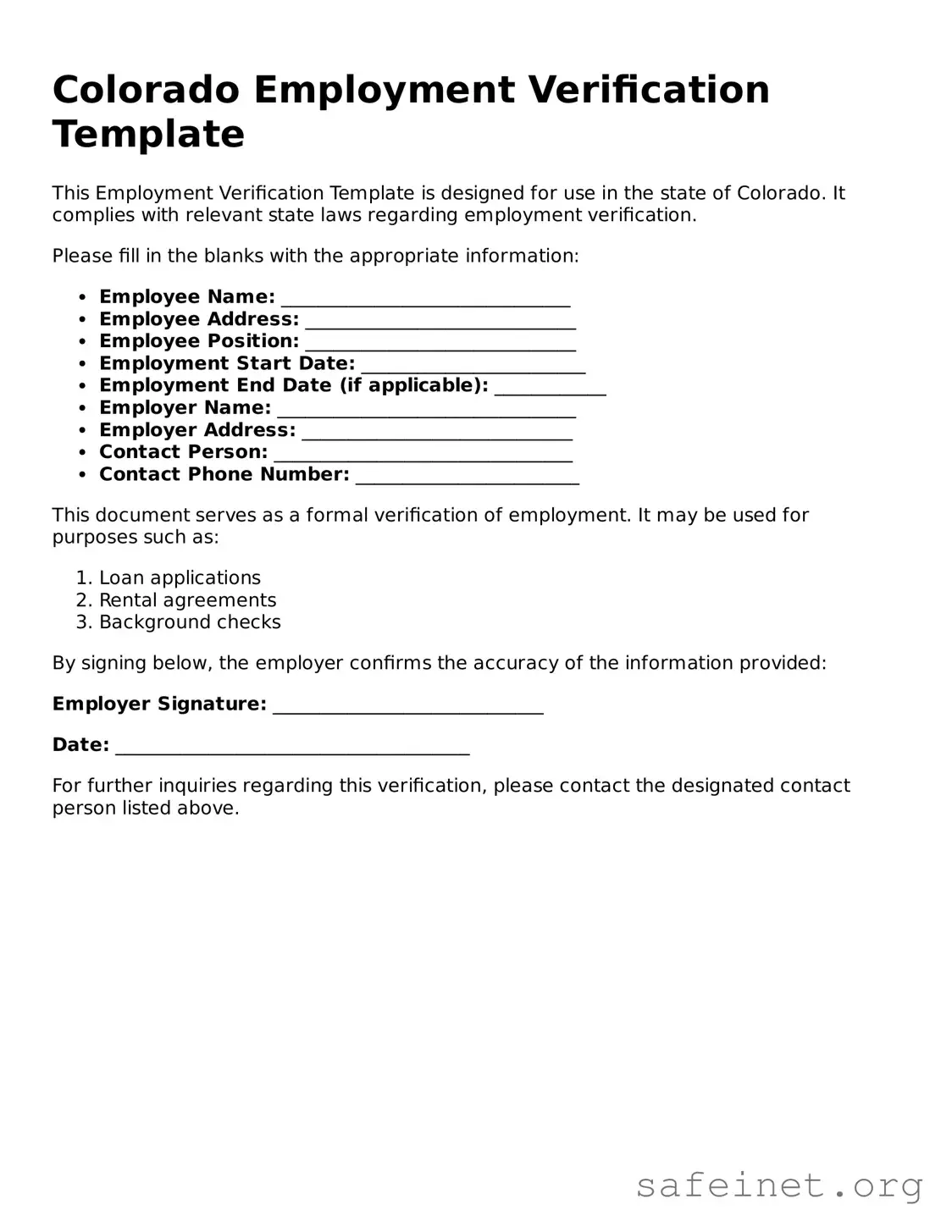
Colorado Employment Verification Template
This Employment Verification Template is designed for use in the state of Colorado. It complies with relevant state laws regarding employment verification.
Please fill in the blanks with the appropriate information:
This document serves as a formal verification of employment. It may be used for purposes such as:
By signing below, the employer confirms the accuracy of the information provided:
Employer Signature: _____________________________
Date: ______________________________________
For further inquiries regarding this verification, please contact the designated contact person listed above.
| Fact Name | Description |
|---|---|
| Purpose | The Colorado Employment Verification form is used to confirm the employment status of an individual in the state of Colorado. |
| Governing Law | This form is governed by Colorado Revised Statutes, specifically Section 8-2-122. |
| Required Information | Employers must provide details such as the employee's name, job title, and dates of employment. |
| Who Uses It | This form is typically used by employers, employees, and sometimes by third parties, like lenders or government agencies. |
| Submission Method | The form can be submitted electronically or in paper format, depending on the employer’s preference. |
| Confidentiality | Information provided in the form must be kept confidential and used solely for verification purposes. |
| Retention Period | Employers are advised to retain completed forms for a minimum of three years after the employee's termination. |
Once you have the Colorado Employment Verification form, you can begin filling it out. This form is essential for confirming employment status and details. Follow these steps to ensure that you complete it accurately.
After filling out the form, review all the information for accuracy. Once confirmed, submit the form as instructed, either electronically or in person, depending on the requirements. Keep a copy for your records.
What is the Colorado Employment Verification form?
The Colorado Employment Verification form is a document used to confirm an individual's employment status. Employers complete this form to provide verification to third parties, such as lenders or government agencies, when requested by an employee.
Who needs to fill out the Employment Verification form?
Typically, employers fill out the Employment Verification form. Employees may request this form to provide proof of employment for various purposes, including applying for loans, renting an apartment, or qualifying for government assistance.
What information is included in the Employment Verification form?
The form generally includes the employee's name, job title, employment dates, salary information, and the employer's contact details. Some forms may also ask for the employee's work status, such as full-time or part-time.
How can I request an Employment Verification form from my employer?
You can request the form by speaking directly to your HR department or your supervisor. It's helpful to explain why you need the verification, as this may expedite the process.
Is there a fee for obtaining an Employment Verification form?
Most employers do not charge a fee for providing employment verification. However, some companies may have policies regarding administrative fees, especially if a third-party service is involved.
How long does it take to receive the completed Employment Verification form?
The time it takes to receive the completed form can vary. Generally, employers aim to provide the verification within a few business days, but it may take longer depending on the company's policies and workload.
Can I use the Employment Verification form for multiple purposes?
Yes, you can use the Employment Verification form for various purposes. Once you have it, you can present it to lenders, landlords, or any other entity that requires proof of your employment status.
What should I do if my employer refuses to complete the Employment Verification form?
If your employer refuses to complete the form, you should first ask for the reason. If it’s due to company policy, consider discussing it with HR or your manager. You may also explore alternative forms of verification, such as pay stubs or tax documents.
Is the Employment Verification form legally required?
The Employment Verification form is not legally required, but many employers provide it as a courtesy. It serves as a reliable way to confirm employment status and is often requested by external parties.
Where can I find a sample Employment Verification form?
You can find sample Employment Verification forms online. Many websites provide templates that you can customize to fit your needs. However, it’s best to check with your employer to see if they have a preferred format.
Incomplete Information: One common mistake is failing to provide all required fields. Ensure that every section of the form is filled out completely, including names, addresses, and dates of employment.
Incorrect Dates: Many individuals mistakenly enter the wrong start or end dates of employment. Double-check these dates to avoid confusion and potential delays in processing.
Signature Issues: Some forget to sign the form or provide an electronic signature where required. Remember, an unsigned form may be considered invalid.
Providing Outdated Information: Using old job titles or contact information can lead to issues. Always ensure that the details reflect the most current information available.
When navigating employment verification in Colorado, several forms and documents may accompany the Employment Verification form. Each of these documents plays a crucial role in ensuring a smooth verification process. Below is a list of commonly used forms that can help clarify employment status and details.
Utilizing these documents alongside the Colorado Employment Verification form can enhance the verification process, ensuring all parties have the necessary information to confirm employment status accurately. By being prepared with these forms, individuals can streamline their verification experience and avoid potential delays.
The I-9 Form, or Employment Eligibility Verification, is a document required by the federal government to confirm an employee's identity and legal authorization to work in the United States. Like the Colorado Employment Verification form, the I-9 requires employers to collect information from employees, such as their name, address, and Social Security number. Both forms serve the purpose of ensuring compliance with employment laws, though the I-9 is federally mandated while the Colorado form is specific to state regulations.
The W-4 Form, also known as the Employee's Withholding Certificate, is another important document that shares similarities with the Colorado Employment Verification form. Both forms require employees to provide personal information, including their name and address. The W-4, however, focuses on tax withholding, helping employers determine the correct amount of federal income tax to withhold from an employee's paycheck. While the purpose differs, both documents are essential for proper payroll processing.
The Colorado Department of Labor and Employment's Wage Verification form is another document that resembles the Colorado Employment Verification form. Both forms are used to confirm employment status and details about the employee's job. The Wage Verification form specifically focuses on the employee's wages and hours worked, providing a financial snapshot that can be useful for various purposes, including loan applications or public assistance programs.
The Form 1099-MISC is used to report income received by independent contractors and freelancers. While it serves a different purpose than the Colorado Employment Verification form, both documents require information about the individual’s earnings and tax identification. The 1099-MISC is essential for tax reporting, ensuring that all income is accurately reported to the IRS, similar to how the Colorado form verifies employment status for compliance purposes.
The Form 4506-T, Request for Transcript of Tax Return, is a document that allows individuals to request tax return information from the IRS. Like the Colorado Employment Verification form, it collects personal information such as name and Social Security number. Both forms are often used in financial contexts, such as when applying for loans or other financial assistance, to verify income and employment history.
The Employment Reference Check form is commonly used by employers to verify an applicant's previous employment and qualifications. This form gathers information about the employee's past job titles, responsibilities, and reasons for leaving. Similar to the Colorado Employment Verification form, it is designed to validate an individual’s work history, ensuring that the information provided by job seekers is accurate and trustworthy.
The State Unemployment Insurance Claim form is another document that shares similarities with the Colorado Employment Verification form. Both are used to confirm employment status, but the Unemployment Insurance Claim form focuses on an individual's eligibility for unemployment benefits. It requires details about previous employment, wages, and reasons for job separation, which helps determine the claimant's eligibility for financial assistance.
The Form 1040, U.S. Individual Income Tax Return, requires individuals to report their annual income, similar to how the Colorado Employment Verification form collects information about employment status. Both documents necessitate accurate personal information and are crucial for compliance with federal and state regulations. The 1040 is primarily concerned with tax obligations, while the Colorado form focuses on employment verification.
The Affidavit of Employment Verification is a sworn statement used to confirm an individual's employment status. Similar to the Colorado Employment Verification form, this affidavit requires details such as the employee's name, job title, and duration of employment. Both documents serve to validate employment, but the affidavit often includes a legal affirmation from the employer, providing an additional layer of verification.
When filling out the Colorado Employment Verification form, it is essential to approach the task with care. Here are some important do's and don'ts to keep in mind.
Many people have misunderstandings about the Colorado Employment Verification form. Here are seven common misconceptions:
Understanding these misconceptions can help ensure compliance and streamline the employment verification process in Colorado.
Filling out and using the Colorado Employment Verification form is an important step for both employers and employees. Here are some key takeaways to keep in mind:
By following these guidelines, both employers and employees can ensure a smooth and efficient verification process.