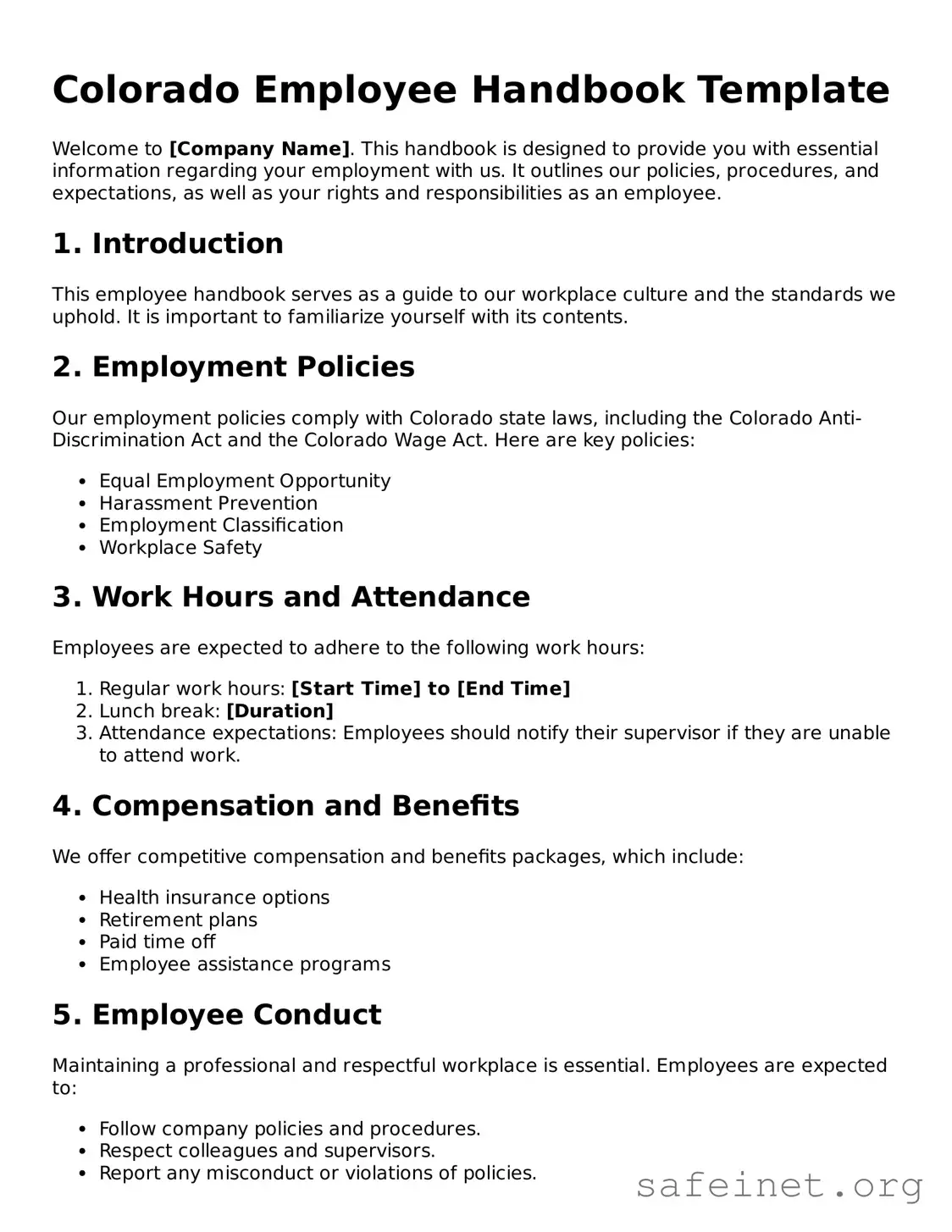
Creating a comprehensive employee handbook is an essential step for any business operating in Colorado. This document serves as a guide for employees, outlining company policies, procedures, and expectations. It typically includes sections on workplace conduct, attendance policies, benefits, and employee rights. Employers may also address issues such as harassment, safety protocols, and disciplinary actions. By providing clear information, the handbook helps foster a positive work environment and ensures that employees understand their responsibilities and the resources available to them. Additionally, having a well-structured handbook can protect businesses by demonstrating compliance with state and federal regulations. Ultimately, the Colorado Employee Handbook form is a vital tool that supports both employers and employees in navigating the workplace effectively.
Colorado Employee Handbook Template
Welcome to [Company Name]. This handbook is designed to provide you with essential information regarding your employment with us. It outlines our policies, procedures, and expectations, as well as your rights and responsibilities as an employee.
1. Introduction
This employee handbook serves as a guide to our workplace culture and the standards we uphold. It is important to familiarize yourself with its contents.
2. Employment Policies
Our employment policies comply with Colorado state laws, including the Colorado Anti-Discrimination Act and the Colorado Wage Act. Here are key policies:
3. Work Hours and Attendance
Employees are expected to adhere to the following work hours:
4. Compensation and Benefits
We offer competitive compensation and benefits packages, which include:
5. Employee Conduct
Maintaining a professional and respectful workplace is essential. Employees are expected to:
6. Disciplinary Procedures
Failure to adhere to company policies may result in disciplinary action, which can include:
7. Acknowledgment of Receipt
By signing below, you acknowledge that you have received and reviewed the Colorado Employee Handbook and understand the policies contained within.
Employee Name: [Employee Name]
Employee Signature: _______________________ Date: _______________
8. Contact Information
If you have any questions or need further clarification regarding any policies, please contact:
Human Resources: [HR Contact Name]
Email: [HR Email]
Phone: [HR Phone Number]
Thank you for being a part of [Company Name]. We look forward to working together to create a positive and productive work environment.
| Fact Name | Description |
|---|---|
| Purpose | The Colorado Employee Handbook serves as a guide for employees, outlining company policies, procedures, and expectations. |
| Legal Requirement | While not legally required, providing an employee handbook is considered best practice for employers in Colorado. |
| Governing Laws | The handbook should comply with Colorado labor laws, including the Colorado Wage Act and the Colorado Anti-Discrimination Act. |
| Contents | Typical contents include workplace policies, employee rights, disciplinary procedures, and benefits information. |
| At-Will Employment | It is essential to clarify the at-will employment relationship, indicating that either party can terminate employment at any time. |
| Updates | Employers should regularly update the handbook to reflect changes in laws or company policies, ensuring accuracy and compliance. |
| Employee Acknowledgment | Employers often require employees to sign an acknowledgment form, confirming that they have received and understood the handbook. |
| Non-Discrimination Policy | A clear non-discrimination policy must be included to comply with state and federal anti-discrimination laws. |
| Confidentiality Clause | Including a confidentiality clause can help protect sensitive company information and trade secrets. |
Completing the Colorado Employee Handbook form is an important step for ensuring that all employees understand the policies and procedures of your workplace. Follow the steps below to accurately fill out the form.
What is the Colorado Employee Handbook form?
The Colorado Employee Handbook form is a document that provides essential information about workplace policies, procedures, and employee rights. It serves as a guide for both employees and employers, ensuring that everyone understands the rules and expectations within the workplace. This form can be customized to reflect the specific needs of a business while adhering to state regulations.
Who needs to complete the Employee Handbook form?
All employers in Colorado are encouraged to create and maintain an Employee Handbook. This includes businesses of all sizes, from small startups to large corporations. Having a handbook helps ensure compliance with state laws and can protect the organization from potential legal issues.
What key topics should be included in the Employee Handbook?
An effective Employee Handbook should cover a variety of topics. These typically include workplace policies, employee benefits, code of conduct, anti-discrimination policies, leave policies, and procedures for reporting grievances. Including these topics helps to create a transparent work environment.
Is it necessary to have employees sign the Employee Handbook?
While it is not legally required to have employees sign the handbook, it is highly recommended. A signature can serve as proof that the employee has received, read, and understood the handbook. This can be beneficial in case of disputes regarding workplace policies.
How often should the Employee Handbook be updated?
The Employee Handbook should be reviewed and updated regularly, at least once a year. Changes in laws, company policies, or workplace practices may necessitate updates. Regular reviews help ensure that the handbook remains relevant and compliant with current regulations.
Can an Employee Handbook be used in legal disputes?
Yes, an Employee Handbook can be used in legal disputes. It serves as a reference point for both employers and employees regarding workplace expectations and policies. If a dispute arises, the handbook may be reviewed to determine if the policies were followed and if the employee was treated fairly according to those policies.
Where can I find resources to help create an Employee Handbook?
Resources for creating an Employee Handbook can be found through various organizations. The Colorado Department of Labor and Employment provides guidelines and templates. Additionally, many HR consulting firms and legal professionals offer services to help businesses develop comprehensive handbooks tailored to their specific needs.
When filling out the Colorado Employee Handbook form, individuals often encounter several common pitfalls. Understanding these mistakes can help ensure that the form is completed accurately and effectively. Below is a list of eight frequent errors:
Many people skip the instructions provided with the form. This can lead to misunderstandings about what information is required and how to present it.
Providing incorrect details such as name, address, or Social Security number can cause significant issues later. Always double-check this information before submission.
A signature is often a crucial component of the form. Failing to sign can render the document invalid, requiring resubmission.
Some individuals may overlook sections that are mandatory. Each part of the form is designed to gather essential information, so it is important to fill out all required fields.
Inconsistency in terminology can lead to confusion. For example, using different names for the same entity can complicate matters.
As circumstances change, so should the information on the form. Not updating it can result in outdated records that may affect employment status.
Each form often has a submission deadline. Missing this deadline can have consequences, including delays in processing or loss of employment benefits.
After submission, it is wise to keep a copy of the completed form for personal records. This can be helpful for future reference and verification.
By being aware of these common mistakes, employees can approach the completion of the Colorado Employee Handbook form with greater confidence and accuracy.
When creating or updating an employee handbook in Colorado, several other forms and documents may be necessary to ensure compliance with state and federal regulations. Each of these documents serves a specific purpose and can help clarify policies and expectations for employees. Below is a list of commonly used forms that often accompany the Colorado Employee Handbook.
Incorporating these documents alongside the Colorado Employee Handbook can enhance clarity and compliance within the workplace. It is essential to ensure that all forms are up-to-date and accurately reflect the company’s policies and legal obligations.
The Colorado Employee Handbook form shares similarities with the Employee Policy Manual. Both documents serve as foundational resources for employees, outlining workplace expectations and policies. While the Employee Handbook typically provides a general overview of company culture and values, the Policy Manual dives deeper into specific procedures and rules. This allows employees to understand not just what is expected of them, but also the rationale behind various policies.
Another document comparable to the Employee Handbook is the Onboarding Guide. This guide is often used during the initial stages of employment to help new hires acclimate to the company. Like the Employee Handbook, it covers essential information about company policies, benefits, and procedures. However, the Onboarding Guide is usually more focused on the first few weeks of employment, providing practical steps for new employees to integrate smoothly into their roles.
The Code of Conduct is also similar to the Employee Handbook in that it outlines acceptable behaviors and ethical standards within the workplace. Both documents aim to foster a positive work environment, but the Code of Conduct typically focuses more on ethical dilemmas and decision-making processes. It helps employees navigate complex situations by providing clear guidelines on how to act in accordance with company values.
Then there’s the Safety Manual, which, like the Employee Handbook, emphasizes the importance of a safe working environment. This document specifically addresses safety protocols, emergency procedures, and health regulations. While the Employee Handbook may touch on safety briefly, the Safety Manual goes into detail, ensuring that employees are well-informed about how to protect themselves and their coworkers.
The Benefits Guide is another document that aligns with the Employee Handbook. Both provide information about employee benefits, such as health insurance, retirement plans, and leave policies. The Benefits Guide, however, typically offers more detailed information about each benefit option, including eligibility requirements and enrollment procedures. This helps employees make informed decisions about their benefits.
Additionally, the Performance Review Process document is akin to the Employee Handbook, as both outline expectations for employee performance. While the Employee Handbook sets the stage for what constitutes good performance, the Performance Review Process document provides a structured approach to evaluating that performance. It details the criteria for assessments, feedback mechanisms, and potential outcomes of the review process.
Lastly, the Training and Development Plan bears similarities to the Employee Handbook. Both documents emphasize the importance of employee growth and development within the company. The Employee Handbook may mention training opportunities, but the Training and Development Plan outlines specific programs, resources, and timelines for skill enhancement. This ensures that employees are aware of how they can advance their careers within the organization.
When filling out the Colorado Employee Handbook form, it's important to follow certain guidelines. Here’s a straightforward list of things you should and shouldn’t do:
Misconceptions about the Colorado Employee Handbook form can lead to confusion for both employers and employees. Here are five common misunderstandings:
Many employers believe that having an employee handbook is not necessary. However, a well-structured handbook can clarify policies, protect the company, and provide guidance to employees.
Some think that there is a one-size-fits-all handbook template. In reality, each handbook should be tailored to fit the specific needs and culture of the organization.
Small businesses often overlook the importance of a handbook. Regardless of size, every business can benefit from having clear policies and procedures documented.
Many assume that a handbook is a static document. In truth, it should be reviewed and updated regularly to reflect changes in laws, company policies, and workplace culture.
Some employees may believe that the handbook guarantees job security or specific benefits. However, most handbooks include disclaimers stating that they do not constitute a contract.
When filling out and using the Colorado Employee Handbook form, there are several important points to keep in mind. Understanding these can help ensure that your handbook is effective and compliant with state laws.
By focusing on these key takeaways, employers can create an effective Employee Handbook that serves as a valuable tool for both management and staff.