Homepage > Blank Closing Disclosure Template
Article Structure

The Closing Disclosure form is a critical document that outlines the final terms of a mortgage loan and the associated closing costs. This form must be provided to borrowers at least three days before closing, allowing time to review and compare it with the Loan Estimate received earlier in the process. Key components of the Closing Disclosure include transaction details, loan information, and a breakdown of closing costs. It specifies the loan amount, interest rate, and monthly payments, while also highlighting any potential changes in costs after closing. Additionally, it details the cash required to close, including closing costs and any prepaids. The form also provides insight into the borrower’s transaction, summarizing what is due at closing and what has already been paid. Understanding this document is essential for making informed decisions and ensuring a smooth closing process.
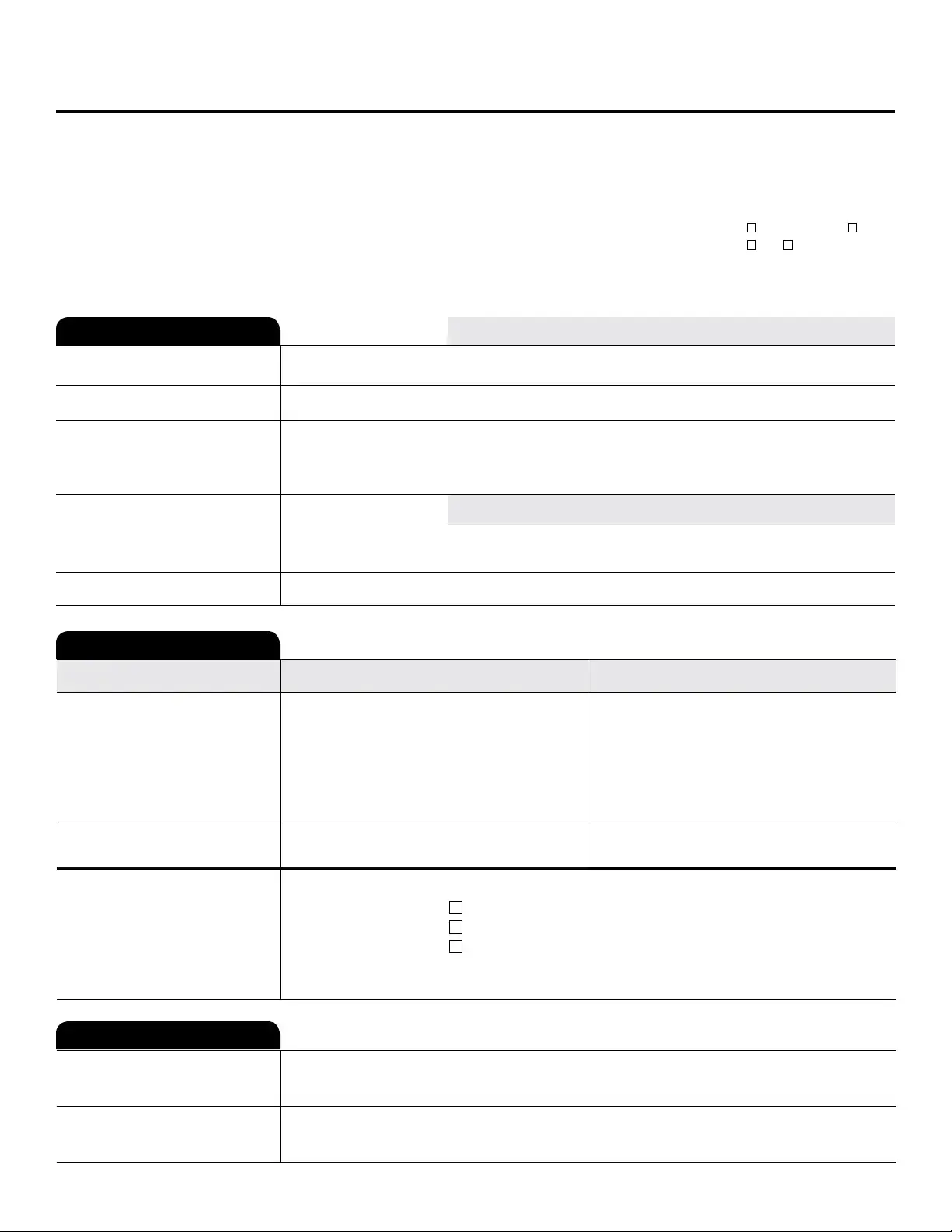
Form Sample

Projected Payments
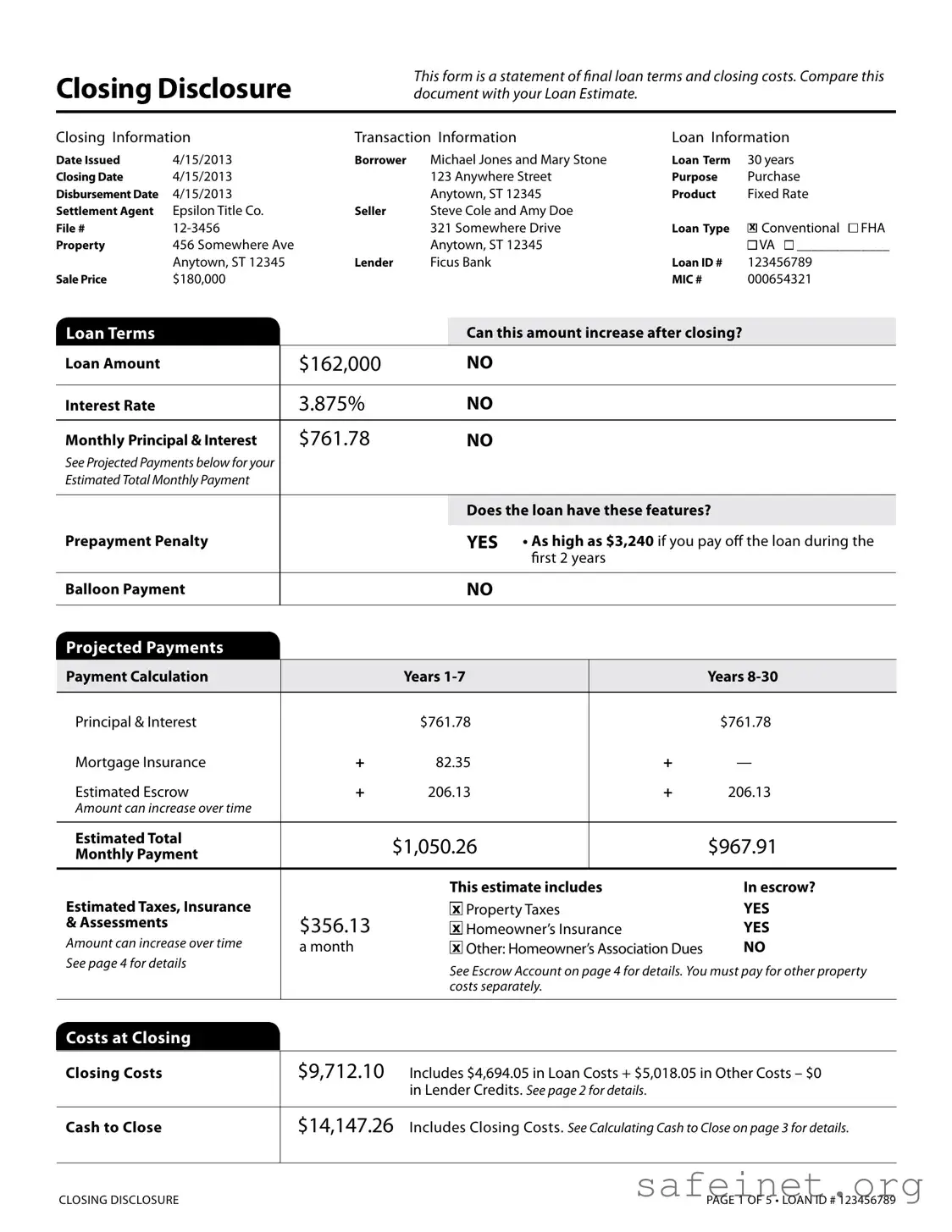
Loan Terms
Can this amount increase after closing?
Loan Amount
$162,000
NO
Interest Rate 3.875%
NO
Monthly Principal & Interest
See Projected Payments below for your
Estimated Total Monthly Payment
$761.78
NO
Does the loan have these features?
Prepayment Penalty
YES
As high as $3,240 if you pay o the loan during the
rst 2 years
Balloon Payment
NO
Costs at Closing
CLOSING DISCLOSURE PAGE 1 OF 5 • LOAN ID # 123456789
Payment Calculation Years 1-7 Years 8-30
Principal & Interest
Mortgage Insurance
Estimated Escrow
Amount can increase over time
$761.78
+ 82.35
+ 206.13
$761.78
+
+ 206.13
Estimated Total
Monthly Payment
$1,050.26 $967.91
Estimated Taxes, Insurance
& Assessments
Amount can increase over time
See page 4 for details
$356.13
a month
See Escrow Account on page 4 for details. You must pay for other property
costs separately.
This estimate includes In escrow?
x
Property Taxes
YES
x
Homeowner’s Insurance
YES
x
Other: Homeowners Association Dues
NO
Closing Costs $9,712.10 Includes $4,694.05 in Loan Costs + $5,018.05 in Other Costs – $0
in Lender Credits. See page 2 for details.
Cash to Close $14,147.26 Includes Closing Costs. See Calculating Cash to Close on page 3 for details.
Transaction Information
Borrower Michael Jones and Mary Stone
123 Anywhere Street
Anytown, ST 12345
Seller Steve Cole and Amy Doe
321 Somewhere Drive
Anytown, ST 12345
Lender Ficus Bank
Loan Information
Loan Term 30 years
Purpose Purchase
Product Fixed Rate
Loan Type
x
Conventional FHA
VA _____________
Loan ID # 123456789
MIC # 000654321
Closing Information
Date Issued 4/15/2013
Closing Date 4/15/2013
Disbursement Date 4/15/2013
Settlement Agent Epsilon Title Co.
File # 12-3456
Property 456 Somewhere Ave
Anytown, ST 12345
Sale Price $180,000
This form is a statement of nal loan terms and closing costs. Compare this
document with your Loan Estimate.
Closing Disclosure
Borrower-Paid Seller-Paid
Paid by
Others
At Closing Before Closing At Closing Before Closing
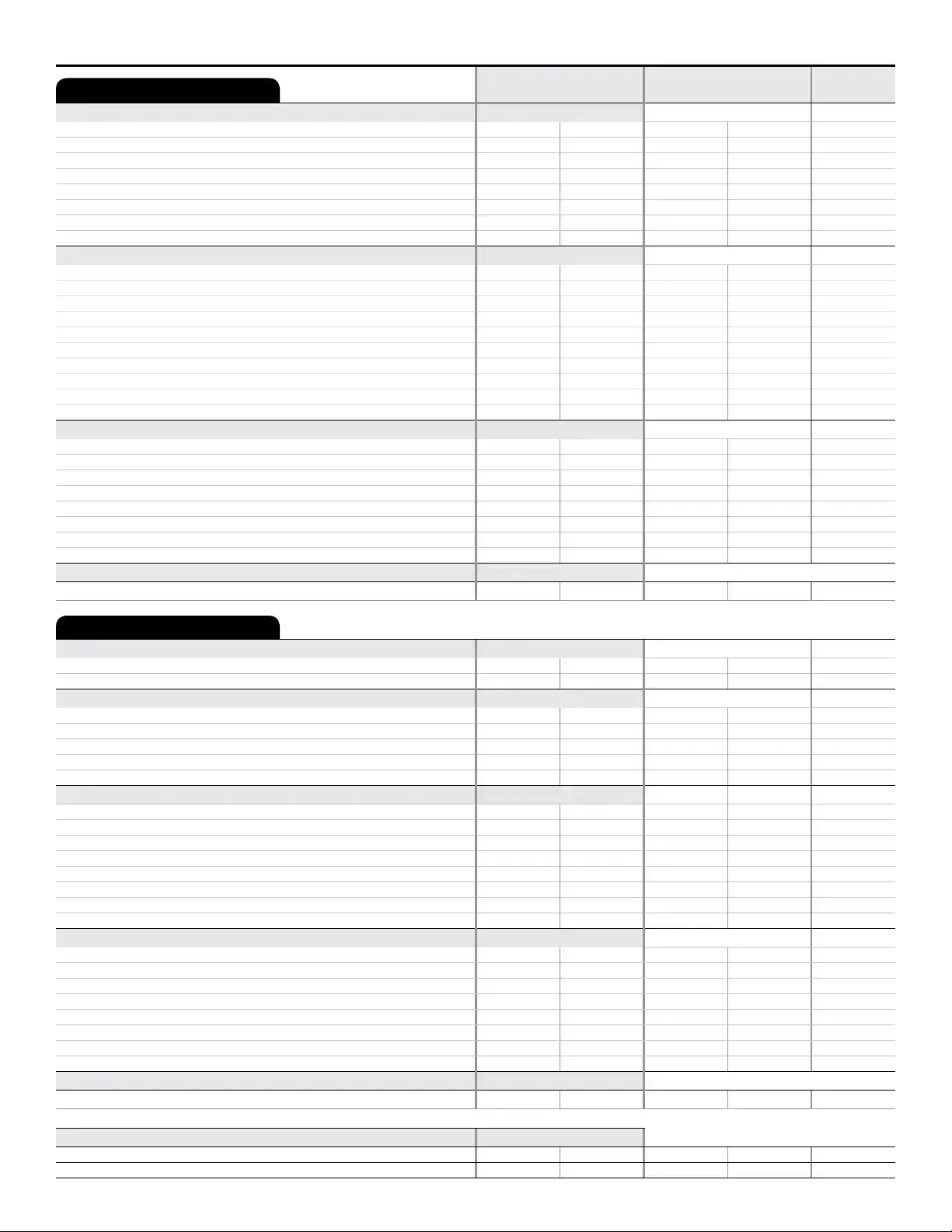
A. Origination Charges $1,802.00
01 0.25 % of Loan Amount (Points) $405.00
02 Application Fee $300.00
03 Underwriting Fee $1,097.00
04
05
06
07
08
B. Services Borrower Did Not Shop For $236.55
01 Appraisal Fee to John Smith Appraisers Inc. $405.00
02 Credit Report Fee to Information Inc.
$29.80
03 Flood Determination Fee to Info Co. $20.00
04 Flood Monitoring Fee to Info Co. $31.75
05 Tax Monitoring Fee to Info Co. $75.00
06 Tax Status Research Fee to Info Co. $80.00
07
08
09
10
C. Services Borrower Did Shop For $2,655.50
01 Pest Inspection Fee to Pests Co. $120.50
02 Survey Fee to Surveys Co. $85.00
03 Title – Insurance Binder to Epsilon Title Co. $650.00
04 Title – Lenders Title Insurance to Epsilon Title Co. $500.00
05 Title – Settlement Agent Fee to Epsilon Title Co. $500.00
06 Title – Title Search to Epsilon Title Co. $800.00
07
08
D. TOTAL LOAN COSTS Borrower-Paid $4,694.05
Loan Costs Subtotals (A + B + C) $4,664.25 $29.80
Loan Costs
CLOSING DISCLOSURE PAGE 2 OF 5 • LOAN ID # 123456789
J. TOTAL CLOSING COSTS Borrower-Paid $9,712.10
Closing Costs Subtotals D + I $9,682.30 $29.80 $12,800.00 $750.00 $405.00
Lender Credits
Closing Cost Details
Other Costs
E. Taxes and Other Government Fees $85.00
01 Recording Fees Deed: $40.00 Mortgage: $45.00
$85.00
02 Transfer Tax to Any State $950.00
F. Prepaids $2,120.80
01 Homeowners Insurance Premium ( 12 mo.) to Insurance Co.
$1,209.96
02 Mortgage Insurance Premium ( mo.)
03 Prepaid Interest ( $17.44 per day from 4/15/13 to 5/1/13 )
$279.04
04 Property Taxes ( 6 mo.) to Any County USA
$631.80
05
G. Initial Escrow Payment at Closing $412.25
01 Homeowners Insurance $100.83 per month for 2 mo. $201.66
02 Mortgage Insurance per month for mo.
03 Property Taxes $105.30 per month for 2 mo. $210.60
04
05
06
07
08 Aggregate Adjustment – 0.01
H. Other $2,400.00
01 HOA Capital Contribution to HOA Acre Inc. $500.00
02 HOA Processing Fee to HOA Acre Inc. $150.00
03 Home Inspection Fee to Engineers Inc. $750.00 $750.00
04 Home Warranty Fee to XYZ Warranty Inc. $450.00
05 Real Estate Commission to Alpha Real Estate Broker $5,700.00
06 Real Estate Commission to Omega Real Estate Broker $5,700.00
07 Title – Owner’s Title Insurance (optional) to Epsilon Title Co. $1,000.00
08
I. TOTAL OTHER COSTS Borrower-Paid $5,018.05
Other Costs Subtotals (E + F + G + H) $5,018.05
Calculating Cash to Close
BORROWER’S TRANSACTION
K. Due from Borrower at Closing $189,762.30
01 Sale Price of Property $180,000.00
02 Sale Price of Any Personal Property Included in Sale
03 Closing Costs Paid at Closing (J) $9,682.30
04
Adjustments
05
06
07
Adjustments for Items Paid by Seller in Advance
08 City/Town Taxes to
09 County Taxes to
10 Assessments to
11 HOA Dues 4/15/13 to 4/30/13 $80.00
12
13
14
15
L. Paid Already by or on Behalf of Borrower at Closing $175,615.04
01 Deposit $10,000.00
02 Loan Amount $162,000.00
03 Existing Loan(s) Assumed or Taken Subject to
04
05 Seller Credit $2,500.00
Other Credits
06 Rebate from Epsilon Title Co. $750.00
07
Adjustments
08
09
10
11
Adjustments for Items Unpaid by Seller
12 City/Town Taxes 1/1/13 to 4/14/13 $365.04
13 County Taxes to
14 Assessments to
15
16
17
CALCULATION
Total Due from Borrower at Closing (K) $189,762.30
Total Paid Already by or on Behalf of Borrower at Closing (L) – $175,615.04
Cash to Close
x
From
To Borrower $14,147.26
SELLER’S TRANSACTION
M. Due to Seller at Closing $180,080.00
01 Sale Price of Property $180,000.00
02 Sale Price of Any Personal Property Included in Sale
03
04
05
06
07
08
Adjustments for Items Paid by Seller in Advance
09 City/Town Taxes to
10 County Taxes to
11 Assessments to
12 HOA Dues 4/15/13 to 4/30/13 $80.00
13
14
15
16
N. Due from Seller at Closing $115,665.04
01 Excess Deposit
02 Closing Costs Paid at Closing (J) $12,800.00
03 Existing Loan(s) Assumed or Taken Subject to
04 Payo of First Mortgage Loan $100,000.00
05 Payo of Second Mortgage Loan
06
07
08 Seller Credit $2,500.00
09
10
11
12
13
Adjustments for Items Unpaid by Seller
14 City/Town Taxes 1/1/13 to 4/14/13 $365.04
15 County Taxes to
16 Assessments to
17
18
19
CALCULATION
Total Due to Seller at Closing (M) $180,080.00
Total Due from Seller at Closing (N) – $115,665.04
Cash From
x
To Seller $64,414.96
Summaries of Transactions
CLOSING DISCLOSURE PAGE 3 OF 5 • LOAN ID # 123456789
Loan Estimate Final Did this change?
Total Closing Costs (J) $8,054.00 $9,712.10 YES • See Total Loan Costs (D) and Total Other Costs (I)
Closing Costs Paid Before Closing $0  $29.80 YES You paid these Closing Costs before closing
Closing Costs Financed
(Paid from your Loan Amount) $0 $0 NO
Down Payment/Funds from Borrower $18,000.00 $18,000.00 NO
Deposit – $10,000.00 – $10,000.00 NO
Funds for Borrower $0 $0 NO
Seller Credits $0 $2,500.00 YESSee Seller Credits in Section L
Adjustments and Other Credits $0 $1,035.04 YESSee details in Sections K and L
Cash to Close $16,054.00 $14,147.26
Use this table to see a summary of your transaction.
Use this table to see what has changed from your Loan Estimate.
Assumption
If you sell or transfer this property to another person, your lender
will allow, under certain conditions, this person to assume this
loan on the original terms.
will not allow assumption of this loan on the original terms.
Demand Feature
Your loan
has a demand feature, which permits your lender to require early
repayment of the loan. You should review your note for details.
does not have a demand feature.
Late Payment
If your payment is more than 15 days late, your lender will charge a
late fee of 5% of the monthly principal and interest payment.
Negative Amortization (Increase in Loan Amount)
Under your loan terms, you
are scheduled to make monthly payments that do not pay all of
the interest due that month. As a result, your loan amount will
increase (negatively amortize), and your loan amount will likely
become larger than your original loan amount. Increases in your
loan amount lower the equity you have in this property.
may have monthly payments that do not pay all of the interest
due that month. If you do, your loan amount will increase
(negatively amortize), and, as a result, your loan amount may
become larger than your original loan amount. Increases in your
loan amount lower the equity you have in this property.
do not have a negative amortization feature.
Partial Payments
Your lender
may accept payments that are less than the full amount due
(partial payments) and apply them to your loan.
may hold them in a separate account until you pay the rest of the
payment, and then apply the full payment to your loan.
does not accept any partial payments.
If this loan is sold, your new lender may have a dierent policy.
Security Interest
You are granting a security interest in
456 Somewhere Ave., Anytown, ST 12345
You may lose this property if you do not make your payments or
satisfy other obligations for this loan.
CLOSING DISCLOSURE PAGE 4 OF 5 • LOAN ID # 123456789
0
Loan Disclosures
Escrow Account
For now, your loan
will have an escrow account (also called an “impound” or “trust”
account) to pay the property costs listed below. Without an escrow
account, you would pay them directly, possibly in one or two large
payments a year. Your lender may be liable for penalties and interest
for failing to make a payment.
Escrow
Escrowed
Property Costs
over Year 1
$2,473.56 Estimated total amount over year 1 for
your escrowed property costs:
Homeowner’s Insurance
Property Taxes
Non-Escrowed
Property Costs
over Year 1
$1,800.00 Estimated total amount over year 1 for
your non-escrowed property costs:
Homeowner’s Association Dues
You may have other property costs.
Initial Escrow
Payment
$412.25 A cushion for the escrow account you
pay at closing. See Section G on page 2.
Monthly Escrow
Payment
$206.13 The amount included in your total
monthly payment.
No Escrow
Estimated
Property Costs
over Year 1
Estimated total amount over year 1. You
must pay these costs directly, possibly
in one or two large payments a year.
Escrow Waiver Fee
will not have an escrow account because you declined it your
lender does not oer one. You must directly pay your property
costs, such as taxes and homeowner’s insurance. Contact your
lender to ask if your loan can have an escrow account.
In the future,
Your property costs may change and, as a result, your escrow pay-
ment may change. You may be able to cancel your escrow account,
but if you do, you must pay your property costs directly. If you fail
to pay your property taxes, your state or local government may (1)
impose nes and penalties or (2) place a tax lien on this property. If
you fail to pay any of your property costs, your lender may (1) add
the amounts to your loan balance, (2) add an escrow account to your
loan, or (3) require you to pay for property insurance that the lender
buys on your behalf, which likely would cost more and provide fewer
benets than what you could buy on your own.
Additional Information About This Loan
x
x
x
x
x
Contact Information
Conrm Receipt
Other Disclosures
Appraisal
If the property was appraised for your loan, your lender is required to
give you a copy at no additional cost at least 3 days before closing.
If you have not yet received it, please contact your lender at the
information listed below.
Contract Details
See your note and security instrument for information about
• what happens if you fail to make your payments,
• what is a default on the loan,
situations in which your lender can require early repayment of the
loan, and
• the rules for making payments before they are due.
Liability after Foreclosure
If your lender forecloses on this property and the foreclosure does not
cover the amount of unpaid balance on this loan,
state law may protect you from liability for the unpaid balance. If you
renance or take on any additional debt on this property, you may
lose this protection and have to pay any debt remaining even after
foreclosure. You may want to consult a lawyer for more information.
state law does not protect you from liability for the unpaid balance.
Renance
Renancing this loan will depend on your future nancial situation,
the property value, and market conditions. You may not be able to
renance this loan.
Tax Deductions
If you borrow more than this property is worth, the interest on the
loan amount above this property’s fair market value is not deductible
from your federal income taxes. You should consult a tax advisor for
more information.
By signing, you are only conrming that you have received this form. You do not have to accept this loan because you have signed or received
this form.
Applicant Signature Date Co-Applicant Signature Date
CLOSING DISCLOSURE PAGE 5 OF 5 • LOAN ID # 123456789
Total of Payments. Total you will have paid after
you make all payments of principal, interest,
mortgage insurance, and loan costs, as scheduled.
$285,803.36
Finance Charge. The dollar amount the loan will
cost you.
$118,830.27
Amount Financed. The loan amount available after
paying your upfront nance charge.
$162,000.00
Annual Percentage Rate (APR). Your costs over
the loan term expressed as a rate. This is not your
interest rate.
4.174%
Total Interest Percentage (TIP). The total amount
of interest that you will pay over the loan term as a
percentage of your loan amount.
69.46%
Loan Calculations
x
Lender Mortgage Broker Real Estate Broker
(B)
Real Estate Broker
(S)
Settlement Agent
Name Ficus Bank
FRIENDLY MORTGAGE
BROKER INC.
Omega Real Estate
Broker Inc.
Alpha Real Estate
Broker Co.
Epsilon Title Co.
Address 4321 Random Blvd.
Somecity, ST 12340
1234 Terrapin Dr.
Somecity, MD 54321
789 Local Lane
Sometown, ST 12345
45
987 Suburb Ct.
Someplace, ST 12340
123 Commerce Pl.
Somecity, ST 12344
NMLS ID
222222
ST License ID Z765416 Z61456 Z61616
Contact Joe Smith
JIM TAYLOR
Samuel Green Joseph Cain Sarah Arnold
Contact NMLS ID 12345
394784
Contact
ST License ID
P16415 P51461 PT1234
Email joesmith@
cusbank.com
JTAYLOR
FRNDLYMTGBRKR.CM
[email protected] joe@alphare.biz sarah@
epsilontitle.com
Phone 123-456-7890
3334445555
123-555-1717 321-555-7171 987-555-4321
Questions? If you have questions about the
loan terms or costs on this form, use the contact
information below. To get more information
or make a complaint, contact the Consumer
Financial Protection Bureau at
www.consumernance.gov/mortgage-closing
?

Document Specifications

Fact Name Details
Purpose The Closing Disclosure form outlines the final loan terms and closing costs for a mortgage transaction.
Comparison This document should be compared with the Loan Estimate received earlier in the mortgage process.
Closing Costs The total closing costs listed on the form amount to $9,712.10, which includes various fees associated with the loan.
Cash to Close The cash required to close on the loan is $14,147.26, which incorporates closing costs and other adjustments.
Loan Information The form specifies key loan details, including the loan amount of $162,000 and an interest rate of 3.875%.
Prepayment Penalty There is a prepayment penalty of up to $3,240 if the loan is paid off within the first two years.
Escrow Account The loan will have an escrow account to manage property costs, including taxes and insurance.
Loan Type This mortgage is a fixed-rate conventional loan with a term of 30 years.
Governing Law The Closing Disclosure form is governed by the Truth in Lending Act (TILA) and the Real Estate Settlement Procedures Act (RESPA).

Steps to Filling Out Closing Disclosure

After receiving the Closing Disclosure form, you will need to carefully fill it out to ensure that all information is accurate and complete. This form outlines your final loan terms and closing costs, so accuracy is crucial. Follow these steps to fill out the form correctly.

  1. Locate the Closing Information section. Fill in the date issued, which should be the same as the closing date.
  2. In the Transaction Information section, enter the address of the property being purchased.
  3. Fill in the Loan Information section. Include the loan amount, interest rate, and loan term. Verify that these figures match your Loan Estimate.
  4. Check the Loan Terms subsection. Answer whether the loan amount, interest rate, or monthly payments can increase after closing.
  5. In the Projected Payments section, fill in the estimated monthly payments for the first seven years and the remaining loan term. Include any mortgage insurance and estimated escrow amounts.
  6. Move to the Costs at Closing section. Enter the total closing costs and cash to close amounts, ensuring they match your calculations.
  7. In the Closing Cost Details section, break down the loan costs, services not shopped for, and services shopped for. Fill in the amounts accurately for each item listed.
  8. Review the Calculating Cash to Close table. Ensure all figures are correct and reflect any changes from your Loan Estimate.
  9. Fill out the Summaries of Transactions section. Provide details on amounts due from the borrower and amounts already paid.
  10. Complete the Additional Information About This Loan section. Confirm any loan disclosures that apply to your situation.
  11. Finally, confirm the Contact Information section is complete. Ensure all lender and broker details are accurate.
  12. Sign and date the form in the Confirm Receipt section to acknowledge receipt of the document.

More About Closing Disclosure

What is the Closing Disclosure form?

The Closing Disclosure form is a detailed document that outlines the final terms of your loan and the closing costs associated with it. It serves as a comparison tool against your initial Loan Estimate, helping you understand what you will pay at closing. The form includes essential information such as the loan amount, interest rate, monthly payments, and any applicable fees. It is important to review this document carefully to ensure all terms are accurate before finalizing your mortgage agreement.

When should I receive the Closing Disclosure?

You should receive the Closing Disclosure at least three business days before your closing date. This timeline allows you to review the document thoroughly and ask any questions or raise concerns with your lender. If you notice any discrepancies or have questions about specific charges, it is advisable to address them as soon as possible to avoid any surprises on closing day.

What should I look for when reviewing my Closing Disclosure?

When reviewing your Closing Disclosure, pay close attention to several key areas. First, check the loan terms, including the loan amount, interest rate, and monthly payments. Next, examine the closing costs section to understand what you will be responsible for paying. Look for any fees that seem higher than expected or were not disclosed previously. Additionally, review the projected payments, which provide insight into how your monthly expenses may change over time. If anything seems unclear or incorrect, don’t hesitate to reach out to your lender for clarification.

Can the terms in the Closing Disclosure change before closing?

While the Closing Disclosure provides the final terms of your loan, some elements may change before closing. However, any changes must be communicated to you, and you should receive a revised Closing Disclosure if significant adjustments occur. For instance, if your loan amount or interest rate changes, you will be notified. It's crucial to stay in contact with your lender and ask for updates to ensure that you are fully informed about any changes that could affect your closing experience.

Common mistakes

  1. Ignoring the Comparison with the Loan Estimate: One of the most common mistakes is failing to compare the Closing Disclosure with the Loan Estimate. This document outlines the final loan terms and closing costs, and discrepancies can indicate potential issues or misunderstandings.

  2. Overlooking Closing Costs: Many people focus solely on the loan amount and interest rate, neglecting to scrutinize the closing costs. These costs can significantly impact the total amount due at closing, so it’s crucial to review them carefully.

  3. Misunderstanding the Escrow Account: Some borrowers may not fully grasp the implications of having an escrow account. This account is used to pay property taxes and insurance, and failing to understand its purpose can lead to unexpected financial burdens later.

  4. Not Asking Questions: Lastly, many individuals hesitate to ask questions about the form. Whether it's about specific fees or terms, seeking clarification is essential. Ignoring this step can lead to confusion and financial missteps down the line.

Documents used along the form

The Closing Disclosure form is a critical document in the home buying process, detailing the final terms of a loan and the associated closing costs. However, several other forms and documents are often used in conjunction with it to ensure a smooth transaction. Here’s a brief overview of these essential documents.

  • Loan Estimate: This document provides an estimate of loan terms and costs. It helps borrowers compare offers from different lenders before they finalize their loan.
  • Appraisal Report: An appraisal assesses the property's value. Lenders require this document to ensure the property is worth the amount being borrowed.
  • Title Insurance Policy: This policy protects against potential defects in the title of the property. It ensures that the buyer has a clear and marketable title.
  • Deed: The deed is a legal document that transfers ownership of the property from the seller to the buyer. It is filed with the local government to record the change in ownership.
  • Settlement Statement (HUD-1): This document outlines all the costs and fees associated with the closing of a real estate transaction. It provides a detailed account of the financial aspects of the deal.
  • Borrower’s Affidavit: This sworn statement confirms the borrower’s identity and verifies that the information provided during the loan application is accurate.
  • Homeowners Insurance Policy: This insurance protects the buyer against losses due to damage to the property. Lenders often require proof of this insurance before closing.
  • IRS Form 4506-T: This form allows lenders to request a transcript of the borrower’s tax returns. It helps verify income and financial stability.
  • Power of Attorney (if applicable): If someone is signing on behalf of the borrower, this document grants them the authority to act in the borrower’s stead during the closing process.

Each of these documents plays a vital role in the home buying process, ensuring that all parties are protected and informed. Understanding them can help buyers navigate the complexities of closing with confidence.

Similar forms

The Loan Estimate is a key document that provides borrowers with an overview of the estimated costs associated with a mortgage. This document is issued early in the mortgage process and includes details such as loan terms, projected monthly payments, and estimated closing costs. Similar to the Closing Disclosure, the Loan Estimate helps borrowers compare different loan offers and understand their financial obligations. Both documents serve to ensure transparency, but while the Loan Estimate outlines expected costs, the Closing Disclosure presents the final terms and costs right before closing.

The HUD-1 Settlement Statement is another important document that resembles the Closing Disclosure. Historically used in real estate transactions, the HUD-1 provided a detailed breakdown of all costs associated with closing a mortgage. Like the Closing Disclosure, it itemized fees and charges, allowing buyers and sellers to see where their money was going. However, the HUD-1 has largely been replaced by the Closing Disclosure for most residential transactions, as the latter is designed to be more user-friendly and easier to understand for borrowers.

The Good Faith Estimate (GFE) was previously used to inform borrowers about the costs associated with obtaining a mortgage. Similar to the Loan Estimate, the GFE provided an estimate of closing costs and loan terms. However, the GFE has been phased out in favor of the Loan Estimate and Closing Disclosure, which are more standardized and easier to compare. Both the GFE and the Loan Estimate aim to give borrowers a clearer picture of their financial commitments, but the newer documents are intended to be more precise and informative.

The Truth in Lending Disclosure (TIL) is a document that details the costs of borrowing money, including the annual percentage rate (APR) and total finance charges. While the TIL focuses more on the cost of credit rather than specific closing costs, it shares a common goal with the Closing Disclosure: to inform borrowers about their financial obligations. Both documents are essential in helping consumers understand what they are agreeing to when they take out a loan, ensuring they are well-informed before making a commitment.

The Promissory Note is a legal document that outlines the borrower's promise to repay the loan under specified terms. While it differs from the Closing Disclosure in that it is not a cost breakdown, it is similar in that it serves as a crucial component of the mortgage process. The Promissory Note details the loan amount, interest rate, and repayment schedule, providing clarity on the borrower's obligations. Both documents are integral to the mortgage transaction, establishing the framework for repayment and the costs associated with the loan.

The Mortgage or Deed of Trust is another document that is closely related to the Closing Disclosure. This legal instrument secures the loan by giving the lender a claim to the property should the borrower default. While the Closing Disclosure focuses on the financial aspects of the transaction, the Mortgage or Deed of Trust outlines the rights and responsibilities of both parties. Both documents are essential for a complete understanding of the mortgage process, as they work together to define the terms of the loan and the security for the lender.

Dos and Don'ts

When filling out the Closing Disclosure form, it is essential to approach the process with care. Here are four important do's and don'ts to consider:

  • Do compare the Closing Disclosure with your Loan Estimate to ensure accuracy.
  • Do verify all personal information, including names and addresses, to avoid any discrepancies.
  • Do review the closing costs carefully and ask questions about any fees you do not understand.
  • Do keep a copy of the signed form for your records after closing.
  • Don't rush through the form; take your time to understand each section.
  • Don't ignore any errors; address them immediately with your lender or settlement agent.
  • Don't forget to check for any changes in loan terms compared to your initial Loan Estimate.
  • Don't assume that all information is correct; double-check all figures and terms.

Misconceptions

  • Misconception 1: The Closing Disclosure is the same as the Loan Estimate.
  • This is not accurate. The Closing Disclosure outlines the final terms and costs of your loan, while the Loan Estimate provides an initial overview of the estimated costs. The two documents serve different purposes and should be compared carefully.

  • Misconception 2: The Closing Disclosure is only for the buyer.
  • In reality, the Closing Disclosure is important for both buyers and sellers. It details all the financial aspects of the transaction, including costs associated with the sale, which affect both parties.

  • Misconception 3: You cannot negotiate the closing costs listed in the Closing Disclosure.
  • This is misleading. While some fees are set and non-negotiable, others can be discussed. Buyers and sellers should feel empowered to ask questions and negotiate where possible.

  • Misconception 4: The Closing Disclosure is not a legally binding document.
  • This is incorrect. The Closing Disclosure is a legally binding document that outlines the terms of the loan and the closing costs. Signing it indicates your agreement to these terms.

  • Misconception 5: You cannot change your mind after signing the Closing Disclosure.
  • While it is true that signing the document indicates acceptance, there are circumstances under which you can still withdraw or renegotiate your loan. It is advisable to communicate with your lender if you have concerns.

Key takeaways

The Closing Disclosure form is an essential document in the home buying process. Here are some key takeaways to help you understand its significance and how to use it effectively:

  • Compare with Loan Estimate: Always compare the Closing Disclosure with your Loan Estimate. This helps ensure that the final terms and costs align with what you were initially quoted.
  • Review Closing Costs: Take a close look at the closing costs listed. They can include loan costs and other costs, which together impact your total cash to close.
  • Understand Your Payments: The form outlines your monthly payments, including principal, interest, mortgage insurance, and estimated taxes. This gives you a clear picture of your financial obligations.
  • Check for Changes: If there are any changes from your Loan Estimate, note them. Significant changes may require further explanation from your lender.
  • Identify Prepayment Penalties: Be aware of any prepayment penalties associated with your loan. This could affect your ability to pay off the loan early without incurring extra costs.
  • Know Your Rights: The Closing Disclosure provides information about your rights, including what happens if you miss payments or if the property is foreclosed.
  • Ask Questions: If anything is unclear, don’t hesitate to reach out to your lender or settlement agent for clarification. Understanding every detail is crucial before you sign.

By keeping these points in mind, you can navigate the closing process with greater confidence and ensure that you are fully informed about your loan and its terms.