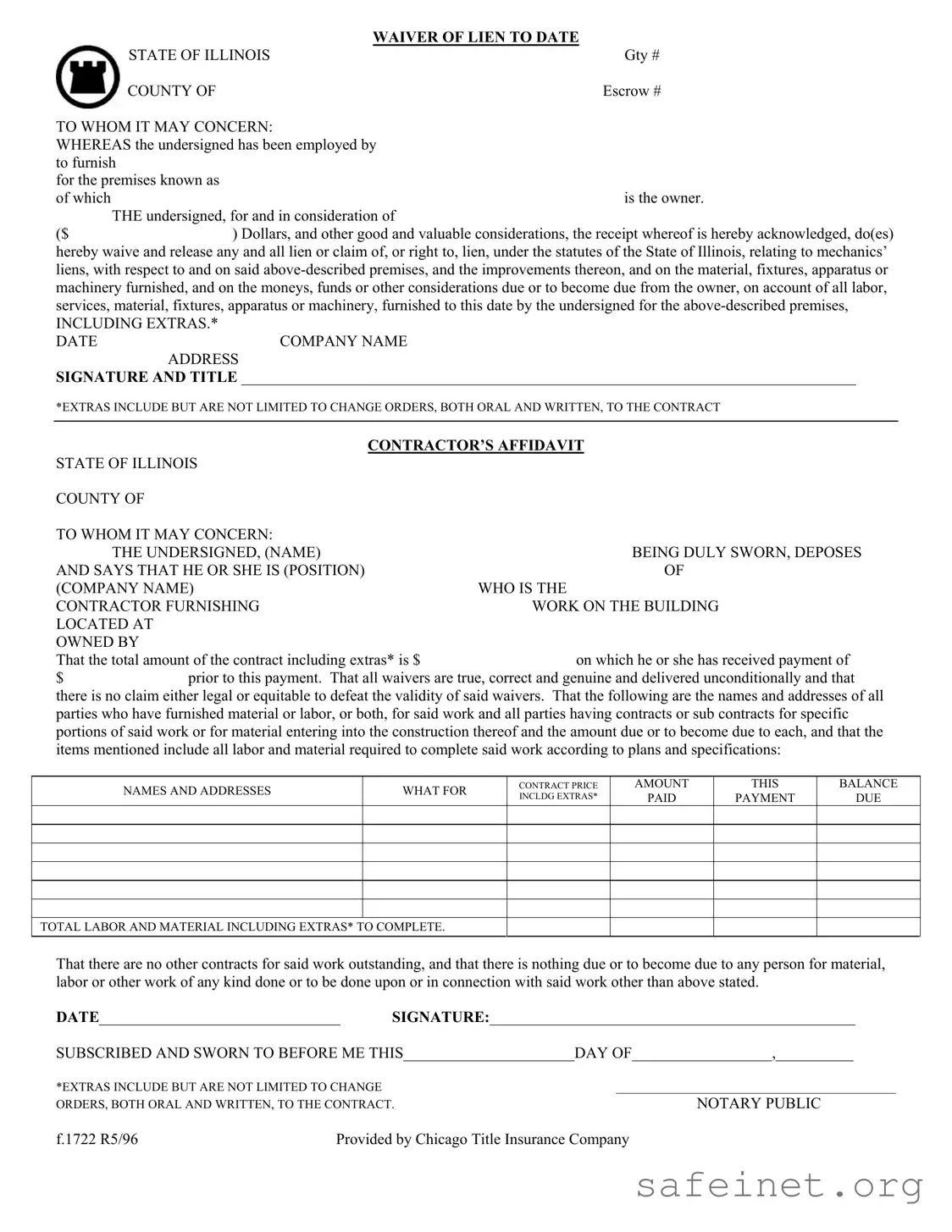
The Chicago Title Waiver Format form plays a crucial role in the construction and real estate industries, particularly in Illinois. This document serves as a formal waiver of lien, allowing contractors and subcontractors to relinquish any claims they may have against a property for unpaid work or materials. It specifies the company name, the property in question, and the amount of consideration received for the work performed. By signing this form, the undersigned acknowledges receipt of payment and agrees to waive any future lien rights related to the property, thus protecting the owner's interests. The form also includes a contractor's affidavit, which requires the contractor to affirm the validity of the waivers and disclose any outstanding payments owed to other parties involved in the project. This transparency is essential for ensuring that all labor and materials provided are accounted for, promoting trust and clarity among all stakeholders. Overall, the Chicago Title Waiver Format is a vital tool in facilitating smooth transactions and maintaining good relationships in the construction process.
| Fact Name | Fact Description |
|---|---|
| Document Purpose | The Chicago Title Waiver Format form is used to waive any lien rights under Illinois law related to mechanics' liens for construction work performed. |
| Governing Law | This form is governed by the statutes of the State of Illinois, specifically those relating to mechanics' liens. |
| Parties Involved | The form includes sections for the contractor, the property owner, and any parties providing labor or materials. |
| Consideration | The undersigned waives lien rights in exchange for a specified dollar amount and other valuable considerations. |
| Extras Definition | Extras, as defined in the form, include change orders, both oral and written, that modify the original contract. |
| Contractor’s Affidavit | The form requires a contractor's affidavit to confirm that all waivers are genuine and that no other claims exist against the project. |
| Payment Details | Contractors must disclose the total contract amount, payments received, and any balances due for labor and materials. |
| Notarization Requirement | The document must be notarized to ensure its validity and enforceability in legal matters. |
Filling out the Chicago Title Waiver Format form requires careful attention to detail. Each section must be completed accurately to ensure that all necessary information is captured. After completing the form, it will need to be signed and possibly notarized, depending on the requirements of the parties involved.
What is the Chicago Title Waiver Format form?
The Chicago Title Waiver Format form is a legal document used in Illinois to waive any lien rights that a contractor or subcontractor may have on a property. This form is important for ensuring that the owner of the property can receive clear title without the risk of claims from those who provided labor or materials for construction or renovation.
Who should use the Chicago Title Waiver Format form?
This form is typically used by contractors, subcontractors, or suppliers who have provided services or materials for a construction project. By signing this waiver, they relinquish their right to file a mechanics' lien against the property for the work performed.
What does the waiver release?
The waiver releases any claims or rights to a lien under Illinois mechanics' lien laws for the specified work done on the property. This includes all labor, materials, and any additional work or changes that may have been agreed upon.
Is the waiver effective immediately upon signing?
Yes, once the waiver is signed and delivered, it is effective immediately. However, it is advisable to provide a copy of the signed waiver to the property owner and keep a record for your own files.
What are "extras" in the context of this waiver?
“Extras” refer to any additional work or materials that were not included in the original contract but are necessary for completing the project. This can include change orders that are either written or verbal. It is essential to specify these extras in the waiver to ensure they are accounted for.
Do I need a notary for this waiver?
Yes, the waiver must be notarized. This adds an extra layer of verification to the document, confirming that the signature is genuine and that the signer is who they claim to be.
What information is required on the form?
The form requires several pieces of information, including the company name, the owner of the property, the total contract amount, the amount received prior to this payment, and details about all parties involved in the project. This ensures transparency regarding who has been paid and what remains due.
Can the waiver be revoked after it is signed?
Once the waiver is signed and delivered, it cannot be revoked. It is a binding agreement that relinquishes any future claims on the property for the specified work. Therefore, it is crucial to ensure all terms are agreeable before signing.
What happens if I do not use the waiver?
If you do not use the waiver, you may retain the right to file a mechanics' lien against the property. This could lead to complications for the property owner and potentially delay payment for your work. Using the waiver helps facilitate smoother transactions and protects both parties.
Where can I obtain the Chicago Title Waiver Format form?
The form can be obtained from the Chicago Title Insurance Company or through legal document services that provide forms for construction-related transactions. It is essential to use the most current version to ensure compliance with Illinois laws.
Incomplete Information: Failing to fill in all required fields can lead to processing delays. Ensure that the company name, addresses, and contract details are fully completed.
Incorrect Dollar Amounts: Entering inaccurate figures for the contract amount or payments received can create discrepancies. Double-check all monetary values before submission.
Missing Signatures: Omitting signatures from the contractor or authorized personnel invalidates the waiver. Ensure that all necessary parties sign the document.
Failure to Include Extras: Not mentioning extras, such as change orders, can lead to misunderstandings. Clearly list any additional costs or services provided.
Inaccurate Notary Information: If the notary section is not properly completed, it may render the document unenforceable. Confirm that the notary public has signed and dated the form correctly.
When dealing with property transactions and construction projects, several forms and documents complement the Chicago Title Waiver Format form. Each document serves a specific purpose and helps ensure clarity and legality in the process. Here’s a list of commonly used forms that you might encounter.
Understanding these forms and their purposes can help streamline property transactions and construction projects. Each document plays a vital role in protecting the interests of all parties involved, ensuring a smoother process from start to finish.
The Chicago Title Waiver Format form is similar to a Construction Lien Waiver. Both documents serve the purpose of waiving any claims against a property for unpaid work or materials. A Construction Lien Waiver is typically used by contractors or subcontractors to assure property owners that they relinquish their right to file a lien for work completed. This waiver protects the property owner from potential legal claims, ensuring that they can proceed with their projects without fear of future disputes regarding payment for labor or materials provided.
Another document that shares similarities is the Final Lien Waiver. This waiver is often used at the conclusion of a project, confirming that all parties have been paid in full and that no further claims will be made. Like the Chicago Title Waiver, the Final Lien Waiver provides peace of mind to property owners and lenders, as it signifies that all obligations have been settled. It is essential for ensuring that the property is free from any liens once the work is completed.
The Contractor’s Affidavit is also closely related to the Chicago Title Waiver Format. This document is a sworn statement by the contractor, confirming that they have paid all subcontractors and suppliers for the work performed. It is often used in conjunction with lien waivers to provide additional assurance that there are no outstanding debts related to the project. This affidavit helps to establish transparency and trust among all parties involved in the construction process.
Similarly, a Subcontractor’s Lien Waiver serves a comparable function. This document is specifically used by subcontractors to waive their rights to file a lien against the property for the work they have completed. It ensures that the general contractor and property owner are protected from potential claims. Just like the Chicago Title Waiver, it is crucial for maintaining clear financial relationships throughout the construction process.
The Owner’s Affidavit is another document that aligns with the Chicago Title Waiver Format. This affidavit is completed by the property owner, confirming that all contractors and subcontractors have been paid for their work. It serves as a declaration that there are no outstanding liens or claims against the property. By providing this affidavit, the owner can further protect themselves from any potential disputes regarding payment and lien rights.
Additionally, the Conditional Lien Waiver is a document that is often used in similar contexts. Unlike the Chicago Title Waiver, which is unconditional, a Conditional Lien Waiver is contingent upon the receipt of payment. This means that if the payment is not received, the waiver does not take effect. While both waivers aim to protect property owners, the Conditional Lien Waiver introduces an element of risk for the contractor or subcontractor until payment is confirmed.
Lastly, the Partial Lien Waiver is akin to the Chicago Title Waiver Format in that it allows a contractor or subcontractor to waive their lien rights for a specific amount of work completed, while retaining the right to file a lien for any remaining unpaid work. This document is useful in situations where payments are made in stages, and it provides a level of assurance to the property owner while still allowing the contractor to secure their rights for future work.
When filling out the Chicago Title Waiver Format form, it’s important to follow certain guidelines to ensure accuracy and compliance. Here are four things you should and shouldn't do:
Understanding the Chicago Title Waiver Format form is crucial for anyone involved in real estate transactions. However, several misconceptions can lead to confusion. Here are six common misunderstandings:
Being aware of these misconceptions can help you navigate the complexities of real estate transactions more effectively. Always seek clarity and ensure all parties understand their rights and responsibilities.
When using the Chicago Title Waiver Format form, keep these key takeaways in mind: