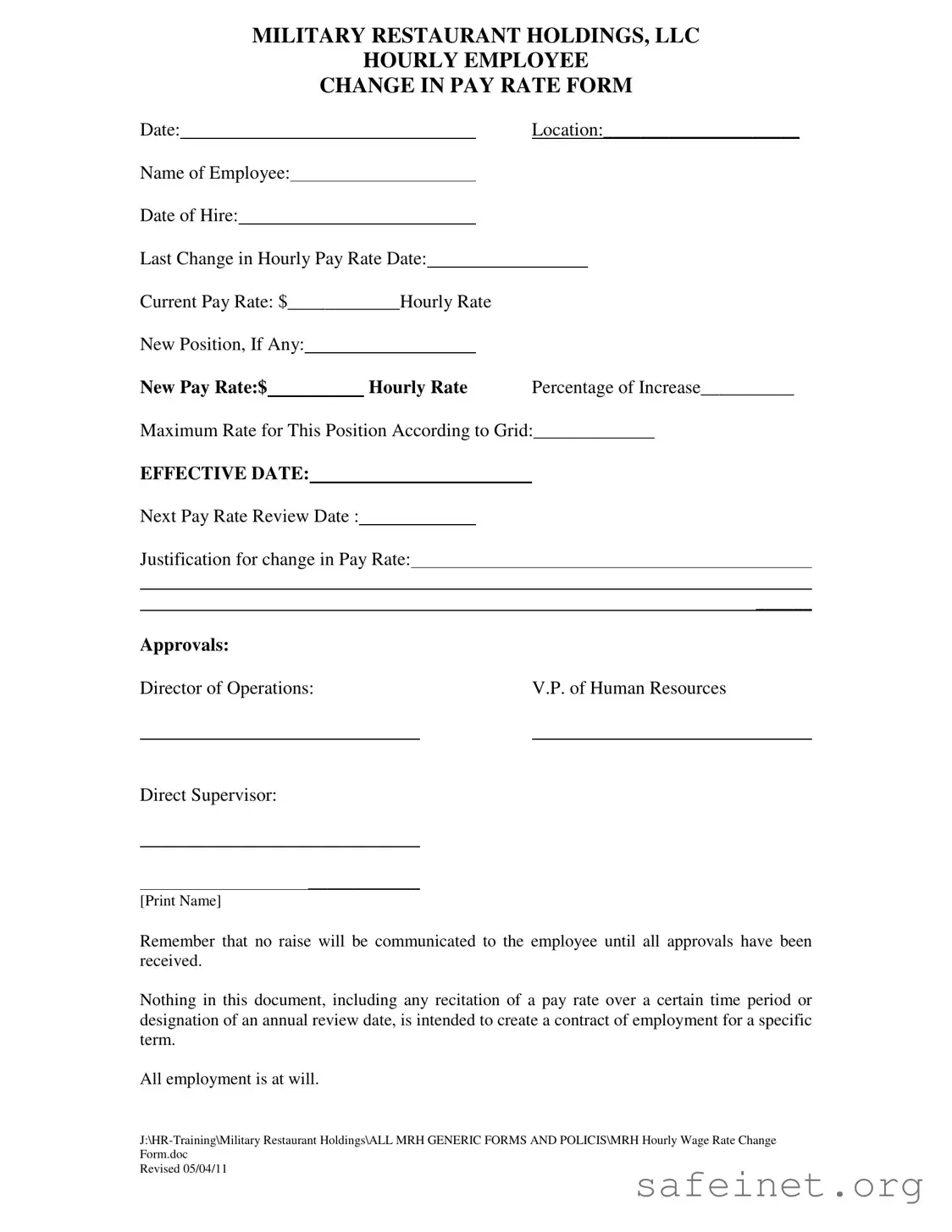
The Change Pay Rate form is an essential tool for managing employee compensation within Military Restaurant Holdings, LLC. This form captures critical details such as the employee's name, date of hire, and current pay rate. It also allows for the documentation of any changes in pay, including new positions or adjustments to hourly rates. The form requires the percentage of increase and outlines the maximum rate for the position according to a predefined grid. Additionally, it specifies the effective date of the new pay rate and sets a date for the next pay rate review. Justification for the change must be provided, ensuring transparency in the decision-making process. Approval from the Director of Operations, the Vice President of Human Resources, and the direct supervisor is mandatory before any raise is communicated to the employee. It is important to note that this document does not create a contract of employment for a specific term; all employment remains at will. Understanding the components of the Change Pay Rate form is crucial for both management and employees to ensure clarity and compliance in pay adjustments.

| Fact Name | Details |
|---|---|
| Purpose | This form is used to document changes in the hourly pay rate for employees at Military Restaurant Holdings, LLC. |
| Employee Information | The form requires essential details such as the employee's name, date of hire, and current pay rate. |
| New Pay Rate | Employers must specify the new hourly pay rate and the percentage increase, if applicable. |
| Approval Process | All pay rate changes must receive approvals from the Director of Operations, V.P. of Human Resources, and the direct supervisor. |
| Effective Date | The form includes an effective date, indicating when the new pay rate will begin. |
| Next Review Date | A next pay rate review date is also included, allowing for future evaluations of the employee's pay. |
| At-Will Employment | The document clarifies that no aspect of the form creates a contract of employment for a specific term; all employment is at-will. |
| State-Specific Laws | Depending on the state, certain labor laws may govern pay rate changes, such as minimum wage regulations and notice requirements. |
Completing the Change Pay Rate form is an important step in adjusting an employee's compensation. After filling out the form, it will require approval from relevant parties before any changes are communicated to the employee. Follow these steps carefully to ensure all necessary information is accurately provided.
What is the purpose of the Change Pay Rate form?
The Change Pay Rate form is designed to formally document any changes to an employee's hourly pay rate. This includes adjustments due to promotions, performance reviews, or other factors that may warrant a pay increase or decrease. It ensures that all changes are recorded and approved by the necessary parties before being communicated to the employee.
Who needs to approve the Change Pay Rate form?
Before any pay rate change is communicated to the employee, it must receive approvals from several key individuals. These include the Director of Operations, the Vice President of Human Resources, and the employee's direct supervisor. This multi-level approval process helps maintain consistency and fairness in pay practices across the organization.
When will the employee be notified of their new pay rate?
An employee will not be informed of their new pay rate until all necessary approvals have been secured. This means that the approval process must be completed before any communication regarding the change occurs. It’s important to ensure that everything is in order to avoid confusion or misunderstandings.
What information is required on the form?
The form requires several key pieces of information, including the employee's name, date of hire, current pay rate, new pay rate, and justification for the change. Additionally, it includes details such as the effective date of the new pay rate and the next pay rate review date. This information helps provide context for the change and supports the decision-making process.
Is the Change Pay Rate form a contract of employment?
No, the Change Pay Rate form does not create a contract of employment for a specific term. It is simply a tool for documenting pay changes. All employment remains at-will, meaning that either the employee or the employer can terminate the employment relationship at any time, for any lawful reason. This understanding is crucial for both parties.
Failing to include the effective date of the pay rate change can lead to confusion about when the new rate will take effect.
Not providing a justification for the pay rate change may result in delays in the approval process. Clear reasoning helps supervisors understand the rationale behind the request.
Leaving the current pay rate section blank can create issues, as it is essential to establish a baseline for the new pay rate.
Omitting the percentage of increase can lead to misunderstandings regarding the raise being requested. This information is crucial for all parties involved.
Not obtaining all necessary approvals before communicating the raise to the employee can cause complications. Ensure that all signatures are collected as required.
Failing to specify the new position, if applicable, may result in discrepancies in the employee’s role and compensation structure.
Neglecting to fill out the location field can create confusion about where the employee is based, which is important for payroll and record-keeping.
Not adhering to the maximum rate for the position according to the grid can lead to budgetary issues and potential compliance problems.
When processing a Change Pay Rate form, several other documents may be necessary to ensure a smooth transition and proper record-keeping. Each of these documents plays a vital role in the overall payroll and employee management process. Below is a list of commonly used forms that accompany the Change Pay Rate form.
These documents collectively support the administration of pay rate changes and help maintain transparency and compliance within the organization. Properly managing these forms ensures that all employees are treated fairly and that the company's payroll processes run smoothly.
The Employee Evaluation Form serves a similar purpose to the Change Pay Rate form by documenting an employee’s performance and any subsequent changes to their compensation. This form typically includes sections for employee strengths, areas for improvement, and overall performance ratings. Like the Change Pay Rate form, it requires management approval before any adjustments to pay are communicated to the employee. Both documents emphasize the importance of formal review processes and ensure that any changes are justified and well-documented.
The Promotion Request Form is another document that aligns closely with the Change Pay Rate form. When an employee seeks a promotion, this form outlines their qualifications and reasons for the request. It often includes a proposed new salary, similar to the new pay rate section in the Change Pay Rate form. Both documents necessitate approval from higher management, reinforcing the need for a structured approach to salary adjustments based on merit and performance.
The Salary Adjustment Request Form also shares similarities with the Change Pay Rate form. This document is used when an employee’s salary needs to be modified due to market changes, internal equity, or exceptional performance. Like the Change Pay Rate form, it requires justification for the adjustment and must be approved by relevant authorities. Both forms ensure that salary changes are based on documented rationale, maintaining transparency within the organization.
The Job Description Change Form is relevant in contexts where an employee’s role evolves, potentially leading to a pay rate change. This form outlines the updated responsibilities and expectations for the position. Similar to the Change Pay Rate form, it requires management review and approval to ensure that any pay adjustments align with the new job requirements. Both documents highlight the connection between job responsibilities and compensation.
The Employee Onboarding Form can also be compared to the Change Pay Rate form in that it establishes the terms of employment, including initial pay rates. This form is filled out when a new employee joins the organization and sets the stage for future pay adjustments. Both documents underscore the importance of clarity and agreement on compensation from the outset of employment, ensuring that all parties are aware of the terms.
The Compensation Review Form is another document that aligns with the Change Pay Rate form. This form is used during scheduled reviews to assess an employee’s pay in relation to their performance and market standards. Like the Change Pay Rate form, it requires a thorough evaluation and justification for any recommended pay changes. Both forms serve as tools for ensuring fair and equitable compensation practices within the organization.
The Bonus Request Form is relevant as it documents requests for additional compensation outside of regular pay adjustments. This form typically outlines the reasons for the bonus, similar to how the Change Pay Rate form requires justification for pay increases. Both forms require approval from management, ensuring that any additional compensation is warranted and aligns with company policies.
The Leave of Absence Request Form can be compared to the Change Pay Rate form in the sense that both require documentation and approval processes. While the Leave of Absence form deals with time away from work, it may also affect pay rates if an employee is on unpaid leave. Both documents ensure that changes to an employee’s status—whether in terms of pay or time off—are formally recognized and approved by management.
The Termination Notice Form shares a connection with the Change Pay Rate form through its focus on employment status. While the Change Pay Rate form documents increases in pay, the Termination Notice Form signifies the end of employment. Both documents require careful consideration and approval, ensuring that all actions taken regarding an employee’s compensation or status are properly recorded and justified.
Lastly, the Employee Recognition Form can be likened to the Change Pay Rate form in that it acknowledges an employee’s contributions and may lead to discussions about compensation. While this form highlights achievements and may not directly change pay rates, it can influence decisions about future raises. Both forms reflect the organization’s commitment to recognizing employee value and ensuring that compensation aligns with performance and contributions.
When filling out the Change Pay Rate form, it is important to follow certain guidelines to ensure accuracy and compliance. Here are six things you should and shouldn't do:
Misconception 1: The Change Pay Rate form guarantees a pay raise.
In reality, completing the form does not automatically mean that an employee will receive a raise. All necessary approvals must be obtained before any changes are communicated.
Misconception 2: The effective date of the pay change is the same as the submission date.
The effective date is determined by the approvals and may differ from when the form is submitted.
Misconception 3: All pay rate changes are permanent.
Some changes may be temporary or tied to specific conditions, which should be clearly noted in the justification section.
Misconception 4: The form can be submitted without justification.
A justification for the pay rate change is required. This helps ensure that all changes are fair and well-documented.
Misconception 5: Employees are informed of their pay change immediately after submission.
Employees will not be informed until all approvals are finalized. This process can take some time.
Misconception 6: The pay rate listed on the form is the final amount.
The amount listed is subject to approval and may change based on the decision of management.
Misconception 7: A higher pay rate guarantees a new position.
While a new pay rate may coincide with a new position, it is not a guarantee. The form allows for changes in pay without a change in role.
Misconception 8: The Change Pay Rate form is only for raises.
This form can also be used to document pay decreases or adjustments, not just increases.
Misconception 9: The form can be filled out by anyone.
Only authorized personnel should complete and submit this form to ensure proper protocol is followed.
Misconception 10: Employment terms are altered by filling out this form.
Completing the Change Pay Rate form does not create a contract of employment or alter the at-will employment status of the employee.
Here are some key takeaways about filling out and using the Change Pay Rate form: