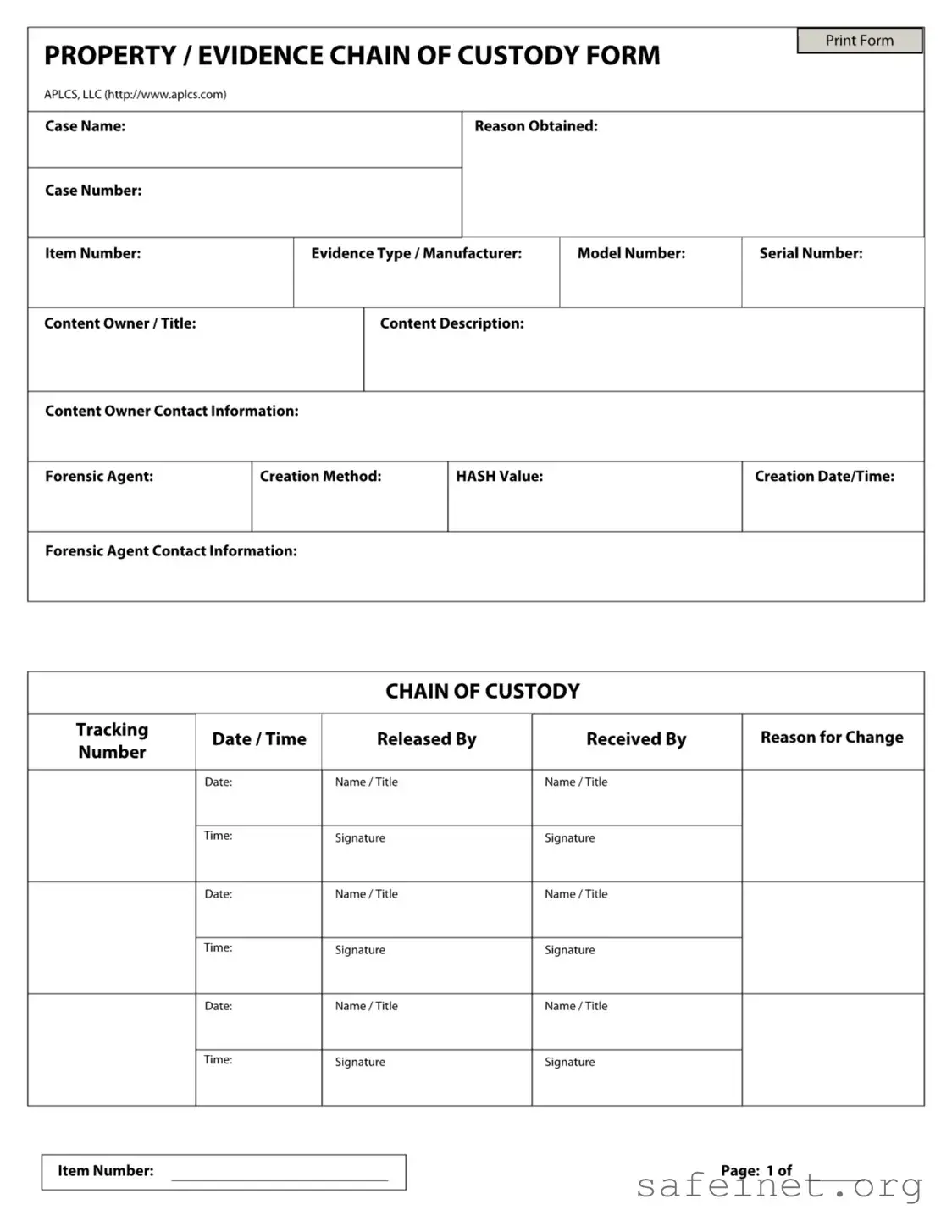
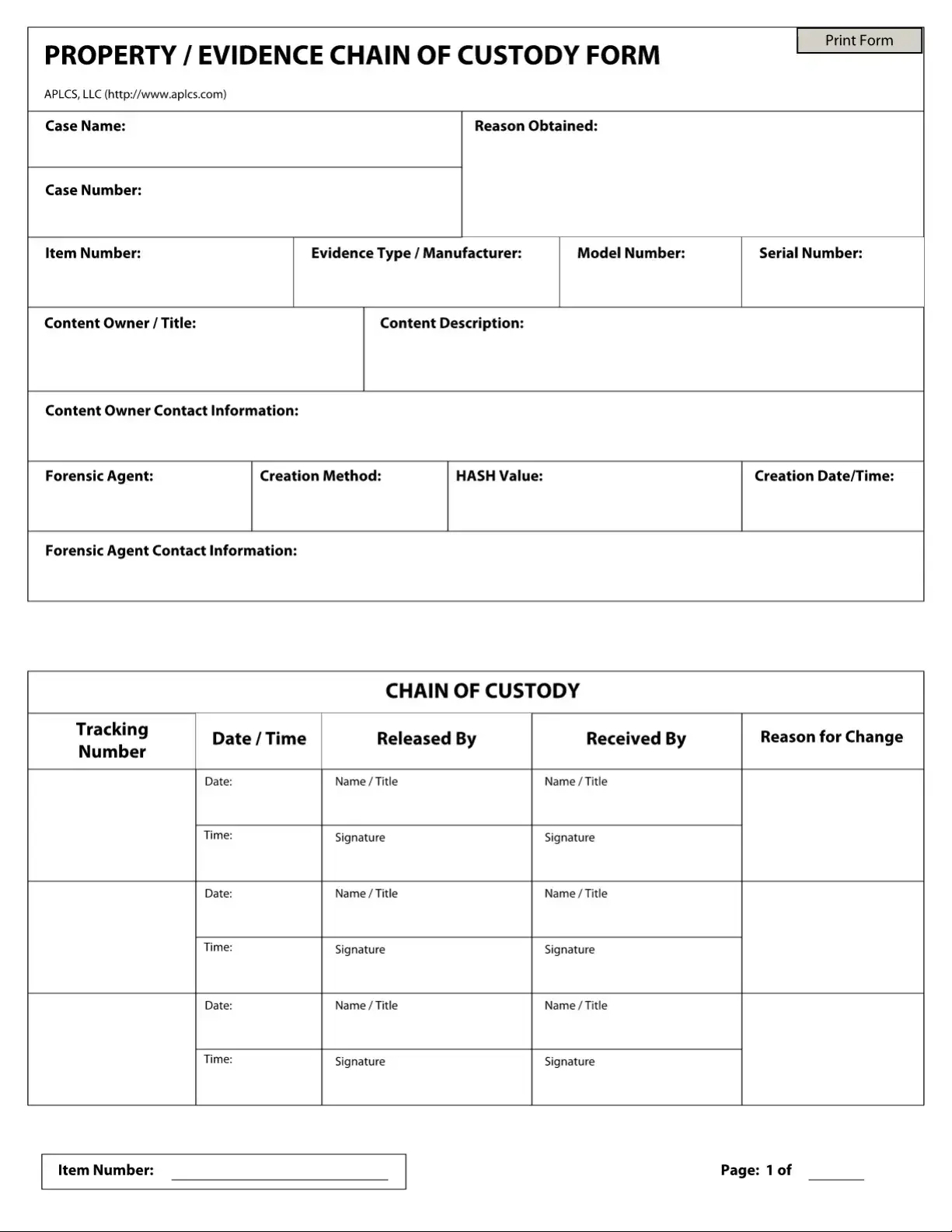
The Chain of Custody form plays a crucial role in the handling and documentation of evidence within legal proceedings. This form serves as a detailed record that tracks the movement and handling of evidence from the moment it is collected until it is presented in court. Key elements of the form include the case name, case number, and item number, which help to identify the specific evidence associated with a particular legal matter. Additionally, information regarding the type of evidence, its manufacturer, model number, and serial number is recorded to ensure accurate identification. The content owner’s details, including contact information, are also noted, providing a clear link to the source of the evidence. Forensic agents involved in the collection and analysis of the evidence are identified, along with the methods used for creation and any associated hash values. The form also tracks the chain of custody, documenting each transfer of the evidence, including dates, times, and signatures of individuals who release and receive the items. This meticulous record-keeping is essential for maintaining the integrity of the evidence and ensuring that it is admissible in court.

| Fact Name | Details |
|---|---|
| Purpose of the Form | The Chain of Custody form is used to document the handling of evidence, ensuring that it remains intact and untampered with throughout the legal process. |
| Key Information Required | Essential details include case name, case number, item number, evidence type, and serial number, which help identify and track the evidence. |
| Forensic Agent Role | The forensic agent is responsible for collecting and documenting the evidence. Their contact information is crucial for any follow-up or inquiries. |
| HASH Value | A HASH value is generated to verify the integrity of the evidence. This unique identifier helps ensure that the evidence has not been altered. |
| Tracking Number | The tracking number allows for easy reference and retrieval of evidence throughout the investigation and legal proceedings. |
| Signature Requirement | Multiple signatures are required on the form to confirm the transfer of evidence between individuals, establishing accountability. |
| State-Specific Laws | Each state may have specific laws governing the chain of custody. For example, California Evidence Code § 1410 outlines requirements for maintaining evidence integrity. |
Filling out the Chain of Custody form is a critical step in maintaining the integrity of evidence in legal proceedings. After completing this form, it will be used to track the handling and transfer of evidence throughout the investigation and legal process.
Now, for the Chain of Custody section, document the following details:
Continue this process until all relevant signatures and details are recorded. This will ensure a comprehensive and accurate Chain of Custody for the evidence in question.
What is a Chain of Custody form?
A Chain of Custody form is a document used to track the handling of evidence or property from the time it is collected until it is presented in court. It helps ensure that the evidence has not been altered or tampered with during this process. This form includes details such as the case name, item number, and signatures of individuals who handle the evidence.
Why is the Chain of Custody important?
The Chain of Custody is crucial for maintaining the integrity of evidence. It establishes a clear path of who handled the evidence and when. This documentation can be vital in legal proceedings, as it helps to confirm that the evidence presented is authentic and has not been compromised. Without proper chain of custody, evidence may be deemed inadmissible in court.
What information is typically included in a Chain of Custody form?
A Chain of Custody form typically includes several key pieces of information. This includes the case name, case number, item number, type of evidence, and details about the content owner. Additionally, it records the names and signatures of individuals who release and receive the evidence, along with dates and reasons for any changes in custody. This comprehensive tracking is essential for accountability.
How do I fill out a Chain of Custody form?
To fill out a Chain of Custody form, start by entering the basic case information, such as the case name and number. Next, provide details about the evidence, including its type, model number, and serial number. Ensure that you include the names and contact information for the content owner and forensic agent. As evidence is transferred, document each transaction with dates, names, and signatures. Accuracy is key.
What happens if the Chain of Custody is broken?
If the Chain of Custody is broken, it can lead to serious consequences in legal cases. A broken chain may result in evidence being challenged or excluded from court. This can undermine a case's strength and affect the outcome. It’s essential to follow proper procedures and maintain thorough documentation to prevent any breaks in the chain.
Inaccurate Information Entry: One of the most common mistakes occurs when individuals fail to accurately fill in essential fields. This includes the case name, case number, and item number. Missing or incorrect details can lead to confusion and complications down the line.
Neglecting Signatures: The chain of custody relies heavily on proper documentation. Failing to obtain signatures from all parties involved in the release and receipt of evidence can undermine the integrity of the form. Each signature serves as a confirmation that the evidence was handled appropriately.
Omitting Dates and Times: Dates and times are crucial in establishing a timeline of evidence handling. Forgetting to include these details can create gaps in the chain of custody, making it difficult to trace the evidence's journey accurately.
Ignoring the Tracking Number: The tracking number is a vital component of the chain of custody. Failing to record this number can hinder the ability to locate and verify evidence later. It acts as a unique identifier, ensuring that the evidence can be tracked throughout the legal process.
The Chain of Custody form is a crucial document in legal and forensic contexts, ensuring that evidence is properly tracked and maintained throughout its lifecycle. Several other forms and documents often accompany the Chain of Custody form to provide additional information and support the integrity of the evidence. Below is a list of commonly used documents that may be relevant in conjunction with the Chain of Custody form.
These documents collectively enhance the reliability and accountability of evidence management. Maintaining accurate records and documentation is essential for upholding the integrity of the legal process.
The Chain of Custody form is similar to an Incident Report in that both documents serve to detail specific events and actions taken during an investigation. An Incident Report outlines what occurred, who was involved, and the timeline of events. Similarly, the Chain of Custody form tracks the handling of evidence from the moment it is collected until it is presented in court. Both documents ensure transparency and accountability, which are critical in maintaining the integrity of the investigation process.
Another document comparable to the Chain of Custody form is the Evidence Log. This log records all items collected as evidence in a case, including descriptions, locations, and the individuals who handled them. The Evidence Log provides a comprehensive overview of the items involved, while the Chain of Custody form focuses on the transfer and handling of each piece of evidence. Both documents work together to create a clear narrative of how evidence is managed throughout the investigation.
The Field Notes taken by investigators are also similar in purpose. Field Notes capture observations, actions, and conversations related to a case in real-time. They provide context and detail that can be crucial for understanding the circumstances surrounding evidence collection. While the Chain of Custody form documents the physical handling of evidence, Field Notes offer a narrative that can support the findings recorded in the Chain of Custody.
In addition, the Forensic Report is another document that shares similarities with the Chain of Custody form. A Forensic Report details the analysis and findings related to the evidence collected. It includes scientific tests, results, and conclusions drawn by forensic experts. The Chain of Custody form complements the Forensic Report by ensuring that the evidence analyzed was properly handled and maintained throughout the investigation, reinforcing the reliability of the forensic findings.
The Receipt for Evidence is also akin to the Chain of Custody form. When evidence is collected, a Receipt for Evidence is often issued to acknowledge its transfer from one party to another. This document serves as proof that the evidence was received and can include details similar to those found in the Chain of Custody form, such as item descriptions and signatures of the individuals involved. Both documents help establish a clear trail of evidence handling.
Lastly, a Subpoena can be compared to the Chain of Custody form in that both documents are vital in legal proceedings. A Subpoena commands the production of evidence or the appearance of a witness in court. It ensures that all parties involved are aware of the evidence being presented. The Chain of Custody form, on the other hand, ensures that the evidence has been properly handled and is admissible in court. Both documents play essential roles in the judicial process, upholding the integrity of the legal system.
When filling out the Chain Of Custody form, it is essential to be careful and precise. Here are some important dos and don’ts to keep in mind:
By following these guidelines, you can help ensure the integrity of the evidence and the effectiveness of the Chain Of Custody process.
Understanding the Chain of Custody form is essential for anyone involved in legal or forensic processes. However, there are several misconceptions that can lead to confusion. Here are ten common misunderstandings:
By addressing these misconceptions, individuals can better understand the importance of the Chain of Custody form in legal matters.
When filling out and using the Chain of Custody form, it's essential to keep a few key points in mind. This form is crucial for maintaining the integrity of evidence throughout the legal process.