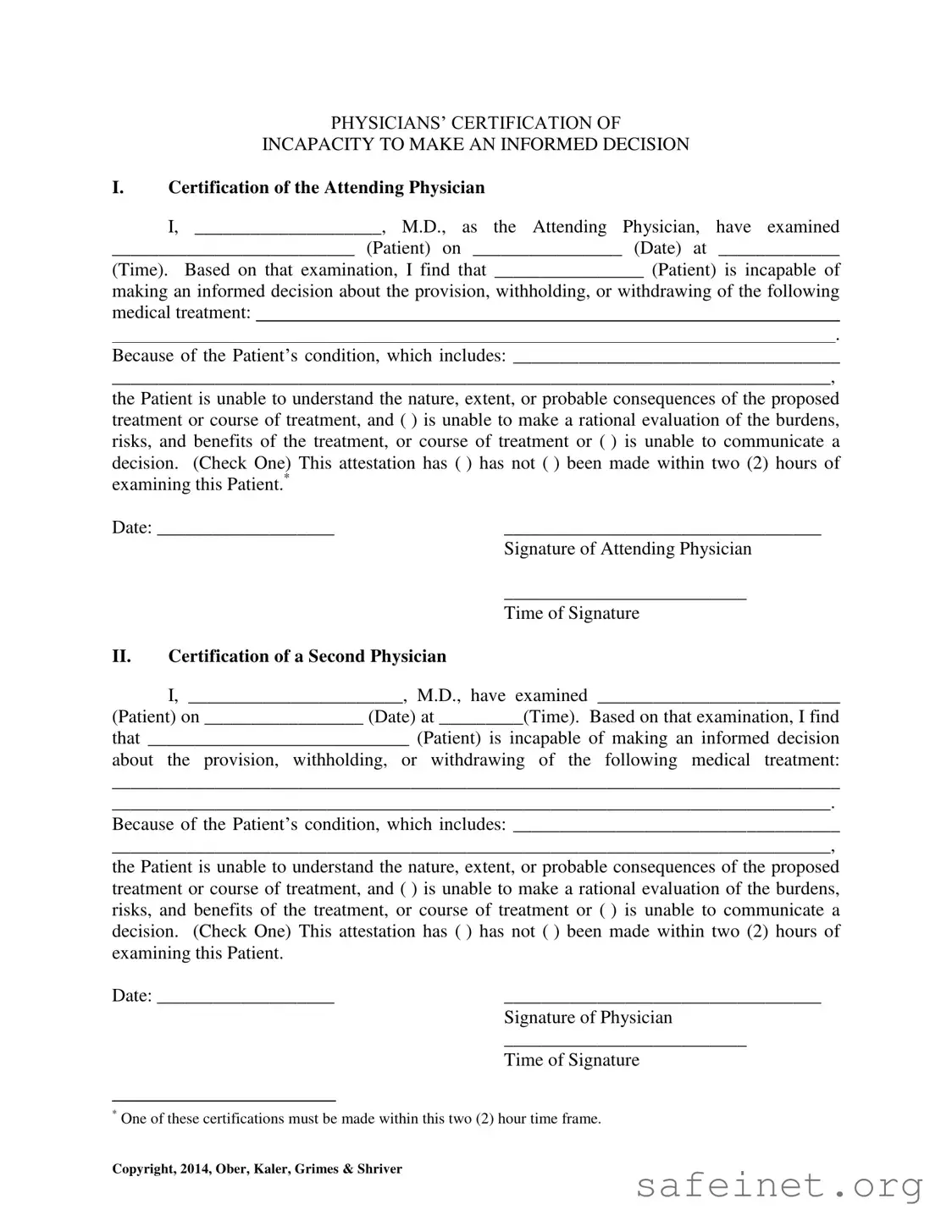
The Certification of Incapacity form is a critical document in the medical and legal landscape, designed to ensure that patients who are unable to make informed decisions about their medical treatment receive appropriate care. This form requires the signatures of two physicians, each of whom must attest to the patient's incapacity following a thorough examination. The attending physician initiates the process by documenting their findings, including the specific medical condition that impairs the patient's ability to understand the nature and consequences of proposed treatments. They must also indicate whether the patient can evaluate the risks and benefits of treatment or communicate a decision. The second physician's certification serves as an additional layer of verification, reinforcing the first physician's assessment. Both certifications must be completed within a two-hour window to ensure timely and accurate evaluations. This form not only protects the rights of patients but also provides clear guidance for healthcare providers navigating complex medical decisions.

| Fact Name | Details |
|---|---|
| Purpose | The Certification of Incapacity form is used to determine if a patient can make informed medical decisions. |
| Attending Physician | It requires certification from the attending physician who has examined the patient. |
| Second Opinion | A second physician must also certify the patient's incapacity to ensure a thorough evaluation. |
| Time Frame | Both certifications must be completed within two hours of examining the patient. |
| Patient's Condition | The form must detail the patient's condition that affects their ability to understand treatment options. |
| Governing Law | The laws governing the use of this form can vary by state, often found in health care directives or mental health statutes. |
Completing the Certification of Incapacity form requires careful attention to detail. This form must be filled out by a physician to certify that a patient is unable to make informed medical decisions. Follow the steps below to ensure that the form is filled out correctly and completely.
After completing the first section, move on to the "Certification of a Second Physician." Repeat the same steps, ensuring that the second physician's information is filled out accurately. This process is critical for confirming the patient's incapacity.
What is the purpose of the Certification of Incapacity form?
The Certification of Incapacity form is designed to document a patient's inability to make informed medical decisions. This form is typically completed by attending physicians who have examined the patient. It serves as a formal acknowledgment that the patient cannot understand the nature or consequences of medical treatments due to their condition. This documentation is essential for ensuring that appropriate medical decisions are made on behalf of the patient, especially in critical situations.
Who can complete the Certification of Incapacity form?
The form must be completed by a licensed physician who has conducted an examination of the patient. In some cases, a second physician may also be required to provide an additional certification. This dual verification helps to ensure that the assessment of the patient's capacity is thorough and accurate. Both physicians must provide their findings regarding the patient's ability to make informed decisions about their medical treatment.
What information is required on the form?
The form requires specific information about the patient, including their name, the date and time of the examination, and the medical treatment in question. Physicians must also describe the patient's condition and the reasons for their incapacity. Additionally, the form includes checkboxes for the physician to indicate whether the patient is unable to evaluate the risks and benefits of treatment or unable to communicate a decision. This detailed information is crucial for clarity and legal purposes.
Is there a time limit for completing the Certification of Incapacity?
Yes, there is a time limit. At least one of the physicians must complete their certification within two hours of examining the patient. This requirement ensures that the assessment of the patient’s incapacity is timely and reflects their current condition. Adhering to this time frame is essential for the validity of the certification, particularly in urgent medical situations.
What happens after the Certification of Incapacity is completed?
Once the Certification of Incapacity form is completed and signed by the physicians, it becomes part of the patient’s medical records. This documentation is used to guide healthcare providers in making decisions regarding the patient's treatment. It may also be referenced in legal contexts, particularly if there are questions about the patient's ability to consent to treatment. The form helps protect the rights and well-being of patients who are unable to advocate for themselves due to their medical condition.
Incomplete Patient Information: Failing to provide the patient's full name, date of examination, and time can lead to confusion. It is crucial to ensure all sections are filled out accurately.
Neglecting to Check the Appropriate Box: The form requires the physician to indicate whether the patient is unable to make a rational evaluation or communicate a decision. Skipping this step can invalidate the certification.
Insufficient Details on Patient's Condition: Providing vague descriptions of the patient's condition may not adequately support the claim of incapacity. Specificity is essential to convey the severity of the situation.
Timing of the Certification: It is important to complete the certification within two hours of the examination. If this time frame is not respected, the certification may be deemed invalid.
The Certification of Incapacity form is a crucial document in healthcare settings, particularly when determining a patient's ability to make informed medical decisions. Several other forms and documents often accompany this certification to ensure comprehensive patient care and legal compliance. Below is a list of these related documents, each serving a specific purpose.
Each of these documents plays a vital role in the healthcare process, particularly when dealing with patients who may be unable to communicate their needs. Understanding these forms can help ensure that patients receive the care that aligns with their wishes and legal rights.
The Medical Power of Attorney is a document that allows an individual to designate someone else to make healthcare decisions on their behalf if they become incapacitated. Similar to the Certification of Incapacity, it requires a clear understanding of the individual's medical condition and treatment options. Both documents emphasize the importance of informed decision-making and ensure that the wishes of the patient are respected even when they cannot communicate them directly.
A Living Will is another important document that outlines a person's preferences regarding medical treatment in situations where they are unable to express their wishes. Like the Certification of Incapacity, a Living Will is activated when a person is unable to make decisions due to incapacity. It serves as a guide for healthcare providers and family members, ensuring that the patient's desires regarding life-sustaining treatments are honored.
The Do Not Resuscitate (DNR) Order is a specific directive that informs medical personnel not to perform CPR if a patient stops breathing or their heart stops. This document is similar to the Certification of Incapacity in that it reflects a patient's wishes regarding medical interventions. Both documents require careful consideration of the patient's medical condition and personal values, highlighting the importance of aligning medical care with the patient's preferences.
The Advance Healthcare Directive combines elements of both a Living Will and a Medical Power of Attorney. It allows individuals to outline their healthcare preferences and appoint someone to make decisions on their behalf. This document is similar to the Certification of Incapacity in that it aims to ensure that a person's healthcare decisions are respected even when they are unable to communicate them, emphasizing the need for clarity in the patient's wishes.
The Physician's Order for Life-Sustaining Treatment (POLST) is designed for patients with serious health conditions. It translates the patient's treatment preferences into actionable medical orders. Like the Certification of Incapacity, the POLST form requires the involvement of healthcare professionals to assess the patient's condition and preferences. Both documents prioritize the patient's autonomy and ensure that their choices are documented and respected in medical settings.
The Guardianship Petition is a legal document filed in court to request the appointment of a guardian for an individual deemed incapacitated. While it serves a different purpose, it shares similarities with the Certification of Incapacity in that it assesses the individual's ability to make informed decisions. Both documents involve evaluations of the person's mental and physical health to determine their capacity to manage their own affairs.
The Consent for Treatment form is often used in medical settings to obtain permission for specific treatments or procedures. While it primarily focuses on the patient's agreement, it also requires an understanding of the proposed treatment, similar to the Certification of Incapacity. Both documents highlight the importance of informed consent and the necessity for patients to comprehend their medical options.
The Health Insurance Portability and Accountability Act (HIPAA) Authorization form allows individuals to designate who can access their medical information. This document is similar to the Certification of Incapacity in that it protects the patient's rights regarding their health information. Both emphasize the importance of consent and ensure that the patient's preferences are respected in healthcare decisions.
The Mental Health Advance Directive allows individuals to specify their preferences for mental health treatment in the event they become incapacitated. Similar to the Certification of Incapacity, it requires an understanding of the individual's mental health needs and treatment options. Both documents aim to ensure that the patient's wishes regarding their care are honored, particularly during vulnerable times.
Finally, the Durable Power of Attorney for Healthcare is a legal document that designates an agent to make healthcare decisions for an individual if they become unable to do so. This document is akin to the Certification of Incapacity in that it requires careful consideration of the individual's medical condition and treatment preferences. Both emphasize the importance of having trusted individuals involved in healthcare decision-making when the patient is unable to advocate for themselves.
When filling out the Certification of Incapacity form, it is important to follow specific guidelines to ensure accuracy and compliance. Below is a list of things to do and avoid during this process.
Here are some common misconceptions about the Certification of Incapacity form:
Understanding the Certification of Incapacity form is crucial for both healthcare providers and patients. Here are key takeaways to consider:
Using this form correctly can help ensure that patients receive appropriate care while respecting their autonomy and rights.