The Cease and Desist Slander and Libel Letter form serves as a crucial tool for individuals seeking to protect their reputation from false statements that may harm their personal or professional life. This form outlines the specific defamatory statements made, identifies the parties involved, and demands the immediate cessation of such harmful behavior. It typically includes a detailed account of the alleged slander or libel, providing context and evidence to support the claims. Additionally, the letter often specifies a timeline for compliance and may warn of potential legal action if the defamatory statements are not retracted. By utilizing this form, individuals assert their rights and communicate the seriousness of the situation, aiming to resolve the matter amicably while preserving their dignity and standing in the community. Understanding the components of this letter is essential for anyone considering taking action against defamation, as it lays the groundwork for potential legal recourse and emphasizes the importance of addressing falsehoods swiftly and effectively.
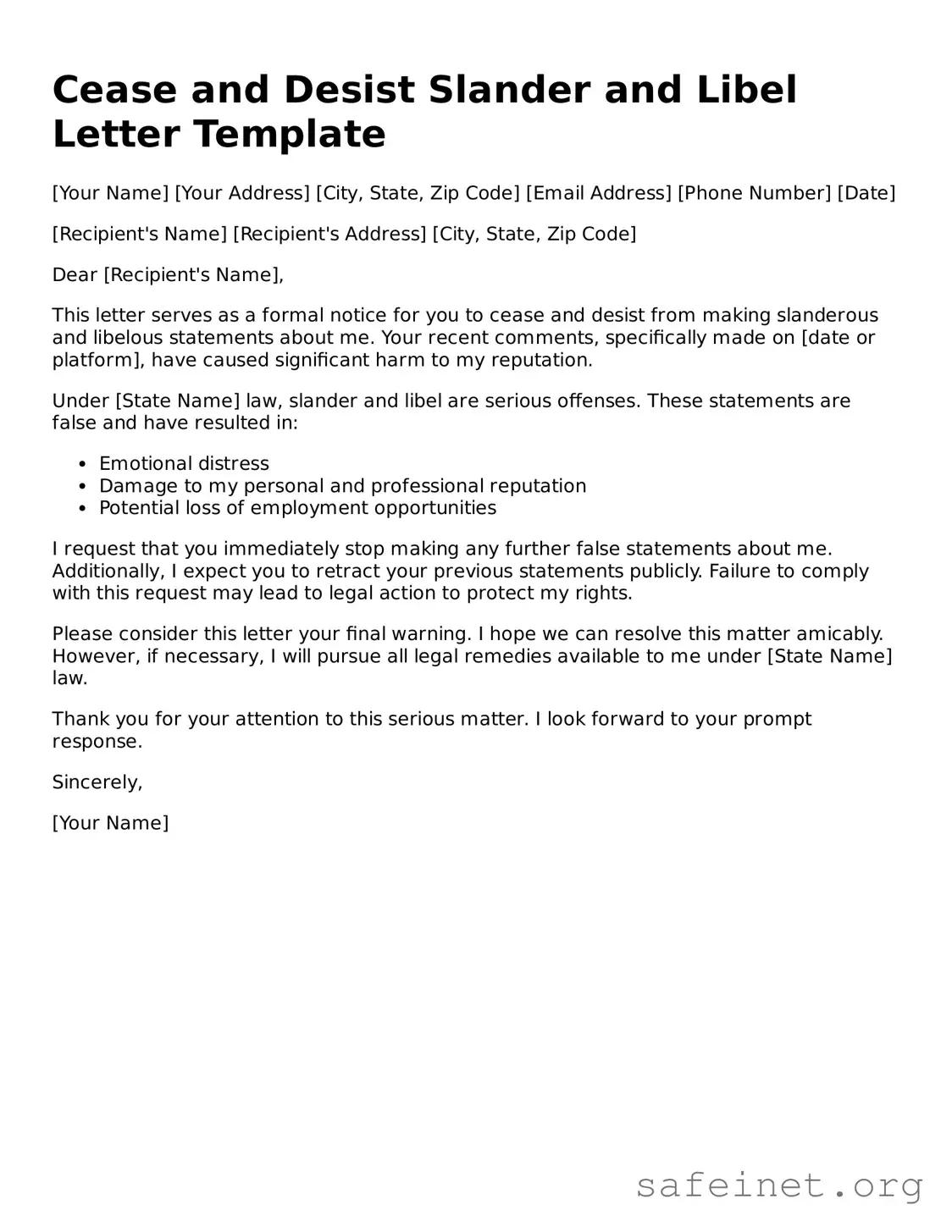
Cease and Desist Slander and Libel Letter Template
[Your Name] [Your Address] [City, State, Zip Code] [Email Address] [Phone Number] [Date]
[Recipient's Name] [Recipient's Address] [City, State, Zip Code]
Dear [Recipient's Name],
This letter serves as a formal notice for you to cease and desist from making slanderous and libelous statements about me. Your recent comments, specifically made on [date or platform], have caused significant harm to my reputation.
Under [State Name] law, slander and libel are serious offenses. These statements are false and have resulted in:
I request that you immediately stop making any further false statements about me. Additionally, I expect you to retract your previous statements publicly. Failure to comply with this request may lead to legal action to protect my rights.
Please consider this letter your final warning. I hope we can resolve this matter amicably. However, if necessary, I will pursue all legal remedies available to me under [State Name] law.
Thank you for your attention to this serious matter. I look forward to your prompt response.
Sincerely,
[Your Name]
| Fact Name | Description |
|---|---|
| Definition | A Cease and Desist Slander and Libel Letter is a formal request to stop defamatory statements that harm an individual's reputation. |
| Purpose | The letter aims to notify the offending party of the harmful statements and demand their immediate removal. |
| Legal Basis | Defamation laws vary by state, but they generally protect individuals from false statements that damage their reputation. |
| State-Specific Laws | For example, California Civil Code § 44 governs defamation laws in California. |
| Content Requirements | The letter should include specific details about the defamatory statements and the harm caused. |
| Delivery Method | It is recommended to send the letter via certified mail to ensure proper documentation of delivery. |
| Consequences of Ignoring | If the recipient ignores the letter, the sender may pursue legal action for damages resulting from the slander or libel. |
After gathering the necessary information, you will be ready to fill out the Cease and Desist Slander and Libel Letter form. This process involves clearly articulating your concerns and outlining the actions you wish the recipient to take. Following these steps will help ensure that your letter is complete and effective.
Once you have completed the form, consider sending it via certified mail to ensure that it is received. Retaining a copy for your records is also advisable. This documentation may prove useful should further action be necessary.
What is a Cease and Desist Slander and Libel Letter?
A Cease and Desist Slander and Libel Letter is a formal document that requests an individual or organization to stop making false statements that harm another person's reputation. This letter serves as a warning and outlines the specific statements considered defamatory.
Who can use this letter?
Any individual or entity who believes they have been defamed can use this letter. This includes private individuals, public figures, businesses, and organizations. It is important for the sender to have evidence of the slanderous or libelous statements before proceeding.
What should be included in the letter?
The letter should clearly identify the sender and the recipient, specify the defamatory statements, provide context for why these statements are harmful, and request that the recipient cease making such statements. Additionally, it may include a deadline for compliance and a warning of potential legal action if the behavior continues.
Is this letter legally binding?
No, a Cease and Desist letter is not legally binding. It is a formal request and serves as a warning. However, it can be an important step in resolving disputes and may be used as evidence if further legal action is necessary.
What happens if the recipient ignores the letter?
If the recipient ignores the letter, the sender may choose to pursue further action, which could include filing a lawsuit for defamation. It is advisable to consult with a legal professional before taking any further steps to ensure that the case is handled appropriately.
Can this letter be sent via email?
Yes, the letter can be sent via email, but it is recommended to also send a physical copy via certified mail. This ensures that there is a record of the letter being sent and received, which can be important if the situation escalates.
How long does it take to see results after sending the letter?
The timeline for seeing results can vary. Some recipients may respond quickly and cease the defamatory behavior, while others may take longer or ignore the request altogether. It is important to be patient but also to monitor the situation closely.
Should I consult a lawyer before sending this letter?
Consulting a lawyer is highly recommended. A legal professional can provide guidance on the content of the letter, help assess the strength of the case, and advise on the best course of action moving forward. This can help ensure that the letter is effective and that the sender's rights are protected.
Failure to Identify the Defamatory Statements: Many individuals neglect to clearly specify the statements that are considered slanderous or libelous. Without this clarity, the recipient may not understand the basis of the claim.
Insufficient Evidence: Providing inadequate or no evidence to support the claims can weaken the letter's effectiveness. It's important to include dates, contexts, and any relevant communications.
Incorrect Recipient Information: Sending the letter to the wrong person or entity can lead to confusion and undermine the seriousness of the claim. Double-checking contact details is crucial.
Using Emotional Language: While it's natural to feel upset, using overly emotional or aggressive language can detract from the professionalism of the letter. A calm, factual tone is more effective.
Not Including a Deadline: Failing to specify a deadline for the recipient to respond or cease the defamatory actions can lead to inaction. A clear timeline encourages a prompt response.
Neglecting to State the Consequences: Not outlining the potential legal consequences of ignoring the letter can leave the recipient unaware of the seriousness of the situation. This can weaken the letter's impact.
Omitting Contact Information: Forgetting to include your contact information can hinder communication. It's important to provide a way for the recipient to respond or seek clarification.
Not Seeking Legal Advice: Many individuals attempt to draft the letter without consulting a legal professional. This can lead to mistakes that may affect the outcome of the situation.
Ignoring State Laws: Each state has its own laws regarding defamation. Failing to consider these laws can result in a letter that is ineffective or even legally questionable.
When addressing issues of slander and libel, a Cease and Desist Slander and Libel Letter is often accompanied by other important documents. These forms help establish a clear legal position and can support your case if further action is necessary. Below is a list of commonly used forms and documents that complement the Cease and Desist letter.
These documents play a crucial role in the process of addressing slander and libel claims. Utilizing them effectively can strengthen your position and facilitate a resolution to the dispute.
The Cease and Desist Letter is often compared to a Demand Letter. Both documents serve to inform the recipient that their actions are causing harm. A Demand Letter typically requests compensation or action to rectify a situation, while a Cease and Desist Letter specifically asks the recipient to stop certain behaviors, such as slander or libel. The goal of both letters is to resolve disputes without resorting to litigation.
Another similar document is the Defamation Notice. This notice is specifically tailored to address false statements that damage a person's reputation. Like the Cease and Desist Letter, it outlines the harmful statements and demands that they be retracted. The Defamation Notice may also serve as a precursor to legal action if the offending party does not comply.
The Settlement Agreement is also relevant. While this document is typically used to formalize a resolution between parties, it can arise from a Cease and Desist Letter. If the parties reach an agreement to stop the harmful behavior, a Settlement Agreement will outline the terms, including any compensation or actions required. Both documents aim to bring closure to a dispute without going to court.
Injunctions are another related legal tool. An injunction is a court order that requires a person to stop engaging in certain conduct. While a Cease and Desist Letter is a request made outside of court, an injunction is a legal remedy sought through the judicial system. Both aim to prevent ongoing harm, but an injunction provides a stronger enforcement mechanism.
Similar to these documents is the Retraction Demand. This document specifically requests that the party who made a false statement publicly retract it. A Retraction Demand can accompany a Cease and Desist Letter, reinforcing the request to stop harmful actions while also seeking a correction of the record. Both documents are focused on addressing misinformation and its consequences.
Lastly, the Apology Letter may come into play in situations involving slander or libel. While not a legal document, an Apology Letter can serve as a means of mending relationships and addressing the harm caused by false statements. It can be requested in conjunction with a Cease and Desist Letter, as an acknowledgment of wrongdoing can sometimes help to resolve disputes amicably.
When filling out a Cease and Desist Slander and Libel Letter form, it is important to follow certain guidelines to ensure clarity and effectiveness. Below is a list of things to do and not to do during this process.
When it comes to the Cease and Desist Slander and Libel Letter, many people hold misconceptions that can lead to confusion or missteps. Understanding these misunderstandings is crucial for anyone considering such a letter. Here are four common misconceptions:
Understanding these misconceptions can help individuals navigate the complexities of defamation and the use of Cease and Desist Letters more effectively.
When filling out and using the Cease and Desist Slander and Libel Letter form, keep these key takeaways in mind: