Homepage > Blank CDC U.S. Standard Certificate of Live Birth Template
Article Structure

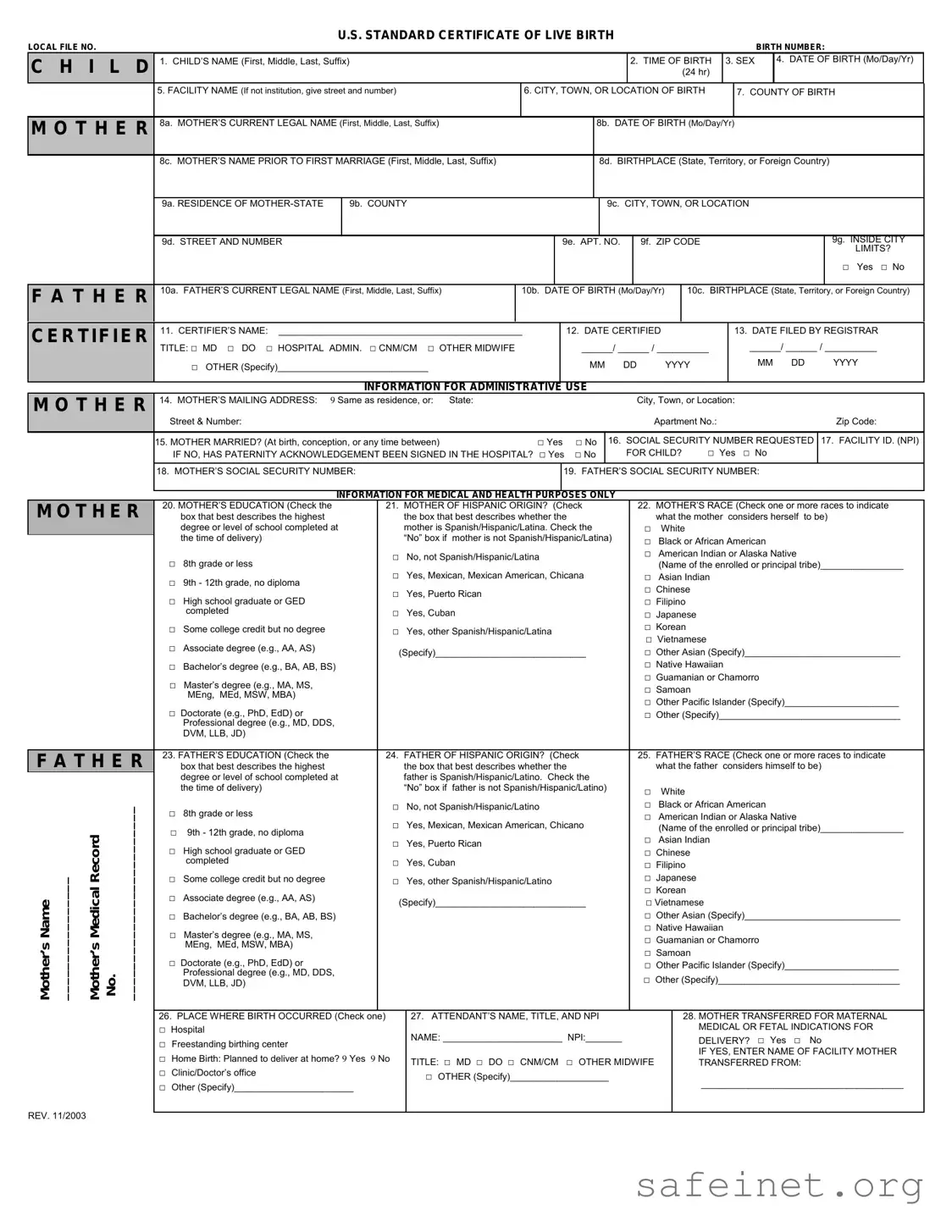
The CDC U.S. Standard Certificate of Live Birth form is a crucial document that serves as the official record of a child's birth in the United States. This form captures essential information, including the child's name, date and place of birth, and the names of the parents. It also records the parents' demographic details, such as their ages, races, and education levels. This comprehensive data collection not only aids in identifying the newborn but also plays a significant role in public health statistics and planning. Additionally, the form requires information about the attending physician or midwife, ensuring accountability and traceability in birth practices. Understanding the structure and purpose of this certificate is vital for parents, healthcare providers, and policymakers alike, as it lays the foundation for the child's identity and access to various rights and services throughout their life.


Form Sample

U.S. STANDARD CERTIFICATE OF LIVE BIRTH
LOCAL FILE NO. BIRTH NUMBER:
CHILD
1. CHILD’S NAME (First, Middle, Last, Suffix)
2. TIME OF BIRTH
(24 hr)
3. SEX
4. DATE OF BIRTH (Mo/Day/Yr)
5. FACILITY NAME
(If not institution, give street and number) 6. CITY, TOWN, OR LOCATION OF BIRTH
7. COUNTY OF BIRTH
MOTHER
8a. MOTHER’S CURRENT LEGAL NAME (First, Middle, Last, Suffix) 8b. DATE OF BIRTH (Mo/Day/Yr)
8c. MOTHER’S NAME PRIOR TO FIRST MARRIAGE (First, Middle, Last, Suffix) 8d. BIRTHPLACE (State, Territory, or Foreign Country)
9a. RESIDENCE OF MOTHER-STATE 9b. COUNTY 9c. CITY, TOWN, OR LOCATION
9d. STREET AND NUMBER 9e. APT. NO. 9f. ZIP CODE
9g. INSIDE CITY
LIMITS?
Yes No
FATHER
10a. FATHER’S CURRENT LEGAL NAME (First, Middle, Last, Suffix) 10b. DATE OF BIRTH (Mo/Day/Yr) 10c. BIRTHPLACE (State, Territory, or Foreign Country)
CERTIFIER
11. CERTIFIER’S NAME: _______________________________________________
TITLE: MD DO HOSPITAL ADMIN. CNM/CM OTHER MIDWIFE
OTHER (Specify)_____________________________
12. DATE CERTIFIED
______/ ______ / __________
MM DD YYYY
13. DATE FILED BY REGISTRAR
______/ ______ / __________
MM DD YYYY
INFORMATION FOR ADMINISTRATIVE USE
MOTHER
14. MOTHER’S MAILING ADDRESS: 9 Same as residence, or: State: City, Town, or Location:
Street & Number: Apartment No.: Zip Code:
15. MOTHER MARRIED? (At birth, conception, or any time between) Yes No
IF NO, HAS PATERNITY ACKNOWLEDGEMENT BEEN SIGNED IN THE HOSPITAL? Yes No
16. SOCIAL SECURITY NUMBER REQUESTED
FOR CHILD? Yes No
17. FACILITY ID. (NPI)
18. MOTHER’S SOCIAL SECURITY NUMBER: 19. FATHER’S SOCIAL SECURITY NUMBER:
INFORMATION FOR MEDICAL AND HEALTH PURPOSES ONLY
MOTHER
20. MOTHER’S EDUCATION (Check the
box that best describes the highest
degree or level of school completed at
the time of delivery)
8th grade or less
9th - 12th grade, no diploma
High school graduate or GED
completed
Some college credit but no degree
Associate degree (e.g., AA, AS)
Bachelor’s degree (e.g., BA, AB, BS)
Master’s degree (e.g., MA, MS,
MEng, MEd, MSW, MBA)
Doctorate (e.g., PhD, EdD) or
Professional degree (e.g., MD, DDS,
DVM, LLB, JD)
21. MOTHER OF HISPANIC ORIGIN? (Check
the box that best describes whether the
mother is Spanish/Hispanic/Latina. Check the
“No” box if mother is not Spanish/Hispanic/Latina)
No, not Spanish/Hispanic/Latina
Yes, Mexican, Mexican American, Chicana
Yes, Puerto Rican
Yes, Cuban
Yes, other Spanish/Hispanic/Latina
(Specify)_____________________________
22. MOTHER’S RACE (Check one or more races to indicate
what the mother considers herself to be)
White
Black or African American
American Indian or Alaska Native
(Name of the enrolled or principal tribe)________________
Asian Indian
Chinese
Filipino
Japanese
Korean
Vietnamese
Other Asian (Specify)______________________________
Native Hawaiian
Guamanian or Chamorro
Samoan
Other Pacific Islander (Specify)______________________
Other (Specify)___________________________________
FATHER
Mother’s Name
________________
Mother’s Medical Record
No.
_________________________
23. FATHER’S EDUCATION (Check the
box that best describes the highest
degree or level of school completed at
the time of delivery)
8th grade or less
9th - 12th grade, no diploma
High school graduate or GED
completed
Some college credit but no degree
Associate degree (e.g., AA, AS)
Bachelor’s degree (e.g., BA, AB, BS)
Master’s degree (e.g., MA, MS,
MEng, MEd, MSW, MBA)
Doctorate (e.g., PhD, EdD) or
Professional degree (e.g., MD, DDS,
DVM, LLB, JD)
24. FATHER OF HISPANIC ORIGIN? (Check
the box that best describes whether the
father is Spanish/Hispanic/Latino. Check the
“No” box if father is not Spanish/Hispanic/Latino)
No, not Spanish/Hispanic/Latino
Yes, Mexican, Mexican American, Chicano
Yes, Puerto Rican
Yes, Cuban
Yes, other Spanish/Hispanic/Latino
(Specify)_____________________________
25. FATHER’S RACE (Check one or more races to indicate
what the father considers himself to be)
White
Black or African American
American Indian or Alaska Native
(Name of the enrolled or principal tribe)________________
Asian Indian
Chinese
Filipino
Japanese
Korean
Vietnamese
Other Asian (Specify)______________________________
Native Hawaiian
Guamanian or Chamorro
Samoan
Other Pacific Islander (Specify)______________________
Other (Specify)___________________________________
26. PLACE WHERE BIRTH OCCURRED (Check one)
Hospital
Freestanding birthing center
Home Birth: Planned to deliver at home? 9 Yes 9 No
Clinic/Doctor’s office
Other (Specify)_______________________
27. ATTENDANT’S NAME, TITLE, AND NPI
NAME: _______________________ NPI:_______
TITLE: MD DO CNM/CM OTHER MIDWIFE
OTHER (Specify)___________________
28. MOTHER TRANSFERRED FOR MATERNAL
MEDICAL OR FETAL INDICATIONS FOR
DELIVERY?
Yes No
IF YES, ENTER NAME OF FACILITY MOTHER
TRANSFERRED FROM:
_______________________________________
REV. 11/2003
MOTHER
29a. DATE OF FIRST PRENATAL CARE VISIT
______ /________/ __________
No Prenatal Care
M M D D YYYY
29b. DATE OF LAST PRENATAL CARE VISIT
______ /________/ __________
M M D D YYYY
30. TOTAL NUMBER OF PRENATAL VISITS FOR THIS PREGNANCY
_________________________ (If none, enter A0".)
31. MOTHER’S HEIGHT
_______ (feet/inches)
32. MOTHER’S PREPREGNANCY WEIGHT
_________ (pounds)
33. MOTHER’S WEIGHT AT DELIVERY
_________ (pounds)
34. DID MOTHER GET WIC FOOD FOR HERSELF
DURING THIS PREGNANCY?
Yes No
35. NUMBER OF PREVIOUS
LIVE BIRTHS (Do not include
this child)
36. NUMBER OF OTHER
PREGNANCY OUTCOMES
(spontaneous or induced
losses or ectopic pregnancies)
35a. Now Living
Number _____
None
35b. Now Dead
Number _____
None
36a. Other Outcomes
Number _____
None
37. CIGARETTE SMOKING BEFORE AND DURING PREGNANCY
For each time period, enter either the number of cigarettes or the
number of packs of cigarettes smoked. IF NONE, ENTER A0".
Average number of cigarettes or packs of cigarettes smoked per day.
# of cigarettes # of packs
Three Months Before Pregnancy _________ OR ________
First Three Months of Pregnancy _________ OR ________
Second Three Months of Pregnancy _________ OR ________
Third Trimester of Pregnancy _________ OR ________
38. PRINCIPAL SOURCE OF
PAYMENT FOR THIS
DELIVERY
Private Insurance
Medicaid
Self-pay
Other
(Specify) _______________
35c. DATE OF LAST LIVE BIRTH
_______/________
MM Y Y Y Y
36b. DATE OF LAST OTHER
PREGNANCY OUTCOME
_______/________
MM Y Y Y Y
39. DATE LAST NORMAL MENSES BEGAN
______ /________/ __________
M M D D YYYY
40. MOTHER’S MEDICAL RECORD NUMBER
MEDICAL
AND
HEALTH
INFORMATION
43. OBSTETRIC PROCEDURES (Check all that apply)
Cervical cerclage
Tocolysis
External cephalic version:
Successful
Failed
None of the above
44. ONSET OF LABOR (Check all that apply)
Premature Rupture of the Membranes (prolonged, 12 hrs.)
Precipitous Labor (<3 hrs.)
Prolonged Labor ( 20 hrs.)
None of the above
46. METHOD OF DELIVERY
A. Was delivery with forceps attempted but
unsuccessful?
Yes No
B. Was delivery with vacuum extraction attempted
but unsuccessful?
Yes No
C. Fetal presentation at birth
Cephalic
Breech
Other
D. Final route and method of delivery (Check one)
Vaginal/Spontaneous
Vaginal/Forceps
Vaginal/Vacuum
Cesarean
If cesarean, was a trial of labor attempted?
Yes
No
41. RISK FACTORS IN THIS PREGNANCY
(Check all that apply)
Diabetes
Prepregnancy (Diagnosis prior to this pregnancy)
Gestational (Diagnosis in this pregnancy)
Hypertension
Prepregnancy (Chronic)
Gestational (PIH, preeclampsia)
Eclampsia
Previous preterm birth
Other previous poor pregnancy outcome (Includes
perinatal death, small-for-gestational age/intrauterine
growth restricted birth)
Pregnancy resulted from infertility treatment-If yes,
check all that apply:
Fertility-enhancing drugs, Artificial insemination or
Intrauterine insemination
Assisted reproductive technology (e.g., in vitro
fertilization (IVF), gamete intrafallopian
transfer (GIFT))
Mother had a previous cesarean delivery
If yes, how many __________
None of the above
42. INFECTIONS PRESENT AND/OR TREATED
DURING THIS PREGNANCY (Check all that apply)
Gonorrhea
Syphilis
Chlamydia
Hepatitis B
Hepatitis C
None of the above
45. CHARACTERISTICS OF LABOR AND DELIVERY
(Check all that apply)
Induction of labor
Augmentation of labor
Non-vertex presentation
Steroids (glucocorticoids) for fetal lung maturation
received by the mother prior to delivery
Antibiotics received by the mother during labor
Clinical chorioamnionitis diagnosed during labor or
maternal temperature >38°C (100.4°F)
Moderate/heavy meconium staining of the amniotic fluid
Fetal intolerance of labor such that one or more of the
following actions was taken: in-utero resuscitative
measures, further fetal assessment, or operative delivery
Epidural or spinal anesthesia during labor
None of the above
47. MATERNAL MORBIDITY (Check all that apply)
(Complications associated with labor and
delivery)
Maternal transfusion
Third or fourth degree perineal laceration
Ruptured uterus
Unplanned hysterectomy
Admission to intensive care unit
Unplanned operating room procedure
following delivery
None of the above
NEWBORN INFORMATION
48. NEWBORN MEDICAL RECORD NUMBER
NEWBORN
49. BIRTHWEIGHT (grams preferred, specify unit)
______________________
9 grams 9 lb/oz
50. OBSTETRIC ESTIMATE OF GESTATION:
_________________ (completed weeks)
51. APGAR SCORE:
Score at 5 minutes:________________________
If 5 minute score is less than 6,
Score at 10 minutes: _______________________
52. PLURALITY - Single, Twin, Triplet, etc.
(Specify)________________________
53. IF NOT SINGLE BIRTH - Born First, Second,
Third, etc. (Specify) ________________
54. ABNORMAL CONDITIONS OF THE NEWBORN
(Check all that apply)
Assisted ventilation required immediately
following delivery
Assisted ventilation required for more than
six hours
NICU admission
Newborn given surfactant replacement
therapy
Antibiotics received by the newborn for
suspected neonatal sepsis
Seizure or serious neurologic dysfunction
Significant birth injury (skeletal fracture(s), peripheral
nerve injury, and/or soft tissue/solid organ hemorrhage
which requires intervention)
9 None of the above
55. CONGENITAL ANOMALIES OF THE NEWBORN
(Check all that apply)
Anencephaly
Meningomyelocele/Spina bifida
Cyanotic congenital heart disease
Congenital diaphragmatic hernia
Omphalocele
Gastroschisis
Limb reduction defect (excluding congenital
amputation and dwarfing syndromes)
Cleft Lip with or without Cleft Palate
Cleft Palate alone
Down Syndrome
Karyotype confirmed
Karyotype pending
Suspected chromosomal disorder
Karyotype confirmed
Karyotype pending
Hypospadias
None of the anomalies listed above
Mother’s Name
________________
Mother’s Medical Record
No. ____________________
56. WAS INFANT TRANSFERRED WITHIN 24 HOURS OF DELIVERY? 9 Yes 9 No
IF YES, NAME OF FACILITY INFANT TRANSFERRED
TO:______________________________________________________
57. IS INFANT LIVING AT TIME OF REPORT?
Yes No Infant transferred, status unknown
58. IS THE INFANT BEING
BREASTFED AT DISCHARGE?
Yes No
Rev. 11/2003
NOTE: This recommended standard birth certificate is the result of an extensive evaluation process. Information on the process and resulting recommendations as well as plans for future
activities is available on the Internet at: http://www.cdc.gov/nchs/vital_certs_rev.htm
.

Document Specifications

Fact Name Description
Purpose The CDC U.S. Standard Certificate of Live Birth form is used to record the birth of a child in the United States, serving as an official document for vital statistics.
Standardization This form is standardized across the U.S. to ensure consistency in how birth information is collected and reported by states.
State-Specific Forms While the CDC form is standardized, each state may have specific variations that comply with local laws, such as the governing laws of vital statistics.
Data Collection Information gathered on the form includes details about the child, parents, and the birth event, which is essential for public health tracking.
Legal Importance The form serves as a legal document that can be used to establish identity, citizenship, and eligibility for various benefits.
Submission Timeline Most states require the completed form to be submitted within a specific timeframe after birth, often within a few days, to ensure timely registration.

Steps to Filling Out CDC U.S. Standard Certificate of Live Birth

Filling out the CDC U.S. Standard Certificate of Live Birth form is an important step in officially recording a new birth. After completing the form, it will need to be submitted to the appropriate local or state vital records office to ensure the birth is registered properly.

  1. Begin by writing the child's full name in the designated section, ensuring correct spelling.
  2. Fill in the date and time of birth, using the format specified on the form.
  3. Indicate the place of birth, including the city, county, and state.
  4. Provide the child's sex, marking the appropriate box.
  5. Enter the mother's full name, including maiden name, as it appears on her identification.
  6. List the mother's address, including street, city, state, and zip code.
  7. Fill in the mother's date of birth.
  8. Provide the father's full name, including any middle names.
  9. Enter the father's address, if different from the mother's.
  10. Fill in the father's date of birth.
  11. Complete any additional sections regarding the parents' marital status and educational background as required.
  12. Sign and date the form at the bottom, ensuring that all information is accurate and complete.

More About CDC U.S. Standard Certificate of Live Birth

What is the CDC U.S. Standard Certificate of Live Birth form?

The CDC U.S. Standard Certificate of Live Birth form is an official document used to record the birth of a child in the United States. It captures essential details such as the child's name, date and place of birth, and information about the parents. This form is vital for establishing identity and citizenship and is often required for various legal and administrative purposes.

Who is responsible for completing the birth certificate?

The birth certificate is typically completed by the hospital staff or attending physician immediately after the birth. Parents may also be involved in providing necessary information. Once completed, the form is submitted to the appropriate state vital records office for official registration.

How can I obtain a copy of the birth certificate?

To obtain a copy of a birth certificate, you need to contact the vital records office in the state where the birth occurred. Most states allow requests to be made online, by mail, or in person. You will likely need to provide identification and pay a fee to receive a certified copy.

What information is required on the form?

The form requires various details, including the child's full name, date of birth, time of birth, place of birth, and parents' names and addresses. Additional information may include the parents' birthplaces, occupations, and education levels. Accurate information is crucial to avoid issues later on.

Is the information on the birth certificate public?

Generally, birth certificates are considered public records. However, access to this information may be restricted to certain individuals, such as the parents or legal guardians. Some states have specific regulations regarding who can request a copy and under what circumstances.

Can the information on the birth certificate be changed?

Yes, changes can be made to the birth certificate, but the process varies by state. Common reasons for amendments include correcting spelling errors or updating the child's name. Typically, a formal request must be submitted along with supporting documentation to the vital records office.

Why is the birth certificate important?

The birth certificate serves multiple purposes. It is essential for establishing identity, obtaining a Social Security number, enrolling in school, and applying for passports. Additionally, it may be required for various legal matters, such as inheritance or custody issues. Having an accurate and official birth certificate is crucial for navigating these processes.

Common mistakes

  1. Not providing complete information. Many people leave out essential details, such as the full name of the child or the parents' information. This can delay the processing of the birth certificate.

  2. Incorrect spelling of names. It's crucial to double-check the spelling of names. Mistakes in names can lead to complications later when obtaining documents.

  3. Missing required signatures. Both parents may need to sign the form. Failing to include these signatures can result in the form being rejected.

  4. Not using the correct date format. The date should be written in the specified format. Using an incorrect format can lead to confusion and processing delays.

  5. Providing inaccurate information about the parents. This includes incorrect birth dates or places of birth. Such inaccuracies can affect the legitimacy of the birth certificate.

  6. Overlooking the need for supporting documents. Some states require additional documentation, such as proof of identity or residency. Not including these can hinder the application process.

  7. Failing to check for updates or changes in the form. Regulations can change, and it’s important to ensure that the correct version of the form is being used.

Documents used along the form

The CDC U.S. Standard Certificate of Live Birth is an essential document for recording the birth of a child in the United States. Along with this certificate, several other forms and documents may be required for various purposes, such as obtaining identification, enrolling in school, or accessing healthcare. Below are five commonly used documents that often accompany the birth certificate.

  • Social Security Card Application: This form is used to apply for a Social Security number for the newborn. A Social Security number is crucial for tax purposes and accessing government services.
  • Hospital Discharge Summary: This document provides a summary of the newborn's health status at the time of discharge from the hospital. It may include details about any medical care received and follow-up instructions.
  • Parentage Acknowledgment Form: This form may be required to establish legal parentage if the parents are not married. It helps clarify the legal relationship between the parents and the child.
  • Immunization Records: These records document the vaccinations the child has received. They are essential for school enrollment and ensuring the child’s health is monitored appropriately.
  • State-Specific Birth Registration Forms: Some states may have additional forms that need to be completed for birth registration. These can vary by state and may include specific information required by local health departments.

These documents play an important role in ensuring that the birth of a child is properly recorded and that the necessary legal and health-related steps are taken. Keeping these documents organized and accessible will facilitate various processes as the child grows.

Similar forms

The CDC U.S. Standard Certificate of Live Birth form is similar to the Certificate of Death. Both documents serve as vital records that officially document significant life events. The Certificate of Death provides information about an individual's passing, including the cause of death, the date, and place of death. Just as the birth certificate is used to establish identity and citizenship, the death certificate is crucial for legal purposes, such as settling estates or claiming life insurance benefits.

Another document comparable to the birth certificate is the Social Security card. This card is essential for tracking an individual's earnings and benefits throughout their lifetime. While the birth certificate establishes identity and citizenship, the Social Security card is often used to access government services and benefits. Both documents require accurate personal information, and they are typically issued shortly after a significant life event, whether it’s birth or the issuance of a Social Security number.

The Passport is another important document that shares similarities with the Certificate of Live Birth. A passport serves as an official identification document, allowing individuals to travel internationally. It requires proof of citizenship, often satisfied by submitting a birth certificate. Both documents must be kept secure, as they are vital for establishing identity and accessing various rights and privileges, such as travel and government services.

The Adoption Certificate is also akin to the birth certificate, particularly for those who have been adopted. This document legally recognizes the adoptive parents and establishes a new identity for the child. While the original birth certificate may still exist, the adoption certificate replaces it for legal purposes. Both documents serve to affirm an individual’s identity and family connections, though they arise from different life circumstances.

Marriage Certificates are another type of document that relates closely to the Certificate of Live Birth. Both serve as vital records that document significant life events. A marriage certificate establishes a legal union between two individuals, often requiring proof of identity and sometimes even a birth certificate for one or both parties. Both documents are critical for legal and administrative processes, such as applying for joint benefits or changing a name after marriage.

Lastly, the Driver’s License is a widely recognized form of identification that can be compared to the Certificate of Live Birth. While the birth certificate establishes one’s identity and age, a driver’s license verifies that an individual is legally permitted to operate a vehicle. Both documents require personal information and may be used interchangeably in certain situations, such as verifying identity for banking or legal purposes.

Dos and Don'ts

When filling out the CDC U.S. Standard Certificate of Live Birth form, there are important guidelines to follow. Here is a list of things you should and shouldn't do:

  • Do read the instructions carefully before starting.
  • Do use black or blue ink for clarity.
  • Do write legibly to ensure all information is readable.
  • Do provide accurate information about the child and parents.
  • Do double-check the form for any mistakes before submission.
  • Don't leave any required fields blank.
  • Don't use abbreviations unless specified.
  • Don't alter the form in any way, such as crossing out information.
  • Don't submit the form without a signature where required.
  • Don't forget to keep a copy for your records.

Misconceptions

There are several misconceptions about the CDC U.S. Standard Certificate of Live Birth form. Understanding these can help clarify its purpose and use. Here are eight common misconceptions:

  1. The form is only for hospital births.

    This is not true. While many hospital births use this form, it can also be completed for home births or births that occur in other settings.

  2. The form must be filled out by a doctor.

    In reality, the form can be completed by a variety of individuals, including midwives or the parents themselves, depending on the circumstances of the birth.

  3. All states use the same version of the form.

    This is a misconception. While the CDC provides a standard form, each state may have its own variations or additional requirements.

  4. It is not necessary to file the form if the birth is registered late.

    Filing the form is essential, even if the birth is registered late. States typically have specific processes for late registrations.

  5. The Certificate of Live Birth is the same as a birth certificate.

    While related, these are not the same. The Certificate of Live Birth is the initial document filed after birth, while a birth certificate is an official document issued by the state after the form is processed.

  6. Only one copy of the form is needed.

    This is misleading. Parents may want to obtain multiple copies for various purposes, such as school enrollment or applying for a passport.

  7. The form can be completed anytime after the birth.

    This is incorrect. Most states require the form to be filed within a certain timeframe, usually within days or weeks of the birth.

  8. The information on the form is not confidential.

    This is a misconception. The information provided on the form is protected and kept confidential according to state laws.

Key takeaways

Filling out the CDC U.S. Standard Certificate of Live Birth form is an important task that requires attention to detail. Here are some key takeaways to consider when completing this document:

  • Ensure all information is accurate. This includes the baby's name, date of birth, and parents' details. Errors can lead to complications later on.
  • Use clear and legible handwriting. If filling out the form by hand, print clearly to avoid any misunderstandings.
  • Be aware of the required signatures. Both parents may need to sign the form, depending on state regulations.
  • Keep a copy of the completed form for your records. Having a copy can be helpful for future reference, especially for obtaining a birth certificate.
  • Submit the form within the required timeframe. Each state has its own deadlines for filing, so be sure to check local regulations.

Completing this form accurately and promptly is essential for ensuring that your child's birth is officially recorded. Take your time and review the information carefully.