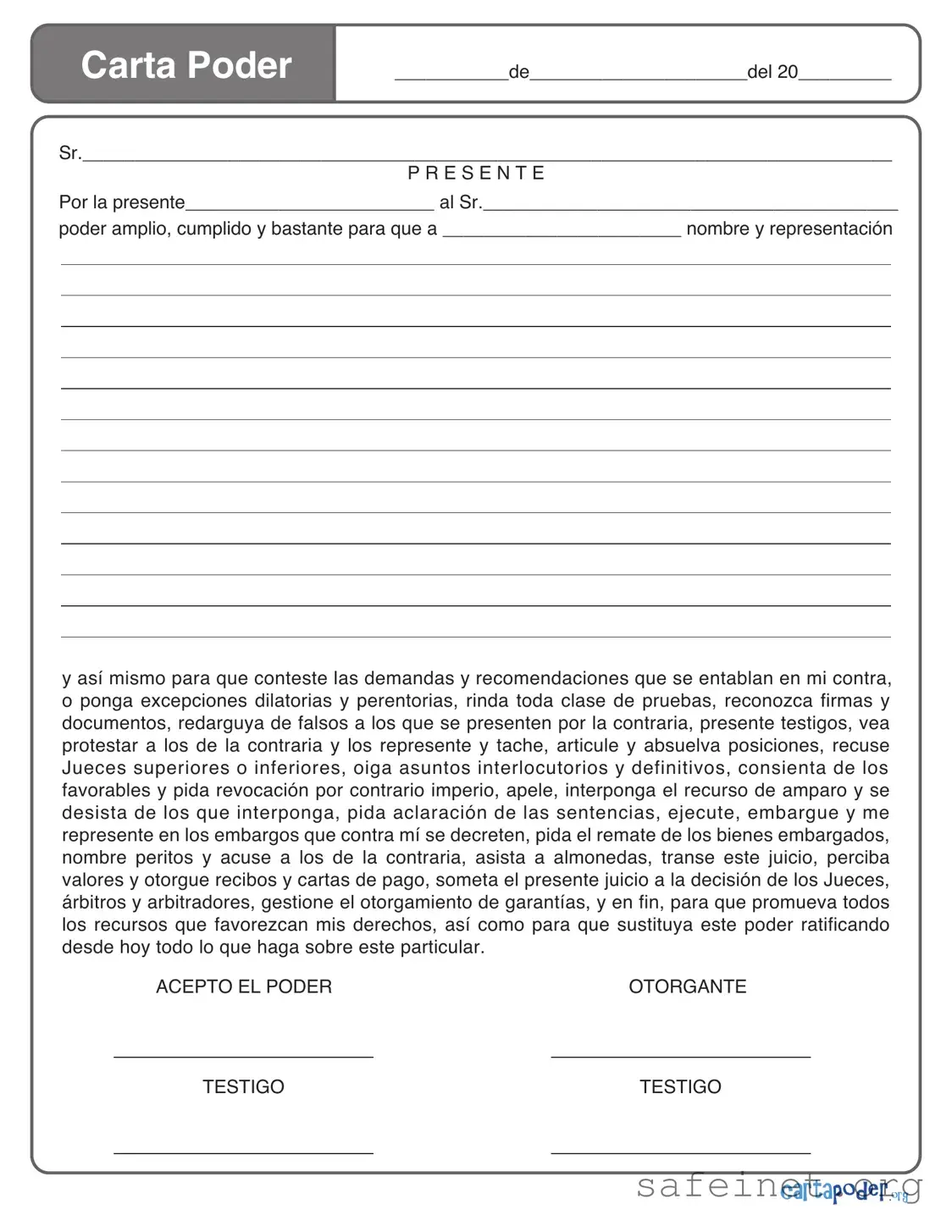
The Carta Poder form serves as a crucial legal document that grants someone the authority to act on behalf of another individual. This form is typically used in various situations, such as legal proceedings, financial transactions, or personal matters. It outlines the specific powers granted, which can include the ability to represent someone in court, manage assets, or handle legal documents. The form requires essential details, including the names of the parties involved, the date, and the specific powers being granted. By signing this document, the individual giving the power allows their representative to take actions that they would normally need to perform themselves. This can include responding to legal demands, presenting evidence, and managing proceedings in a court of law. The Carta Poder is designed to ensure that the person acting on behalf of another has the necessary authority to perform these tasks effectively and legally. It can be a powerful tool, providing flexibility and support in various scenarios, while also ensuring that the rights and interests of the person granting the power are adequately protected.
| Fact Name | Details |
|---|---|
| Definition | The Carta Poder is a legal document that grants authority to an individual to act on behalf of another person in legal matters. |
| Purpose | This form allows the appointed individual to manage legal proceedings, respond to claims, and represent the interests of the person granting the power. |
| Governing Law | In the United States, the use of a Carta Poder may be governed by state-specific laws, such as the Uniform Power of Attorney Act in many states. |
| Signature Requirements | The document typically requires the signatures of the person granting the power and witnesses to validate its authenticity. |
| Scope of Authority | The authority granted can be broad or limited, depending on the specifications outlined in the document. |
| Revocation | The person who granted the power can revoke it at any time, provided they follow the legal procedures required by their state. |
Filling out the Carta Poder form requires careful attention to detail. Ensure all necessary information is accurately entered. Once completed, this document will empower another individual to act on your behalf in legal matters.
What is a Carta Poder?
A Carta Poder is a legal document that grants authority to one person to act on behalf of another in various matters. This document is often used in legal situations where the principal (the person granting the power) cannot be present to manage their affairs. It allows the appointed individual, known as the attorney-in-fact, to make decisions, represent the principal in court, and handle financial transactions.
Who can create a Carta Poder?
Any adult who is of sound mind can create a Carta Poder. This means the individual must understand the nature of the document and the powers they are granting. It is important that the principal is capable of making informed decisions at the time of signing the document.
What powers can be granted through a Carta Poder?
The Carta Poder can grant a wide range of powers. This includes the ability to represent the principal in legal proceedings, manage financial transactions, and make decisions regarding property. Specific powers can be tailored based on the principal's needs and can include the ability to appeal court decisions, manage debts, and handle other legal matters.
Is a Carta Poder legally binding?
Yes, a Carta Poder is legally binding as long as it is properly executed. This means it should be signed by the principal and, in some cases, witnessed or notarized. The requirements may vary by state, so it is advisable to check local laws to ensure compliance.
Can a Carta Poder be revoked?
Yes, a Carta Poder can be revoked at any time by the principal, as long as they are competent to do so. To revoke the power, the principal should provide a written notice to the attorney-in-fact and any relevant parties. It is recommended to document the revocation formally to avoid any confusion.
Do I need a lawyer to create a Carta Poder?
While it is not strictly necessary to have a lawyer to create a Carta Poder, consulting with one can be beneficial. A lawyer can help ensure that the document meets all legal requirements and that the powers granted are appropriate for the principal's situation. This can prevent potential issues in the future.
Failing to provide complete names. It is essential to include full legal names for all parties involved. Incomplete names can lead to confusion and potential legal issues.
Not specifying the date correctly. The date must be clearly indicated. An incorrect or missing date can invalidate the document.
Omitting the purpose of the power. Clearly stating the purpose of granting the power is crucial. Without this, the authority granted may be questioned.
Neglecting to sign the document. All parties must sign the Carta Poder. A missing signature can render the document ineffective.
Forgetting to include witnesses. Witness signatures are often required to validate the document. Failing to include witnesses can lead to complications.
Using vague language. It is important to be specific about the powers being granted. Vague language can lead to misunderstandings and disputes.
Not reviewing the document thoroughly. Before submitting, it is crucial to review the entire document for errors or omissions. A careful review can prevent future legal issues.
The Carta Poder form is a legal document that grants someone the authority to act on behalf of another person in various legal matters. It is often used in conjunction with several other forms and documents to ensure that all legal bases are covered. Below is a list of related documents that can be beneficial when dealing with legal representation or authority.
Using these documents in conjunction with the Carta Poder can streamline legal processes and provide clarity on authority and responsibilities. Each form plays a specific role in protecting rights and ensuring that legal matters are handled appropriately.
The Carta Poder form is similar to a General Power of Attorney. This document grants broad authority to an individual to act on behalf of another person in various matters, including financial and legal decisions. Like the Carta Poder, a General Power of Attorney allows the designated agent to manage affairs, make decisions, and represent the principal in legal matters. Both documents require clear identification of the parties involved and often need to be notarized to be legally binding.
Another document that resembles the Carta Poder is the Limited Power of Attorney. Unlike the General Power of Attorney, which provides wide-ranging powers, the Limited Power of Attorney specifies particular tasks or decisions that the agent is authorized to handle. This specificity can be beneficial when the principal wants to retain control over certain aspects of their affairs while delegating others. Both forms require a clear description of the powers granted and can be revoked at any time by the principal.
The Durable Power of Attorney is also comparable to the Carta Poder. This document remains effective even if the principal becomes incapacitated. It ensures that someone can manage the principal’s affairs during times when they are unable to do so themselves. Similar to the Carta Poder, it must be executed with care, and the scope of authority should be clearly outlined to avoid confusion later on.
A Medical Power of Attorney shares similarities with the Carta Poder, specifically in its purpose of granting authority to make decisions on behalf of another person. This document specifically pertains to healthcare decisions, allowing the designated agent to make medical choices if the principal is unable to communicate their wishes. Both documents emphasize the importance of the principal’s intentions and require careful consideration in their execution.
The Authorization to Release Information is another document akin to the Carta Poder. This form allows an individual to grant permission for another party to access their personal information, often for medical or legal purposes. While the scope is narrower than that of the Carta Poder, it serves to empower another person to act on behalf of the principal in specific situations. Both documents require clarity regarding the information being shared and the parties involved.
A Trust Agreement can also be compared to the Carta Poder. This document establishes a fiduciary relationship where one party holds property or assets for the benefit of another. While the Carta Poder focuses on granting authority for legal representation, a Trust Agreement outlines the management of assets. Both require careful drafting to ensure that the intentions of the principal are honored and that the designated individual acts in the best interests of the beneficiary.
The Advance Directive is another document similar to the Carta Poder, particularly in the context of healthcare decisions. This legal document allows individuals to outline their preferences for medical treatment in case they become unable to communicate those wishes. Like the Carta Poder, it empowers a designated agent to make decisions on behalf of the principal, emphasizing the importance of respecting the principal’s values and desires.
Lastly, the Consent to Treat form bears resemblance to the Carta Poder. This document allows a designated individual to provide consent for medical treatment on behalf of another person. While it is often used in emergency situations, it serves a similar purpose of granting authority to act in the best interests of someone who may not be able to do so themselves. Both documents highlight the necessity of clear communication regarding the powers being granted and the responsibilities assumed by the designated individual.
When filling out the Carta Poder form, it is essential to follow certain guidelines to ensure accuracy and legality. Here are four things you should and shouldn't do:
The Carta Poder form is often misunderstood. Here are nine common misconceptions:
When filling out and using the Carta Poder form, consider the following key takeaways: