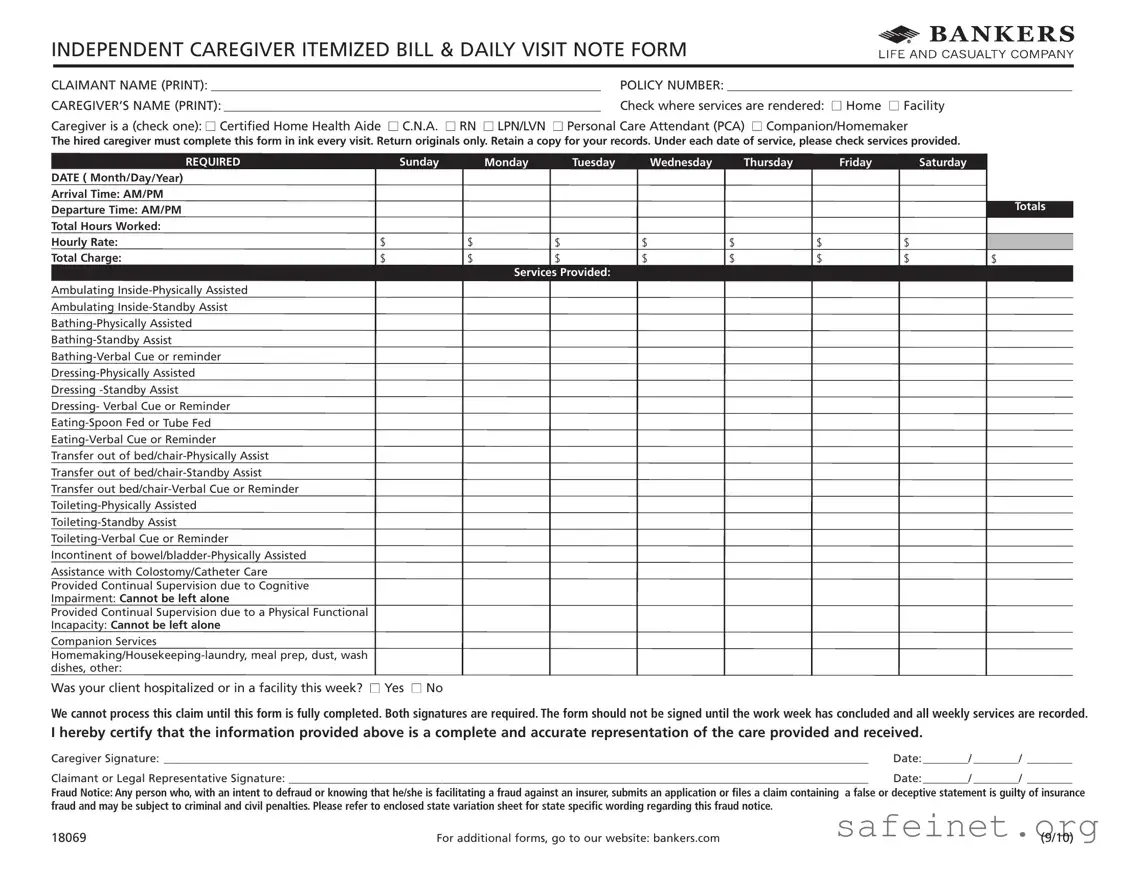
The Caregiver Daily Log form serves as an essential tool for documenting the services provided by caregivers, ensuring a comprehensive record of care is maintained for each client. Designed for use by various types of caregivers, including certified home health aides, registered nurses, and personal care attendants, this form captures critical details about the care rendered. Caregivers are required to fill out the form in ink during each visit, noting the date of service, arrival and departure times, total hours worked, and the hourly rate. Additionally, the form includes a section for itemizing specific services provided, such as assistance with bathing, dressing, and toileting, as well as any necessary supervision due to cognitive or physical impairments. Caregivers must also indicate whether the client was hospitalized or in a facility during the week. To ensure accuracy, both the caregiver and the client or their legal representative must sign the form only after all services for the week have been recorded. This careful documentation not only facilitates the processing of claims but also upholds accountability and transparency in the caregiving process. Furthermore, the form includes a fraud notice, emphasizing the importance of honesty in reporting services rendered, which protects both caregivers and clients alike.
| Fact Name | Details |
|---|---|
| Purpose | The Caregiver Daily Log form is used to document the services provided by caregivers to clients, ensuring accurate billing and care records. |
| Completion Requirement | The caregiver must fill out this form in ink for each visit, ensuring all sections are completed accurately. |
| Signature Requirement | Both the caregiver and the claimant or legal representative must sign the form after all services for the week have been recorded. |
| Service Categories | Services provided include assistance with ambulation, bathing, dressing, eating, toileting, and companionship, among others. |
| Hourly Rate | The form requires the caregiver to specify their hourly rate and total charges for the services rendered during the visit. |
| Fraud Notice | A fraud notice is included, warning against submitting false information, which may lead to criminal and civil penalties. |
| State-Specific Variations | Each state may have variations in the form and associated laws; refer to the enclosed state variation sheet for details. |
| Retention of Copies | Caregivers are advised to retain a copy of the completed form for their records after submitting the originals. |
To complete the Caregiver Daily Log form, follow these steps carefully. Ensure that all information is accurate and complete before submission. This form must be filled out in ink during each visit, and it is important to retain a copy for your records.
After completing the form, review all entries for accuracy. Ensure that both signatures are present before submitting the original form. Keep a copy for your records to maintain documentation of the care provided.
What is the purpose of the Caregiver Daily Log form?
The Caregiver Daily Log form is designed to document the services provided by a caregiver during their visits. It serves as a record of the care given, including the specific tasks performed, arrival and departure times, and total hours worked. This form is essential for billing purposes and ensures that all care activities are accurately tracked and reported.
Who should complete the Caregiver Daily Log form?
The caregiver who provides the services must complete the form. This includes various types of caregivers, such as Certified Home Health Aides, CNAs, RNs, LPNs/LVNs, Personal Care Attendants, and Companions/Homemakers. It is important that the caregiver fills out the form in ink for clarity and accuracy.
What information is required on the form?
Essential information includes the claimant's name, policy number, caregiver's name, dates of service, arrival and departure times, total hours worked, hourly rate, and total charge. Additionally, caregivers must check off the specific services provided during each visit. Completing all sections of the form is necessary for processing claims.
What should I do if my client was hospitalized or in a facility during the week?
If the client was hospitalized or in a facility during the week, it is important to indicate this on the form by checking "Yes." This information is crucial for the claims process and may affect the services billed for that week. Accurate reporting helps ensure that the claim is processed correctly.
Can the form be signed before the week of services is completed?
No, the form should not be signed until the work week has concluded and all services have been recorded. Both the caregiver and the claimant or legal representative must sign the form to certify that the information is complete and accurate. This helps prevent any discrepancies in the claims process.
What happens if the form is not fully completed?
If the form is not fully completed, the claim cannot be processed. It is essential to ensure that all required information is provided, including signatures from both the caregiver and the claimant. Incomplete forms can lead to delays in payment or denial of the claim altogether.
What are the consequences of submitting false information on the form?
Submitting false information with the intent to defraud can lead to serious consequences, including criminal and civil penalties. It is important to provide accurate and truthful information on the Caregiver Daily Log form. This helps maintain the integrity of the claims process and protects all parties involved.
Incomplete Information: Failing to fill out all required fields, such as the claimant name or policy number, can lead to delays in processing the claim.
Incorrect Dates: Entering the wrong date of service can create confusion. Always double-check that the date corresponds with the actual day services were provided.
Missing Signatures: Both the caregiver and the claimant must sign the form. Omitting either signature will prevent the claim from being processed.
Incorrect Service Checkmarks: Not accurately checking the services provided can lead to discrepancies. Ensure that all relevant services are marked clearly.
Failure to Retain Copies: Not keeping a copy of the completed form for personal records can be problematic. Always retain a copy for reference.
Signing Too Early: The form should not be signed until all services for the week have been recorded. Signing prematurely can result in inaccuracies.
The Caregiver Daily Log form is essential for documenting the services provided by caregivers. However, several other forms and documents often accompany it to ensure a comprehensive record of care. Here’s a list of those documents:
These documents work together with the Caregiver Daily Log to create a thorough record of care. Keeping accurate and complete records is essential for the well-being of the client and for fulfilling legal and insurance requirements.
The Caregiver Daily Log form shares similarities with the Time Sheet for Home Health Aides. Both documents track the hours worked by caregivers, detailing the services provided during each visit. The Time Sheet typically includes sections for arrival and departure times, as well as total hours worked. This format allows for easy verification of caregiver hours, ensuring that clients are billed accurately for the services rendered. Both forms require the caregiver's signature, confirming the accuracy of the reported information.
Another document similar to the Caregiver Daily Log is the Patient Care Report. This report documents the specific care provided to patients during a visit. Like the Daily Log, it includes information on the patient's condition and the caregiver's observations. The Patient Care Report often emphasizes the medical aspects of care, while the Daily Log focuses on daily activities and tasks performed. Both documents serve as essential records for tracking care and ensuring compliance with health regulations.
The Service Agreement form also resembles the Caregiver Daily Log. This document outlines the terms and conditions of care, including the services to be provided, payment rates, and caregiver responsibilities. While the Daily Log records the actual care delivered, the Service Agreement sets the framework for that care. Both documents are crucial for establishing clear expectations between caregivers and clients, fostering transparency in the caregiving process.
The Incident Report form is another document that aligns with the Caregiver Daily Log. While the Daily Log records routine care activities, the Incident Report captures any unusual events or accidents that occur during caregiving. Both forms require detailed documentation, but the Incident Report focuses on specific incidents that may require further action or investigation. This ensures that all aspects of care are monitored and addressed appropriately.
Similar to the Caregiver Daily Log is the Client Intake Form. This document gathers essential information about the client before care begins. It includes details such as medical history, specific needs, and preferences. While the Daily Log tracks ongoing services, the Client Intake Form serves as the initial step in understanding the client's requirements. Both documents work together to create a comprehensive care plan tailored to the individual's needs.
The Care Plan is another relevant document that parallels the Caregiver Daily Log. The Care Plan outlines the specific goals and objectives for the client's care, detailing the types of services needed. In contrast, the Daily Log provides a record of how those services are implemented on a daily basis. Both documents are essential for ensuring that care is consistent and meets the client's evolving needs.
The Billing Statement is also similar to the Caregiver Daily Log. This document summarizes the services provided and outlines the charges for those services. While the Daily Log details the specific activities performed, the Billing Statement translates that information into a financial format for clients. Both documents are vital for maintaining clear communication regarding care costs and ensuring timely payments.
Finally, the Caregiver Training Log has similarities with the Caregiver Daily Log. This document records the training and certifications that caregivers have completed. While the Daily Log focuses on the services provided to clients, the Training Log ensures that caregivers are qualified and prepared for their roles. Both documents contribute to the overall quality of care by tracking the skills and experiences of caregivers.
When filling out the Caregiver Daily Log form, it is essential to approach the task with care and attention. Here are four important dos and don'ts to consider:
Following these guidelines will help ensure that the form is filled out correctly and that the care provided is accurately represented. This attention to detail not only assists in the claims process but also honors the care recipient’s needs.
Here are seven misconceptions about the Caregiver Daily Log form, along with explanations for each.
Filling out and using the Caregiver Daily Log form is crucial for accurate record-keeping and billing. Here are key takeaways to ensure proper use: