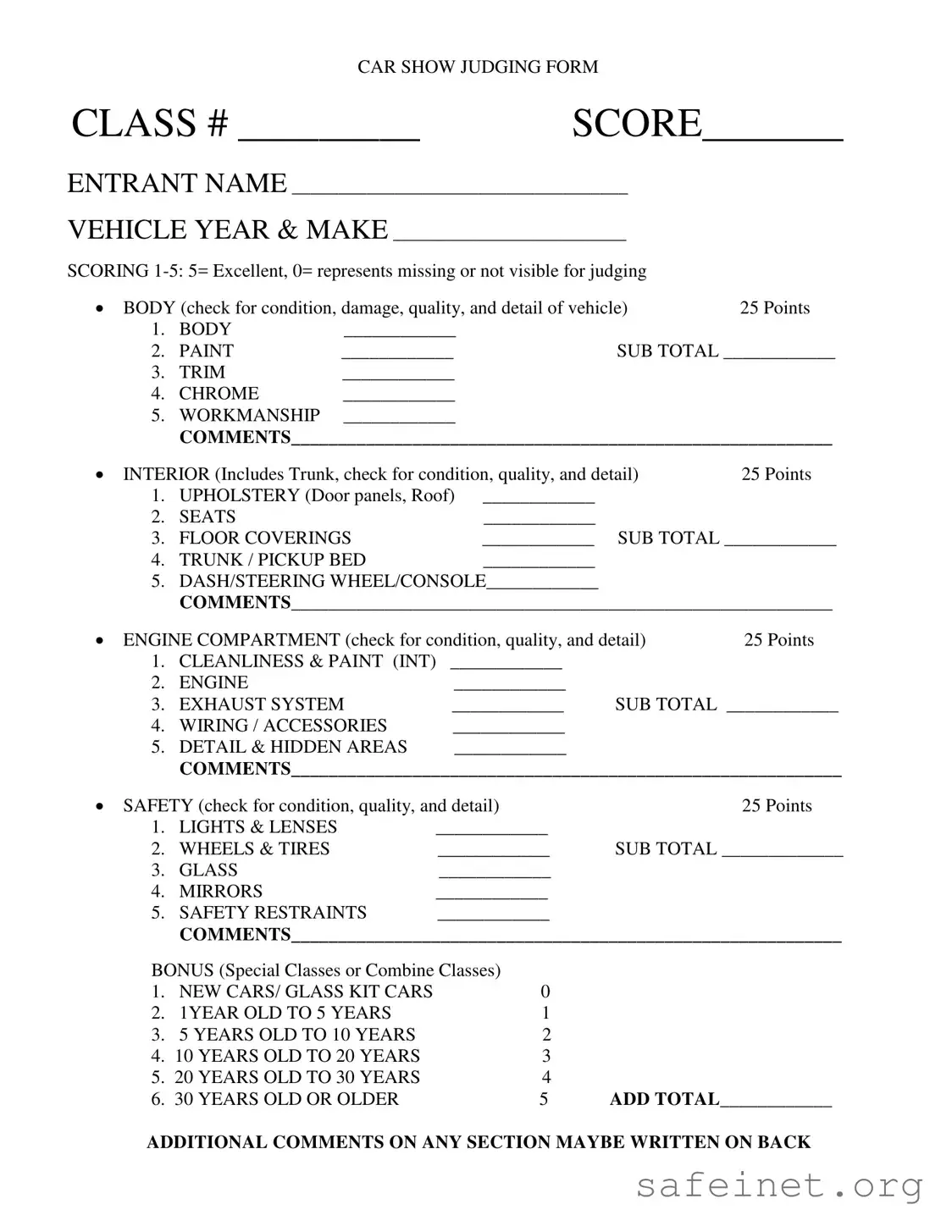
The Car Show Judging form is a comprehensive tool designed to evaluate vehicles across various categories, ensuring a fair and thorough assessment during competitions. Entrants provide essential information, including their class number, score, name, and vehicle details, which set the stage for the judging process. The form breaks down the evaluation into four main sections: Body, Interior, Engine Compartment, and Safety. Each section allows judges to score specific attributes on a scale from 0 to 5, with detailed criteria that include the condition, quality, and attention to detail of the vehicle. Points are allocated to various components, such as paint quality, upholstery, and engine cleanliness, with a total of 100 points available. Additionally, there is a bonus scoring section that recognizes vehicles based on their age, rewarding those that showcase exceptional craftsmanship and historical significance. Judges are encouraged to provide comments throughout the form, allowing for personalized feedback that can benefit entrants in future shows. This structured approach not only promotes fairness but also enhances the overall experience for participants and spectators alike.

| Fact Name | Details |
|---|---|
| Class Number | The judging form requires a class number to categorize vehicles for evaluation. |
| Scoring System | Judges score each section on a scale of 0 to 5, with 5 indicating excellent condition. |
| Categories Evaluated | The form includes four main categories: Body, Interior, Engine Compartment, and Safety. |
| Bonus Points | Special classes allow for additional points based on the age of the vehicle. |
| Additional Comments | Judges can provide further comments on the back of the form for clarity and feedback. |
Filling out the Car Show Judging form is an important step in ensuring that each vehicle is evaluated fairly and accurately. Once you have completed the form, it will be used to determine the scores for each vehicle based on various criteria. Follow these steps to fill out the form correctly.
What is the purpose of the Car Show Judging Form?
The Car Show Judging Form is designed to provide a structured way for judges to evaluate vehicles at car shows. It helps ensure that all aspects of the vehicles are assessed fairly and consistently. The form includes various categories, such as body condition, interior quality, engine compartment cleanliness, and safety features, allowing judges to score each area on a scale from 0 to 5.
How is the scoring system structured?
The scoring system ranges from 0 to 5, with 5 indicating excellent condition and 0 signifying that an item is missing or not visible for judging. Each main category, including body, interior, engine compartment, and safety, is worth 25 points. Judges assess specific components within each category and tally their scores to arrive at a total score for the vehicle.
What categories are included in the judging process?
The judging process includes four main categories: Body, Interior, Engine Compartment, and Safety. Each of these categories is further broken down into specific components. For example, the Body category evaluates aspects like paint, trim, and workmanship, while the Interior category assesses upholstery, seats, and floor coverings.
Can judges provide comments on the form?
Yes, judges can provide comments for each category on the form. There is also space for additional comments at the end of the form. This feedback can be valuable for entrants, offering insights into areas where their vehicle may excel or require improvement.
What is the bonus scoring section for?
The bonus scoring section allows judges to award extra points based on the age and type of the vehicle. This section recognizes special classes, such as new cars or glass kit cars, and assigns bonus points based on the vehicle's age, ranging from 0 to 5 additional points. This helps to level the playing field for vehicles of varying ages and conditions.
How should judges evaluate the cleanliness of the engine compartment?
Judges should look for overall cleanliness and the quality of paint in the engine compartment. They should assess the condition of the engine, exhaust system, wiring, and accessories. Attention to detail in hidden areas is also important, as it reflects the owner's dedication to maintaining the vehicle.
What should judges consider when scoring safety features?
Judges should evaluate the condition and quality of safety features, including lights, lenses, wheels, tires, glass, mirrors, and safety restraints. Each component should be checked for functionality and overall appearance, as these factors contribute significantly to the vehicle's safety profile.
Is there a place for additional comments on the judging form?
Yes, there is a designated area on the back of the form for judges to write additional comments. This space allows for more detailed feedback that may not fit within the structured categories, providing a comprehensive overview of the vehicle's strengths and weaknesses.
Incomplete Information: Failing to fill out all required fields, such as the class number or entrant name, can lead to disqualification or lower scores.
Neglecting Subtotals: Not calculating the subtotal for each section can create confusion and inaccuracies in the final score.
Misunderstanding Scoring: Misinterpreting the scoring system, such as assigning a score of 0 for minor issues, may skew the overall evaluation.
Omitting Comments: Failing to provide comments in the designated sections can prevent judges from understanding the reasoning behind the scores given.
Inconsistent Scoring: Applying different scoring criteria for similar items can lead to inconsistencies and perceived bias in the judging process.
Ignoring Detail Areas: Overlooking hidden areas or details in the vehicle may result in missed points that could enhance the overall score.
Not Reviewing the Form: Submitting the form without a thorough review can lead to errors that could have been easily corrected.
Forgetting Bonus Points: Not considering the bonus points for special or combined classes can lead to a lower final score than achievable.
Using Unclear Handwriting: Filling out the form with illegible handwriting can cause confusion and misinterpretation of the information provided.
The Car Show Judging Form is an essential document used to evaluate vehicles at car shows. Several other forms and documents complement this judging process, each serving a specific purpose. Below is a list of these additional documents, along with brief descriptions of their functions.
These documents collectively enhance the organization and execution of car shows, ensuring a smooth experience for participants, judges, and attendees alike. Each form plays a critical role in maintaining the integrity and enjoyment of the event.
The Car Show Judging form shares similarities with the Event Evaluation Form used in various competitions. Both documents aim to assess participants based on specific criteria. The Event Evaluation Form typically includes sections for performance, presentation, and overall impression. Each category is often rated on a scale, similar to the scoring system in the Car Show Judging form. This structured approach allows judges to provide detailed feedback, ensuring a fair and comprehensive evaluation of all entries.
Another document that resembles the Car Show Judging form is the Performance Review Template used in workplaces. This template evaluates employee performance based on set criteria, such as teamwork, communication, and productivity. Like the judging form, it employs a scoring system to quantify performance levels. Both documents emphasize the importance of detailed comments to support the scores given, helping to clarify the rationale behind the evaluations.
The Contest Scoring Sheet also shares characteristics with the Car Show Judging form. This sheet is often utilized in talent shows or art contests to score participants on various aspects, including creativity and execution. Each section on the Contest Scoring Sheet is rated similarly, allowing judges to provide a numerical score alongside qualitative feedback. This parallel structure helps maintain consistency in judging across different types of events.
The Sports Event Scoring Card is another document that mirrors the Car Show Judging form. Used in competitions like gymnastics or diving, this card allows judges to score athletes based on technique, difficulty, and presentation. Both documents focus on detailed criteria and scoring, ensuring that judges can articulate their assessments clearly. This method fosters transparency in how scores are derived, whether for vehicles or athletic performances.
The Quality Assurance Checklist used in manufacturing is similar to the Car Show Judging form in its evaluative nature. This checklist assesses products based on criteria such as functionality, appearance, and safety. Each item on the checklist is rated, much like the scoring sections in the judging form. Both documents aim to ensure that only the highest quality items or entries meet the established standards, reinforcing the importance of thorough evaluations.
Lastly, the Academic Grading Rubric used in educational settings aligns with the Car Show Judging form. This rubric outlines specific criteria for grading assignments or projects, such as content, organization, and creativity. Just like the judging form, it provides a scoring system that allows for clear differentiation between levels of achievement. Both documents serve to guide evaluators in providing constructive feedback, ultimately enhancing the quality of submissions in their respective fields.
When filling out the Car Show Judging form, attention to detail is crucial. Here are ten recommendations to enhance the accuracy and effectiveness of your submission.
Misconceptions about the Car Show Judging form can lead to misunderstandings regarding the judging process and criteria. Here are six common misconceptions:
Understanding these misconceptions can help participants better prepare for car shows and appreciate the judging process.
When filling out and using the Car Show Judging form, keep these key takeaways in mind: