When a loved one passes away, the last thing anyone wants to deal with is a complicated legal process. In California, the Small Estate Affidavit offers a streamlined solution for settling the estates of individuals who have left behind limited assets. This form is particularly useful for estates valued at $166,250 or less, allowing heirs to bypass the lengthy probate process. By completing the Small Estate Affidavit, beneficiaries can claim personal property without needing to go to court. The form requires essential information, such as the decedent's details, a list of assets, and a declaration stating that no other probate proceedings are pending. It simplifies the transfer of property, making it easier for families to manage their loved one's affairs during a difficult time. Understanding how to properly fill out and file this affidavit can save time and reduce stress, enabling heirs to focus on what truly matters: honoring the memory of the person they lost.
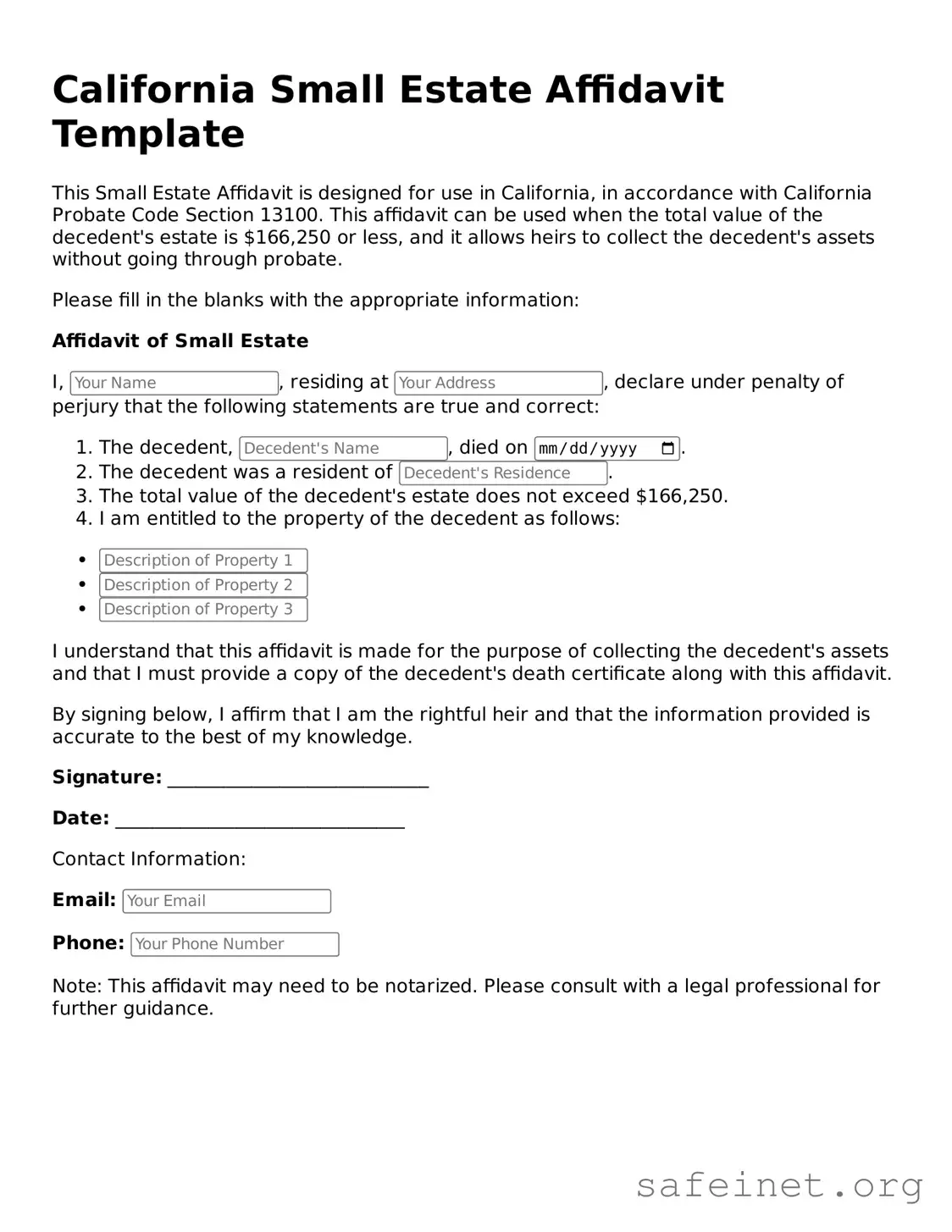
California Small Estate Affidavit Template
This Small Estate Affidavit is designed for use in California, in accordance with California Probate Code Section 13100. This affidavit can be used when the total value of the decedent's estate is $166,250 or less, and it allows heirs to collect the decedent's assets without going through probate.
Please fill in the blanks with the appropriate information:
Affidavit of Small Estate
I, , residing at , declare under penalty of perjury that the following statements are true and correct:
I understand that this affidavit is made for the purpose of collecting the decedent's assets and that I must provide a copy of the decedent's death certificate along with this affidavit.
By signing below, I affirm that I am the rightful heir and that the information provided is accurate to the best of my knowledge.
Signature: ____________________________
Date: _______________________________
Contact Information:
Email:
Phone:
Note: This affidavit may need to be notarized. Please consult with a legal professional for further guidance.
| Fact Name | Details |
|---|---|
| Purpose | The California Small Estate Affidavit allows heirs to claim property of a deceased person without going through probate, provided the estate's total value is under a certain threshold. |
| Value Limit | As of 2023, the total value of the estate must not exceed $166,250 to qualify for the Small Estate Affidavit process. |
| Governing Law | The Small Estate Affidavit is governed by California Probate Code Section 13000 et seq. |
| Eligibility | Only certain individuals, such as heirs or beneficiaries, may use the Small Estate Affidavit to claim the deceased's assets. |
| Required Information | The affidavit must include details about the deceased, the estate's value, and the relationship of the affiant to the deceased. |
| Filing Process | Once completed, the affidavit is presented to financial institutions or property holders to transfer assets without probate court intervention. |
Once you have the California Small Estate Affidavit form, you will need to complete it carefully. This form allows individuals to claim property from a deceased person's estate without going through a lengthy probate process. Follow these steps to fill out the form correctly.
After completing the form, gather any necessary supporting documents. You may need to submit these along with the affidavit to the appropriate court or financial institution to access the deceased's assets.
What is a California Small Estate Affidavit?
The California Small Estate Affidavit is a legal document that allows individuals to claim assets of a deceased person without going through the lengthy probate process. It is typically used when the total value of the estate is below a certain threshold, making it easier and faster for heirs to access their inheritance.
Who is eligible to use the Small Estate Affidavit?
To qualify, the estate must be valued at $166,250 or less as of 2023. Additionally, the person filing the affidavit must be an heir, a beneficiary named in the decedent's will, or a person entitled to the estate under California law.
What assets can be claimed using the Small Estate Affidavit?
Assets that can be claimed include bank accounts, personal property, and vehicles. However, real estate cannot be transferred using this affidavit. The total value of all assets must not exceed the specified limit to proceed with this process.
How do I complete the Small Estate Affidavit?
To complete the affidavit, you will need to fill out the form with information about the deceased, the assets being claimed, and your relationship to the decedent. It is essential to provide accurate details and signatures where required. You can obtain the form from the California courts or online legal resources.
Do I need to file the Small Estate Affidavit with the court?
No, the Small Estate Affidavit does not need to be filed with the court. Instead, you present it directly to the financial institutions or entities holding the assets. They will review the affidavit and, if everything is in order, release the assets to you.
Is there a waiting period after the decedent's death before I can use the affidavit?
Yes, you must wait at least 40 days after the death of the individual before filing the Small Estate Affidavit. This waiting period allows time for any debts or claims against the estate to be addressed.
Are there any fees associated with using the Small Estate Affidavit?
While there are no court fees for filing the affidavit, some financial institutions may charge a fee to process the claim. It is advisable to check with the specific institutions involved for their policies.
What happens if the estate is worth more than the Small Estate limit?
If the estate's value exceeds the limit, you cannot use the Small Estate Affidavit. In this case, you would need to go through the probate process, which can be more time-consuming and may require legal assistance.
Can I use the Small Estate Affidavit if there is a will?
Yes, you can still use the Small Estate Affidavit even if there is a will. However, the will must be probated if the estate exceeds the Small Estate limit. If the estate is within the limit, the affidavit can help you claim the assets without probate.
Incomplete Information: Many people forget to fill out all required sections of the form. Each part is crucial for the affidavit to be valid. Missing information can lead to delays or rejections.
Incorrect Value Assessment: Some individuals miscalculate the total value of the estate. It's essential to include all assets and ensure they do not exceed the California limit for small estates. Underestimating or overestimating can cause issues.
Failure to Sign: A common oversight is neglecting to sign the affidavit. Without a signature, the document is not legally binding. Double-checking for signatures can save time later.
Not Notarizing the Document: Many forget that the affidavit must be notarized. This step is necessary for the form to be accepted. Failing to get it notarized can lead to complications when presenting the affidavit.
The California Small Estate Affidavit is a useful tool for settling the estate of a deceased person with limited assets. Along with this form, several other documents may be required to ensure a smooth process. Here are four commonly used forms and documents that accompany the Small Estate Affidavit:
These documents work together to support the Small Estate Affidavit process, ensuring that the estate is settled efficiently and in accordance with California law.
The California Small Estate Affidavit is similar to the Affidavit of Heirship. This document is often used when someone passes away without a will, helping to establish who the rightful heirs are. It provides a way for heirs to claim property without going through the lengthy probate process. Just like the Small Estate Affidavit, the Affidavit of Heirship simplifies the transfer of assets by allowing heirs to assert their rights based on family relationships rather than court orders.
Another document that shares similarities is the Petition for Probate. While the Small Estate Affidavit is used for smaller estates, the Petition for Probate is necessary for larger ones. This document initiates the probate process, allowing the court to oversee the distribution of a deceased person's assets. Both documents aim to facilitate the transfer of property, but the Petition for Probate involves more formal court procedures, which can be time-consuming and costly.
The Declaration of Trust also resembles the Small Estate Affidavit in that it allows for the transfer of assets outside of probate. This document outlines how a trust is managed and how the assets within it should be distributed upon the trust creator's death. Like the Small Estate Affidavit, the Declaration of Trust provides a way to bypass the probate process, but it requires the creation of a trust, which may not be suitable for everyone.
Lastly, the Transfer on Death Deed (TOD) is another document that can facilitate the transfer of property without going through probate. This deed allows property owners to designate beneficiaries who will receive the property upon the owner's death. Similar to the Small Estate Affidavit, the TOD provides a straightforward method for transferring assets. However, it specifically applies to real estate and requires proper execution to be valid, making it a bit more complex than the Small Estate Affidavit.
When filling out the California Small Estate Affidavit form, it is important to follow specific guidelines to ensure the process goes smoothly. Below are some key dos and don'ts to consider.
By adhering to these guidelines, you can help ensure that the affidavit is processed efficiently and correctly.
The California Small Estate Affidavit is a useful tool for settling the estates of individuals who have passed away. However, several misconceptions can lead to confusion about its use and requirements. Here are five common misconceptions:
Only estates worth less than $150,000 qualify. Many believe that the limit is strictly $150,000. In reality, the threshold can change based on the type of property involved. For example, real estate may not be included in this limit, allowing for a higher overall estate value.
All heirs must agree to use the Small Estate Affidavit. While it is ideal for all heirs to be on board, it is not a strict requirement. If one heir is unwilling to sign, the affidavit can still be filed, provided the other requirements are met.
The Small Estate Affidavit is the same as a will. Some people mistakenly think that the affidavit serves the same purpose as a will. However, the affidavit is a tool for transferring assets after death, while a will outlines how a person's assets should be distributed.
It can be used for any type of asset. Many individuals assume that all assets can be transferred using this affidavit. However, certain assets, such as those held in a trust or life insurance policies, may require different processes for transfer.
The process is quick and requires no documentation. Although the Small Estate Affidavit simplifies the process, it still requires specific documentation. Proof of death, details about the estate, and identification of the affiant must be included.
Understanding these misconceptions can help individuals navigate the Small Estate Affidavit process more effectively, ensuring a smoother transition of assets after a loved one's passing.
Filling out and using the California Small Estate Affidavit can be straightforward if you keep a few key points in mind. Here are ten important takeaways:
Following these guidelines can simplify the process and help ensure a smoother transition of assets.