The California Self-Proving Affidavit form plays a crucial role in the estate planning process, providing a streamlined way for individuals to validate their wills. By using this form, testators can simplify the probate process, reducing the need for witnesses to testify about the will's authenticity after the testator's death. This affidavit serves as a legal declaration, confirming that the will was executed properly, with the necessary signatures and mental capacity of the testator at the time of signing. It is particularly beneficial in ensuring that the testator's wishes are honored without unnecessary delays or complications. Additionally, the form can help mitigate potential disputes among heirs and beneficiaries, fostering a smoother transition of assets. Understanding the requirements and implications of this affidavit is essential for anyone looking to create or update their will in California.
California Self-Proving Affidavit Template
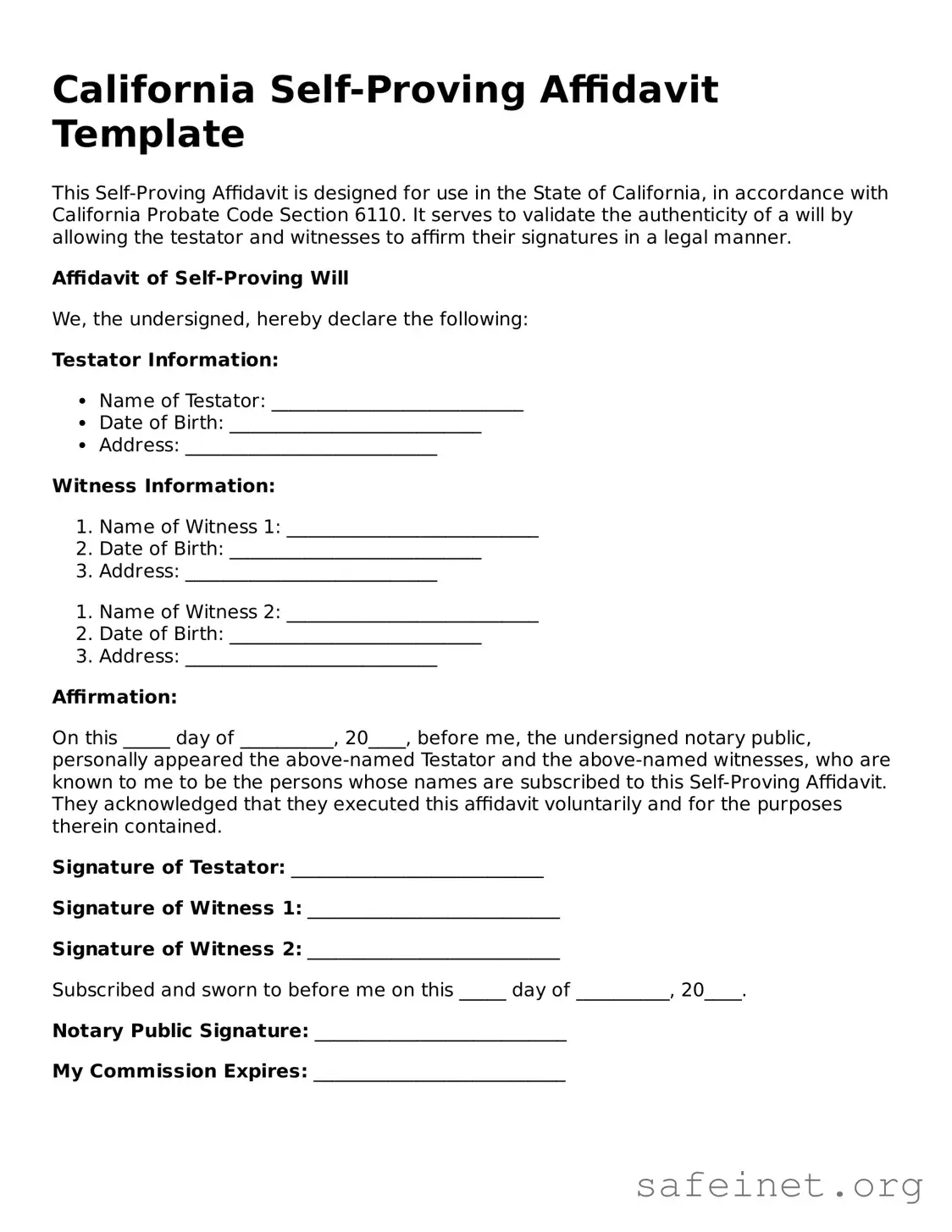
This Self-Proving Affidavit is designed for use in the State of California, in accordance with California Probate Code Section 6110. It serves to validate the authenticity of a will by allowing the testator and witnesses to affirm their signatures in a legal manner.
Affidavit of Self-Proving Will
We, the undersigned, hereby declare the following:
Testator Information:
Witness Information:
Affirmation:
On this _____ day of __________, 20____, before me, the undersigned notary public, personally appeared the above-named Testator and the above-named witnesses, who are known to me to be the persons whose names are subscribed to this Self-Proving Affidavit. They acknowledged that they executed this affidavit voluntarily and for the purposes therein contained.
Signature of Testator: ___________________________
Signature of Witness 1: ___________________________
Signature of Witness 2: ___________________________
Subscribed and sworn to before me on this _____ day of __________, 20____.
Notary Public Signature: ___________________________
My Commission Expires: ___________________________
| Fact Name | Description |
|---|---|
| Purpose | The California Self-Proving Affidavit form allows a will to be validated without the need for witnesses to testify in court. |
| Governing Law | This form is governed by California Probate Code Section 8202. |
| Witness Requirement | Typically, a will must be signed by two witnesses. This affidavit can eliminate that requirement during probate. |
| Form Components | The form includes a declaration by the witnesses affirming the testator's signature. |
| Notarization | The affidavit must be notarized to be considered valid. |
| Timing | It is best to complete the affidavit at the time of signing the will. |
| Accessibility | The form can be obtained from legal websites or local probate court offices. |
| Legal Effect | Using this affidavit can streamline the probate process, making it faster and less complicated. |
| Limitations | The affidavit only applies to wills; it cannot be used for other types of legal documents. |
| Common Mistakes | Failing to have the affidavit notarized is a common error that can invalidate the process. |
Once you have gathered all necessary information and documents, you can begin filling out the California Self-Proving Affidavit form. This form will require specific details about the testators and witnesses involved in the will. Careful attention to detail is essential to ensure everything is accurate and complete.
What is a California Self-Proving Affidavit?
A California Self-Proving Affidavit is a legal document that allows a testator’s will to be validated without the need for witnesses to appear in court. This affidavit is typically executed at the same time as the will and serves as evidence that the will was properly signed and witnessed, thus streamlining the probate process.
Why should I use a Self-Proving Affidavit?
Utilizing a Self-Proving Affidavit can simplify the probate process significantly. When a will includes this affidavit, it can often be admitted to probate without requiring the witnesses to testify. This can save time and reduce potential disputes among heirs, as the affidavit provides a clear declaration of the will's authenticity.
Who can sign a Self-Proving Affidavit?
The Self-Proving Affidavit must be signed by the testator, who is the person making the will, and by at least two witnesses. These witnesses must be present when the testator signs the will, and they must also sign the affidavit, affirming that they witnessed the testator’s signature and that the testator was of sound mind at the time.
How is a Self-Proving Affidavit executed?
To execute a Self-Proving Affidavit, the testator and the witnesses must sign the affidavit in front of a notary public. The notary will then acknowledge the signatures, which adds an additional layer of verification. This process ensures that the document is legally binding and recognized by the court.
Can I create a Self-Proving Affidavit without a lawyer?
While it is possible to create a Self-Proving Affidavit without a lawyer, it is advisable to seek legal assistance. A legal professional can help ensure that the document complies with California law and that all necessary elements are included. This can prevent potential issues during the probate process.
What happens if I do not use a Self-Proving Affidavit?
If a will does not include a Self-Proving Affidavit, the witnesses may need to testify in court to confirm the validity of the will. This can lead to delays in the probate process and may increase the likelihood of disputes among heirs, particularly if the witnesses are unavailable or if their recollections differ.
Is there a specific format for a Self-Proving Affidavit in California?
California law does not prescribe a specific format for the Self-Proving Affidavit, but it must contain certain essential elements. These include a statement affirming that the testator signed the will in the presence of the witnesses, the witnesses’ affirmations, and the notary’s acknowledgment. Many templates are available that comply with California law, making it easier to draft a proper affidavit.
Can I revoke a Self-Proving Affidavit?
Yes, a Self-Proving Affidavit can be revoked if the testator decides to change their will or if they create a new will that does not include the affidavit. It is important to properly execute the new will and ensure that the old will is revoked according to legal standards to avoid confusion during the probate process.
Not Including Witness Signatures: One common mistake is failing to have the required witnesses sign the affidavit. In California, the presence of at least two witnesses is necessary to validate the document. Without their signatures, the affidavit may not hold up in court.
Incorrectly Completing the Affidavit: Many individuals overlook the importance of accurately filling out all sections of the form. Each part has specific information that must be provided, and leaving any section blank can lead to complications later on.
Not Dating the Affidavit: Forgetting to include the date on which the affidavit is signed is another frequent error. This date is crucial as it establishes when the affidavit was executed, which can be important for legal purposes.
Using Improper Notarization: Some people mistakenly believe that any notary can notarize the affidavit without following specific procedures. In California, the notary must witness the signing of the affidavit and ensure that all parties understand what they are signing.
Failing to Review Before Submission: Lastly, many individuals neglect to review the completed affidavit before submitting it. A thorough review can catch errors or omissions that could invalidate the document, saving time and potential legal issues down the road.
The California Self-Proving Affidavit is a useful document for simplifying the probate process. When preparing a will, several other forms and documents may be required to ensure everything is in order. Below are five common documents often used alongside the Self-Proving Affidavit in California.
Using these documents in conjunction with the California Self-Proving Affidavit can help streamline the probate process and ensure that the wishes of the deceased are honored effectively.
The California Self-Proving Affidavit is similar to a Will. Both documents serve the purpose of outlining an individual's wishes regarding the distribution of their estate after death. A Will requires the signature of the testator and witnesses, while a Self-Proving Affidavit includes a sworn statement from the witnesses, affirming that they observed the testator sign the Will. This additional layer of verification can simplify the probate process, making it easier to validate the Will's authenticity.
Another document that shares similarities is the Durable Power of Attorney. Like the Self-Proving Affidavit, this document allows individuals to designate someone to act on their behalf. The Durable Power of Attorney remains effective even if the person becomes incapacitated. While the Self-Proving Affidavit is focused on estate planning after death, both documents empower individuals to make decisions about their affairs, ensuring their wishes are honored.
The Living Will is also comparable to the Self-Proving Affidavit. A Living Will outlines an individual's preferences regarding medical treatment in case they become unable to communicate their wishes. Both documents require the individual’s signature and often need witnesses or notarization to be legally binding. They ensure that personal choices are respected and followed, whether in life or after passing.
The Affidavit of Heirship is another related document. This affidavit is used to establish the heirs of a deceased person, similar to how a Self-Proving Affidavit verifies the authenticity of a Will. Both documents provide clarity regarding an individual's estate, helping to prevent disputes among potential heirs. The Affidavit of Heirship can be especially useful when a person dies without a Will, while the Self-Proving Affidavit supports the validity of a Will.
A Trust Certification is also akin to the Self-Proving Affidavit. This document confirms the existence of a trust and outlines its terms, similar to how a Self-Proving Affidavit verifies a Will's legitimacy. Both documents are used to facilitate the transfer of assets and ensure that the wishes of the deceased are carried out. They help streamline the administration of an estate, reducing potential conflicts among beneficiaries.
The Codicil is another document that bears resemblance. A Codicil amends an existing Will, similar to how a Self-Proving Affidavit supports a Will's validity. Both documents must meet specific legal requirements to be enforceable. While a Codicil modifies the terms of a Will, the Self-Proving Affidavit enhances the Will's acceptance in probate court, making it easier for executors to fulfill the testator's wishes.
The Estate Inventory is also similar in that it lists the assets of a deceased person. While the Self-Proving Affidavit serves to affirm the validity of a Will, the Estate Inventory provides a clear outline of what the deceased owned. Both documents play a critical role in the probate process, helping to ensure that the estate is settled according to the individual's wishes and in compliance with the law.
Lastly, the Declaration of Trust is comparable. This document outlines the terms and conditions of a trust, much like a Self-Proving Affidavit affirms the validity of a Will. Both documents aim to clarify the intentions of the individual regarding their estate. They help prevent misunderstandings and disputes among beneficiaries, ensuring that the estate is managed according to the deceased's wishes.
When filling out the California Self-Proving Affidavit form, it's important to approach the task with care. This document serves a crucial role in the estate planning process, and how you fill it out can impact its effectiveness. Here’s a list of things you should and shouldn’t do:
By following these guidelines, you can help ensure that your Self-Proving Affidavit is completed correctly and serves its intended purpose effectively.
Understanding the California Self-Proving Affidavit form is essential for anyone involved in estate planning or probate matters. However, several misconceptions can lead to confusion. Below is a list of ten common misconceptions about this form, along with clarifications.
While a Self-Proving Affidavit can simplify the probate process, it is not legally required in California. A will can still be valid without this affidavit.
This form is optional. A will can be valid without it, and many individuals choose to execute a will without this additional documentation.
This affidavit is primarily used for attested wills, which are signed by witnesses. Holographic wills, which are handwritten and signed by the testator, do not require this form.
The affidavit can be executed separately from the will, as long as it is signed by the witnesses and the testator in the presence of a notary public.
Both witnesses who signed the will must also sign the Self-Proving Affidavit for it to be valid.
While the form is specific to California, similar affidavits exist in other states. Each state has its own requirements and procedures regarding self-proving wills.
This is not true. The will must still be witnessed according to California law, even if a Self-Proving Affidavit is used.
The affidavit itself can be amended or replaced, but any changes to the will must follow proper legal procedures.
While it can help streamline the probate process, it does not prevent someone from contesting the will based on other grounds.
This form is beneficial for anyone who wants to ensure a smoother probate process, regardless of their financial status.
Clarifying these misconceptions can help individuals better understand the purpose and function of the California Self-Proving Affidavit, ensuring more informed decisions in estate planning.
Filling out and using the California Self-Proving Affidavit form can be a straightforward process if you keep a few key points in mind. Here are some essential takeaways to help you navigate this important document:
By following these takeaways, you can ensure that your Self-Proving Affidavit is completed correctly and serves its intended purpose effectively.