In California, the Release of Liability form serves as a crucial document that protects individuals and organizations from legal claims arising from accidents or injuries that may occur during activities or events. This form is commonly used in various settings, including recreational activities, sports events, and even professional services, where participants acknowledge the inherent risks involved. By signing this form, individuals agree to waive their right to hold the organization or individual responsible for any potential harm, thereby providing a layer of legal protection for the parties involved. The form typically outlines the specific activities covered, the risks associated with those activities, and the responsibilities of both the participant and the organizer. It's essential for participants to read the document thoroughly, as it often requires them to accept the terms willingly and understand the implications of their signature. This proactive approach not only fosters a sense of personal responsibility but also helps organizations manage liability concerns effectively.
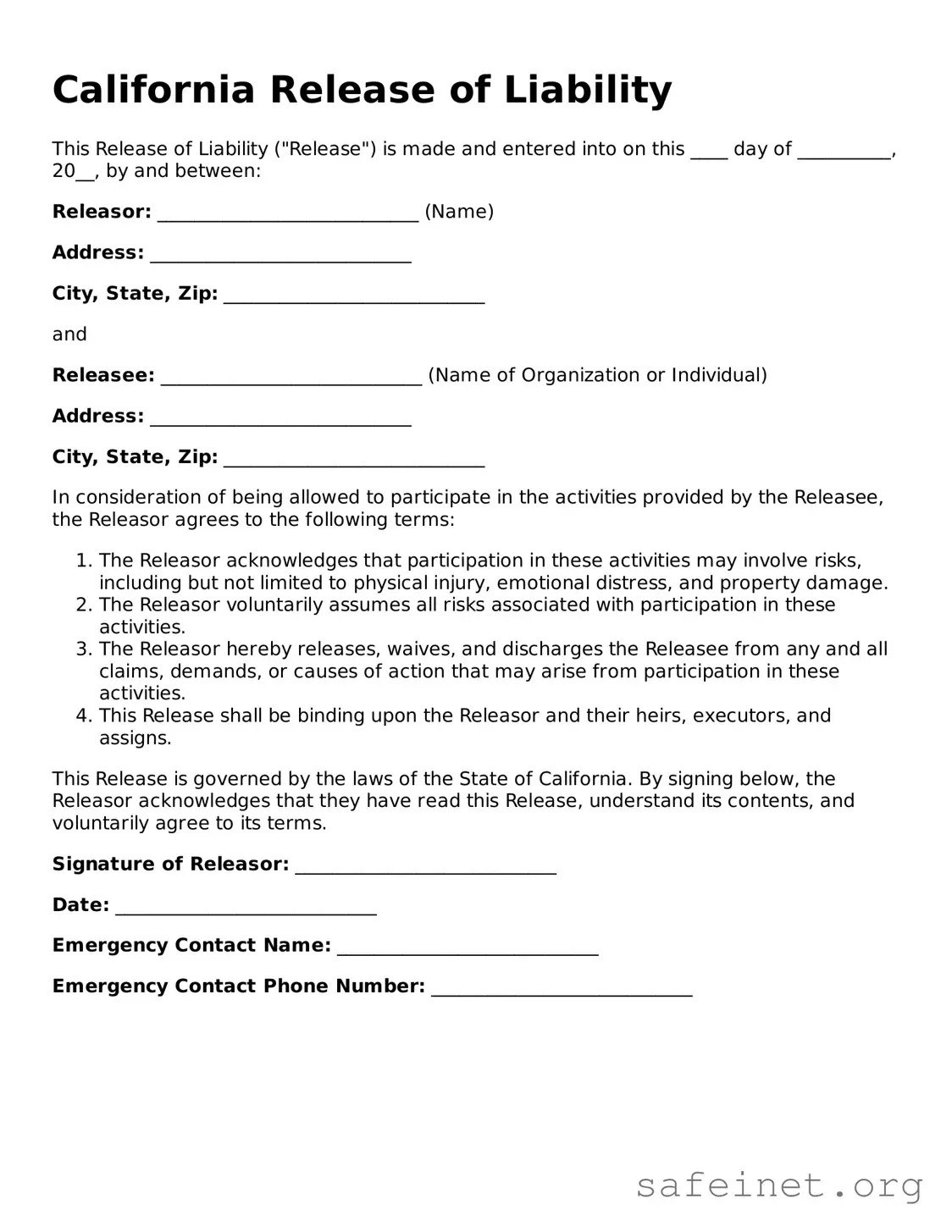
California Release of Liability
This Release of Liability ("Release") is made and entered into on this ____ day of __________, 20__, by and between:
Releasor: ____________________________ (Name)
Address: ____________________________
City, State, Zip: ____________________________
and
Releasee: ____________________________ (Name of Organization or Individual)
Address: ____________________________
City, State, Zip: ____________________________
In consideration of being allowed to participate in the activities provided by the Releasee, the Releasor agrees to the following terms:
This Release is governed by the laws of the State of California. By signing below, the Releasor acknowledges that they have read this Release, understand its contents, and voluntarily agree to its terms.
Signature of Releasor: ____________________________
Date: ____________________________
Emergency Contact Name: ____________________________
Emergency Contact Phone Number: ____________________________
| Fact Name | Details |
|---|---|
| Purpose | The California Release of Liability form is used to protect individuals and organizations from legal claims related to activities that may cause injury. |
| Governing Law | This form is governed by California Civil Code Section 1668, which allows individuals to waive certain rights. |
| Parties Involved | The form typically involves a releasor (the person giving up the right to sue) and a releasee (the person or organization being released from liability). |
| Activities Covered | It can cover a wide range of activities, including sports, recreational events, and other potentially risky activities. |
| Legal Enforceability | For the release to be enforceable, it must be clear, specific, and not against public policy. |
| Signature Requirement | The releasor must sign the form to indicate their understanding and acceptance of the risks involved. |
| Minors | If a minor is involved, a parent or guardian must sign the release on their behalf. |
Completing the California Release of Liability form requires careful attention to detail. After filling out the form, it will need to be submitted to the appropriate party, which may include an organization or individual overseeing the activity in question.
What is a California Release of Liability form?
A California Release of Liability form is a legal document that individuals or organizations use to protect themselves from legal claims. By signing this form, participants acknowledge the risks associated with an activity and agree not to hold the organizer liable for any injuries or damages that may occur during that activity.
When should I use a Release of Liability form?
This form is typically used in situations where there is a risk of injury, such as sports events, recreational activities, or any event where participants may face physical hazards. It is advisable to use this form whenever an organization or individual wants to minimize potential legal liability.
What information is typically included in the form?
The form generally includes details such as the names of the parties involved, a description of the activity, acknowledgment of the inherent risks, and a statement of release from liability. Additionally, it may require signatures from participants, indicating their understanding and acceptance of the terms.
Is a Release of Liability form enforceable in California?
Yes, a Release of Liability form can be enforceable in California, provided it meets certain legal requirements. The language must be clear and unambiguous, and it should not violate public policy. Courts will generally uphold the release unless it is found to be unconscionable or if gross negligence is involved.
Can a minor sign a Release of Liability form?
Minors cannot legally enter into contracts, including a Release of Liability form. However, a parent or legal guardian can sign the form on behalf of a minor. This signature indicates that the guardian understands the risks and consents to the minor's participation in the activity.
What happens if someone is injured despite signing the form?
If an injury occurs, the enforceability of the Release of Liability form will be evaluated based on the circumstances. Factors such as the nature of the injury, the clarity of the form, and whether any negligence was involved will be considered. In some cases, individuals may still pursue legal action, particularly if gross negligence is suspected.
How can I ensure my Release of Liability form is effective?
To create an effective Release of Liability form, it is essential to use clear and straightforward language. Be specific about the risks involved and ensure that participants are fully informed. Consulting with a legal professional can also help ensure that the form complies with California laws and adequately protects your interests.
Can I modify a standard Release of Liability form?
Yes, you can modify a standard Release of Liability form to suit your specific needs. However, it is crucial to ensure that any changes maintain the form's clarity and legal enforceability. Consulting with a legal expert before making modifications can help prevent potential issues down the line.
Incomplete Information: One of the most common mistakes is failing to provide all required information. This includes personal details such as name, address, and contact information. Leaving out any of these can lead to confusion or even invalidate the release.
Not Reading the Entire Document: Many individuals rush through the form without fully understanding its contents. This can result in missing critical clauses or conditions that may affect their rights. Taking the time to read the document thoroughly is essential.
Incorrect Signatures: Signatures must be provided by all parties involved. A common error is having someone sign on behalf of another without proper authorization. Each individual should sign the form personally to ensure its validity.
Failure to Date the Form: Omitting the date can lead to complications later on. The date serves as a reference point for when the agreement was made. Always ensure that the date is clearly indicated to avoid disputes.
When engaging in activities that carry a certain level of risk, it's essential to have the right documentation in place. The California Release of Liability form is a crucial document, but it often works in conjunction with other forms to ensure comprehensive protection for all parties involved. Here are five other forms and documents commonly used alongside the Release of Liability:
Using these documents in conjunction with the California Release of Liability form can help create a safer environment for everyone involved. Always ensure that all parties fully understand the implications of these forms to promote transparency and accountability.
The California Release of Liability form shares similarities with the Waiver of Liability form. Both documents serve to protect organizations or individuals from legal claims arising from injuries or damages. They outline the risks involved in an activity and require participants to acknowledge these risks. By signing, participants agree not to hold the organization responsible for any accidents that may occur. This mutual understanding helps create a safer environment for all involved.
Another document akin to the California Release of Liability is the Indemnity Agreement. This agreement involves one party agreeing to compensate another for any losses or damages that may arise from specific activities. While the Release of Liability focuses on preventing claims against the organization, the Indemnity Agreement places the responsibility on one party to cover costs related to any claims that may arise. Both documents are essential in risk management for businesses and organizations.
The Consent Form is also similar to the California Release of Liability. Consent Forms are often used in medical or recreational settings, where participants must agree to certain terms before engaging in an activity. Like the Release of Liability, these forms require individuals to understand the risks involved. However, Consent Forms often provide additional details about the specific procedures or treatments participants will undergo, ensuring informed consent is obtained.
The Hold Harmless Agreement is another document that parallels the California Release of Liability. This agreement explicitly states that one party will not hold another party liable for any injuries or damages that may occur. While the Release of Liability generally covers a broader range of activities, the Hold Harmless Agreement is often more specific, detailing particular situations or events where liability is waived. Both documents aim to reduce legal exposure for organizations.
Similarly, the Participant Agreement is akin to the California Release of Liability. This document outlines the expectations and responsibilities of participants in an activity. It often includes a section where participants acknowledge the risks involved and agree to waive any claims against the organizing party. The Participant Agreement can be more comprehensive, covering aspects like behavior and adherence to rules, while still focusing on liability waivers.
Lastly, the Safety Acknowledgment Form is comparable to the California Release of Liability. This form is used to confirm that participants have received safety information and understand the risks associated with an activity. While it may not explicitly waive liability, it serves a similar purpose by ensuring participants are aware of potential dangers. By signing this form, individuals acknowledge their responsibility for their safety, which can help mitigate claims in the event of an incident.
When filling out the California Release of Liability form, it is essential to be thorough and accurate. Here are seven important do's and don'ts to consider:
Many people have misunderstandings about the California Release of Liability form. Here are some common misconceptions:
While this form can limit liability, it does not protect against all claims. It may not be enforceable in cases of gross negligence or intentional harm.
Signing the form does not mean you give up all your legal rights. You still have the right to pursue claims under certain circumstances.
This form can be used for various activities, not just extreme sports. It is often used in recreational activities, events, and other situations where there may be risks involved.
Parents or guardians can sign on behalf of minors. This means that children can be included in the waiver, but it must be done by an adult.
Not all forms are created equal. Each form should be tailored to the specific activity and circumstances. Generic forms may not provide the necessary protections.
While these forms are generally enforceable, they can be challenged in court. A judge may determine if the form is valid based on various factors.
Individuals hosting events or activities can also benefit from using this form. It helps protect them from potential legal issues.
Enforceability can depend on several factors, including how clearly the risks are outlined and whether the signer had a full understanding of what they were signing.
Filling out and using the California Release of Liability form can be straightforward if you keep a few key points in mind. Here are some important takeaways to consider: