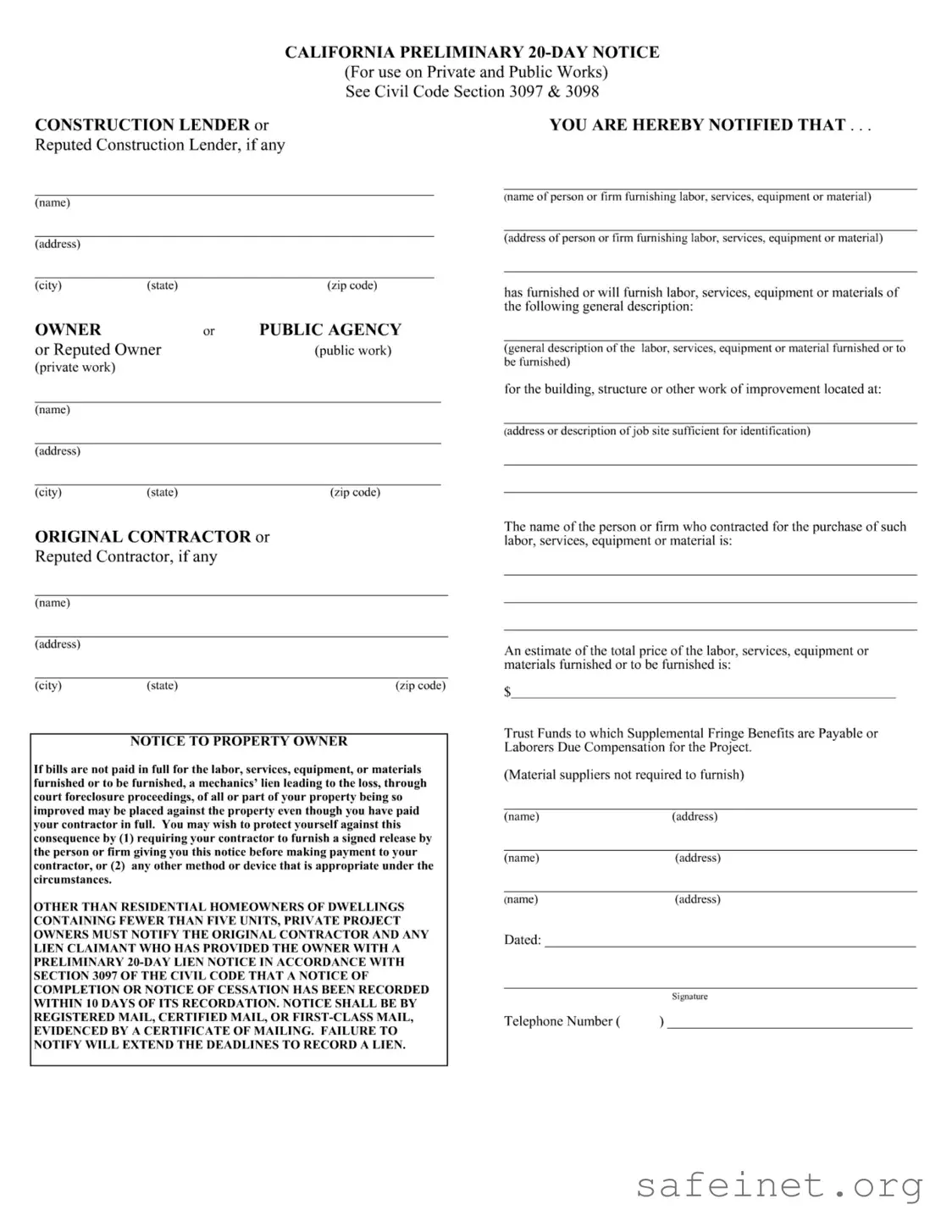
The California Preliminary 20-Day Notice form serves as a crucial tool for individuals and entities involved in construction projects, whether private or public. This form is designed to inform property owners, contractors, and other stakeholders about the labor, services, equipment, or materials that have been, or will be, provided for a specific project. It outlines essential details such as the names and addresses of the construction lender, owner, and original contractor, along with a general description of the work being performed. Importantly, the notice also serves as a warning to property owners about potential mechanics' liens that could be placed on their property if payments for the provided services are not made in full. To protect themselves, owners are advised to consider requiring signed releases from contractors before making payments. Additionally, for private project owners, there are specific notification requirements regarding the recording of a Notice of Completion or Notice of Cessation, emphasizing the importance of timely communication in the construction process. This form is not just a formality; it is a proactive measure that can help prevent disputes and financial complications down the road.
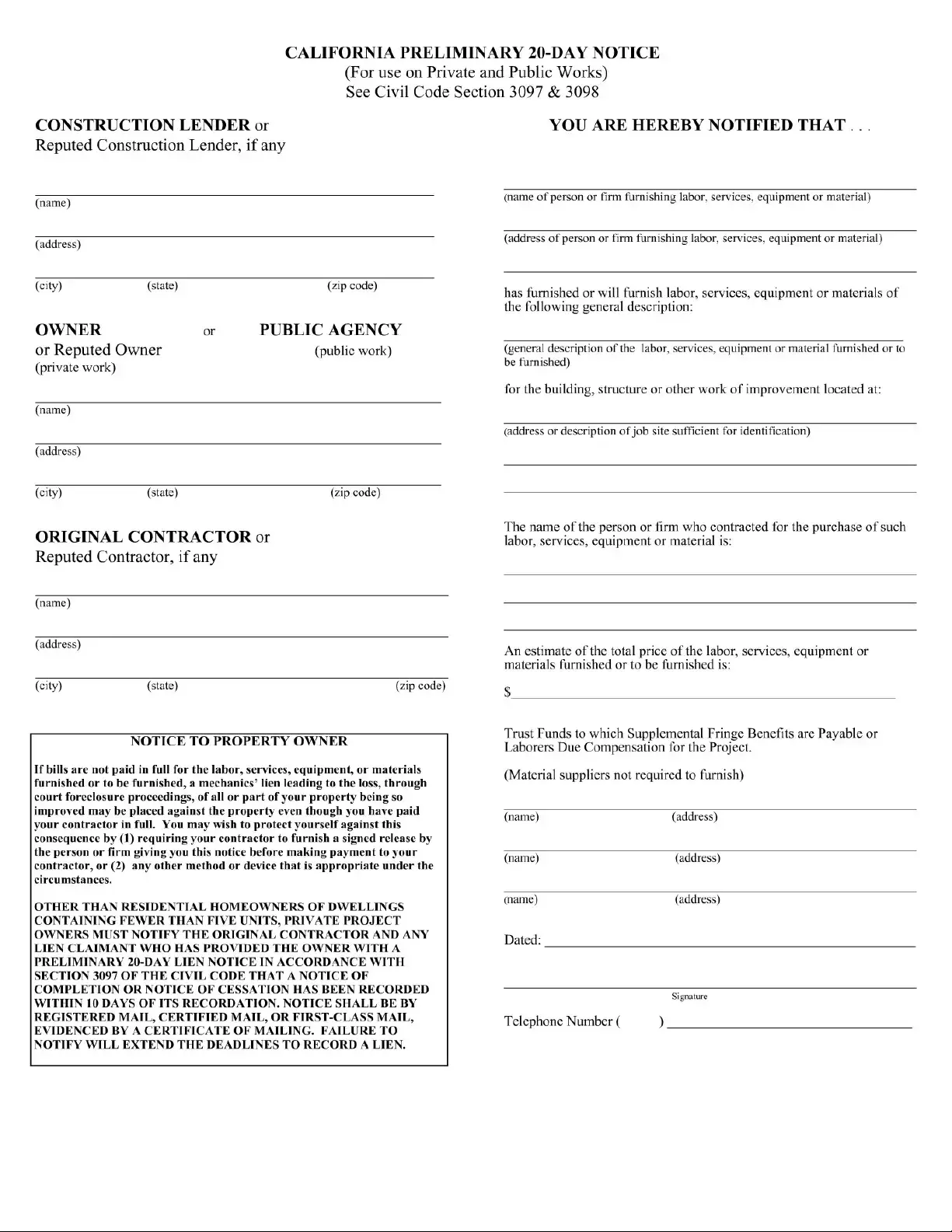
| Fact Name | Description |
|---|---|
| Purpose | The California Preliminary 20-Day Notice is designed to inform property owners about potential claims for unpaid labor, services, equipment, or materials provided for construction projects. |
| Governing Laws | This notice is governed by California Civil Code Sections 3097 and 3098, which outline the requirements and implications of the notice. |
| Timeframe | It must be served within 20 days of the commencement of work or the delivery of materials to ensure the right to file a mechanics' lien. |
| Notification Requirement | Property owners must notify the original contractor and any lien claimant about the recording of a Notice of Completion or Notice of Cessation within 10 days of its recordation. |
| Liability Warning | The notice warns that property owners may face a mechanics' lien against their property, even if they have paid their contractor in full, should bills remain unpaid. |
Once you have the California Preliminary 20 Day Notice form ready, you’ll need to fill it out accurately. This notice is essential in protecting your rights when providing labor, services, or materials for a construction project. Completing this form correctly ensures that all parties involved are informed about the work being done and helps secure your right to payment.
What is the purpose of the California Preliminary 20 Day Notice form?
The California Preliminary 20 Day Notice serves as a notification to property owners, contractors, and lenders that labor, services, equipment, or materials have been or will be provided for a construction project. It is a critical document that helps protect the rights of those who contribute to the project by ensuring they can claim payment if necessary.
Who needs to file a Preliminary 20 Day Notice?
What information is required to complete the form?
The form requires several key pieces of information, including the name and address of the person or firm providing the labor or materials, the name of the property owner or public agency, a description of the work being performed, and the address of the job site. Additionally, an estimate of the total price for the services or materials should be included.
What happens if a property owner does not receive a Preliminary 20 Day Notice?
If a property owner does not receive a Preliminary 20 Day Notice, they may not be aware of potential claims against their property. This lack of notification can lead to complications, including the risk of a mechanics' lien being placed on their property, even if they have paid their contractor in full.
How does the Preliminary 20 Day Notice protect contractors and suppliers?
This notice provides legal protection by informing property owners of the parties involved in the project. If payment issues arise, those who filed the notice have a stronger claim to pursue payment through a mechanics' lien, which can ultimately lead to the sale of the property to satisfy unpaid debts.
What is a mechanics' lien, and how does it relate to the Preliminary 20 Day Notice?
A mechanics' lien is a legal claim against a property for unpaid work or materials supplied. The Preliminary 20 Day Notice is a prerequisite for filing a mechanics' lien in California. By submitting this notice, contractors and suppliers establish their right to claim a lien if they do not receive payment.
What should property owners do upon receiving a Preliminary 20 Day Notice?
Upon receiving this notice, property owners should take it seriously. They may want to verify the claims made in the notice and ensure that all parties involved are being paid appropriately. To protect themselves, they can request a signed release from the contractor before making any payments.
Are there specific deadlines associated with the Preliminary 20 Day Notice?
What is the consequence of failing to notify the original contractor?
If a property owner fails to notify the original contractor and lien claimants, it can extend the deadlines for recording a lien. This may leave the property owner vulnerable to additional claims and potential legal complications.
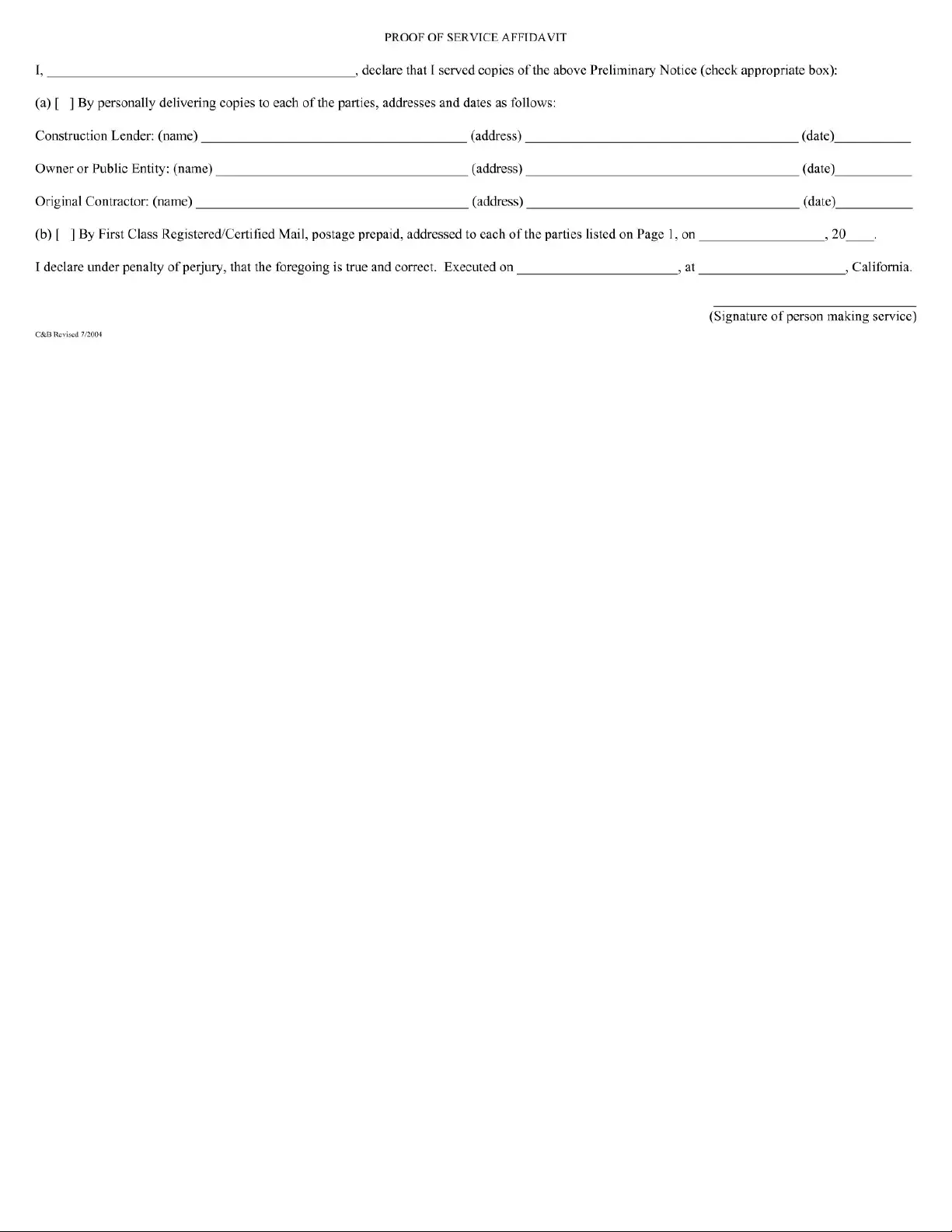
How can I ensure that my Preliminary 20 Day Notice is properly served?
Incomplete Information: One common mistake is failing to fill out all required fields. Each section of the form must be completed, including names, addresses, and descriptions. Missing information can lead to delays or rejection.
Incorrect Addresses: Providing incorrect addresses for the owner or contractor can cause significant issues. Ensure that all addresses are accurate and complete to avoid confusion.
Failure to Notify: Private project owners must notify the original contractor and lien claimants about a notice of completion or cessation. Neglecting this step can extend the deadlines for recording a lien.
Not Including a Total Price Estimate: The form requires an estimate of the total price for the labor, services, equipment, or materials. Omitting this information can create problems for all parties involved.
Improper Service Method: It is essential to serve the notice correctly. Using the wrong method, such as failing to send it via registered or certified mail, can invalidate the notice.
Missing Signature: A signature is necessary to validate the notice. Forgetting to sign the form can render it ineffective.
Ignoring Deadlines: There are strict deadlines for submitting the notice. Failing to adhere to these timelines can result in losing the right to file a mechanics' lien.
The California Preliminary 20 Day Notice form is an essential document in the construction industry, particularly for those involved in private and public works projects. It serves as a notification to property owners, contractors, and lenders about the labor, services, equipment, or materials being provided. However, several other forms and documents often accompany this notice to ensure compliance and protect the rights of all parties involved. Below is a list of these related documents.
Understanding these documents is vital for anyone involved in construction projects. They help protect the rights and interests of property owners, contractors, and suppliers alike. Being informed about these forms can prevent legal complications and ensure smoother project completion.
The California Preliminary 20-Day Notice form serves a crucial role in construction law by notifying property owners and contractors about potential liens. A similar document is the Notice of Completion. This notice is filed by the property owner or contractor once the construction project is completed. It provides a clear timeline for when the project was finished, which can affect the deadlines for filing liens. Both documents aim to protect the rights of parties involved in construction projects, ensuring that everyone is aware of their obligations and rights regarding payments and liens.
Another comparable document is the Notice of Cessation. This is used when a construction project has stopped for a certain period, typically for 30 days or more. Like the Preliminary 20-Day Notice, it serves to inform interested parties about the status of the project. It helps to clarify the timeline for filing liens and protects the rights of those who have provided labor or materials. Both notices are critical in managing the legal implications of construction delays or completions.
The Mechanic's Lien is also similar to the California Preliminary 20-Day Notice. This legal claim is filed against a property by a contractor or supplier who has not been paid for work performed. While the Preliminary Notice serves as a warning, the Mechanic's Lien is an action that can lead to foreclosure on the property. Both documents emphasize the importance of timely payments and provide a mechanism for those in the construction industry to secure their financial interests.
The Stop Notice is another document that aligns closely with the Preliminary 20-Day Notice. A Stop Notice can be served on a property owner or construction lender to halt payment to the contractor until the claimant is paid. Like the Preliminary Notice, it is a way to protect the rights of those who have provided labor or materials. Both notices require timely action to safeguard the interests of the parties involved.
The Release of Lien is also relevant in this context. This document is used to formally remove a lien that has been placed on a property once payment has been made. It is similar to the Preliminary 20-Day Notice in that it is a means of communication regarding financial obligations. Both documents play a vital role in ensuring that all parties are aware of their rights and responsibilities in relation to payments and liens.
The Notice of Non-Payment is another document that bears similarities to the Preliminary 20-Day Notice. This notice is sent to inform a property owner that payment has not been received for work performed. Like the Preliminary Notice, it serves as a warning and a reminder of the financial obligations involved in construction projects. Both documents highlight the necessity of clear communication among all parties involved to avoid disputes.
The Claim of Lien is also comparable to the California Preliminary 20-Day Notice. This document is filed by a contractor or supplier who has not been paid, similar to a Mechanic's Lien. It serves as a formal claim against the property and can lead to legal action if not resolved. Both documents underscore the importance of timely payments and the potential consequences of failing to fulfill financial obligations.
Lastly, the Preliminary Notice for Public Works is similar to the California Preliminary 20-Day Notice. This document is specifically designed for public construction projects and serves the same purpose of notifying interested parties about potential liens. Both notices are essential for protecting the rights of contractors and suppliers, ensuring that they are informed about their financial rights and obligations in relation to public works projects.
When filling out the California Preliminary 20-Day Notice form, it is essential to follow specific guidelines to ensure accuracy and compliance with legal requirements. Below are four important do's and don'ts to consider.
By adhering to these guidelines, you can help protect your rights and interests in the construction process.
Understanding the California Preliminary 20 Day Notice form can be challenging. Here are seven common misconceptions about this important document:
By clarifying these misconceptions, individuals can better navigate the requirements and protections associated with the California Preliminary 20 Day Notice form.
The California Preliminary 20-Day Notice is crucial for anyone involved in construction projects, whether private or public. It serves as a formal notification regarding the provision of labor, services, equipment, or materials.
This notice must be sent to the property owner, construction lender, and original contractor. Properly notifying all parties helps protect the rights of those providing services.
Timeliness is essential. The notice must be delivered within 20 days of starting work or providing materials to ensure that lien rights are preserved.
Property owners should take the notice seriously. If bills remain unpaid, a mechanics' lien can be placed on the property, potentially leading to foreclosure, even if the owner has paid the contractor.
To safeguard against potential liens, property owners can require contractors to provide a signed release from the party issuing the notice before making any payments.
For private project owners, it is mandatory to notify the original contractor and any lien claimants when a notice of completion or cessation is recorded. This notification must occur within 10 days.
Failure to provide the required notifications can extend the deadlines for recording a lien, which could complicate the situation for all parties involved.