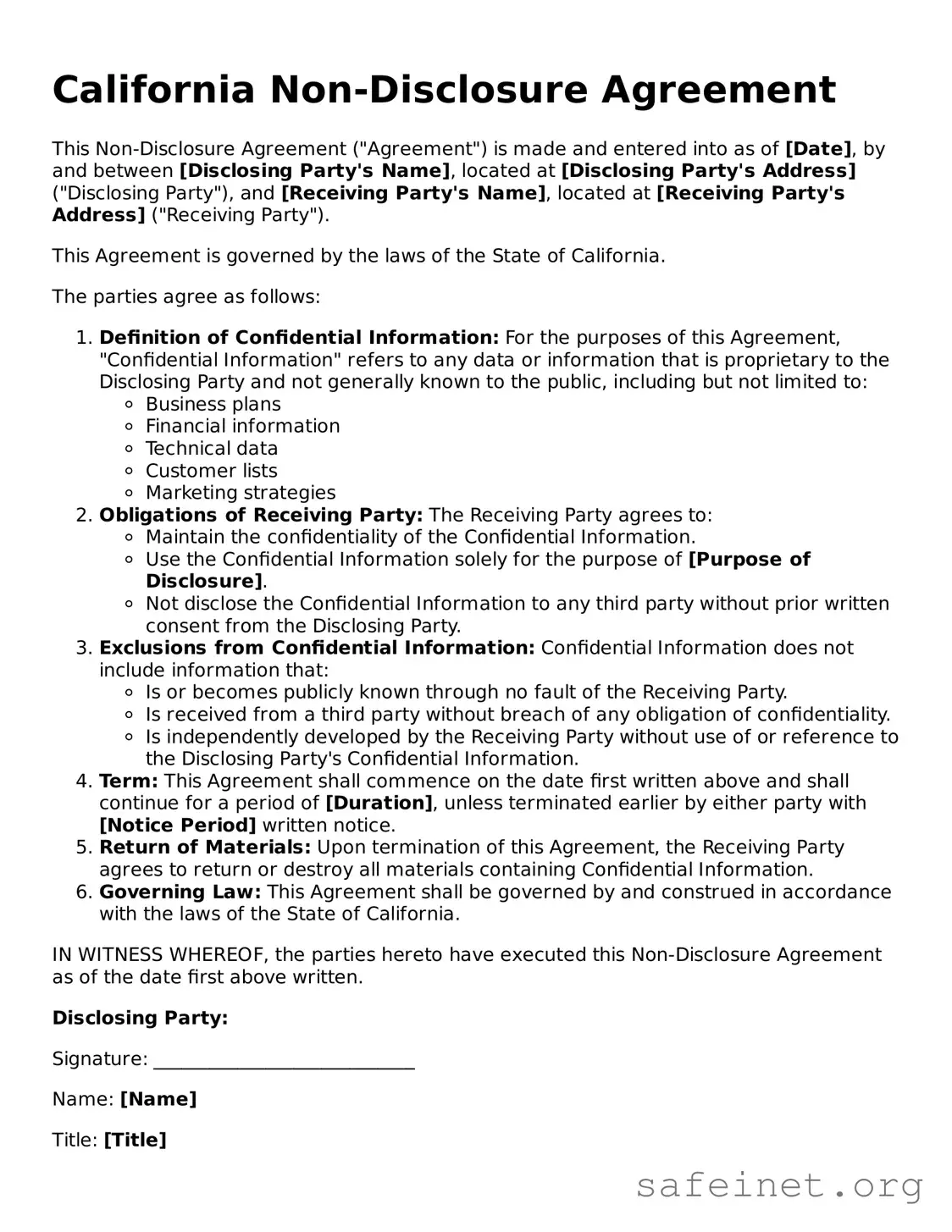
In the competitive landscape of California's business environment, protecting sensitive information is paramount. The California Non-disclosure Agreement (NDA) form serves as a crucial tool for individuals and organizations seeking to safeguard proprietary information from unauthorized disclosure. This legally binding document outlines the obligations of parties involved in sharing confidential information, ensuring that trade secrets, business strategies, and other sensitive data remain protected. Key aspects of the form include the definition of confidential information, the duration of confidentiality obligations, and the consequences of breach. Additionally, the NDA specifies the permitted uses of the disclosed information and may include clauses related to dispute resolution. Understanding these components is essential for anyone looking to maintain a competitive edge while fostering trust in business relationships.
California Non-Disclosure Agreement
This Non-Disclosure Agreement ("Agreement") is made and entered into as of [Date], by and between [Disclosing Party's Name], located at [Disclosing Party's Address] ("Disclosing Party"), and [Receiving Party's Name], located at [Receiving Party's Address] ("Receiving Party").
This Agreement is governed by the laws of the State of California.
The parties agree as follows:
IN WITNESS WHEREOF, the parties hereto have executed this Non-Disclosure Agreement as of the date first above written.
Disclosing Party:
Signature: ____________________________
Name: [Name]
Title: [Title]
Receiving Party:
Signature: ____________________________
Name: [Name]
Title: [Title]
| Fact Name | Details |
|---|---|
| Purpose | A California Non-disclosure Agreement (NDA) protects confidential information shared between parties. |
| Governing Law | The NDA is governed by California state law. |
| Parties Involved | The agreement typically involves a disclosing party and a receiving party. |
| Duration | The confidentiality obligation can last for a specified period or indefinitely, depending on the terms. |
| Definition of Confidential Information | Confidential information can include trade secrets, business plans, and customer lists. |
| Exclusions | Information that is public knowledge or independently developed is usually excluded from confidentiality. |
| Permitted Disclosures | Disclosures may be allowed if required by law or court order. |
| Consequences of Breach | Breaching the NDA can lead to legal action and financial damages. |
| Signature Requirement | Both parties must sign the NDA for it to be enforceable. |
| Amendments | Any changes to the NDA must be made in writing and signed by both parties. |
Completing the California Non-disclosure Agreement form is a crucial step in protecting sensitive information. After filling out the form, ensure that all parties involved sign it to make it legally binding. Follow these steps carefully to fill out the form correctly.
What is a Non-disclosure Agreement (NDA) in California?
A Non-disclosure Agreement, or NDA, is a legal contract that protects confidential information shared between parties. In California, it ensures that sensitive information, such as trade secrets or proprietary data, remains private. Both parties agree not to disclose this information to others without permission.
Who typically uses a Non-disclosure Agreement?
NDAs are commonly used by businesses, entrepreneurs, and individuals who share confidential information. For instance, a company may require employees to sign an NDA before discussing sensitive projects. Similarly, two businesses might use an NDA when exploring potential partnerships.
What should be included in a California NDA?
A comprehensive NDA should clearly outline the confidential information being protected. It should also specify the obligations of each party regarding the information. Important elements include the duration of confidentiality, the purpose of sharing the information, and any exclusions, such as information already in the public domain.
How long does the confidentiality obligation last?
The duration of the confidentiality obligation can vary based on the agreement. Some NDAs specify a fixed period, while others may remain in effect indefinitely. It is essential for both parties to agree on a reasonable time frame that reflects the nature of the information being protected.
What happens if someone breaches the NDA?
If a party breaches the NDA, the other party may seek legal remedies. This could include monetary damages or injunctive relief to prevent further disclosure. It is crucial for both parties to understand the potential consequences of a breach before signing the agreement.
Can an NDA be enforced in California?
Yes, NDAs can be enforced in California as long as they meet certain legal requirements. The agreement must be reasonable in scope and not overly broad. Courts will typically uphold NDAs that protect legitimate business interests and do not violate public policy.
Is it necessary to have a lawyer review an NDA?
While it is not legally required, having a lawyer review an NDA is highly advisable. A legal professional can help ensure that the agreement is clear, enforceable, and tailored to the specific needs of the parties involved. This can provide peace of mind and help avoid potential disputes in the future.
Failing to clearly define the confidential information that will be protected. Without specificity, the agreement may be less enforceable.
Not identifying all parties involved in the agreement. Ensure that all individuals or entities that will share or receive confidential information are included.
Using vague language that can lead to misunderstandings. Clear and concise terms are essential for effective communication.
Neglecting to specify the duration of the confidentiality obligation. This can create confusion about how long the information must be kept confidential.
Omitting a description of the permitted uses of the confidential information. It is important to outline how the information can and cannot be used.
Failing to include provisions for the return or destruction of confidential information after the agreement ends. This step is crucial for protecting sensitive data.
Not considering the consequences of a breach. Clearly outline the repercussions to deter unauthorized disclosure.
Overlooking the need for legal review. Having a legal professional review the agreement can help ensure that it meets all necessary requirements.
Using outdated templates without customization. Generic forms may not address specific needs or circumstances.
Failing to obtain signatures from all parties involved. An unsigned agreement may not hold up in court if disputes arise.
A California Non-disclosure Agreement (NDA) is a critical document used to protect confidential information shared between parties. In addition to the NDA, several other forms and documents may be relevant in similar contexts. Below are some common documents that are often used alongside a California NDA.
These documents complement the California Non-disclosure Agreement by addressing various aspects of confidentiality and business relations. When used together, they help establish a clearer framework for protecting sensitive information and ensuring that all parties understand their responsibilities.
A Confidentiality Agreement is similar to a Non-disclosure Agreement (NDA) in that both documents aim to protect sensitive information. A Confidentiality Agreement typically binds parties to keep certain information private, outlining what constitutes confidential information and the obligations of each party. Like an NDA, it can be used in various contexts, such as business negotiations or employment relationships, ensuring that proprietary information does not fall into the hands of competitors or the public.
A Proprietary Information Agreement is another document that shares similarities with an NDA. This agreement specifically focuses on protecting proprietary information, which may include trade secrets, business strategies, or unique processes. Both documents require the receiving party to refrain from disclosing or using the proprietary information without permission. The key difference lies in the emphasis; a Proprietary Information Agreement often highlights the ownership of the information, whereas an NDA may cover a broader range of confidential data.
An Employment Agreement often includes confidentiality clauses akin to those found in an NDA. In this context, the employee agrees to keep certain company information confidential during and after their employment. This ensures that sensitive business information, such as client lists or internal processes, remains protected. While an Employment Agreement encompasses various terms of employment, the confidentiality aspect aligns closely with the purpose of an NDA.
A Non-circumvention Agreement can also be compared to an NDA, as both documents serve to protect business interests. While an NDA focuses on confidentiality, a Non-circumvention Agreement prevents one party from bypassing the other to engage directly with third parties. This is particularly relevant in business dealings where one party introduces another to potential clients or partners. The aim is to maintain trust and ensure that all parties benefit from the relationships established.
When filling out the California Non-disclosure Agreement form, it is important to follow certain guidelines to ensure accuracy and compliance. Below is a list of things to do and not to do during this process.
Things You Should Do:
Things You Shouldn't Do:
There are several misconceptions about the California Non-disclosure Agreement (NDA) form that can lead to confusion. Here are four common misunderstandings:
Many people think that all NDAs are identical. In reality, each NDA can be tailored to fit specific situations and needs. The terms can vary significantly based on the parties involved and the information being protected.
While businesses often use NDAs, individuals can also benefit from them. Anyone sharing sensitive information, like inventors or freelancers, can use an NDA to protect their ideas and work.
Some believe that signing an NDA completely restricts communication. However, NDAs typically allow sharing information with certain parties, like employees or legal representatives, as long as they are also bound by confidentiality.
Not all NDAs are enforceable. For an NDA to hold up in court, it must meet certain legal requirements. If the terms are too broad or unreasonable, a court may not enforce it.
When filling out and using the California Non-disclosure Agreement (NDA) form, it is important to keep several key points in mind. Below are some essential takeaways to consider:
Understanding these points can help ensure that the NDA serves its intended purpose effectively.