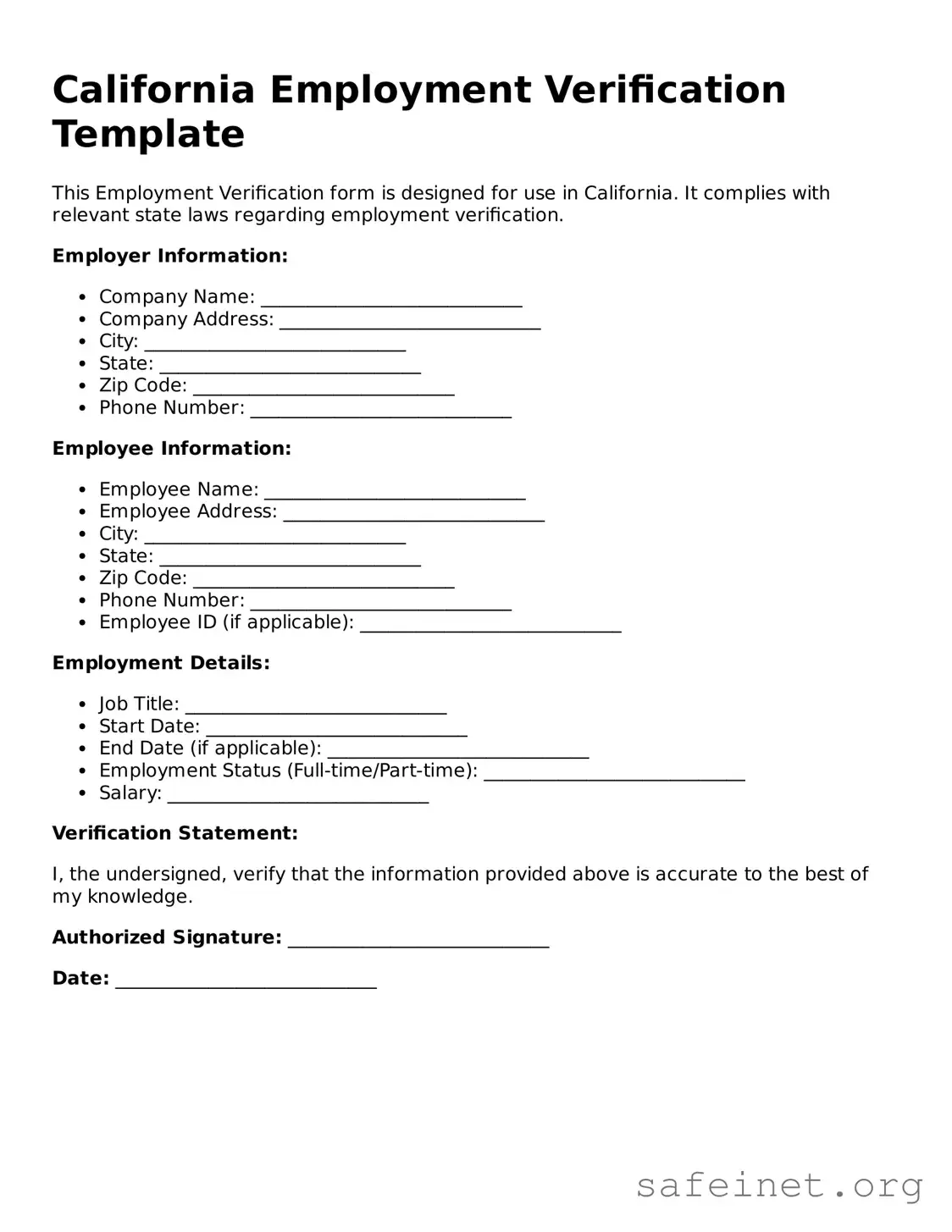
The California Employment Verification form serves as a crucial document for both employers and employees within the state. This form is typically used to confirm an individual’s employment status, job title, and duration of employment. It plays a vital role in various situations, such as loan applications, rental agreements, and background checks. Employers are responsible for completing the form accurately, ensuring that all information provided is truthful and up-to-date. Employees may request this verification to support their applications or to fulfill other personal needs. The form also helps protect both parties by providing a clear record of employment details. Understanding the purpose and proper use of the California Employment Verification form can facilitate smoother transactions and interactions in professional environments.
California Employment Verification Template
This Employment Verification form is designed for use in California. It complies with relevant state laws regarding employment verification.
Employer Information:
Employee Information:
Employment Details:
Verification Statement:
I, the undersigned, verify that the information provided above is accurate to the best of my knowledge.
Authorized Signature: ____________________________
Date: ____________________________
| Fact Name | Description |
|---|---|
| Purpose | The California Employment Verification form is used to verify an employee's identity and eligibility to work in the United States. |
| Governing Law | This form is governed by California Labor Code Section 226 and federal immigration laws. |
| Required Information | Employers must collect the employee's name, Social Security number, and employment start date. |
| Submission Timeline | Employers are required to complete and retain the form within three days of the employee's start date. |
| Retention Period | The completed form must be retained for at least three years after the employee's termination. |
| Employee Rights | Employees have the right to review their employment verification records upon request. |
| Penalties for Non-Compliance | Failure to comply with the verification requirements can lead to fines and legal consequences for the employer. |
| Use of Form | This form is not only for new hires but also for employees seeking to update their verification status. |
Once you have the California Employment Verification form in hand, it’s time to get started on filling it out. This process is straightforward and ensures that all necessary information is accurately provided. Completing the form correctly will help facilitate the verification process, allowing for a smoother experience.
What is the California Employment Verification form?
The California Employment Verification form is a document used by employers to verify the employment status of an individual. This form is often requested by third parties, such as banks or landlords, to confirm a person's job title, duration of employment, and income. It helps ensure that the information provided by the employee is accurate and can be relied upon for various purposes, such as loan applications or rental agreements.
Who needs to complete the Employment Verification form?
Typically, the form is completed by the employer or human resources representative. However, the employee may also need to provide consent or request that the employer fill out the form on their behalf. This process ensures that the verification is conducted in accordance with privacy laws and company policies.
What information is typically included in the Employment Verification form?
The form usually contains several key pieces of information. This includes the employee's name, job title, dates of employment, and salary information. Additionally, the employer may provide details about the employee's job duties and status (full-time or part-time). The specific information required can vary based on the requestor's needs.
How can an employee request an Employment Verification form?
An employee can request an Employment Verification form by contacting their employer's human resources department. It is advisable for the employee to provide clear details about why the verification is needed, such as for a loan or rental application. Some employers may have a standard process for handling such requests, while others may require a written request.
Is there a fee associated with obtaining an Employment Verification form?
In most cases, there is no fee for obtaining an Employment Verification form. Employers typically provide this service as part of their standard operations. However, if a third party is involved, such as a verification service, there may be fees associated with their services. Employees should clarify any potential costs upfront.
How long does it take to receive the completed Employment Verification form?
The time it takes to receive a completed Employment Verification form can vary. Generally, employers aim to process such requests promptly, often within a few business days. However, factors such as the employer's workload, the complexity of the request, and company policies can affect the timeline. Employees should allow sufficient time for processing.
What should an employee do if their Employment Verification form is denied?
If an Employment Verification request is denied, the employee should first seek clarification from their employer. Understanding the reasons for the denial can help address any misunderstandings. In some cases, the employee may need to provide additional documentation or information to satisfy the requestor's requirements.
Are there any privacy concerns related to the Employment Verification form?
Yes, privacy is an important consideration when it comes to Employment Verification forms. Employers must comply with laws regarding the handling of personal information. Employees should be aware of their rights and may want to inquire about how their information will be used and stored. Consent is typically required before sharing employment details with third parties.
Not providing complete information. It's essential to fill out every section of the form. Missing details can delay the verification process.
Using incorrect or outdated job titles. Make sure to list the job title exactly as it appears in company records.
Forgetting to include dates of employment. Clearly state the start and end dates to avoid confusion.
Neglecting to sign the form. A signature is crucial; without it, the form is not valid.
Providing inaccurate salary information. Ensure that the salary figures reflect the current or most recent pay accurately.
Failing to mention part-time or temporary positions. All relevant employment should be included for a complete picture.
Not reviewing the form for errors. Take a moment to double-check all entries before submission.
Ignoring instructions. Each section of the form may have specific guidelines. Follow them closely to ensure proper processing.
The California Employment Verification form is an essential document used to confirm an individual's employment status. Alongside this form, several other documents may be required to provide a complete picture of a person's employment history and qualifications. Below are four commonly used forms and documents that often accompany the Employment Verification form.
These documents, when used together with the California Employment Verification form, help create a thorough understanding of an individual's employment background and financial situation. Collectively, they facilitate various processes, such as loan applications, rental agreements, and job applications.
The I-9 form, officially known as the Employment Eligibility Verification form, is a document required by the federal government for all employers in the United States. Similar to the California Employment Verification form, the I-9 is designed to confirm an employee’s identity and eligibility to work in the country. Employers must complete this form for each new hire, ensuring that the employee presents valid identification. Both forms serve the purpose of preventing unauthorized employment and protecting the rights of workers, but the I-9 focuses specifically on immigration status, while the California form may encompass additional state-specific requirements.
The W-4 form, or Employee's Withholding Certificate, is another document that shares similarities with the California Employment Verification form in that it is essential for new employees. While the W-4 does not verify employment eligibility, it is crucial for determining the amount of federal income tax to withhold from an employee's paycheck. This form requires employees to provide personal information, such as marital status and the number of allowances claimed. Both forms aim to gather critical information from employees to ensure compliance with legal and tax obligations, albeit in different contexts.
The pay stub is an important document that, like the California Employment Verification form, provides essential information regarding an employee's work status. Pay stubs detail an employee’s earnings, deductions, and hours worked, which can serve as proof of employment when applying for loans or rental agreements. While the California form is primarily focused on verifying employment status at the outset of a job, pay stubs continuously document that status over time, reinforcing the employment relationship and providing transparency in compensation.
The job offer letter is another document that bears resemblance to the California Employment Verification form. When an employer extends a job offer, the letter outlines the terms of employment, including job title, salary, and start date. This document confirms that an individual has been selected for a position, similar to how the California form verifies that an individual is employed. Both documents play a vital role in establishing the employer-employee relationship, ensuring that both parties have a clear understanding of the terms and conditions of employment.
The employment contract is a more formal agreement between an employer and an employee, akin to the California Employment Verification form in its role of establishing the employment relationship. This document typically outlines job responsibilities, compensation, and other terms of employment. While the California form verifies employment status for administrative purposes, an employment contract serves as a legally binding agreement that can be referenced in case of disputes. Both documents are integral to the employment process, ensuring clarity and mutual understanding between the employer and the employee.
The background check authorization form is another document that parallels the California Employment Verification form in its function of validating an employee’s credentials. Employers often require this form to conduct background checks, which may include criminal history, credit reports, and employment history. Like the California form, which verifies current employment status, the background check form seeks to ensure that the individual meets the qualifications and standards set by the employer. Both documents are crucial in the hiring process, helping to mitigate risks associated with potential hires.
When filling out the California Employment Verification form, it is essential to approach the task with care. Here are some important dos and don'ts to keep in mind:
By following these guidelines, you can ensure that your submission is complete and accurate, which can help facilitate a smoother verification process.
Understanding the California Employment Verification form can be challenging, and several misconceptions often arise. Here are nine common misunderstandings about this important document:
This is not true. The California Employment Verification form may be required for various purposes, including audits and compliance checks, not just for new hires.
Employers must still complete the Employment Verification form, even if they maintain other records. This form serves a specific purpose and is often required by law.
While there are standard forms, employers may customize their forms to meet specific needs, provided they comply with legal requirements.
This misconception is incorrect. The Employment Verification form applies to all employees across various industries in California.
Part-time and temporary employees also require employment verification. The form is applicable to all types of employment arrangements.
Employees must provide accurate information for the form. Their input is crucial to ensure the verification process is correct.
Employers can update or correct the information on the form if necessary. Accuracy is essential for compliance.
Employees have the right to review the information submitted on their behalf and to request corrections if they believe inaccuracies exist.
Employment verification may be required at various points during employment, including promotions or when applying for benefits.
By clarifying these misconceptions, both employers and employees can better understand the importance and requirements of the California Employment Verification form.
When filling out and using the California Employment Verification form, several important aspects should be kept in mind to ensure accuracy and compliance. Here are six key takeaways: