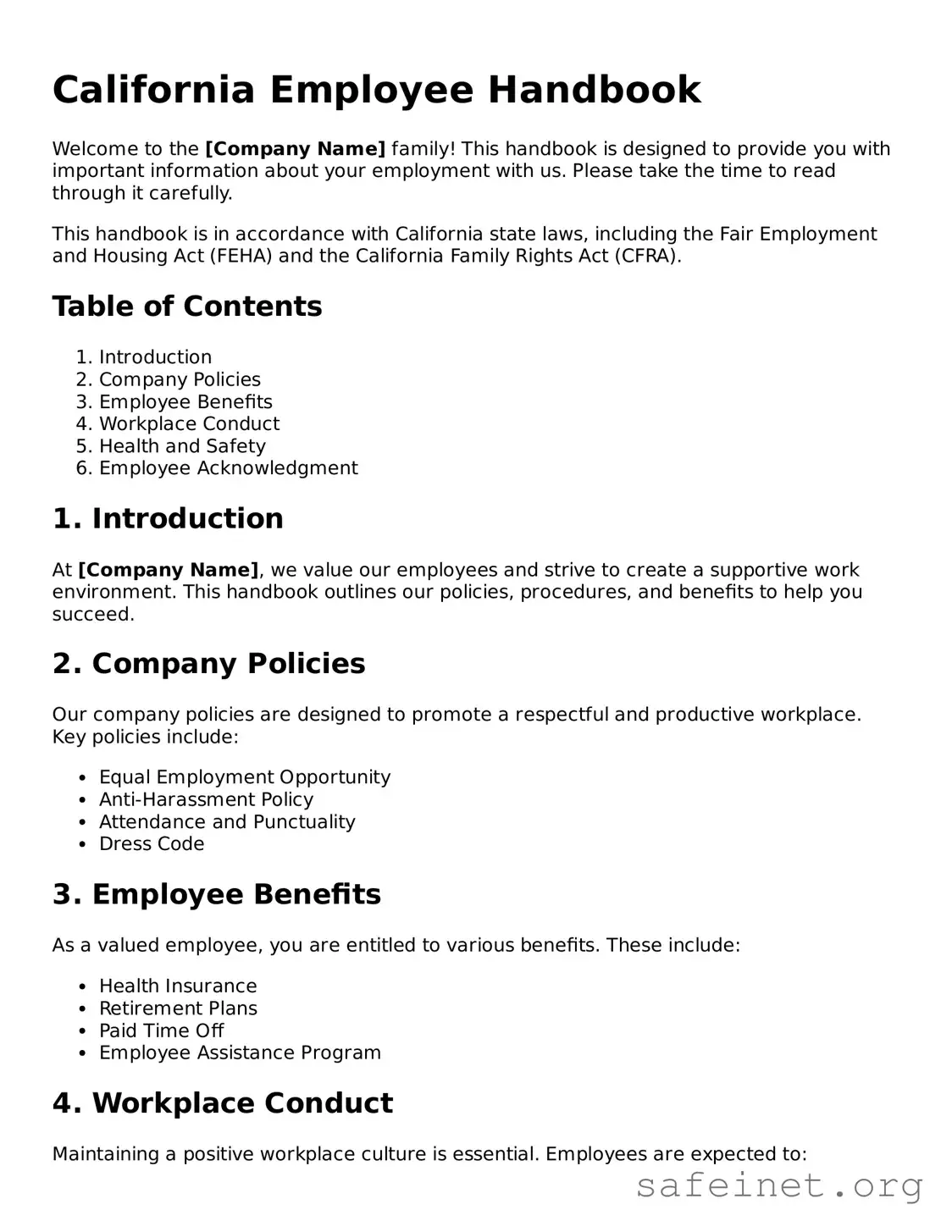
Creating a comprehensive employee handbook is a vital step for any business operating in California. This document serves as a foundational resource, outlining essential policies, procedures, and expectations for employees. It typically covers key areas such as workplace conduct, anti-discrimination policies, and employee benefits. Additionally, it addresses important topics like leave policies, safety protocols, and disciplinary procedures. By providing clear guidelines, the handbook helps foster a positive work environment and promotes compliance with state and federal laws. Employers can use this tool not only to communicate their values and culture but also to protect their interests and mitigate potential legal risks. A well-structured employee handbook is an investment in both the workforce and the overall success of the organization.
California Employee Handbook
Welcome to the [Company Name] family! This handbook is designed to provide you with important information about your employment with us. Please take the time to read through it carefully.
This handbook is in accordance with California state laws, including the Fair Employment and Housing Act (FEHA) and the California Family Rights Act (CFRA).
Table of Contents
1. Introduction
At [Company Name], we value our employees and strive to create a supportive work environment. This handbook outlines our policies, procedures, and benefits to help you succeed.
2. Company Policies
Our company policies are designed to promote a respectful and productive workplace. Key policies include:
3. Employee Benefits
As a valued employee, you are entitled to various benefits. These include:
4. Workplace Conduct
Maintaining a positive workplace culture is essential. Employees are expected to:
5. Health and Safety
Your health and safety are our top priorities. We follow all relevant California safety regulations, including:
6. Employee Acknowledgment
By signing below, you acknowledge that you have received, read, and understood the [Company Name] Employee Handbook.
Employee Name: [Employee Name]
Employee Signature: ____________________ Date: _______________
| Fact Name | Details |
|---|---|
| Purpose | The California Employee Handbook serves as a guide for employees regarding company policies, procedures, and expectations. |
| Legal Requirement | While not legally required, having an employee handbook can help protect employers from legal disputes. |
| Governing Laws | The handbook should comply with California labor laws, including the California Labor Code and the Fair Employment and Housing Act (FEHA). |
| Content Recommendations | It is recommended to include sections on anti-discrimination, harassment policies, and employee rights. |
| Updates | Regular updates are essential to reflect changes in laws and company policies. |
| Employee Acknowledgment | Employees should sign an acknowledgment form to confirm they have received and understood the handbook. |
| Accessibility | The handbook should be easily accessible to all employees, whether in print or digital format. |
| Review Process | Employers should periodically review the handbook to ensure compliance and relevance. |
Completing the California Employee Handbook form is an important step in ensuring that you are aware of your rights and responsibilities as an employee. Once you have filled out the form, it will be submitted to your employer for their records. Here’s how to accurately complete the form.
What is the California Employee Handbook form?
The California Employee Handbook form is a document designed to outline the policies, procedures, and expectations within a workplace. It serves as a guide for employees, providing them with essential information about their rights, responsibilities, and the company culture. This handbook is crucial for ensuring that both employers and employees understand their roles and the standards that govern their workplace interactions.
Why is an Employee Handbook important?
An Employee Handbook is important because it helps establish clear communication between employers and employees. It can reduce misunderstandings and conflicts by providing a reference point for workplace policies. Additionally, having a well-structured handbook can protect the company legally by demonstrating that it has communicated its policies effectively to employees.
What should be included in the California Employee Handbook?
A comprehensive California Employee Handbook should include various sections such as company history, mission and values, employment policies, code of conduct, anti-discrimination policies, harassment policies, attendance expectations, and benefits information. It may also cover procedures for reporting issues, disciplinary actions, and employee rights under California law.
How often should the Employee Handbook be updated?
The Employee Handbook should be reviewed and updated regularly, ideally at least once a year. Changes in laws, company policies, or industry standards may necessitate updates. Regular reviews ensure that the handbook remains relevant and compliant with current legal requirements.
Is it necessary for all employees to sign the Employee Handbook?
While it is not legally required for employees to sign the Employee Handbook, having them acknowledge receipt and understanding of the handbook is a best practice. This acknowledgment can serve as proof that employees have been informed of the policies and can help protect the company in case of disputes.
Can an Employee Handbook be used in legal disputes?
Yes, an Employee Handbook can be used in legal disputes. If a disagreement arises regarding workplace policies or employee conduct, the handbook can serve as evidence of the company's stated policies. However, it is essential that the handbook is well-drafted, clear, and consistently enforced to be effective in such situations.
What are the consequences of not having an Employee Handbook?
Not having an Employee Handbook can lead to confusion among employees regarding workplace expectations and policies. This lack of clarity can result in increased conflicts, potential legal issues, and a negative workplace culture. Furthermore, without documented policies, a company may struggle to defend itself against claims of unfair treatment or discrimination.
Where can I find a template for a California Employee Handbook?
Templates for California Employee Handbooks can be found online through various HR and legal resources. Many organizations provide customizable templates that can be tailored to meet specific business needs. However, it is advisable to consult with a legal professional to ensure compliance with California laws and regulations before finalizing any handbook.
Incomplete Information: Many individuals fail to fill out all required fields, leaving sections blank. This can lead to delays in processing or even rejection of the form.
Incorrect Personal Details: Mistakes in names, addresses, or contact numbers are common. Double-checking this information is crucial to ensure accurate records.
Neglecting to Sign: Some forget to provide their signature at the end of the form. A signature is often necessary to validate the document.
Not Reading the Instructions: Skipping over the instructions can lead to misunderstandings about what is required. Carefully reviewing the guidelines can prevent errors.
Using Inappropriate Language: In some cases, individuals may include informal language or comments that are not suitable for a professional document. Maintaining a formal tone is important.
Failing to Update Information: As personal circumstances change, such as a new address or phone number, individuals may forget to update their information on the form. Keeping this information current is essential.
The California Employee Handbook is an essential document that outlines company policies, procedures, and expectations for employees. However, several other forms and documents complement the handbook, ensuring both employers and employees have a clear understanding of their rights and responsibilities. Below is a list of commonly used documents that often accompany the Employee Handbook.
These documents, when used in conjunction with the Employee Handbook, provide a comprehensive framework for managing employee relations and fostering a clear understanding of workplace expectations. Together, they help create a more structured and transparent work environment.
The California Employee Handbook is similar to an Employee Manual. Both documents serve as comprehensive guides for employees, outlining company policies, procedures, and expectations. An Employee Manual typically includes sections on workplace behavior, dress code, and attendance policies, much like the Employee Handbook. Both documents aim to ensure that employees understand their rights and responsibilities within the organization.
Another document that shares similarities is the Company Policy Document. This document outlines specific policies that govern various aspects of the workplace, such as leave policies, harassment prevention, and disciplinary actions. Like the Employee Handbook, the Company Policy Document is designed to provide clarity and consistency in how policies are applied. Both documents help employees navigate their work environment by setting clear guidelines.
The Orientation Packet is another comparable document. This packet is often provided to new hires and includes essential information about the company, its culture, and its policies. Similar to the Employee Handbook, the Orientation Packet aims to familiarize employees with the organization’s values and expectations. Both documents serve as resources to help employees integrate smoothly into their new roles.
The Code of Conduct is also similar to the California Employee Handbook. This document outlines acceptable behaviors and ethical standards within the workplace. It addresses issues such as conflict of interest, confidentiality, and workplace behavior. Like the Employee Handbook, the Code of Conduct emphasizes the importance of maintaining a respectful and professional work environment.
Lastly, the Benefits Summary is akin to the Employee Handbook in that it provides crucial information about employee benefits and entitlements. This document details health insurance, retirement plans, and other perks offered by the employer. Both the Benefits Summary and the Employee Handbook aim to inform employees about what they can expect in terms of compensation and benefits, ensuring they are aware of their rights and options.
When filling out the California Employee Handbook form, it's essential to follow specific guidelines to ensure accuracy and compliance. Below is a list of what you should and shouldn't do.
When it comes to the California Employee Handbook, several misconceptions often arise. Understanding the truth behind these can help employers and employees navigate workplace policies more effectively.
Many small business owners believe that they do not need an employee handbook. However, having one can clarify policies and expectations, reducing misunderstandings and potential legal issues.
Some think that an employee handbook must cover every conceivable situation. In reality, it should outline key policies and procedures, but it does not need to be exhaustive.
Many assume that a handbook is a one-time project. In fact, it should be reviewed and updated regularly to reflect changes in laws, regulations, and company practices.
Some believe that handbooks are solely for employees. However, they also serve as a guide for management, ensuring consistent enforcement of policies.
It is a common belief that employees must sign an acknowledgment to be subject to the handbook's policies. However, employees are generally bound by the handbook once they are informed of its contents, even without a signature.
While a well-crafted handbook can help mitigate risks, it does not provide absolute protection against legal claims. Employers must still adhere to laws and regulations to avoid liability.
When filling out and using the California Employee Handbook form, it is essential to consider several key points to ensure compliance and clarity for all employees.
By following these guidelines, employers can create an effective employee handbook that fosters a positive work environment and minimizes potential legal issues.