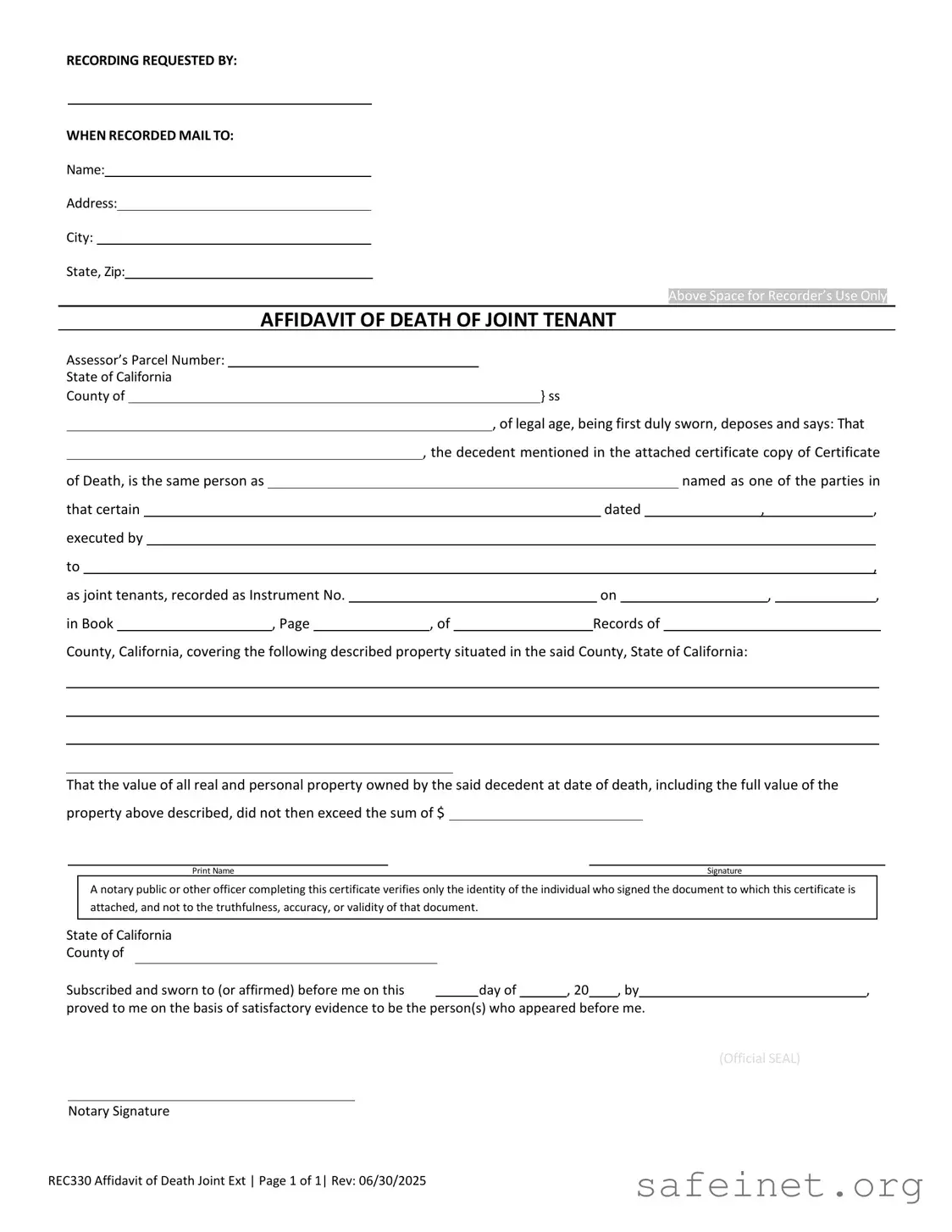
In California, the Death of a Joint Tenant Affidavit form plays a crucial role in the transfer of property ownership when one of the joint tenants passes away. This legal document serves as a means to clarify the status of the property and facilitate the transfer of the deceased tenant's interest to the surviving joint tenant(s). By using this affidavit, surviving tenants can avoid the complexities of probate, ensuring a smoother transition of property rights. The form typically requires essential information, such as the names of the deceased and surviving tenants, details about the property in question, and the date of death. Additionally, the affidavit must be signed under penalty of perjury, affirming the accuracy of the information provided. This process not only simplifies the legalities surrounding property ownership but also offers peace of mind to those navigating the emotional landscape following a loved one's passing.

| Fact Name | Description |
|---|---|
| Purpose | The California Death of a Joint Tenant Affidavit is used to transfer ownership of property when a joint tenant passes away. |
| Governing Law | This form is governed by California Probate Code Section 5600 and related statutes. |
| Eligibility | Only the surviving joint tenant can complete and file this affidavit. |
| Required Information | The affidavit must include details such as the decedent's name, date of death, and property description. |
| Notarization | The affidavit typically requires notarization to be considered valid. |
| Filing Location | The completed affidavit should be filed with the county recorder's office where the property is located. |
| Effect on Property | Once filed, the property title is updated to reflect the surviving joint tenant as the sole owner. |
After obtaining the California Death of a Joint Tenant Affidavit form, you will need to fill it out accurately to reflect the necessary information regarding the deceased joint tenant. Completing this form is an essential step in the process of transferring ownership of the property to the surviving joint tenant. Follow the steps below to ensure that the form is filled out correctly.
What is the California Death of a Joint Tenant Affidavit?
The California Death of a Joint Tenant Affidavit is a legal document used to establish the death of one joint tenant in a property. This affidavit allows the surviving joint tenant to remove the deceased tenant's name from the property title without the need for probate. It simplifies the transfer of ownership and helps clarify property rights after a joint tenant passes away.
Who can file this affidavit?
The surviving joint tenant is the individual who can file the affidavit. This person must have been a joint tenant with the deceased and should have all necessary information regarding the property and the deceased tenant.
What information is required to complete the affidavit?
To complete the affidavit, you will need the names of both joint tenants, the date of the deceased tenant's death, and details about the property, such as its address and legal description. Additionally, you may need to provide a certified copy of the death certificate.
Is there a specific format for the affidavit?
Yes, the affidavit must follow a specific format as outlined by California law. It should include certain language and sections to ensure it is valid. It is advisable to use a template or consult with a legal professional to ensure compliance with all requirements.
Where do I file the affidavit?
The affidavit must be filed with the county recorder's office in the county where the property is located. This ensures that the change in ownership is officially recorded and recognized by local authorities.
Is there a filing fee for the affidavit?
Yes, there is typically a filing fee associated with submitting the affidavit to the county recorder's office. The fee can vary by county, so it's important to check with your local office for the exact amount.
Do I need an attorney to file this affidavit?
While you do not need an attorney to file the affidavit, consulting one can be beneficial. An attorney can provide guidance on the process, ensure the affidavit is completed correctly, and help address any complications that may arise.
What happens if there are multiple joint tenants?
If there are multiple joint tenants and one passes away, the surviving joint tenants can file the affidavit to remove the deceased tenant's name. The ownership interest of the deceased tenant will automatically transfer to the surviving joint tenants, according to the terms of the joint tenancy agreement.
Can this affidavit be used for properties held in a trust?
No, the California Death of a Joint Tenant Affidavit is specifically for properties held in joint tenancy. If the property is held in a trust, different procedures must be followed to transfer ownership according to the trust's terms.
What should I do if the deceased tenant left a will?
If the deceased tenant left a will, it may still be necessary to file the affidavit, especially if the property was held in joint tenancy. However, if the will designates a different form of ownership or transfer, it may be necessary to follow the instructions in the will or consult an attorney for guidance on the next steps.
Failing to provide accurate information about the deceased joint tenant. This includes their full name, date of birth, and date of death. Inaccuracies can lead to delays or complications.
Not signing the affidavit. An unsigned affidavit is not valid and will not be accepted by the county recorder's office.
Neglecting to include the correct property description. The affidavit must clearly identify the property that is being transferred. Omitting this detail can cause issues in the transfer process.
Using outdated forms. Always ensure that you are using the most current version of the affidavit. Older versions may not be accepted.
Overlooking witness requirements. Some jurisdictions may require the affidavit to be signed in the presence of a witness. Check local requirements to ensure compliance.
Failing to notarize the affidavit if required. In certain cases, notarization is necessary to validate the document.
Ignoring local filing fees. Some counties may impose fees for filing the affidavit. Be sure to check and include payment if necessary.
Not keeping copies of the submitted affidavit. It is wise to retain a copy for personal records, as it may be needed for future reference or legal purposes.
The California Death of a Joint Tenant Affidavit is a crucial document for individuals navigating the transfer of property ownership following the death of a joint tenant. However, this affidavit is often accompanied by several other forms and documents to ensure a smooth transition of assets and to comply with legal requirements. Below is a list of commonly used documents that may be necessary in conjunction with the affidavit.
Understanding these associated documents is essential for anyone dealing with the aftermath of a joint tenant's death. Ensuring that all necessary paperwork is completed accurately can prevent delays and complications in the transfer process. It is advisable to consult with a legal professional to navigate these requirements effectively.
The California Death of a Joint Tenant Affidavit form is similar to the Affidavit of Heirship. Both documents serve to establish the rightful heirs of a deceased individual. The Affidavit of Heirship is often used when a person dies without a will, and it helps clarify who inherits the deceased's property. Like the Death of a Joint Tenant Affidavit, it provides a legal declaration that can simplify the transfer of property ownership.
Another similar document is the Affidavit of Survivorship. This form is used when one joint tenant passes away, and the surviving tenant wishes to confirm their ownership of the property. The Affidavit of Survivorship, like the California Death of a Joint Tenant Affidavit, facilitates the transfer of property by affirming the surviving tenant's rights without the need for probate proceedings.
The Transfer on Death Deed (TOD) is also comparable. This deed allows individuals to transfer property upon their death without going through probate. Both the TOD and the Death of a Joint Tenant Affidavit streamline the process of transferring property ownership, making it easier for heirs to claim their inheritance without unnecessary delays.
The Living Trust is another document that shares similarities. A Living Trust allows individuals to manage their assets during their lifetime and specifies how those assets should be distributed after death. Like the Death of a Joint Tenant Affidavit, it avoids probate and ensures a smoother transition of property to beneficiaries.
The Will is a fundamental estate planning document that outlines how a person's assets should be distributed after their death. While the Death of a Joint Tenant Affidavit pertains specifically to joint tenancy, both documents play a crucial role in determining asset distribution and ensuring that the deceased's wishes are honored.
The Small Estate Affidavit is relevant as well. This document allows heirs to claim assets of a deceased person without going through the full probate process, provided the estate qualifies as a small estate. Similar to the Death of a Joint Tenant Affidavit, it simplifies the transfer of property and reduces the administrative burden on heirs.
The Declaration of Trust is another document that can be compared. This declaration outlines the terms of a trust and how assets within it should be managed. While it primarily focuses on asset management, both the Declaration of Trust and the Death of a Joint Tenant Affidavit can serve to clarify ownership and facilitate the transfer of property after death.
The Probate Petition is also similar, as it initiates the probate process for a deceased person's estate. While the Death of a Joint Tenant Affidavit bypasses probate for joint tenants, the Probate Petition is necessary for estates without joint tenancy. Both documents are essential in the context of property transfer, but they operate in different legal frameworks.
The Assignment of Interest is another relevant document. This form is used to transfer an individual's interest in a property to another party. Similar to the Death of a Joint Tenant Affidavit, it formalizes the transfer of ownership, though it is typically used in different contexts, such as sales or gifts of property.
Lastly, the Quitclaim Deed is comparable. This deed transfers ownership interest in a property without guaranteeing that the title is clear. Like the Death of a Joint Tenant Affidavit, it can be used to transfer property but does not provide the same assurances about the property’s title. Both documents facilitate property transfer, but they differ in their legal implications and protections.
When filling out the California Death of a Joint Tenant Affidavit form, it’s essential to approach the task with care. Here are some key dos and don'ts to keep in mind:
The California Death of a Joint Tenant Affidavit form is an important legal document, but there are several misconceptions surrounding its use and purpose. Here are eight common misunderstandings:
Understanding these misconceptions can help individuals navigate the process more effectively and ensure proper handling of joint tenancy matters.
When dealing with the California Death of a Joint Tenant Affidavit form, it is essential to understand its purpose and how to fill it out correctly. Here are nine key takeaways to consider:
Understanding these key points will facilitate a smoother experience when filling out and using the California Death of a Joint Tenant Affidavit form.