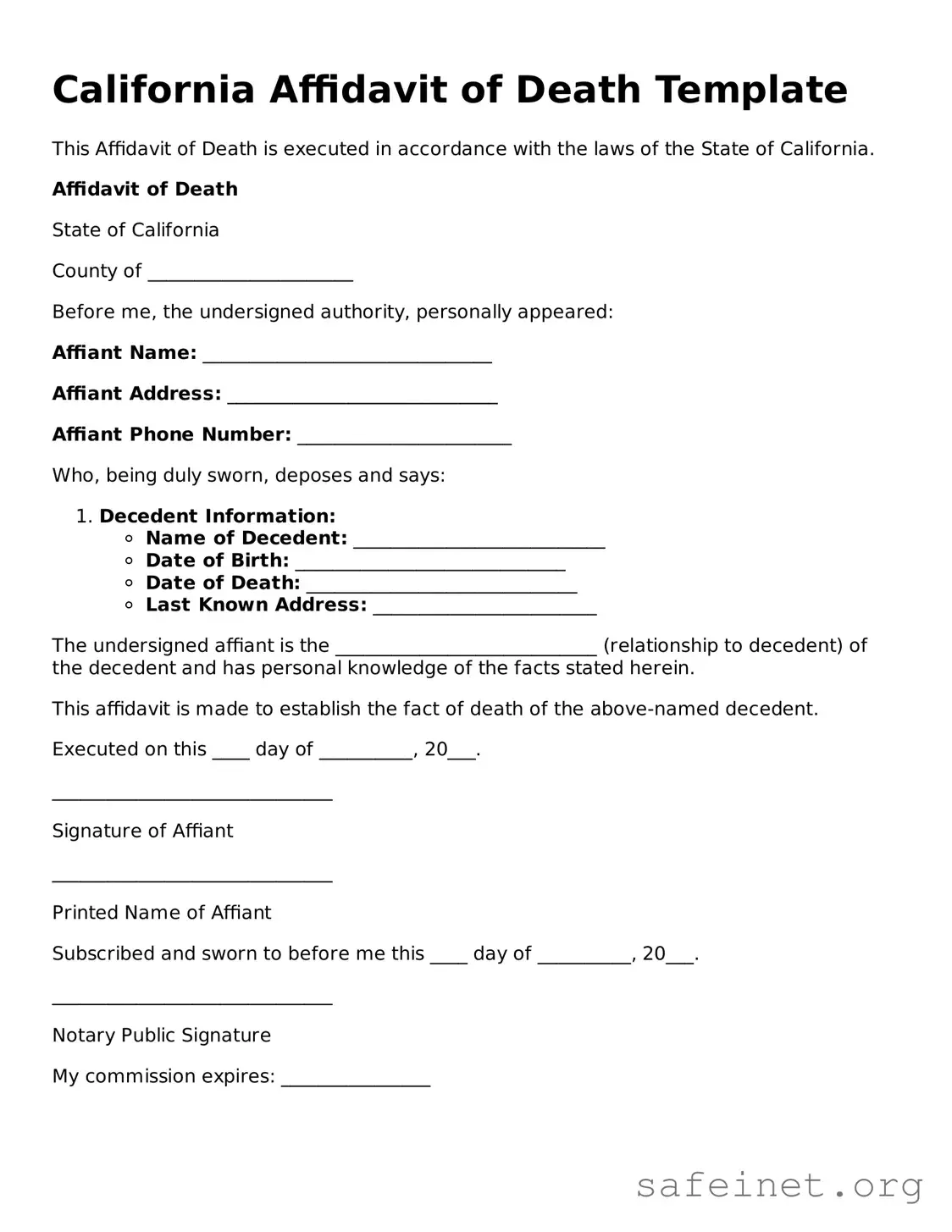
The California Affidavit of Death form serves as a crucial document in the process of settling a deceased person's estate. This form allows an individual, typically an heir or personal representative, to declare the death of the decedent officially. By completing this affidavit, the signer can facilitate the transfer of property or assets that may be held in the decedent's name. It is essential for addressing matters such as bank accounts, real estate, and other financial assets that require proof of death before they can be transferred to beneficiaries. The form must include specific details, such as the decedent's name, date of death, and relevant information about the relationship between the affiant and the deceased. Additionally, it must be signed under penalty of perjury, ensuring the accuracy of the statements made. Understanding the significance and requirements of this affidavit is vital for anyone involved in the estate administration process in California.
California Affidavit of Death Template
This Affidavit of Death is executed in accordance with the laws of the State of California.
Affidavit of Death
State of California
County of ______________________
Before me, the undersigned authority, personally appeared:
Affiant Name: _______________________________
Affiant Address: _____________________________
Affiant Phone Number: _______________________
Who, being duly sworn, deposes and says:
The undersigned affiant is the ____________________________ (relationship to decedent) of the decedent and has personal knowledge of the facts stated herein.
This affidavit is made to establish the fact of death of the above-named decedent.
Executed on this ____ day of __________, 20___.
______________________________
Signature of Affiant
______________________________
Printed Name of Affiant
Subscribed and sworn to before me this ____ day of __________, 20___.
______________________________
Notary Public Signature
My commission expires: ________________
| Fact Name | Description |
|---|---|
| Purpose | The California Affidavit of Death form is used to formally declare the death of an individual for legal purposes. |
| Governing Law | This form is governed by California Probate Code Section 13100. |
| Who Can File | Any interested party, such as a family member or executor, may file the affidavit. |
| Required Information | The form typically requires the deceased's name, date of death, and details about their estate. |
| Use in Estate Settlement | It is often used to facilitate the transfer of property or assets without going through probate. |
| Filing Location | The affidavit must be filed with the county recorder's office where the deceased owned property. |
| No Fee for Filing | In many counties, there is no fee for filing the Affidavit of Death. |
| Signature Requirement | The affidavit must be signed by the person filing it, affirming the truth of the information provided. |
| Notarization | Although notarization is not always required, it is recommended to add credibility to the document. |
| Importance of Accuracy | Providing accurate information is crucial, as errors can lead to complications in the estate settlement process. |
After obtaining the California Affidavit of Death form, the next step involves accurately filling it out. This form is used to officially declare a person's death and is often necessary for settling estates, transferring property, or addressing financial matters. Careful attention to detail is important to ensure all required information is correctly provided.
Once the form is completed and notarized, it can be submitted to the appropriate authorities or institutions that require it. This may include banks, courts, or other entities involved in the deceased's affairs.
What is the California Affidavit of Death form?
The California Affidavit of Death form is a legal document used to declare the death of an individual. It serves as a formal statement that can be used to transfer property or assets from the deceased to their heirs or beneficiaries. This document can be essential for settling estates and ensuring that the wishes of the deceased are honored.
Who can file the Affidavit of Death?
Generally, any interested party can file the Affidavit of Death. This may include a family member, a personal representative, or an executor of the deceased's estate. It is important for the person filing to have a legitimate interest in the estate or the assets in question.
What information is required on the form?
The form typically requires basic information about the deceased, such as their full name, date of birth, date of death, and last known address. Additionally, details about the affiant, or the person filing the affidavit, must be included. This includes their name, relationship to the deceased, and contact information.
Is the Affidavit of Death form notarized?
Yes, the Affidavit of Death must be notarized. This means that the person filing the affidavit must sign the document in the presence of a notary public. The notary will verify the identity of the signer and witness the signing, which adds a layer of authenticity to the document.
Where do I file the Affidavit of Death?
The Affidavit of Death is usually filed with the county recorder's office in the county where the deceased lived at the time of their death. Some situations may require filing with other entities, such as a probate court, depending on the nature of the estate and the assets involved.
Are there any fees associated with filing the form?
Yes, there may be fees associated with filing the Affidavit of Death. These fees can vary by county and may include charges for recording the document. It is advisable to check with the local county recorder's office for the most current fee schedule.
Can the Affidavit of Death be used for any type of asset?
The Affidavit of Death can be used for many types of assets, including real estate, bank accounts, and personal property. However, certain assets may require additional documentation or processes to transfer ownership, especially if they are held in a trust or have specific beneficiary designations.
What happens if the Affidavit of Death is not filed?
If the Affidavit of Death is not filed, it may complicate the process of transferring assets from the deceased to their heirs. Without this document, heirs may face delays or legal challenges when trying to access the deceased's property or settle the estate. It is often advisable to file the affidavit promptly to avoid potential issues.
Incomplete Information: One common mistake is failing to provide all required details. This includes not only the deceased's name and date of death but also missing information such as the place of death or the relationship to the deceased. Each section of the form must be filled out completely to avoid delays.
Incorrect Signatures: Signatures must be accurate and in accordance with the instructions. Some individuals neglect to sign the form or may use a different name than what is listed on the document. Ensuring that the signature matches the name on the form is crucial.
Failure to Notarize: Notarization is often a requirement for the affidavit to be considered valid. Many people overlook this step. Without a notary's signature, the form may be rejected, leading to additional complications.
Incorrect Filing Location: Submitting the affidavit to the wrong office can cause significant delays. It's essential to know where to file the form, whether it’s with a county clerk or another relevant agency. Researching the appropriate filing location beforehand can save time and effort.
When dealing with the California Affidavit of Death form, several other documents may be necessary to ensure a smooth legal process. These documents help clarify the deceased's estate, facilitate the transfer of property, and provide necessary legal backing for various transactions. Below is a list of commonly used forms and documents that often accompany the Affidavit of Death.
Understanding these documents can help streamline the process of managing an estate following a death. Each document plays a crucial role in ensuring that the wishes of the deceased are honored and that legal requirements are met.
The California Affidavit of Death form is similar to the Last Will and Testament. Both documents serve important roles in the estate planning process. A Last Will and Testament outlines an individual’s wishes regarding the distribution of their assets after death. In contrast, the Affidavit of Death is typically used to confirm the death of an individual, allowing for the transfer of property and assets to beneficiaries. While the will details how an estate should be handled, the affidavit acts as a formal declaration that facilitates the execution of those wishes.
Another document that shares similarities is the Death Certificate. A Death Certificate is an official record issued by a government authority that confirms an individual's death. This document provides essential information, such as the date and cause of death. Like the Affidavit of Death, the Death Certificate is often required to settle an estate or transfer assets. However, while the affidavit may be used in various legal contexts, the Death Certificate is primarily a factual record that serves as proof of death.
The Durable Power of Attorney (DPOA) also bears resemblance to the Affidavit of Death. A DPOA allows an individual to appoint someone else to make decisions on their behalf, especially regarding financial matters. In cases where the principal has passed away, the DPOA becomes void. The Affidavit of Death serves to formally notify relevant parties of the individual's passing, thus impacting any previously established powers of attorney. Both documents emphasize the importance of clear communication and authority in managing an individual’s affairs.
Additionally, the Probate Petition is another document that is related. A Probate Petition is filed in court to initiate the probate process, which involves validating a will and overseeing the distribution of the deceased’s assets. The Affidavit of Death can be used in conjunction with a Probate Petition to confirm that the individual has indeed passed away, thus allowing the court to proceed with the probate process. Both documents play crucial roles in ensuring that an estate is handled properly and in accordance with the deceased's wishes.
Lastly, the Trust Certification is similar in that it can be used to affirm the existence of a trust and the death of the trustor. When a trustor passes away, a Trust Certification may be needed to manage and distribute the trust assets. The Affidavit of Death can support this process by providing proof of death, thereby allowing trustees to carry out their duties effectively. Both documents are vital in estate management, ensuring that the intentions of the deceased are honored and that beneficiaries receive their rightful inheritance.
When filling out the California Affidavit of Death form, it's important to approach the task with care and attention to detail. This form is used to officially declare someone's death and to assist in settling their estate. Here are some key points to consider:
By following these guidelines, you can help ensure that the process goes smoothly and that the necessary steps are taken to honor the deceased's wishes.
The California Affidavit of Death form is often misunderstood. Here are nine common misconceptions that can lead to confusion:
Many people believe this form is only necessary when a deceased person's estate goes through probate. However, it can also be used to transfer property without probate in certain situations.
While it may seem straightforward, the Affidavit of Death must be completed by an interested party, such as a family member or someone with a legal interest in the property.
Some think that notarization is mandatory for the Affidavit of Death. In California, the form does not require notarization, but it must be signed under penalty of perjury.
Many assume that the form can be filed at any county office. In reality, it must be filed in the county where the deceased person owned property.
People often confuse the Affidavit of Death with a death certificate. The affidavit is a legal document used for property transfer, while the death certificate is an official record of the person's death.
Some think the affidavit applies to all types of property. However, it is typically used for real estate and may not be suitable for all assets, such as bank accounts or personal property.
Many believe they can wait until after settling the estate to file the affidavit. However, it is best to file it promptly to avoid complications with property transfers.
Some think a single affidavit suffices for all properties owned by the deceased. In fact, separate affidavits are generally required for each property.
People often assume there are no time constraints. However, timely filing is important to ensure a smooth transfer of property and to avoid potential legal issues.
Understanding these misconceptions can help you navigate the process more effectively and ensure that you meet all necessary requirements.
When filling out and using the California Affidavit of Death form, it is important to keep the following key points in mind: