Homepage > Blank California Advanced Health Care Directive Template
Article Structure

In California, planning for future health care decisions is an important step that many individuals overlook. The Advanced Health Care Directive form serves as a vital tool, allowing individuals to express their medical preferences and appoint someone to make decisions on their behalf if they become unable to do so. This form combines two key elements: a health care power of attorney and a living will. The health care power of attorney designates a trusted person, often referred to as an agent, to make medical choices aligned with the individual's wishes. Meanwhile, the living will outlines specific preferences regarding medical treatments, such as life-sustaining measures, should the individual face terminal illness or irreversible conditions. By completing this directive, individuals can ensure their values and desires are respected, relieving loved ones from the burden of making difficult decisions during emotional times. The process of creating an Advanced Health Care Directive is straightforward, and it can provide peace of mind for both the individual and their family members.


Form Sample

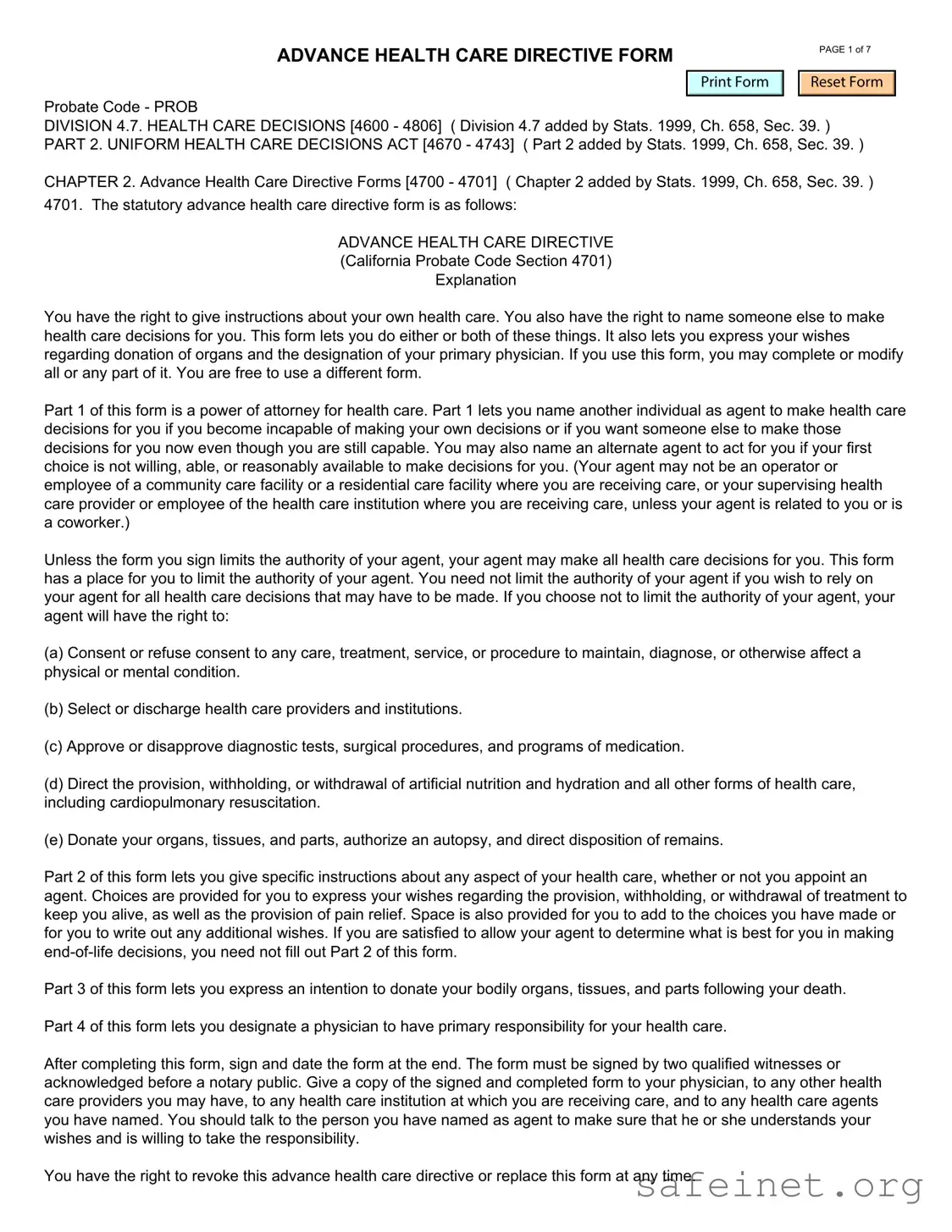
ADVANCE HEALTH CARE DIRECTIVE FORM
PAGE 1 of 7
Probate Code - PROB
DIVISION 4.7. HEALTH CARE DECISIONS [4600 - 4806] ( Division 4.7 added by Stats. 1999, Ch. 658, Sec. 39. )
PART 2. UNIFORM HEALTH CARE DECISIONS ACT [4670 - 4743] ( Part 2 added by Stats. 1999, Ch. 658, Sec. 39. )
CHAPTER 2. Advance Health Care Directive Forms [4700 - 4701] ( Chapter 2 added by Stats. 1999, Ch. 658, Sec. 39. )
4701. The statutory advance health care directive form is as follows:
ADVANCE HEALTH CARE DIRECTIVE
(California Probate Code Section 4701)
Explanation
You have the right to give instructions about your own health care. You also have the right to name someone else to make
health care decisions for you. This form lets you do either or both of these things. It also lets you express your wishes
regarding donation of organs and the designation of your primary physician. If you use this form, you may complete or modify
all or any part of it. You are free to use a different form.
Part 1 of this form is a power of attorney for health care. Part 1 lets you name another individual as agent to make health care
decisions for you if you become incapable of making your own decisions or if you want someone else to make those
decisions for you now even though you are still capable. You may also name an alternate agent to act for you if your first
choice is not willing, able, or reasonably available to make decisions for you. (Your agent may not be an operator or
employee of a community care facility or a residential care facility where you are receiving care, or your supervising health
care provider or employee of the health care institution where you are receiving care, unless your agent is related to you or is
a coworker.)
Unless the form you sign limits the authority of your agent, your agent may make all health care decisions for you. This form
has a place for you to limit the authority of your agent. You need not limit the authority of your agent if you wish to rely on
your agent for all health care decisions that may have to be made. If you choose not to limit the authority of your agent, your
agent will have the right to:
(a) Consent or refuse consent to any care, treatment, service, or procedure to maintain, diagnose, or otherwise affect a
physical or mental condition.
(b) Select or discharge health care providers and institutions.
(c) Approve or disapprove diagnostic tests, surgical procedures, and programs of medication.
(d) Direct the provision, withholding, or withdrawal of artificial nutrition and hydration and all other forms of health care,
including cardiopulmonary resuscitation.
(e) Donate your organs, tissues, and parts, authorize an autopsy, and direct disposition of remains.
Part 2 of this form lets you give specific instructions about any aspect of your health care, whether or not you appoint an
agent. Choices are provided for you to express your wishes regarding the provision, withholding, or withdrawal of treatment to
keep you alive, as well as the provision of pain relief. Space is also provided for you to add to the choices you have made or
for you to write out any additional wishes. If you are satisfied to allow your agent to determine what is best for you in making
end-of-life decisions, you need not fill out Part 2 of this form.
Part 3 of this form lets you express an intention to donate your bodily organs, tissues, and parts following your death.
Part 4 of this form lets you designate a physician to have primary responsibility for your health care.
After completing this form, sign and date the form at the end. The form must be signed by two qualified witnesses or
acknowledged before a notary public. Give a copy of the signed and completed form to your physician, to any other health
care providers you may have, to any health care institution at which you are receiving care, and to any health care agents
you have named. You should talk to the person you have named as agent to make sure that he or she understands your
wishes and is willing to take the responsibility.
You have the right to revoke this advance health care directive or replace this form at any time.
Print Form
Reset Form
ADVANCE HEALTH CARE DIRECTIVE FORM
PAGE 2 of 7
(home phone) (work phone)
PART 1
POWER OF ATTORNEY FOR HEALTH CARE
(1.1) DESIGNATION OF AGENT: I designate the following individual as my agent to make health care decisions for me:
(name of individual you choose as agent)
(address) (city) (state) (ZIP Code)
OPTIONAL: If I revoke my agent's authority or if my agent is not willing, able, or reasonably available to make a health care
decision for me, I designate as my first alternate agent:
(name of individual you choose as first alternate agent)
(address) (city) (state) (ZIP Code)
(home phone) (work phone)
OPTIONAL: If I revoke the authority of my agent and first alternate agent or if neither is willing, able, or reasonably available
to make a health care decision for me, I designate as my second alternate agent:
(name of individual you choose as second alternate agent)
(address) (city) (state) (ZIP Code)
(home phone) (work phone)
(1.2) AGENT'S AUTHORITY: My agent is authorized to make all health care decisions for me, including decisions to
provide, withhold, or withdraw artificial nutrition and hydration and all other forms of health care to keep me alive, except as I
state here:
(Add additional sheets if needed.)
(1.3) WHEN AGENT'S AUTHORITY BECOMES EFFECTIVE: My agent's authority becomes effective when my primary
physician determines that I am unable to make my own health care decisions unless I mark the following box.
If I mark this box , my agent's authority to make health care decisions for me takes effect immediately.
ADVANCE HEALTH CARE DIRECTIVE FORM
PAGE 3 of 7
(1.4.) AGENT'S OBLIGATION: My agent shall make health care decisions for me in accordance with this power of attorney
for health care, any instructions I give in Part 2 of this form, and my other wishes to the extent known to my agent. To the
extent my wishes are unknown, my agent shall make health care decisions for me in accordance with what my agent
determines to be in my best interest. In determining my best interest, my agent shall consider my personal values to the
extent known to my agent.
(1.5) AGENT'S POSTDEATH AUTHORITY: My agent is authorized to donate my organs, tissues, and parts, authorize an
autopsy, and direct disposition of my remains, except as I state here or in Part 3 of this form:
:
(Add additional sheets if needed.)
(1.6) NOMINATION OF CONSERVATOR: If a conservator of my person needs to be appointed for me by a court, I
nominate the agent designated in this form. If that agent is not wiling, able, or reasonably available to act as conservator, I
nominate the alternate agents whom I have named, in the order designated.
PART 2
INSTRUCTIONS FOR HEALTH CARE
If you fill out this part of the form, you may strike any wording you do not want.
(2.1) END-OF-LIFE DECISIONS: I direct that my health care providers and others involved in my care provide, withhold,
or withdraw treatment in accordance with the choice I have marked below:
(a) Choice Not to Prolong Life
I do not want my life to be prolonged if (1) I have an incurable and irreversible condition that will result in my death
within a relatively short time, (2) I become unconscious and, to a reasonable degree of medical certainty, I will not
regain consciousness, or (3) the likely risks and burdens of treatment would outweigh the expected benefits, OR
(b) Choice to Prolong Life
I want my life to be prolonged as long as possible within the limits of generally accepted health care standards.
(2.2) RELIEF FROM PAIN: Except as I state in the following space, I direct that treatment for alleviation of pain or
discomfort be provided at all times, even if it hastens my death:
(Add additional sheets if needed.)
(2.3) OTHER WISHES: (If you do not agree with any of the optional choices above and wish to write your own, or if you
wish to add to the instructions you have given above, you may do so here.) I direct that:
(Add additional sheets if needed.)
ADVANCE HEALTH CARE DIRECTIVE FORM
PAGE 4 of 7
PART 3
DONATION OF ORGANS, TISSUES, AND PARTS AT DEATH
(OPTIONAL)
(3.1) Upon my death, I give my organs, tissues, and parts (mark box to indicate yes).
By checking the box above, and notwithstanding my choice in Part 2 of this form, I authorize my agent to consent to any
temporary medical procedure necessary solely to evaluate and/or maintain my organs, tissues, and/or parts for purposes of
donation.
(a) Transplant
My donation is for the following purposes (strike any of the following you do not want):
(b) Therapy
(c) Research
(d) Education
If you want to restrict your donation of an organ, tissue, or part in some way, please state your restriction on the following
lines:
If I leave this part blank, it is not a refusal to make a donation. My state-authorized donor registration should be followed, or,
if none, my agent may make a donation upon my death. If no agent is named above, I acknowledge that California law
permits an authorized individual to make such a decision on my behalf. (To state any limitation, preference, or instruction
regarding donation, please use the lines above or in Section 1.5 of this form).
PART 4
PRIMARY PHYSICIAN
(OPTIONAL)
(4.1) I designate the following physician as my primary physician:
(name of physician)
(address) (city) (state) (ZIP Code)
(phone)
OPTIONAL: If the physician I have designated above is not willing, able, or reasonably available to act as my primary
physician, I designate the following physician as my primary physician:
(name of physician)
(address) (city) (state) (ZIP Code)
(phone)
ADVANCE HEALTH CARE DIRECTIVE FORM
PAGE 5 of 7
PART 5
(5.1) EFFECT OF COPY: A copy of this form has the same effect as the original.
(5.2) SIGNATURE: Sign and date the form here:
(print your name)
(sign your name)
(5.3) STATEMENT OF WITNESSES: I declare under penalty of perjury under the laws of California (1) that the individual
who signed or acknowledged this advance health care directive is personally known to me, or that the individual's identity
was proven to me by convincing evidence (2) that the individual signed or acknowledged this advance directive in my
presence, (3) that the individual appears to be of sound mind and under no duress, fraud, or undue influence, (4) that I am
not a person appointed as agent by this advance directive, and (5) that I am not the individual's health care provider, an
employee of the individual's health care provider, the operator of a community care facility, an employee of an operator of a
community care facility, the operator of a residential care facility for the elderly, nor an employee of an operator of a
residential care facility for the elderly.
First witness Second witness
(print name) (print name)
(date)
(address)
(city) (state)
(address)(address)
(city) (state) (city) (state)
(signature of witness) (signature of witness)
(date)
(date)
(5.4) ADDITIONAL STATEMENT OF WITNESSES: At least one of the above witnesses must also sign the following
declaration:
I further declare under penalty of perjury under the laws of California that I am not related to the individual executing
this advance health care directive by blood, marriage, or adoption, and to the best of my knowledge, I am not entitled to any
part of the individual's estate upon his or her death under a will now existing or by operation of law.
(signature of witness) (signature of witness)
ADVANCE HEALTH CARE DIRECTIVE FORM
PAGE 6 of 7
PART 6
SPECIAL WITNESS REQUIREMENT
(6.1) The following statement is required only if you are a patient in a skilled nursing facility--a health care facility that
provides the following basic services: skilled nursing care and supportive care to patients whose primary need is for
availability of skilled nursing care on an extended basis. The patient advocate or ombudsman must sign the following
statement:
STATEMENT OF PATIENT ADVOCATE OR OMBUDSMAN
I declare under penalty of perjury under the laws of California that I am a patient advocate or ombudsman as
designated by the State Department of Aging and that I am serving as a witness as required by Section 4675 of the Probate
Code.
(print your name)
(sign your name)(date)
(address)
(city) (state)
(Amended by Stats. 2018, Ch. 287, Sec. 1. (AB 3211) Effective January 1, 2019.)
ADVANCE HEALTH CARE DIRECTIVE FORM
PAGE 7 of 7
A notary public or other officer completing this
certificate verifies only the identity of the individual
who signed the document to which this certificate
is attached, and not the truthfulness, accuracy, or
validity of that document.
ACKNOWLEDGMENT
State of California,
County of
On before me,
(insert name and title of officer)
personally appeared
who proved to me on the basis of satisfactory evidence to be the person(s) whose name(s)
is/are subscribed to the within instrument and acknowledged to me that he/she/they
executed the same in his/her/their authorized capacity(ies), and that by his/her/their
signature(s) on the instrument the person(s), or the entity upon behalf of which the person
(s) acted, executed the instrument.
I certify under PENALTY OF PERJURY under the laws of the State of California that the
foregoing paragraph is true and correct.
WITNESS my hand and official seal.
Signature
(SEAL)

Document Specifications

Fact Name Details
Purpose The California Advanced Health Care Directive allows individuals to outline their healthcare preferences and appoint a healthcare agent.
Governing Law The directive is governed by the California Probate Code, specifically Sections 4600-4806.
Types of Decisions It covers medical decisions, including life-sustaining treatments and end-of-life care options.
Agent Appointment Individuals can designate a healthcare agent to make decisions on their behalf if they become unable to do so.
Witness Requirements The form must be signed in the presence of two witnesses or notarized to be valid.
Revocation Individuals can revoke the directive at any time, provided they communicate their intent clearly.
Durability The directive remains effective even if the individual becomes incapacitated.
Availability The form is available online through various state and healthcare websites, ensuring accessibility for all residents.

Steps to Filling Out California Advanced Health Care Directive

Filling out the California Advanced Health Care Directive form is an important step in planning for your future health care needs. This document allows you to express your preferences regarding medical treatment and appoint someone to make decisions on your behalf if you are unable to do so.

  1. Begin by downloading the California Advanced Health Care Directive form from a trusted source.
  2. Read the instructions carefully to understand each section of the form.
  3. In the first section, provide your full name and contact information.
  4. Designate an agent by filling in the name and contact details of the person you trust to make health care decisions for you.
  5. Next, specify any limitations or specific instructions for your agent regarding your health care preferences.
  6. In the following section, outline your wishes regarding medical treatment in different scenarios, such as terminal illness or irreversible conditions.
  7. Sign and date the form in the designated area. Ensure that your signature is clear.
  8. Have the form witnessed by two adults who are not related to you and do not stand to gain from your estate.
  9. Make copies of the signed form for your agent, your doctor, and yourself.

More About California Advanced Health Care Directive

What is a California Advanced Health Care Directive?

The California Advanced Health Care Directive is a legal document that allows individuals to outline their healthcare preferences in the event they become unable to communicate their wishes. This directive provides guidance to healthcare providers and loved ones regarding medical treatment decisions. It typically includes a durable power of attorney for healthcare and a living will, specifying the types of medical interventions one would or would not want in various scenarios.

Who can complete a California Advanced Health Care Directive?

Any adult who is at least 18 years old and of sound mind can complete a California Advanced Health Care Directive. It is important for individuals to consider their personal values and beliefs when making decisions about their healthcare preferences. Consulting with family members, friends, or healthcare professionals can provide additional support and clarity during this process.

How do I complete the California Advanced Health Care Directive?

To complete the California Advanced Health Care Directive, individuals should obtain the official form, which is available online or through healthcare providers. The form must be filled out in its entirety, including the designation of a healthcare agent and the specification of medical treatment preferences. After completing the form, it must be signed and dated in the presence of at least one witness or a notary public to ensure its validity.

Can I change or revoke my California Advanced Health Care Directive?

Yes, individuals have the right to change or revoke their California Advanced Health Care Directive at any time, as long as they are of sound mind. To make changes, one can complete a new directive or write a statement indicating the revocation of the previous directive. It is advisable to inform all relevant parties, including healthcare providers and the appointed healthcare agent, about any changes made to ensure that updated wishes are respected.

Is a California Advanced Health Care Directive recognized in other states?

Generally, a California Advanced Health Care Directive is recognized in other states, but there may be variations in laws and requirements. It is recommended to check the specific laws of the state where the individual is residing or receiving care. If necessary, individuals may want to consult with legal professionals to ensure their directive complies with the regulations of other states.

Common mistakes

  1. Failing to clearly designate a health care agent. It's essential to name someone who understands your wishes and can make decisions on your behalf.

  2. Not discussing your wishes with your health care agent. Communication is key. Ensure that your agent knows your preferences regarding medical treatment.

  3. Leaving sections of the form blank. Each part of the directive is important. Omitting information can lead to confusion or misinterpretation of your wishes.

  4. Using vague language. Be specific about your desires for treatment. Ambiguity can lead to decisions that do not align with your values.

  5. Not updating the directive regularly. Life circumstances change. Review and revise your directive periodically to reflect your current wishes.

  6. Neglecting to sign and date the form properly. A signature is required for the directive to be valid. Ensure that you follow the signing requirements outlined in the form.

Documents used along the form

The California Advanced Health Care Directive is an essential document for individuals wishing to outline their healthcare preferences and appoint someone to make medical decisions on their behalf. It is often used alongside other important forms and documents that help ensure a comprehensive approach to healthcare planning. Below is a list of related documents that may be beneficial to consider.

  • Durable Power of Attorney for Health Care: This document allows you to appoint someone to make healthcare decisions for you if you become unable to do so. It is similar to the Advanced Health Care Directive but focuses specifically on medical decisions.
  • Living Will: A living will provides instructions about the types of medical treatment you want or do not want in specific situations, such as terminal illness or irreversible coma.
  • Do Not Resuscitate (DNR) Order: This order informs medical personnel that you do not wish to receive CPR or other life-saving measures in case of cardiac arrest or respiratory failure.
  • Physician Orders for Life-Sustaining Treatment (POLST): This form translates your wishes regarding life-sustaining treatment into actionable medical orders. It is intended for those with serious illnesses or frailty.
  • HIPAA Authorization: This document allows you to grant permission for specific individuals to access your medical records and discuss your health information with healthcare providers.
  • Financial Power of Attorney: While not specifically about healthcare, this document allows you to designate someone to handle your financial matters if you become incapacitated, ensuring that your bills and expenses are managed.
  • Estate Planning Documents: These include wills and trusts that outline how your assets will be managed and distributed after your death. They can also address healthcare decisions in the context of your overall estate plan.
  • Organ Donation Registration: This document allows you to indicate your wishes regarding organ donation after death, ensuring that your preferences are known and respected.

These documents work together to provide a clear picture of your healthcare and financial preferences. By preparing them, you can ensure that your wishes are honored and that your loved ones have guidance during difficult times.

Similar forms

The California Advanced Health Care Directive is often compared to a Living Will. A Living Will allows individuals to outline their preferences regarding medical treatment in the event they become unable to communicate their wishes. Both documents serve the purpose of guiding healthcare providers and loved ones in making decisions that align with the individual’s values and desires. However, while a Living Will focuses primarily on end-of-life care, the Advanced Health Care Directive can also appoint a healthcare agent to make decisions on the individual’s behalf, providing a broader scope of authority in medical situations.

Another similar document is the Durable Power of Attorney for Health Care. This legal form enables a person to designate someone else to make healthcare decisions for them if they are incapacitated. Like the Advanced Health Care Directive, it emphasizes the importance of appointing a trusted individual to advocate for one’s health care preferences. However, the Durable Power of Attorney for Health Care may not include specific treatment preferences, whereas the Advanced Health Care Directive often encompasses detailed instructions about medical care choices.

The Do Not Resuscitate (DNR) order is also akin to the California Advanced Health Care Directive. A DNR order specifically instructs medical personnel not to perform cardiopulmonary resuscitation (CPR) if a person’s heart stops or they stop breathing. While the Advanced Health Care Directive can include a DNR directive, it covers a wider range of medical decisions beyond resuscitation. This makes the Advanced Health Care Directive a more comprehensive document for individuals wanting to express their overall healthcare wishes.

Lastly, the Physician Orders for Life-Sustaining Treatment (POLST) form shares similarities with the Advanced Health Care Directive. POLST is designed for individuals with serious health conditions, allowing them to communicate their preferences for life-sustaining treatments in a medical emergency. Both documents aim to ensure that a person’s healthcare wishes are respected. However, the POLST form is a medical order that must be signed by a physician, whereas the Advanced Health Care Directive is a legal document that can be completed without a physician’s signature, making it more accessible for individuals looking to express their healthcare preferences.

Dos and Don'ts

When filling out the California Advanced Health Care Directive form, it’s essential to approach the task thoughtfully. This document allows you to express your healthcare preferences in case you cannot communicate them yourself. Here are some important dos and don’ts to keep in mind:

  • Do clearly state your healthcare wishes.
  • Do choose a trusted person as your healthcare agent.
  • Do discuss your wishes with your healthcare agent beforehand.
  • Do sign and date the form in front of witnesses or a notary.
  • Do keep copies of the completed directive for yourself and your healthcare agent.
  • Don't leave any sections blank; fill out all required information.
  • Don't use vague language; be as specific as possible about your wishes.
  • Don't forget to update the directive if your preferences change.
  • Don't overlook the importance of discussing your directive with family members.
  • Don't assume that verbal instructions are enough; written directives are crucial.

By following these guidelines, you can ensure that your healthcare preferences are clearly communicated and respected. Taking the time to fill out this form correctly can provide peace of mind for both you and your loved ones.

Misconceptions

The California Advanced Health Care Directive is a crucial document that allows individuals to express their healthcare preferences and appoint someone to make medical decisions on their behalf. However, several misconceptions surround this form. Here are six common misunderstandings:

  • Misconception 1: The directive only applies to end-of-life situations.
  • This is not true. While many people associate the directive with end-of-life care, it actually covers a wide range of medical decisions, including treatments for serious illnesses or accidents.

  • Misconception 2: You need a lawyer to complete the form.
  • Although legal advice can be beneficial, it is not required. The form is designed to be user-friendly and can be filled out without legal assistance.

  • Misconception 3: Once completed, the directive cannot be changed.
  • This is false. You can update or revoke your directive at any time as long as you are mentally competent to do so.

  • Misconception 4: The form is only for older adults.
  • People of all ages can benefit from having an Advanced Health Care Directive. Unexpected health issues can arise at any time, making it wise for everyone to consider having one.

  • Misconception 5: The directive is only effective in California.
  • While it is true that this directive is specific to California, many states recognize similar documents. However, if you move, you may need to review and possibly update your directive according to your new state’s laws.

  • Misconception 6: Having a directive means you lose control over your healthcare decisions.
  • This is a common fear, but in reality, the directive empowers you to make your wishes known. It ensures that your preferences are respected, even if you cannot communicate them at the time.

Understanding these misconceptions can help you make informed decisions about your healthcare planning. It’s important to take action sooner rather than later to ensure your wishes are documented and honored.

Key takeaways

  • The California Advanced Health Care Directive allows individuals to outline their medical care preferences in case they become unable to communicate their wishes.

  • It is essential to complete the form while you are still in good health, ensuring that your choices reflect your values and beliefs.

  • Designating a health care agent is a critical component of the directive. This person will make medical decisions on your behalf if you cannot do so.

  • The form should be signed in the presence of a witness or notarized to ensure its validity, as required by California law.

  • Individuals can specify their preferences regarding life-sustaining treatments, including resuscitation and artificial nutrition, within the directive.

  • It is advisable to discuss your wishes with your designated health care agent and family members to ensure everyone understands your preferences.

  • Reviewing and updating your directive periodically is important, especially after significant life changes, to ensure it remains aligned with your current values and circumstances.