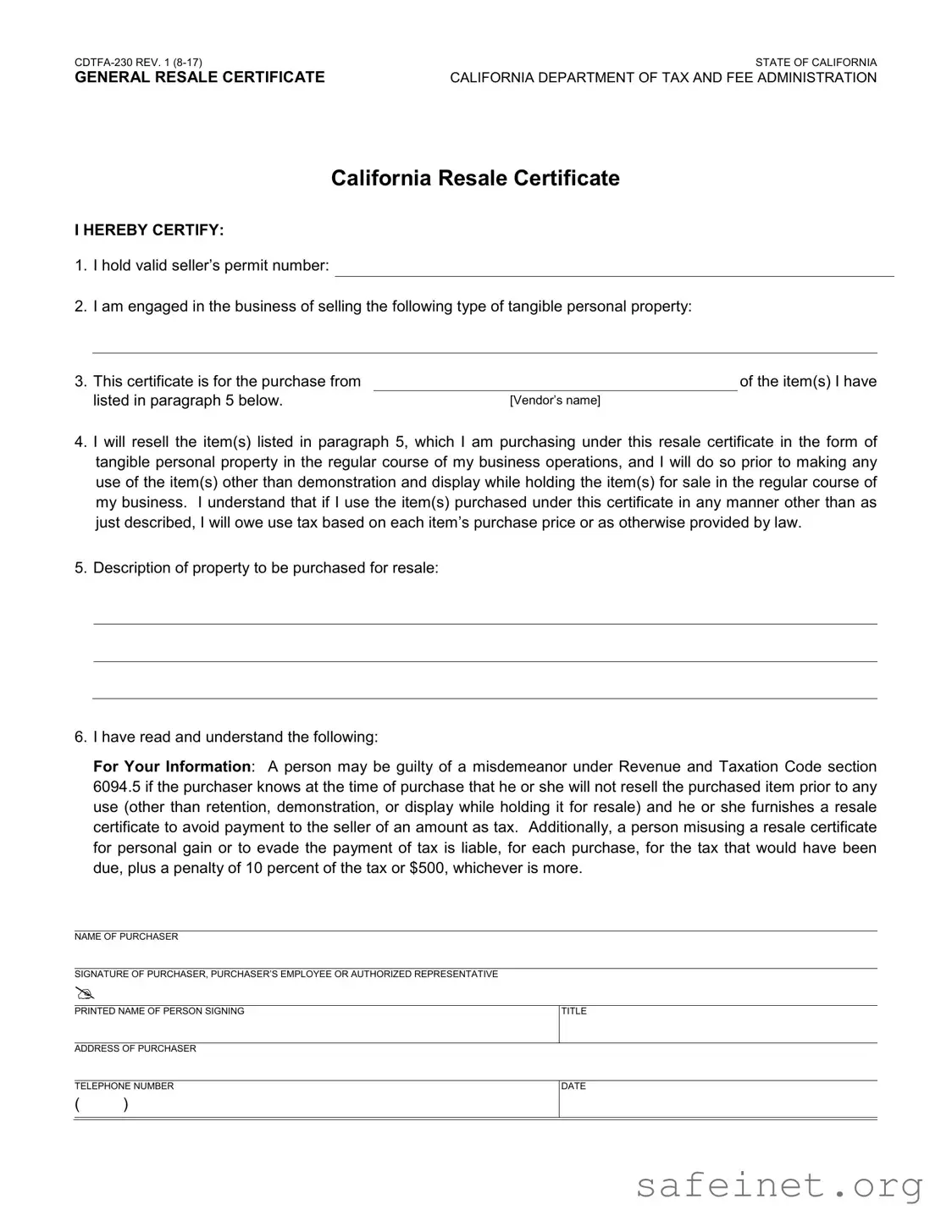
The California Resale Certificate, officially known as CDTFA-230 REV. 1 (8-17), serves as an essential tool for businesses engaged in the sale of tangible personal property. This certificate allows sellers to purchase items without paying sales tax, provided they intend to resell those items in the normal course of their operations. To utilize this form, the purchaser must possess a valid seller’s permit number and must clearly identify the type of goods they plan to sell. The certificate requires specific details, including the vendor's name and a description of the property being purchased for resale. It also emphasizes the importance of adhering to the conditions of use; items acquired under this certificate must not be used for purposes other than demonstration or display prior to resale. Misusing the resale certificate can lead to serious consequences, including penalties and tax liabilities. Understanding the nuances of this form is crucial for business owners to ensure compliance and avoid potential legal pitfalls.
| Fact Name | Description |
|---|---|
| Form Title | The form is officially known as the California General Resale Certificate, designated as CDTFA230 REV. 1 (817). |
| Governing Authority | This form is governed by the California Revenue and Taxation Code, specifically section 6094.5. |
| Purpose | The primary purpose of the form is to allow businesses to purchase items for resale without paying sales tax at the time of purchase. |
| Seller’s Permit | To use this form, the purchaser must hold a valid seller’s permit number, confirming their status as a retailer. |
| Usage Restrictions | The items purchased under this certificate must be resold in the regular course of business, with limited exceptions for demonstration and display. |
| Penalties for Misuse | Misusing the resale certificate can lead to a misdemeanor charge and financial penalties, including a 10% tax penalty or a minimum of $500. |
Once the California Resale Certificate form is completed, it should be provided to the vendor from whom the items are being purchased. This certificate allows the purchaser to buy goods for resale without paying sales tax at the time of purchase. It is important to ensure that all information is accurate and complete to avoid any potential legal issues.
What is the California Resale Certificate?
The California Resale Certificate is a document that allows a business to purchase tangible personal property without paying sales tax. Instead of paying tax at the time of purchase, the buyer certifies that they will resell the items in the regular course of their business. This helps businesses manage their cash flow by deferring tax payments until the items are sold to the final consumer.
Who can use the California Resale Certificate?
Any business that holds a valid seller’s permit in California can use the resale certificate. This includes retailers, wholesalers, and other entities engaged in selling tangible goods. It’s important that the business intends to resell the items rather than use them for personal purposes.
What information is required on the resale certificate?
The resale certificate requires several key pieces of information. This includes the seller’s permit number, a description of the property being purchased for resale, the vendor’s name from whom the items are being bought, and the purchaser's signature. Each of these details ensures that the transaction is properly documented and compliant with state regulations.
What happens if a business misuses the resale certificate?
If a business uses the resale certificate incorrectly—such as purchasing items they do not intend to resell—they may face serious consequences. This can include owing use tax based on the purchase price of the items, as well as potential penalties. The law states that if a person knowingly provides a resale certificate to avoid paying tax on items they won't resell, they could be charged with a misdemeanor and face fines.
Can I use the resale certificate for items I plan to use personally?
No, the resale certificate should not be used for items intended for personal use. It is strictly for items that will be resold in the regular course of business. If you purchase items for personal use and provide a resale certificate, you may be liable for back taxes and penalties.
How do I complete the resale certificate?
To complete the resale certificate, fill out all required fields accurately. This includes your seller’s permit number, a description of the items, and the vendor’s name. After filling out the form, ensure that it is signed by you or an authorized representative. Keep a copy for your records and provide the original to the vendor at the time of purchase.
Is there a specific format for the resale certificate?
Yes, the California Department of Tax and Fee Administration provides a specific form, known as CDTFA-230, which should be used for resale transactions. Using the correct form helps ensure compliance with state regulations and simplifies the process for both the buyer and seller.
Where can I obtain a California Resale Certificate?
The California Resale Certificate can be obtained directly from the California Department of Tax and Fee Administration’s website. You can download the form, print it, and fill it out as needed. Additionally, many businesses may have copies available for their customers to use during transactions.
Incomplete Information: Failing to provide all required details, such as the seller's permit number or the description of the property, can lead to delays or rejection of the form.
Incorrect Seller's Permit Number: Entering an invalid or expired seller's permit number can invalidate the resale certificate.
Misunderstanding Business Operations: Not clearly stating the type of tangible personal property being sold may cause confusion and compliance issues.
Improper Use of Items: Using purchased items for personal use instead of resale can result in tax liabilities and penalties.
Signature Issues: Omitting a signature or failing to have the correct person sign the form can render it invalid.
Failure to Read Instructions: Ignoring the guidelines provided on the form can lead to unintentional mistakes.
Incorrect Date: Not dating the form accurately may cause complications during audits or when verifying the certificate's validity.
When engaging in business transactions in California, several forms and documents often accompany the California Resale Certificate (CDTFA-230). Understanding these documents is essential for compliance and smooth operations. Here is a list of commonly used forms that may be relevant.
Being familiar with these forms and their purposes can help ensure that businesses operate within the legal framework and avoid unnecessary tax liabilities. Always consult with a professional if there are any uncertainties regarding the use of these documents.
The California Resale Certificate (CDTFA-230) is similar to the Uniform Commercial Code (UCC) forms used in various states. Both documents facilitate the process of resale by allowing businesses to purchase goods without paying sales tax upfront. The UCC provides a standardized framework for commercial transactions, ensuring that businesses can operate smoothly across state lines. Like the California Resale Certificate, UCC forms require the buyer to affirm their intent to resell the purchased goods, thus establishing a legal basis for tax exemption.
Another document that shares similarities with the California Resale Certificate is the Sales Tax Exemption Certificate. This certificate is often used by organizations that qualify for tax-exempt status, such as non-profits or government entities. Both documents serve the same purpose of allowing certain buyers to purchase goods without incurring sales tax. They require the buyer to provide information about their tax-exempt status, ensuring compliance with tax laws while facilitating the purchasing process.
The IRS Form W-9 is also comparable to the California Resale Certificate in that it collects essential information from the buyer. While the W-9 is used to request taxpayer identification information for reporting purposes, it serves a similar function of verifying the legitimacy of the buyer. Both documents help establish a clear line of accountability, ensuring that businesses operate within legal frameworks when making purchases.
The Certificate of Exemption is another document akin to the California Resale Certificate. This certificate is often issued by state tax authorities to allow specific buyers to purchase goods without paying sales tax. Similar to the resale certificate, it requires the buyer to declare their intent to resell or use the goods in a manner that qualifies for exemption. Both documents aim to simplify the purchasing process while ensuring compliance with tax regulations.
The Vendor's License is another relevant document. This license certifies that a seller is authorized to conduct business in a specific jurisdiction. It often works in conjunction with resale certificates, as buyers must verify that sellers are legitimate and registered. Both documents help maintain transparency in commercial transactions and protect both buyers and sellers from potential legal issues.
The Purchase Order (PO) can also be seen as similar to the California Resale Certificate. While a PO is primarily a document issued by a buyer to a seller indicating the types and quantities of goods being ordered, it also serves as a formal agreement that can include tax-exempt status. When a resale certificate is attached to a PO, it clarifies the buyer's intention to resell the goods, aligning with the purpose of the California Resale Certificate.
The Bill of Sale is another document that shares some characteristics with the California Resale Certificate. A Bill of Sale serves as a legal proof of transfer of ownership from seller to buyer. While it does not specifically address tax exemptions, it does require the buyer to affirm their intent to use the purchased goods in a certain manner, similar to the resale certificate's requirements.
The Affidavit of Exempt Use is also relevant in this context. This document is used by buyers to declare that the goods they are purchasing will be used in a manner that qualifies for tax exemption. Like the California Resale Certificate, it requires the buyer to provide specific information about their intended use of the goods, reinforcing compliance with tax laws.
Finally, the Certificate of Authority is similar to the California Resale Certificate in that it establishes a business's legal right to operate and conduct transactions. This certificate is often required by businesses to prove their legitimacy to suppliers. Like the resale certificate, it helps ensure that transactions are conducted legally and transparently, protecting both parties involved.
When filling out the California Resale Certificate form, it's important to follow certain guidelines to ensure accuracy and compliance. Here’s a list of things you should and shouldn't do:
Here are seven common misconceptions about the California Resale Certificate (CDTFA-230) and clarifications for each:
This is incorrect. The resale certificate is strictly for items intended for resale in the regular course of business, not for personal use.
In fact, a valid seller’s permit is required. Without it, the resale certificate is invalid.
This is not true. The items purchased must be tangible personal property that you plan to resell.
This is misleading. You must resell the items before using them in any way other than demonstration or display. Otherwise, you may owe use tax.
This is false. Misuse can lead to penalties, including a 10% tax penalty or a minimum fine of $500.
This is incorrect. You must ensure that the information, such as your seller’s permit number, is current and accurate each time you use the form.
This is not accurate. You should only provide the resale certificate to vendors from whom you are purchasing items for resale.
When filling out and using the California Resale Certificate (CDTFA-230), it is essential to understand the implications and requirements associated with the document. Below are key takeaways to keep in mind:
By adhering to these guidelines, you can ensure compliance and avoid potential legal issues related to the use of the California Resale Certificate.