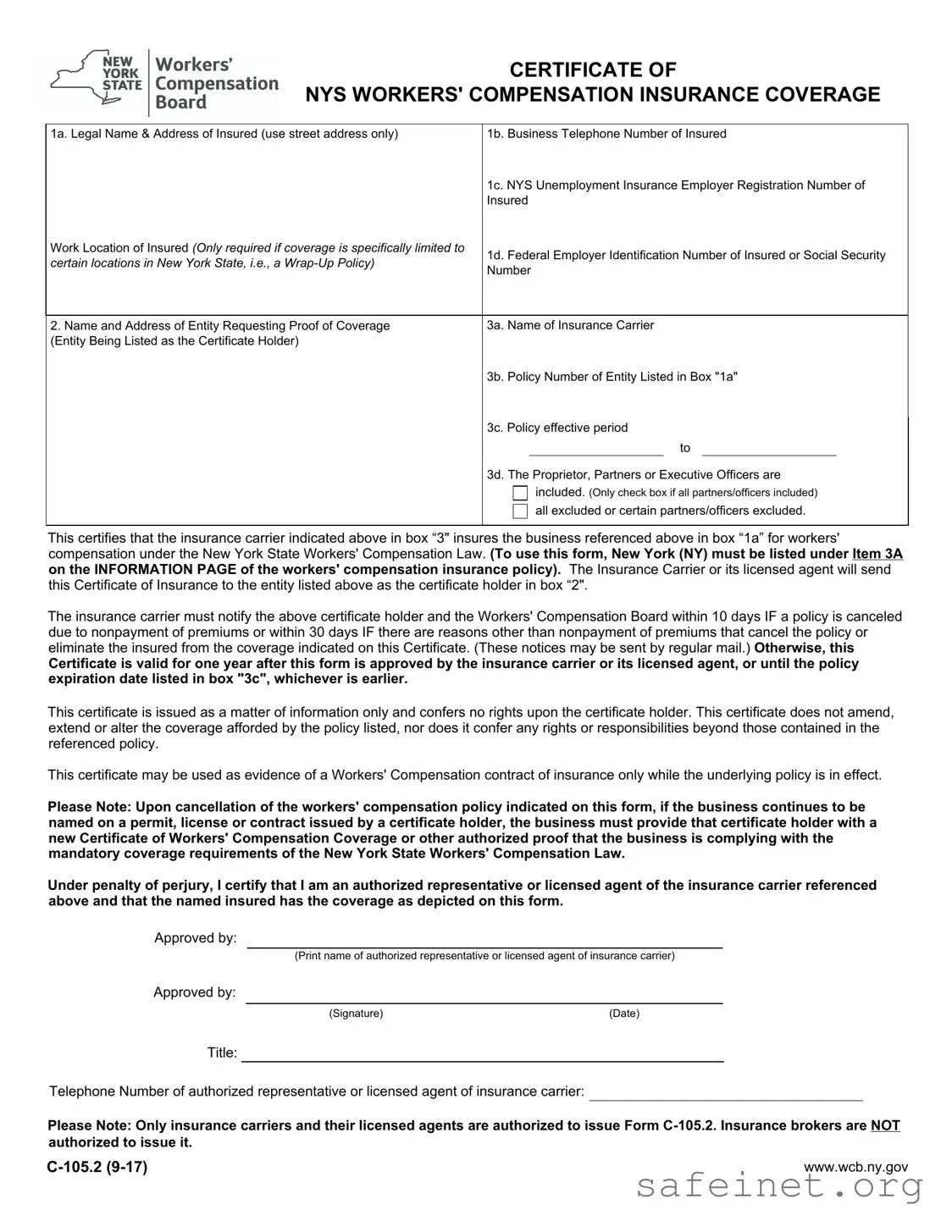
The C 105 2 form, officially known as the Certificate of New York State Workers' Compensation Insurance Coverage, serves a crucial role in ensuring compliance with New York's workers' compensation laws. This form provides essential information about the insured business, including the legal name, address, and contact details, as well as the insurance carrier's name and policy number. It verifies that the business has the necessary workers' compensation coverage and outlines the policy's effective period. Notably, the form also specifies whether all partners or executive officers are included in the coverage. The insurance carrier is responsible for sending this certificate to the requesting entity, ensuring they are informed of the coverage status. In the event of policy cancellation, the carrier must notify both the certificate holder and the Workers' Compensation Board within specified timeframes. While the C 105 2 form serves as proof of insurance, it does not alter the coverage terms of the underlying policy. Businesses must provide updated certificates upon policy cancellation to maintain compliance with legal requirements. Understanding the details of the C 105 2 form is essential for businesses operating in New York, as it helps navigate the complexities of workers' compensation obligations.

| Fact Name | Description |
|---|---|
| Purpose | The C-105.2 form certifies that a business has workers' compensation insurance coverage in New York State. |
| Insured Information | It requires the legal name, address, and contact details of the insured business. |
| Insurance Carrier | The form must include the name of the insurance carrier providing the coverage. |
| Policy Details | Policy number and effective dates are necessary to validate the coverage. |
| Notification Requirements | The insurance carrier must notify the certificate holder of policy cancellations within specified time frames. |
| Validity Period | This certificate is valid for one year or until the policy expiration date, whichever comes first. |
| Authorized Issuers | Only licensed agents or insurance carriers can issue the C-105.2 form; brokers cannot. |
| Legal Compliance | It complies with New York Workers' Compensation Law, ensuring employees are covered before permits or contracts are issued. |
| Certification | An authorized representative must certify the information under penalty of perjury. |
Filling out the C 105 2 form requires careful attention to detail. This form serves as proof of workers' compensation insurance coverage for a business in New York State. After completing the form, it must be submitted to the relevant entity requesting the proof of coverage.
What is the purpose of the C 105 2 form?
The C 105 2 form serves as a Certificate of New York State Workers' Compensation Insurance Coverage. It provides proof that a business has secured workers' compensation insurance as required by New York State law. This certificate is often needed when applying for permits, licenses, or contracts that involve employment in hazardous occupations.
Who is authorized to issue the C 105 2 form?
Only insurance carriers and their licensed agents can issue the C 105 2 form. Insurance brokers are not authorized to provide this certificate. This restriction ensures that the certificate is valid and recognized by state authorities.
How long is the C 105 2 form valid?
The certificate is valid for one year after it is approved by the insurance carrier or its licensed agent, or until the policy expiration date, whichever comes first. It is important to keep the certificate updated, especially if the underlying insurance policy is canceled or expires.
What should be done if the workers' compensation policy is canceled?
If the workers' compensation policy indicated on the C 105 2 form is canceled, the business must provide a new Certificate of Workers' Compensation Coverage or other authorized proof to any certificate holder that requires it. This ensures compliance with New York State Workers' Compensation Law and helps avoid potential penalties.
What information is included on the C 105 2 form?
The C 105 2 form includes essential information such as the legal name and address of the insured business, the insurance carrier's name and policy number, the effective period of the policy, and details about the coverage of the proprietor, partners, or executive officers. This information helps verify the insurance coverage and the business's compliance with legal requirements.
Incorrect Legal Name or Address: Providing the wrong legal name or address of the insured can lead to issues with coverage verification. Ensure that you use the street address only, as specified.
Missing Business Telephone Number: Failing to include the business telephone number of the insured can delay communication and verification processes.
Omitting NYS Unemployment Insurance Employer Registration Number: This number is crucial for proper identification of the insured. Leaving it blank can cause complications.
Incorrect Federal Employer Identification Number (FEIN): Entering an incorrect FEIN or Social Security Number can result in significant processing delays. Verify this information carefully.
Failure to Specify Work Location: If coverage is limited to certain locations, not providing the work location can create confusion and potential coverage gaps.
Inaccurate Policy Effective Period: Ensure that the policy effective period is accurately filled out. Incorrect dates can lead to misunderstandings regarding coverage.
Misunderstanding Exclusions: When indicating if all partners or executive officers are included, be clear on the exclusions. Misrepresenting this can lead to legal complications.
Failing to Have Authorized Representative Sign: Without the signature of an authorized representative or licensed agent, the form may not be considered valid. This step is crucial for compliance.
The C 105 2 form, known as the Certificate of New York State Workers' Compensation Insurance Coverage, is an essential document that serves as proof of workers' compensation insurance for businesses operating in New York. Alongside this form, several other documents may be required to ensure compliance with state regulations and provide necessary information to various stakeholders. Below is a list of commonly used forms and documents that accompany the C 105 2 form.
Understanding the various forms and documents related to the C 105 2 form is vital for employers and businesses to maintain compliance with New York State's workers' compensation laws. Proper documentation not only protects the rights of employees but also safeguards the interests of employers in navigating the complexities of insurance requirements.
The C-105.2 form, which certifies New York State workers' compensation insurance coverage, shares similarities with the Certificate of Liability Insurance (COI). Both documents serve as proof of insurance coverage for businesses, ensuring that they meet specific legal requirements. A COI provides details about the type of insurance, the coverage limits, and the policy period, much like the C-105.2. However, while the C-105.2 is specific to workers' compensation, the COI can cover various types of liability insurance, including general liability and professional liability. This makes the COI a more versatile document for businesses needing to demonstrate their insurance status across multiple areas of risk.
Another document similar to the C-105.2 is the ACORD Certificate of Insurance. This form is widely recognized in the insurance industry and is used to provide evidence of various types of insurance coverage. Like the C-105.2, the ACORD certificate includes essential information such as the insured’s name, the insurance provider, and the policy number. However, the ACORD certificate encompasses a broader range of coverages, including property, auto, and general liability insurance, making it a go-to document for many businesses needing to show proof of insurance to clients or regulatory bodies.
The Employer's Liability Insurance Policy is another document that parallels the C-105.2 form. While the C-105.2 specifically addresses workers' compensation, the Employer's Liability Insurance Policy covers legal liabilities that arise from employee injuries or illnesses that are not covered by workers' compensation. Both documents are essential for businesses, as they provide a safety net for employee-related risks. However, the Employer's Liability Insurance Policy may be more comprehensive in terms of covering lawsuits and claims that could arise from workplace incidents.
In addition, the Certificate of Insurance for Unemployment Insurance is similar to the C-105.2 in that it serves as proof of coverage for a specific type of insurance. This certificate is often required by state agencies when businesses apply for permits or licenses. While the C-105.2 focuses on workers' compensation, the unemployment insurance certificate confirms that a business is compliant with unemployment insurance regulations. Both documents are crucial for businesses to demonstrate compliance with state laws and secure necessary permits.
The Waiver of Subrogation is another document that shares some characteristics with the C-105.2. This document is often included in contracts to prevent an insurance company from seeking compensation from a third party after paying a claim. While the C-105.2 certifies coverage, the Waiver of Subrogation adds a layer of protection for the parties involved in a contract. Both documents highlight the importance of insurance in protecting businesses from financial loss, although they serve different purposes in the realm of risk management.
The Certificate of Workers' Compensation Coverage (CWC) is closely related to the C-105.2 form. It also serves as proof of compliance with workers' compensation laws, but it is often used in different contexts or jurisdictions. While the C-105.2 is specific to New York State, the CWC can be utilized in various states, depending on local regulations. Both documents are essential for businesses to show that they are meeting legal requirements for employee coverage, but they may differ in terms of formatting and specific information required.
Lastly, the Proof of Insurance form is akin to the C-105.2 in that it provides verification of coverage. This form is often requested by clients or partners before entering into contracts or agreements. While the C-105.2 is specifically tailored for workers' compensation, the Proof of Insurance form can encompass a wide range of insurance types. Both documents are vital for establishing trust and compliance in business relationships, ensuring that all parties are aware of the insurance coverage in place.
When filling out the C 105 2 form, it is essential to follow certain guidelines to ensure accuracy and compliance. Below is a list of things you should and shouldn't do during this process.
By adhering to these guidelines, individuals can help ensure that the C 105 2 form is filled out correctly, facilitating smoother processing and compliance with New York State Workers' Compensation Law.
Here are six common misconceptions about the C-105.2 form, which certifies New York State Workers' Compensation insurance coverage:
Understanding these misconceptions can help ensure compliance with New York State Workers' Compensation requirements and avoid potential issues.
When filling out and using the C-105.2 form, there are several important aspects to keep in mind. This form serves as a Certificate of New York State Workers' Compensation Insurance Coverage. Here are key takeaways:
By following these guidelines, you can ensure that you are using the C-105.2 form correctly and maintaining the necessary coverage for your business.