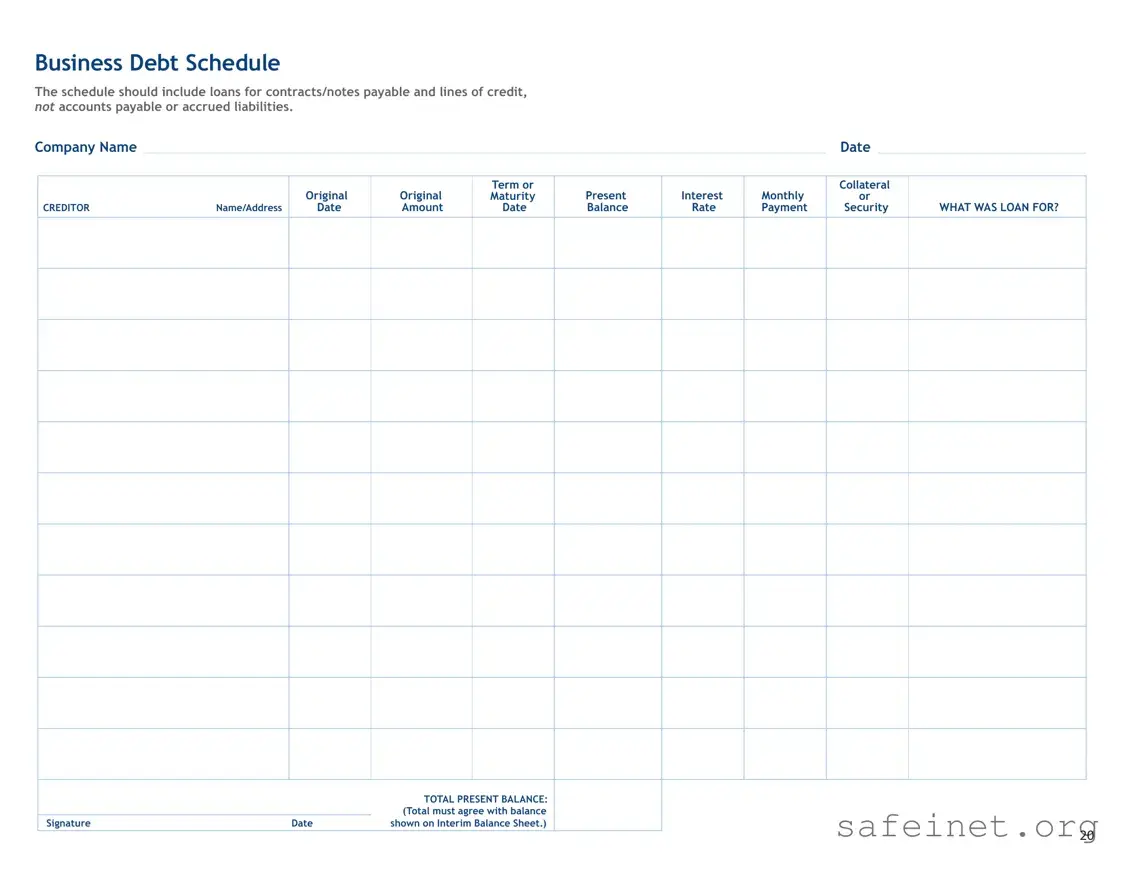
The Business Debt Schedule form is a crucial tool for any company looking to maintain a clear overview of its financial obligations. This form captures essential details about various types of debt, including loans for contracts, notes payable, and lines of credit. However, it specifically excludes accounts payable or accrued liabilities, focusing instead on the more formalized debts that a business may have. Each entry on the schedule requires information about the creditor, including their name and address, as well as the original date and amount of the loan. Additionally, it outlines important terms such as the maturity date, present balance, interest rate, and monthly payment obligations. To provide a comprehensive picture, the form also asks for details regarding any collateral or security tied to the loan and the purpose of the loan itself. At the bottom, it sums up the total present balance, which must align with the balance shown on the interim balance sheet. This alignment is vital for accurate financial reporting and planning.

| Fact Name | Details |
|---|---|
| Purpose | The Business Debt Schedule is designed to provide a comprehensive overview of a company's outstanding debts. |
| Types of Debt Included | This schedule includes loans for contracts, notes payable, and lines of credit, but excludes accounts payable and accrued liabilities. |
| Required Information | It requires details such as the creditor's name and address, original loan date, original amount, term or maturity date, present balance, interest rate, monthly payment, collateral or security, and the purpose of the loan. |
| Total Present Balance | The total present balance must match the balance shown on the Interim Balance Sheet, ensuring accuracy in financial reporting. |
| Signature Requirement | A signature is required on the form to validate the information provided and confirm its accuracy. |
| Governing Law | The specific governing laws may vary by state; for example, in California, the relevant laws include the California Corporations Code. |
| Frequency of Updates | Businesses should regularly update the Business Debt Schedule to reflect changes in their debt obligations. |
| Importance for Financial Health | This schedule is crucial for assessing a company's financial health and understanding its leverage. |
| Use in Bankruptcy Proceedings | The Business Debt Schedule can be a key document in bankruptcy proceedings, helping to outline liabilities and obligations. |
After completing the Business Debt Schedule form, the next steps typically involve reviewing the information for accuracy and ensuring it aligns with the company's financial statements. This form is essential for providing a clear picture of the business's outstanding debts.
What is the Business Debt Schedule form used for?
The Business Debt Schedule form is designed to provide a clear overview of a company's outstanding debts. It includes details about loans, contracts, notes payable, and lines of credit. This form helps businesses track their financial obligations and is often required for financial reporting or loan applications.
What types of debts should be included in the schedule?
Only loans, contracts, notes payable, and lines of credit should be included in the Business Debt Schedule. Accounts payable and accrued liabilities are not to be listed here. This distinction ensures that the schedule focuses on formal debts that require repayment.
What information do I need to fill out the form?
You will need several key pieces of information: the creditor's name and address, the original date of the loan, the original amount borrowed, the term or maturity date, the present balance, the interest rate, the monthly payment amount, and details about any collateral or security associated with the loan. Additionally, you should note the purpose of the loan.
How do I calculate the total present balance?
To calculate the total present balance, add up all the present balances of each loan or line of credit listed on the schedule. This total should match the balance shown on the interim balance sheet to ensure accuracy in financial reporting.
Is there a specific format I need to follow when completing the form?
While there may not be a strict format, it is important to fill out each section clearly and accurately. Ensure that all required fields are completed, and use consistent terminology throughout the form. This will make it easier for anyone reviewing the schedule to understand your financial obligations.
What if I have multiple creditors?
If you have multiple creditors, you should list each one separately in the schedule. Make sure to provide all relevant details for each loan or line of credit. This thoroughness will provide a comprehensive view of your business's debt situation.
How often should I update the Business Debt Schedule?
It is advisable to update the Business Debt Schedule regularly, especially after making payments or taking on new debt. Keeping this document current helps maintain an accurate picture of your financial obligations and supports better financial decision-making.
Who should review the Business Debt Schedule?
The Business Debt Schedule should be reviewed by key stakeholders in your business, including financial officers, accountants, or business owners. Regular reviews can help ensure that everyone is aware of the company's financial commitments and can assist in strategic planning.
What should I do if I find discrepancies in the schedule?
If you discover any discrepancies in the Business Debt Schedule, address them immediately. Verify the information against your financial records and communicate with your creditors if necessary. Accurate records are crucial for effective financial management.
Omitting Accounts Payable: Many individuals mistakenly include accounts payable or accrued liabilities on the form. This schedule should only list loans, contracts, notes payable, and lines of credit.
Incorrect Creditor Information: It's essential to provide accurate names and addresses for each creditor. Missing or incorrect information can lead to confusion and potential disputes.
Missing Original Date: Failing to include the original date of the loan can create issues when determining the loan's age and maturity.
Not Specifying the Purpose of the Loan: The form requires an explanation of what the loan was for. Skipping this step can leave the schedule incomplete and unclear.
Inaccurate Present Balance: Ensure that the present balance is correct and matches the amount shown on the interim balance sheet. Discrepancies can raise red flags during reviews.
Ignoring Interest Rates: It's crucial to list the correct interest rate for each loan. This information impacts financial assessments and repayment calculations.
Forgetting Monthly Payments: Some individuals overlook including the monthly payment amount. This detail is vital for understanding cash flow and financial obligations.
Neglecting Collateral Information: If the loan is secured, it's important to specify the collateral or security backing the loan. Omitting this can lead to misunderstandings about the loan's risk.
Not Summarizing Total Present Balance: The total present balance must be calculated and clearly stated at the end of the schedule. This total should agree with the balance shown on the interim balance sheet.
Failure to Sign and Date: Finally, remember to sign and date the form. An unsigned document may not be considered valid, which could complicate your financial reporting.
The Business Debt Schedule form is a vital tool for businesses to track their debts and obligations. However, it is often used in conjunction with several other documents that provide a comprehensive view of a company's financial situation. Below is a list of commonly associated forms and documents that can enhance the understanding of a business's debt landscape.
Understanding these documents in relation to the Business Debt Schedule can provide a clearer picture of a company's financial obligations and overall health. Together, they enable business owners and stakeholders to make informed decisions and strategize effectively for the future.
The Loan Amortization Schedule is a document that outlines the repayment of a loan over time. It details each payment, including principal and interest, and shows how the loan balance decreases with each payment. Similar to the Business Debt Schedule, it provides a clear view of financial obligations, helping businesses manage cash flow and plan for future payments. Both documents serve as essential tools for understanding the terms and conditions of debt obligations.
The Accounts Payable Aging Report is another important document that tracks what a business owes to its suppliers. While the Business Debt Schedule focuses on loans and lines of credit, the Accounts Payable Aging Report categorizes outstanding bills by due dates. This document helps businesses prioritize payments and maintain good relationships with vendors, ensuring that debts are managed effectively.
The Balance Sheet is a financial statement that provides a snapshot of a company's assets, liabilities, and equity at a specific point in time. It includes information about debts similar to the Business Debt Schedule but presents it in a broader context. The Balance Sheet helps stakeholders assess the financial health of a business, while the Business Debt Schedule offers a detailed breakdown of specific debts.
The Cash Flow Statement is a document that outlines the inflow and outflow of cash within a business over a specific period. It includes cash generated from operating activities, investing activities, and financing activities. Like the Business Debt Schedule, it provides insight into how debt affects cash flow, helping businesses understand their liquidity and ability to meet financial obligations.
The Loan Agreement is a legal document that outlines the terms of a loan between a borrower and a lender. It includes details such as the loan amount, interest rate, repayment schedule, and collateral. While the Business Debt Schedule summarizes existing debts, the Loan Agreement serves as the foundational document that establishes the terms of those debts.
The Financial Statement Notes are supplementary notes that accompany financial statements, providing additional context and detail. They often include information about debt obligations, such as interest rates and repayment terms. These notes complement the Business Debt Schedule by offering a deeper understanding of the company's financial commitments and potential risks.
The Debt Service Coverage Ratio (DSCR) Report evaluates a company's ability to repay its debts. It compares cash flow available to the debt servicing obligations. Similar to the Business Debt Schedule, the DSCR Report highlights the importance of managing debt effectively, ensuring that businesses can meet their financial commitments without jeopardizing operations.
The Personal Guarantee Document is a legal agreement where an individual agrees to repay a business debt if the business defaults. This document is relevant for small business owners who may need to secure loans with personal assets. Like the Business Debt Schedule, it emphasizes the importance of understanding the implications of debt and the obligations that come with it.
The Debt Restructuring Proposal outlines a plan for reorganizing a company's debt obligations to improve financial stability. This document may include terms for reducing interest rates or extending repayment periods. Similar to the Business Debt Schedule, it focuses on managing debt but emphasizes strategies for improving a company's financial situation.
The Credit Report is a detailed report that provides information about a business's credit history and current creditworthiness. It includes details about outstanding debts, payment history, and credit utilization. While the Business Debt Schedule lists specific debts, the Credit Report offers a broader view of how those debts impact the overall financial standing of the business.
When filling out the Business Debt Schedule form, it’s important to approach the task with care and attention to detail. Here’s a list of things you should and shouldn’t do to ensure accuracy and compliance.
Following these guidelines will help ensure that your Business Debt Schedule form is completed correctly, minimizing potential issues down the line.
The Business Debt Schedule form is a crucial document for businesses, yet several misconceptions surround its purpose and use. Here are ten common misunderstandings:
The form is specifically designed for loans, contracts, and lines of credit. Accounts payable and accrued liabilities should not be included.
Only debts that are formal loans or credit lines need to be listed. Informal debts do not require disclosure on this schedule.
For certain financial assessments or loan applications, completing the Business Debt Schedule may be mandatory.
A signature is required to validate the information presented in the schedule, ensuring accountability.
The form requires detailed information, including original amounts and terms, not just the present balance.
The interest rate is a critical component, impacting the total cost of the debt and monthly payments.
Indicating collateral or security is essential, as it provides insight into the risk associated with the debt.
The schedule should be updated regularly, especially when there are changes to any debts or new loans are acquired.
The Business Debt Schedule is distinct from a balance sheet; it focuses solely on debts rather than overall financial position.
Only creditors related to formal loans and credit lines are to be included, not every financial obligation of the business.
When filling out and using the Business Debt Schedule form, consider the following key takeaways:
By following these guidelines, you can create a comprehensive and useful Business Debt Schedule.