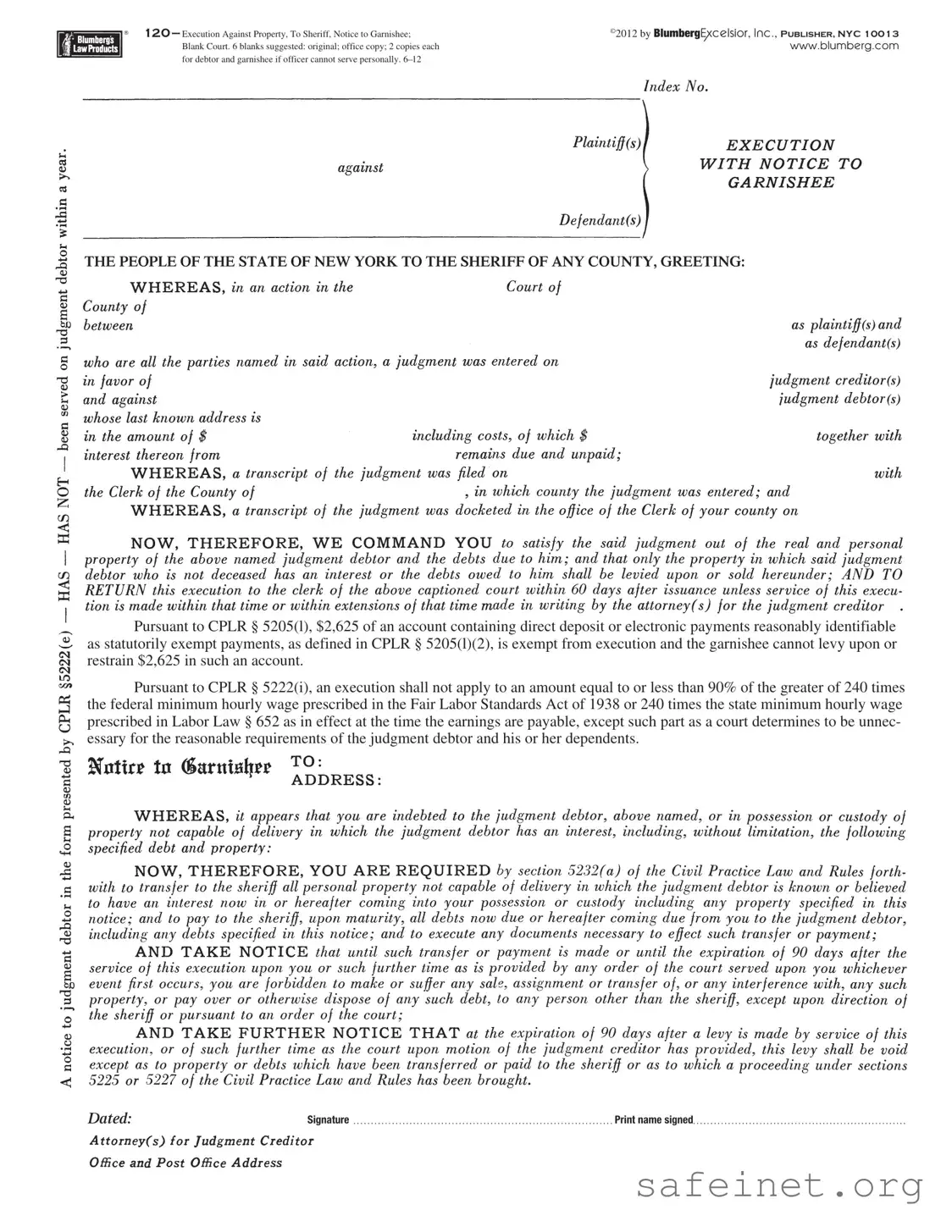
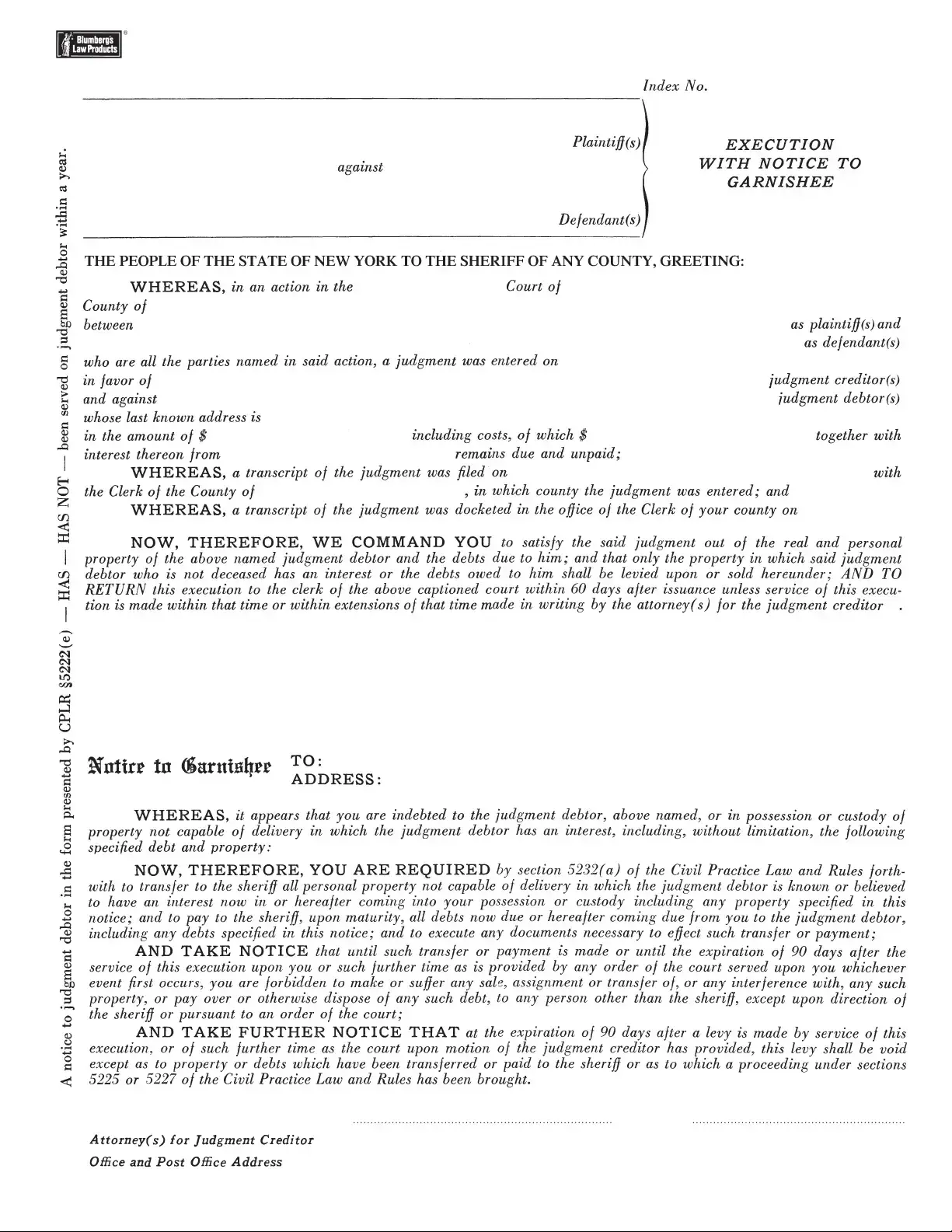
The Blumberg 120 form plays a crucial role in the execution process against property in New York. This form is designed to facilitate the legal procedure for garnishing wages or seizing assets to satisfy a judgment. It includes essential sections for identifying the parties involved, such as the judgment debtor and the garnishee, ensuring that all necessary information is documented clearly. The form stipulates that a sheriff is responsible for serving notice to the garnishee, which is vital for initiating the garnishment process. Additionally, it outlines exemptions that protect certain amounts in a debtor's account from being levied, specifically referencing statutory limits that safeguard funds deemed necessary for the debtor's reasonable living expenses. The form also requires the inclusion of pertinent details such as the index number, court information, and the attorney's contact information, ensuring that the execution is properly recorded and executed. By adhering to these guidelines, the Blumberg 120 form helps streamline the garnishment process while providing necessary protections for debtors.

| Fact Name | Description |
|---|---|
| Form Purpose | The Blumberg 120 form is used for executing a judgment against a debtor's property and notifying a garnishee. |
| Governing Law | This form is governed by the New York Civil Practice Law and Rules (CPLR), specifically sections 5205 and 5222. |
| Exempt Amount | Under CPLR § 5205(l), $2,625 in certain accounts is exempt from execution, protecting specific types of income. |
| Copies Required | It is suggested to prepare six copies of the form: one original, one office copy, and two copies each for the debtor and garnishee. |
| Minimum Wage Calculation | CPLR § 5222(i) states that execution does not apply to amounts equal to or less than 90% of 240 times the federal or state minimum wage. |
| Defendant Notification | The form requires notification if any defendants were not served with a summons, restricting execution against their sole property. |
| Joint Property Collection | Execution can be collected from real and personal property jointly owned by the defendant and others who were summoned. |
| Signature Requirement | The form must be signed and dated by the attorney or plaintiff to be valid and enforceable. |
| Contact Information | It is essential to include the names and addresses of the garnishee, judgment debtor, and attorney for proper processing. |
Filling out the Blumberg 120 form requires careful attention to detail. Each section must be completed accurately to ensure proper processing. Follow these steps to fill out the form correctly.
What is the Blumberg 120 form used for?
The Blumberg 120 form is primarily utilized for executing a judgment against a debtor's property. This legal document notifies the sheriff to levy and collect on the property of the debtor. It also includes a notice to the garnishee, informing them of their obligations regarding the debtor's assets. This form is essential for creditors seeking to recover amounts owed through the seizure of property or funds held by third parties.
How many copies of the Blumberg 120 form are needed?
When preparing the Blumberg 120 form, it is advisable to create multiple copies. The suggested number is six: one original for the court, one office copy, and two copies each for the debtor and the garnishee. This ensures that all parties involved receive the necessary documentation, and the court has its records in order. If the sheriff cannot serve the documents personally, having these copies becomes even more critical.
What exemptions apply when using the Blumberg 120 form?
Exemptions are an important consideration when executing against a debtor's property. According to CPLR § 5205(l), certain funds are protected from execution. Specifically, $2,625 of an account containing direct deposits or electronic payments that can be identified as statutorily exempt is not subject to levy. Additionally, under CPLR § 5222(i), amounts equal to or less than 90% of a specified minimum wage are also protected, unless a court determines otherwise. These exemptions help safeguard essential funds for the debtor and their dependents.
What should I do if a named defendant was not served?
If a named defendant was not served with a summons, it is crucial to note this on the Blumberg 120 form. The execution against property must be restricted for those defendants. Specifically, the property owned solely by an unserved defendant cannot be levied upon. However, property that is jointly owned with other defendants can still be subject to execution. This ensures that the rights of all parties are respected while allowing the creditor to pursue the judgment effectively.
Incomplete Information: Many people fail to fill out all required fields on the Blumberg 120 form. Missing information can lead to delays or rejections of the filing.
Incorrect Signature: Some individuals forget to sign the form or do not provide the correct signature. This oversight can invalidate the document and halt the execution process.
Failure to Specify Exemptions: It is crucial to identify any exemptions correctly. Not mentioning the $2,625 exemption or other applicable exemptions can result in improper garnishment of funds.
Ignoring Court Requirements: Each court may have specific rules regarding the filing of the Blumberg 120 form. Ignoring these requirements can lead to complications or dismissals.
The Blumberg 120 form is used primarily for execution against property in garnishment cases. However, several other forms and documents often accompany it to ensure a comprehensive legal process. Below is a list of these related documents, along with brief descriptions of their purposes.
These documents work together to facilitate the legal process of garnishment and execution. Each plays a vital role in ensuring that the rights of both the creditor and debtor are considered throughout the proceedings.
The Blumberg 120 form is similar to the Notice of Motion form, which is often used in civil litigation. Both documents serve to inform parties involved in a legal matter about specific actions being taken. The Notice of Motion outlines the request being made to the court, while the Blumberg 120 form notifies the garnishee and debtor about the execution against property. Each document requires clear identification of the parties involved and the specific relief sought, ensuring that all parties are aware of the legal proceedings in a timely manner.
Another comparable document is the Writ of Execution. This legal instrument is issued by a court to enforce a judgment by allowing the seizure of a debtor's property. Like the Blumberg 120 form, the Writ of Execution specifies the property subject to seizure and informs the sheriff of the actions needed to collect on a judgment. Both documents are crucial in the enforcement of court orders, providing clear guidance on how to proceed with the collection of debts owed.
The Judgment Lien form shares similarities with the Blumberg 120 form as well. A Judgment Lien establishes a legal claim against a debtor's property until the judgment is satisfied. Both forms serve to protect the rights of the creditor, ensuring that they have a legal avenue to pursue the collection of debts. The Judgment Lien form, like the Blumberg 120, must be properly filed and served to ensure that the debtor and any third parties are aware of the creditor's claim.
The Garnishment Order is another document that resembles the Blumberg 120 form. This order directs a third party, typically an employer or bank, to withhold a portion of a debtor's earnings or funds to satisfy a debt. Both documents require precise information about the debtor and the amount owed. They also establish the legal basis for the garnishment, ensuring that the creditor can collect the owed amount while adhering to legal protections afforded to the debtor.
Similar to the Blumberg 120 form is the Affidavit of Service. This document serves as proof that legal papers have been delivered to the appropriate parties. In the context of the Blumberg 120 form, the Affidavit of Service confirms that the garnishee and debtor have received notice of the execution against property. Both documents are essential for maintaining transparency and accountability in legal proceedings.
The Subpoena is another document that bears resemblance to the Blumberg 120 form. A Subpoena compels a person to appear in court or produce documents relevant to a case. Both the Subpoena and the Blumberg 120 form are tools for gathering information and enforcing legal rights. They require careful drafting to ensure that the parties involved understand their obligations and the consequences of non-compliance.
The Release of Judgment is akin to the Blumberg 120 form in that it signifies the conclusion of a legal obligation. When a debtor has satisfied their debt, the Release of Judgment formally removes the lien or claim against their property. Both documents are critical in the lifecycle of a judgment, marking the transition from enforcement to resolution, ensuring that all parties are aware of the current status of the debt.
Finally, the Satisfaction of Judgment form is similar to the Blumberg 120 form in its purpose of documenting that a judgment has been fully paid or settled. This form provides official confirmation to the court and the debtor that the creditor has received the owed amount. Both documents play a vital role in the legal process, ensuring that all parties have clarity regarding the status of the debt and the enforcement actions taken.
When filling out the Blumberg 120 form, consider the following tips to ensure accuracy and compliance:
Following these guidelines will help you complete the form correctly and avoid potential issues.
Understanding the Blumberg 120 form is crucial for navigating legal processes related to execution against property. However, several misconceptions often arise. Here are eight common misunderstandings:
Clarifying these misconceptions can help individuals better understand their rights and responsibilities when dealing with the Blumberg 120 form.
When filling out and using the Blumberg 120 form, keep these key takeaways in mind: