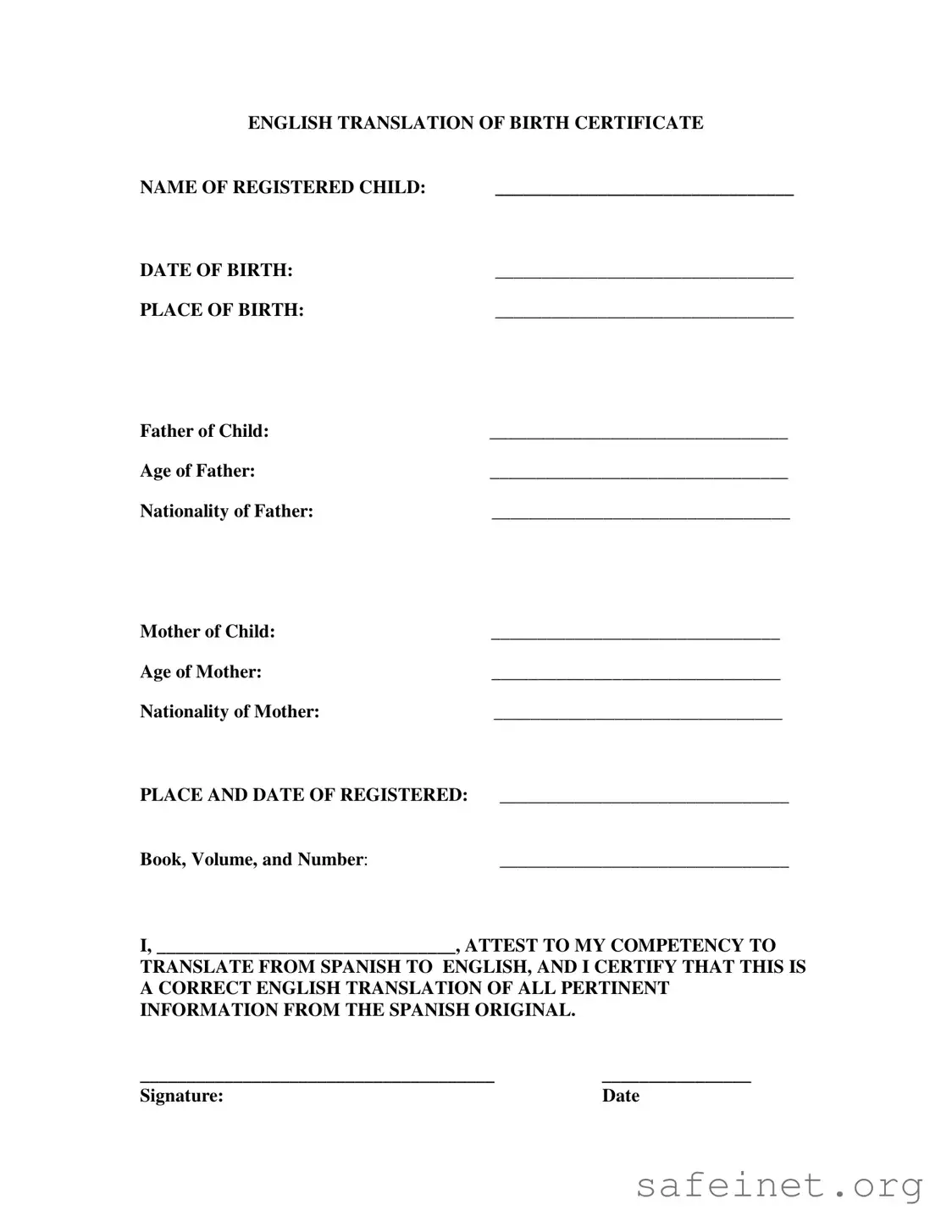
The Birth Certificate Translation to English form serves a crucial purpose for individuals needing to provide an accurate English version of their birth certificate. This form includes essential information about the registered child, such as their name, date of birth, and place of birth. Additionally, it captures details about the parents, including their names, ages, and nationalities. The form also requires information about where and when the birth was registered, along with specific identifiers like book, volume, and number. To ensure the translation's accuracy, the translator must attest to their competency in translating from Spanish to English. A signature and date from the translator confirm that the translation reflects all pertinent information from the original Spanish document. This process is vital for various legal and administrative purposes, ensuring that individuals can navigate systems that require official documentation in English.

| Fact Name | Description |
|---|---|
| Purpose | The Birth Certificate Translation to English form is used to provide an accurate English version of a birth certificate originally issued in Spanish. |
| Required Information | This form requires details such as the child's name, date and place of birth, and parents' information. |
| Certification | The translator must attest to their competency in translating from Spanish to English, ensuring accuracy in the translation. |
| Signature | The form must be signed by the translator, confirming that the translation is correct. |
| State Variations | Different states may have specific requirements for the translation, so it's essential to check local laws. |
| Governing Laws | In California, for example, the governing law for birth certificate translations can be found under California Family Code § 7100. |
| Usage | This form is commonly required for legal processes, immigration applications, and educational enrollments. |
Filling out the Birth Certificate Translation To English form is a straightforward process. You will need to provide specific details about the child, parents, and the translation itself. Follow the steps below to ensure that all necessary information is accurately recorded.
What is the purpose of the Birth Certificate Translation to English form?
The Birth Certificate Translation to English form is used to provide an accurate English version of a birth certificate originally written in another language, such as Spanish. This translation is often required for legal, immigration, or identification purposes in the United States.
Who needs to complete this form?
Individuals who possess a birth certificate in a language other than English may need to complete this form. This includes parents or guardians who are applying for services that require proof of identity or citizenship for their children.
What information is required on the form?
The form requires specific details, including the name of the registered child, date of birth, place of birth, and parental information such as names, ages, and nationalities. Additionally, the place and date of registration, along with book, volume, and number, must be provided.
Who can certify the translation?
A qualified translator who is proficient in both Spanish and English must certify the translation. The translator must attest to their competency in translating the document and confirm that the translation is accurate and complete.
Is there a specific format for the translation?
While the form provides a structured format, the translation should maintain the integrity of the original document. It should be clear, legible, and include all pertinent information from the original birth certificate.
What happens if the translation is inaccurate?
An inaccurate translation can lead to delays or rejections of applications requiring the birth certificate. It is crucial to ensure that the translation is correct and complete to avoid complications in legal or administrative processes.
How do I submit the completed form?
The completed Birth Certificate Translation to English form should be submitted along with any other required documentation to the relevant authority or organization requesting the translation. This may include immigration offices, schools, or other governmental entities.
Incomplete Information: Many people fail to fill out all required fields. Leaving any section blank can lead to delays in processing. Ensure that every line is completed, including names, dates, and places.
Incorrect Translations: Some individuals may attempt to translate names or terms inaccurately. It's important to use the correct English equivalents for names and places. Misinterpretations can cause confusion and may require resubmission.
Signature Issues: The form requires a signature from the translator. Failing to sign or using an illegible signature can invalidate the document. Always ensure that the signature is clear and matches the name provided.
Missing Certification Statement: The certification statement must be included and signed. Omitting this statement or failing to affirm competency to translate can lead to rejection of the application. Always double-check that this section is completed.
When obtaining a Birth Certificate Translation to English, there are several other documents that may be required to support your application or serve various purposes. Each of these documents plays a crucial role in verifying identity, citizenship, or family relationships. Below is a list of commonly used forms and documents that often accompany a birth certificate translation.
Gathering these documents can seem overwhelming, but each one serves a specific purpose in confirming your identity or legal status. Ensure that you have all necessary forms ready to avoid delays in processing your birth certificate translation and any related applications. Being prepared will help streamline the process and provide peace of mind.
The first document similar to the Birth Certificate Translation to English form is the Marriage Certificate Translation. Just like a birth certificate, a marriage certificate serves as an official record of a significant life event. It includes details such as the names of the spouses, the date of the marriage, and the location where the marriage took place. When translating a marriage certificate, accuracy is crucial to ensure that all details align with the original document, just as it is with a birth certificate.
Another comparable document is the Death Certificate Translation. This document provides essential information about the deceased, including their name, date of birth, date of death, and place of death. Similar to the birth certificate, the death certificate must be accurately translated to reflect the original information. Both documents serve as vital records that may be required for legal processes, such as settling estates or obtaining benefits.
The Adoption Certificate Translation also shares similarities with the Birth Certificate Translation. An adoption certificate documents the legal process of adopting a child, detailing the names of the adoptive parents and the adopted child. Accurate translation is essential here as well, ensuring that all names and dates are correctly represented. Both documents carry significant emotional and legal weight, often required for immigration or legal identity purposes.
Next, the Divorce Decree Translation is another document that resembles the Birth Certificate Translation. A divorce decree outlines the terms of a divorce, including custody arrangements and property division. Just as with birth certificates, accuracy in translating this document is vital for legal clarity and compliance. Both documents can impact an individual's legal status and rights.
The Passport Translation is also similar in nature. A passport serves as an official identification document that verifies a person's identity and nationality. When translating a passport, all personal details such as name, date of birth, and nationality must be accurately rendered in the target language. This is comparable to the birth certificate, where precise information is critical for identification purposes.
Lastly, the Immigration Document Translation can be likened to the Birth Certificate Translation. Immigration documents, such as visas or residency permits, often require supporting documentation like birth certificates. These translations must maintain the integrity of the original information to facilitate legal processes. Both types of documents are essential for establishing identity and legal status within a country.
When filling out the Birth Certificate Translation To English form, it's important to follow specific guidelines to ensure accuracy and compliance. Here are some things you should and shouldn't do:
Understanding the process of translating a birth certificate into English can be confusing. Many people hold misconceptions about what is required and how it works. Here are eight common misconceptions, along with clarifications to help you navigate this important task.
By addressing these misconceptions, individuals can better prepare for the translation process and ensure that their birth certificates meet the necessary requirements for use in English-speaking contexts.
When filling out the Birth Certificate Translation To English form, consider the following key points: