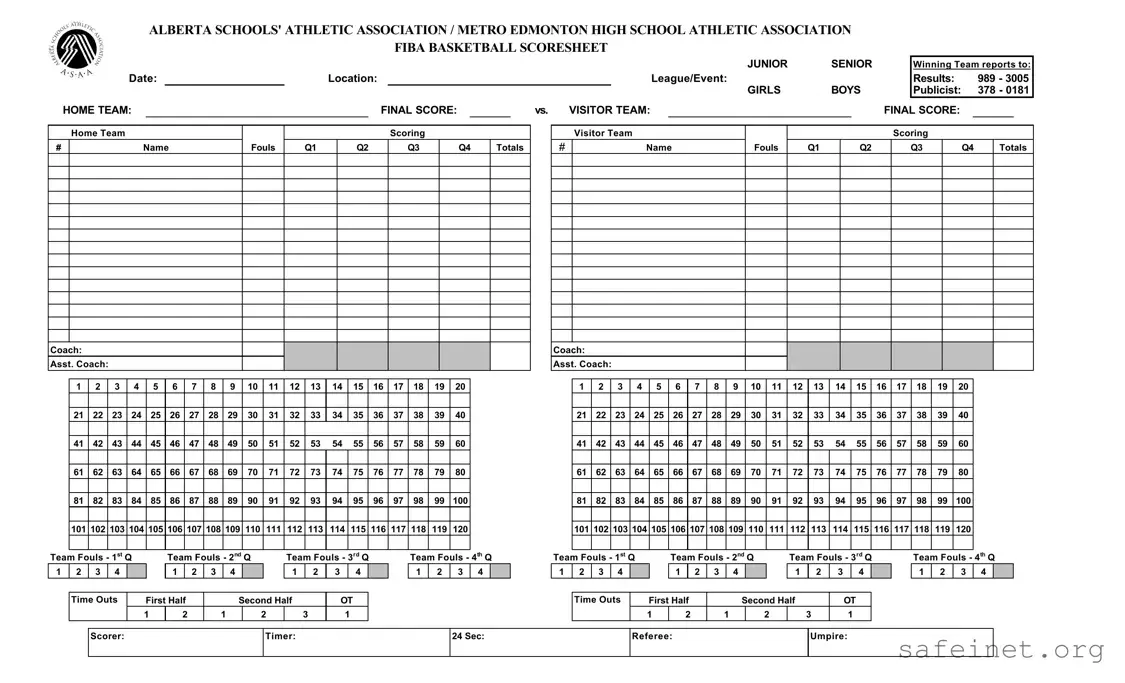
The Basketball Scoresheet form is an essential tool for tracking and documenting the details of a basketball game. This form captures critical information, including the names and numbers of players from both the home and visitor teams, along with their individual scoring and fouls throughout each quarter. Coaches for both teams are also recorded, ensuring accountability and proper representation during the game. Additionally, the scoresheet includes sections to note the final score of the game, the date, location, and league or event, providing a comprehensive overview of the match. Team fouls for each quarter are meticulously tracked, allowing for a clear understanding of the game's flow and any potential impacts on player availability. Timeouts taken during the game are also documented, offering insights into strategic decisions made by the coaches. Overall, this scoresheet serves as a vital record for teams, coaches, and leagues, facilitating communication and analysis of game performance.
| Fact Name | Details |
|---|---|
| Governing Bodies | The scoresheet is used by the Alberta Schools' Athletic Association and the Metro Edmonton High School Athletic Association. |
| Event Type | This scoresheet is applicable for both junior and senior basketball games. |
| Reporting Requirements | The winning team is responsible for reporting the results of the game. |
| Scoring Sections | Each team has designated sections for player scoring, fouls, and total points across four quarters. |
| Time Outs | The scoresheet includes sections for tracking timeouts taken during the first half, second half, and overtime. |
| Official Roles | It designates roles for key officials, including the scorer, timer, referee, and umpire. |
Filling out the Basketball Scoresheet form is a straightforward process that ensures accurate record-keeping during a game. Following these steps will help you complete the form efficiently, allowing for a clear representation of the game’s events and outcomes.
What is the purpose of the Basketball Scoresheet form?
The Basketball Scoresheet form is designed to provide a structured way to record the details of a basketball game. It captures essential information such as team names, final scores, individual player statistics, fouls, and timeouts. This documentation is crucial for tracking performance and ensuring accurate reporting of game results.
How should I fill out the scoresheet for each team?
When filling out the scoresheet, start by entering the names of the home and visitor teams at the top of the form. For each player, include their number, name, and fouls incurred during the game. Record the points scored by each player in each quarter, as well as the total points at the end of the game. Ensure that the coaches' names are also noted for both teams.
What information is required at the beginning of the scoresheet?
At the beginning of the scoresheet, you need to fill in the date, location of the game, league or event name, and the names of the winning team. This information provides context for the game and helps with future reference and record-keeping.
How are team fouls tracked on the scoresheet?
Team fouls are tracked by quarter. Each quarter has designated spaces to record the total number of fouls committed by each team. This allows for easy monitoring of foul counts throughout the game, which is important for understanding team discipline and potential foul trouble for players.
What should I do if a player has multiple fouls in a quarter?
If a player accumulates multiple fouls in a quarter, record each foul in the corresponding quarter column. The total fouls for each player will be summed at the end of the game. This helps coaches and officials keep track of players who may be at risk of fouling out.
How are timeouts recorded on the scoresheet?
Timeouts are recorded separately for the first half, second half, and any overtime periods. Each team has designated spaces to indicate the number of timeouts taken. This information is vital for managing game strategy and ensuring teams adhere to timeout regulations.
Who is responsible for completing the scoresheet during a game?
The scoresheet is typically completed by a designated scorer, who is responsible for accurately recording all statistics throughout the game. This role is crucial for maintaining the integrity of the game records. Additionally, the timer, referees, and umpires may also provide input or oversight to ensure accuracy.
Omitting Team Information: Failing to fill in the home and visitor team names can lead to confusion. Ensure both teams are clearly identified at the top of the scoresheet.
Incorrect Date and Location: Entering the wrong date or location for the game can create issues for record-keeping. Double-check these details before submission.
Forgetting Player Numbers: Each player must have a unique number. Leaving this field blank can hinder accurate scoring and statistics.
Not Recording Fouls: Failing to track player fouls can lead to misunderstandings regarding eligibility and game flow. Make sure to update this information after each quarter.
Skipping Quarter Scores: Leaving the quarter scores blank or incorrectly filled can lead to disputes about the final score. Record scores for each quarter diligently.
Ignoring Time Outs: Not documenting timeouts taken can affect game strategy and player management. Record each timeout accurately.
Missing Coach Information: Not including the names of the head coach and assistant coach can lead to accountability issues. Always fill in this section.
Neglecting to Sign: The scoresheet requires signatures from the scorer and referee. Omitting these can invalidate the document.
Submitting Incomplete Scoresheets: Ensure that all sections are filled out completely before submission. An incomplete scoresheet can result in delays or penalties.
The Basketball Scoresheet form is a vital document used during games to track player performance, team fouls, and overall game statistics. Several other forms and documents complement this scoresheet, ensuring that all aspects of the game are accurately recorded and reported. Below is a list of some of the most commonly used documents alongside the Basketball Scoresheet.
These forms and documents play a crucial role in the organization and administration of basketball games. By ensuring that all necessary information is recorded, they help maintain the integrity of the sport and enhance the overall experience for players and fans alike.
The Basketball Scoresheet form shares similarities with the Game Report form used in various sports. Both documents serve to record essential information about a game, including scores, player statistics, and team fouls. The Game Report is crucial for coaches and managers as it provides a comprehensive overview of the match, allowing for better analysis and strategy development in future games. Just like the scoresheet, it includes sections for team names, final scores, and a breakdown of individual player performance.
Another document akin to the Basketball Scoresheet is the Player Performance Sheet. This sheet focuses specifically on individual players, detailing their scoring, assists, rebounds, and fouls. Coaches utilize this document to assess player contributions and areas for improvement. Similar to the scoresheet, it organizes data into quarters, making it easy to track performance throughout the game.
The Match Summary form is also comparable. This document provides an overview of the entire game, summarizing key events and outcomes. It often includes highlights, player of the game, and any significant incidents. Like the Basketball Scoresheet, it serves as a historical record that teams can refer back to for insights and reflections on their performance.
The Tournament Bracket form is another similar document, particularly in competitive settings. It outlines the progression of teams through a tournament, showing matchups and results. While the scoresheet captures detailed game statistics, the bracket provides a broader view of how teams advance based on their performances, making it a valuable companion to the scoresheet.
Next, the Stat Sheet serves a similar purpose by compiling statistics for multiple games or an entire season. Coaches and analysts use this document to identify trends and patterns in team and player performance. Like the Basketball Scoresheet, it emphasizes quantitative data, allowing for informed decision-making and strategy adjustments.
The Attendance Sheet is another related document that records player participation in games. This form is essential for tracking eligibility and understanding team dynamics. While it does not capture game statistics, it complements the scoresheet by ensuring that all players are accounted for during the match.
The Injury Report form also bears resemblance to the Basketball Scoresheet, as it documents player injuries sustained during games. Coaches and medical staff utilize this report to monitor player health and recovery. Although it focuses on a different aspect of the game, it is crucial for maintaining player safety, much like the scoresheet is essential for tracking performance.
Lastly, the Coaching Evaluation form aligns with the Basketball Scoresheet by assessing coaching strategies and decisions during a game. This document allows for reflection on what worked and what didn’t, promoting growth and improvement in coaching methods. Both forms serve as tools for analysis, fostering a deeper understanding of the game from different perspectives.
When filling out the Basketball Scoresheet form, it's essential to follow specific guidelines to ensure accuracy and clarity. Here are ten things you should and shouldn't do:
By following these tips, you can help ensure that the scoresheet serves its purpose effectively.
Misconceptions about the Basketball Scoresheet form can lead to confusion and errors during games. Below are ten common misconceptions, along with clarifications to ensure accurate use of the form.
Both teams are required to complete the scoresheet. This ensures that all game details are recorded accurately, regardless of the outcome.
The scoresheet can be used for any organized basketball event, including scrimmages and tournaments, not just league games.
Recording fouls is essential. It helps coaches and referees track player eligibility and game flow.
Totals should be updated after each quarter. This practice helps maintain accuracy throughout the game.
It is recommended that designated individuals, such as a team manager or coach, fill out the scoresheet to ensure consistency and accuracy.
All timeouts should be recorded. This information is crucial for understanding team strategy and managing game flow.
In addition to points, fouls, timeouts, and player substitutions should also be recorded for a complete overview of the game.
The scoresheet serves as a vital document for reviewing game performance, making it important for coaches and players alike.
Different leagues and organizations may have variations in their scoresheets. It is important to use the correct form for your specific league or event.
Scoresheets must be completed during the game to ensure accuracy. Filling them out afterward can lead to errors and omissions.
When filling out and using the Basketball Scoresheet form, consider the following key takeaways: