Homepage > Blank Baseball Assessment Template
Article Structure

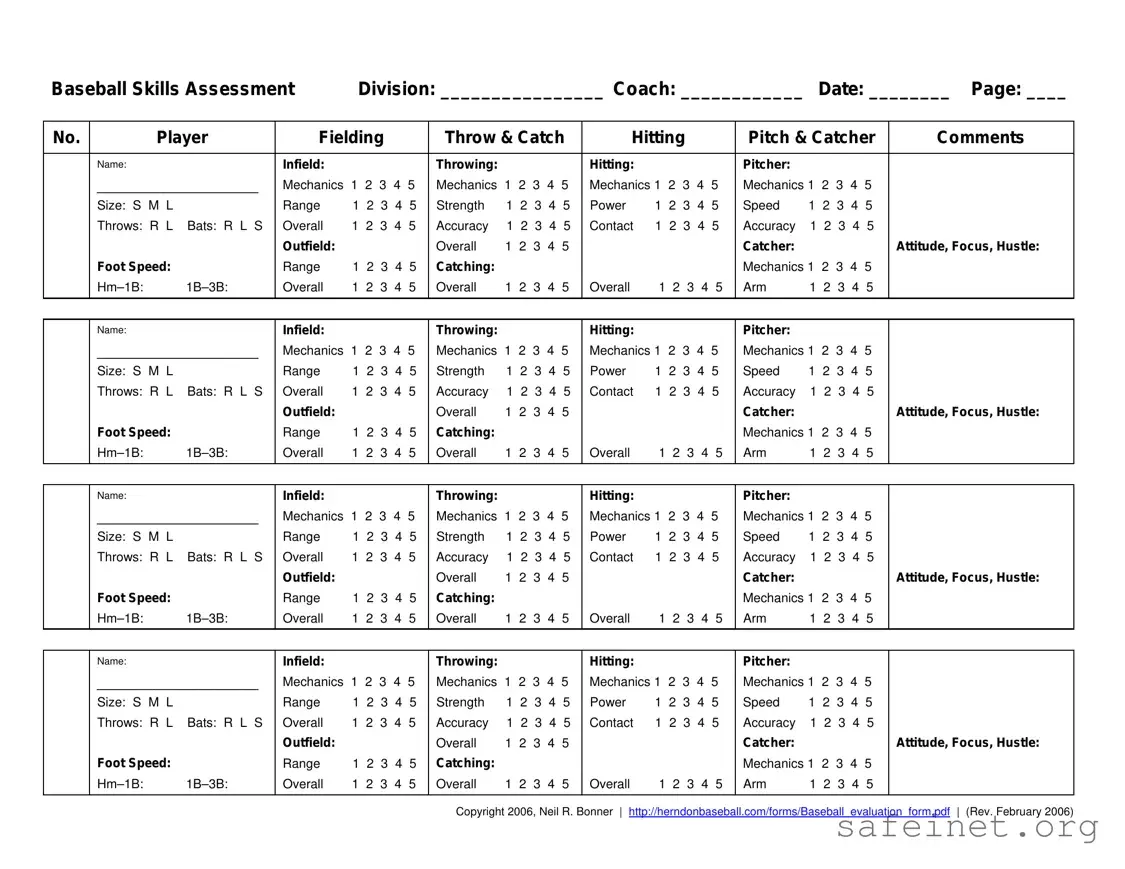
The Baseball Assessment form plays a crucial role in evaluating players during tryouts, ensuring a fair and comprehensive selection process for teams. Coaches utilize this standardized tool to assess various skills, including fielding, throwing, hitting, and pitching abilities. Each player's performance is rated on a five-point scale, allowing for a clear comparison of skills among peers. The form captures essential details such as the player's name, position, and specific mechanics, while also noting additional factors like attitude, focus, and hustle. The assessment covers multiple categories, from infield and outfield skills to catching and base running, providing a holistic view of each player's capabilities. By structuring the evaluation process, coaches can make informed decisions on team selections, emphasizing the importance of both skill and sportsmanship. This form not only aids in identifying talent for All-Star travel teams but can also be adapted for use in local leagues, making it a versatile resource for baseball coaches across various levels.

Form Sample

Copyright 2006, Neil R. Bonner | http://herndonbaseball.com/forms/Baseball_evaluation_form.pdf | (Rev. February 2006)
Baseball Skills Assessment Division: ________________ Coach: ____________ Date: ________ Page: ____
No. Player Fielding Throw & Catch Hitting Pitch & Catcher Comments
Name:
Infield: Throwing: Hitting: Pitcher:
_________________
Mechanics 1 2 3 4 5 Mechanics 1 2 3 4 5 Mechanics 1 2 3 4 5 Mechanics 1 2 3 4 5
Size: S M L Range 1 2 3 4 5 Strength 1 2 3 4 5 Power 1 2 3 4 5 Speed 1 2 3 4 5
Throws: R L Bats: R L S Overall 1 2 3 4 5 Accuracy 1 2 3 4 5 Contact 1 2 3 4 5 Accuracy 1 2 3 4 5
Outfield:
Overall 1 2 3 4 5
Catcher: Attitude, Focus, Hustle:
Foot Speed:
Range 1 2 3 4 5
Catching:
Mechanics 1 2 3 4 5
Hm–1B: 1B–3B: Overall 1 2 3 4 5 Overall 1 2 3 4 5 Overall 1 2 3 4 5 Arm 1 2 3 4 5
Name:
Infield: Throwing: Hitting: Pitcher:
_________________
Mechanics 1 2 3 4 5 Mechanics 1 2 3 4 5 Mechanics 1 2 3 4 5 Mechanics 1 2 3 4 5
Size: S M L Range 1 2 3 4 5 Strength 1 2 3 4 5 Power 1 2 3 4 5 Speed 1 2 3 4 5
Throws: R L Bats: R L S Overall 1 2 3 4 5 Accuracy 1 2 3 4 5 Contact 1 2 3 4 5 Accuracy 1 2 3 4 5
Outfield:
Overall 1 2 3 4 5
Catcher: Attitude, Focus, Hustle:
Foot Speed:
Range 1 2 3 4 5
Catching:
Mechanics 1 2 3 4 5
Hm–1B: 1B–3B: Overall 1 2 3 4 5 Overall 1 2 3 4 5 Overall 1 2 3 4 5 Arm 1 2 3 4 5
Name:
Infield: Throwing: Hitting: Pitcher:
_________________
Mechanics 1 2 3 4 5 Mechanics 1 2 3 4 5 Mechanics 1 2 3 4 5 Mechanics 1 2 3 4 5
Size: S M L Range 1 2 3 4 5 Strength 1 2 3 4 5 Power 1 2 3 4 5 Speed 1 2 3 4 5
Throws: R L Bats: R L S Overall 1 2 3 4 5 Accuracy 1 2 3 4 5 Contact 1 2 3 4 5 Accuracy 1 2 3 4 5
Outfield:
Overall 1 2 3 4 5
Catcher: Attitude, Focus, Hustle:
Foot Speed:
Range 1 2 3 4 5
Catching:
Mechanics 1 2 3 4 5
Hm–1B: 1B–3B: Overall 1 2 3 4 5 Overall 1 2 3 4 5 Overall 1 2 3 4 5 Arm 1 2 3 4 5
Name:
Infield: Throwing: Hitting: Pitcher:
_________________
Mechanics 1 2 3 4 5 Mechanics 1 2 3 4 5 Mechanics 1 2 3 4 5 Mechanics 1 2 3 4 5
Size: S M L Range 1 2 3 4 5 Strength 1 2 3 4 5 Power 1 2 3 4 5 Speed 1 2 3 4 5
Throws: R L Bats: R L S Overall 1 2 3 4 5 Accuracy 1 2 3 4 5 Contact 1 2 3 4 5 Accuracy 1 2 3 4 5
Outfield:
Overall 1 2 3 4 5
Catcher: Attitude, Focus, Hustle:
Foot Speed:
Range 1 2 3 4 5
Catching:
Mechanics 1 2 3 4 5
Hm–1B: 1B–3B: Overall 1 2 3 4 5 Overall 1 2 3 4 5 Overall 1 2 3 4 5 Arm 1 2 3 4 5
Standard Structure for Baseball Tryouts &
Skills Assessment
This standardized format may be used for all outdoor baseball tryouts. This
structure is designed for evaluating players for All-Star travel teams but can also
be used to evaluate players for draft purposes within “house” leagues.
Using the attached Baseball Skills Assessment Form, coaches should score each
player according to the listed categories of skills. The evaluation form uses a five
point scale to measure the various skills that a player should possess in order to
play baseball at a competitive/competent level. A score of five (5) points should
be awarded for any skill which the player demonstrates an exceptional level of
ability relative to his peers. A score of one (1) point should be awarded for any
skill which the player demonstrates an extremely poor level of ability relative to
his peers. Score two, three or four points for levels of skill in-between the two
extremes.
So that the All-Star selection process is fair to all players, the evaluators should
use the quantitative scores to select the first eight (8) players on the team. The
All-Star manager would then select the final four (or more) positions on the
team using any criteria he sees fit. Managers can weight the categories
according to their thoughts as to what makes a good team. The following is a
suggestion for a balanced approach: Using the overall score in each of the
following defensive categories: infield, outfield, throwing, and catching, there
are a maximum of 20 points. For the hitting skills, coaches should count
mechanics, power and contact for a maximum hitting total of 15 points.
Coaches should add 1 or 2 points to the players with the fastest times during the
base running assessment and deduct 1 or 2 points to the slowest players.
Coaches may award or deduct points based on a player’s demonstrated attitude,
focus and hustle. Finally, coaches may wish to add between 1 and 5 points for
pitching or catching skills as these positions are very important to a team.
Format of Tryouts
So that there be a well defined structure and opportunities for evaluation, the
league should consider structuring the tryouts as follows. Everyone should plan
on the tryouts taking between 2 and 2.5 hours to complete.
Time Activity
5 min.
0:05
Opening remarks by All-Star manager and/or tryouts coach.
Explain format of tryouts, how players will be evaluated, and
importance of behavior, hustle and good attitude.
10 min.
0:15
Warm up. Jog once around entire field, then warm-up by throwing
to a partner.
10 min.
0:25
Base Running skills. Lineup players at home plate. Time players
on their ability to go from the batter’s box to 1B. Afterwards, have
them run from 1B to 3B. Allow them to overrun 3B as you don’t
want them to slide into 3B. Make sure players tag each base. Use a
stopwatch to call out times.
20 min.
0:45
Infield skills. Lineup players in outfield just behind the shortstop.
Each player rotates through the positions starting with shortstop.
Coach hits five balls to shortstop who fields and makes a throw to
1B. Hit balls to left and right to evaluate range. Then hit one ball to
2Bman who throws it to the shortstop who then throws to 1B for a
double play. Players then rotate from SS to 2B to 1B to home.
5 min. Water break. Have players return to dugout for a quick break.
25 min.
1:15
Outfield skills. Lineup players in deep outfield. If using a pitching
machine to simulate flyballs, have four small cones setup in a
square approximately 50 feet apart. Have the player start in the
center of the square. The flyball should come right to him. He then
rotates to each cone position and moves once the ball is “hit”. This
will test his range and the ability to catch. After each ball the player
throws the ball to 2B who throws it to 3B who throws it to the
player at home. Players rotate from OF to 2B to 3B to home.
5 min. Water break. Have players return to dugout for a quick break.
35 min.
1:55
Hitting skills. Have about 1/3 of the players in the dugout ready to
hit. The other players field the batted balls. Rotate players as
needed. Recommend using pitching machine for consistency unless
several coaches with good pitching skills are available to throw
“batting practice” balls to each player. Give each player 5 to 8 good
pitches. Bunting first pitch is optional.
5 min.
2:00
Thank You. Have manager thank all players for attending the
tryouts. Let them know when a decision will be made regarding
who makes the team. Let them know that anyone not interested in
trying out as a pitcher or catcher may be dismissed.
20 min.
2:20
Pitchers & Catchers. Any player that would like to be considered
as a pitcher or catcher should tryout. Have pitchers throw
approximately 5 pitches. Catchers should catch at least two pitchers.
Copyright 2006, Neil R. Bonner | http://herndonbaseball.com/forms/Baseball_evaluation_form.pdf | (Rev. February 2006)

Document Specifications

Fact Name Description
Purpose The Baseball Skills Assessment form is designed to evaluate players' skills for All-Star travel teams and house leagues.
Scoring System Players are scored on a scale from 1 to 5, with 5 indicating exceptional skill and 1 indicating poor skill.
Categories Assessed The assessment covers various skills including fielding, throwing, hitting, and pitching.
Time Structure Tryouts typically last between 2 to 2.5 hours, allowing for multiple skill evaluations.
Attitude Evaluation Coaches may adjust scores based on players' attitude, focus, and hustle during tryouts.
Governing Law This assessment form complies with local youth sports regulations, ensuring fair evaluation practices.

Steps to Filling Out Baseball Assessment

Filling out the Baseball Assessment form is a straightforward process that helps coaches evaluate players' skills across various categories. Follow these steps to ensure that the form is completed accurately and efficiently.

  1. Start with the header: Fill in the Division, Coach's name, and the Date at the top of the form.
  2. Enter player information: Write the player's Name in the designated space.
  3. Assess fielding skills: For Infield, Outfield, and Catcher, rate the player on Mechanics, Range, Strength, and other specified categories using the scale of 1 to 5.
  4. Evaluate throwing skills: Rate the player’s Throwing Mechanics and Accuracy on the same 1 to 5 scale.
  5. Review hitting abilities: Assess Hitting Mechanics, Power, and Contact, again using the 1 to 5 rating system.
  6. Consider pitching skills: If applicable, rate the player as a Pitcher on Mechanics and other relevant categories.
  7. Record additional comments: Use the Comments section to note any specific observations about the player's attitude, focus, or hustle.
  8. Complete size and throw/bat information: Indicate the player's Size (S, M, L) and whether they throw and bat right (R), left (L), or switch (S).
  9. Finalize the form: Double-check all entries for accuracy and ensure that every section has been filled out completely.

Once the form is filled out, it will serve as a valuable tool for evaluating player skills during tryouts. Coaches can use this information to make informed decisions about team selections and player development.

More About Baseball Assessment

What is the purpose of the Baseball Assessment form?

The Baseball Assessment form is designed to evaluate players' skills during tryouts. Coaches use it to score players in various categories, including fielding, throwing, hitting, and pitching. This helps in selecting players for All-Star teams or house leagues based on their demonstrated abilities.

How is the scoring system structured on the form?

The form uses a five-point scale for scoring. A score of five indicates exceptional skill, while one represents a very poor level of ability. Scores of two, three, or four reflect varying levels of competence. Coaches assign scores based on each player's performance in the listed skill areas.

What categories are evaluated on the form?

Players are assessed in multiple categories, including infield and outfield skills, throwing accuracy, hitting mechanics, and pitching abilities. Other important factors like attitude, focus, and hustle are also considered, as they contribute to a player's overall performance.

Can the form be used for different age groups?

Yes, the Baseball Assessment form is versatile and can be used for various age groups. While it is primarily intended for All-Star travel teams, it can also be adapted for house leagues or other competitive settings. Coaches may adjust the evaluation criteria as needed based on the age and skill level of the players.

What should coaches consider when using the form?

Coaches should aim for a balanced evaluation by considering all skill categories. They may choose to weight certain skills more heavily based on their importance for team success. Additionally, coaches should ensure that evaluations are fair and consistent across all players to promote a transparent selection process.

How long do tryouts typically take?

Tryouts usually last between two to two and a half hours. This timeframe allows for a comprehensive evaluation of each player's skills, including warm-ups, skill assessments, and breaks. Coaches should plan the schedule carefully to ensure all activities fit within this time frame.

What happens after the evaluations are completed?

After evaluations, coaches will use the scores to select the top players for the team. The All-Star manager may choose the final positions based on additional criteria. Players will be informed about the selection results and any next steps in a timely manner.

Is there any specific equipment needed for the tryouts?

Yes, certain equipment can enhance the evaluation process. Coaches may use a pitching machine for hitting assessments, cones for outfield drills, and stopwatches for timing base running. Having these tools ensures a consistent and efficient tryout experience for all players.

How can players prepare for their assessment?

Players should practice their skills in advance, focusing on fielding, hitting, and pitching techniques. Additionally, they should arrive early to warm up properly and maintain a positive attitude throughout the tryout. This preparation can significantly impact their performance and evaluation results.

Common mistakes

  1. Incomplete Information: Failing to fill out all required fields, such as the player's name, division, or coach's name, can lead to confusion and delays in processing the form.

  2. Incorrect Scoring: Misunderstanding the scoring system can result in inaccurate assessments. Each skill should be rated on a scale of 1 to 5, and it's crucial to adhere to this scale.

  3. Neglecting Comments: Not providing comments for each player can miss important insights. Comments help clarify scores and give context to the evaluations.

  4. Forgetting to Sign: Coaches must remember to sign the form. An unsigned form may not be considered valid and could complicate the selection process.

  5. Ignoring Player Attitude: Failing to assess a player's attitude, focus, and hustle can overlook critical aspects of their performance that influence team dynamics.

  6. Overlooking Mechanics: Not evaluating the mechanics of throwing, hitting, and fielding can lead to an incomplete picture of a player's skills. Each mechanic is essential for overall performance.

  7. Misclassifying Positions: Confusing the roles of infielders, outfielders, and catchers can skew evaluations. It's important to accurately categorize players based on their primary positions.

  8. Failing to Review: Not double-checking the completed form for errors or omissions can result in submitting inaccurate information. A final review ensures accuracy and completeness.

Documents used along the form

The Baseball Assessment form serves as a crucial tool for evaluating players' skills during tryouts. However, several other forms and documents complement this assessment, enhancing the overall evaluation process. Below is a list of these documents, each playing a unique role in the assessment and selection of players.

  • Player Registration Form: This document collects essential information about each player, including their contact details, age, and previous playing experience. It ensures that the coaches have a complete profile of each participant, which is vital for communication and organization.
  • Parental Consent Form: A necessary legal document that requires a parent or guardian's signature, this form grants permission for the player to participate in tryouts and other team activities. It often includes liability waivers to protect the organization from potential legal issues.
  • Tryout Schedule: This document outlines the timeline for the tryouts, detailing when each skill assessment will occur. It helps players and their families plan their attendance and ensures that everyone is aware of the structure and timing of the events.
  • Coaches' Evaluation Form: Used by coaches to provide feedback on players, this form includes specific categories for assessment, similar to the Baseball Assessment form. It allows coaches to record their observations and scores, which can be referenced later during team selection.
  • Team Roster: After tryouts, a finalized team roster is created. This document lists the selected players, their positions, and contact information. It serves as a reference for team management and communication throughout the season.
  • Code of Conduct: This document outlines the expectations for player behavior, sportsmanship, and team commitment. It is crucial for fostering a positive team environment and ensuring that all players understand the standards they are expected to uphold.

Each of these documents plays a vital role in the organization and execution of baseball tryouts. Together, they create a comprehensive framework that supports the evaluation process, enhances communication, and promotes a positive experience for all involved.

Similar forms

The Player Evaluation Form is a document used across various sports to assess an athlete's skills and abilities. Similar to the Baseball Assessment form, it includes sections for different skill categories, such as speed, agility, and teamwork. Coaches or evaluators score players on a scale, providing a structured way to compare athletes' performances and identify strengths and weaknesses.

The Sports Tryout Checklist serves as a guideline for coaches during player evaluations. Like the Baseball Assessment form, it outlines specific skills to assess, including physical abilities and mental attributes. The checklist ensures that all necessary evaluations are conducted systematically, making it easier to track player progress over time and make informed decisions about team selections.

The Skills Assessment Matrix is another document that shares similarities with the Baseball Assessment form. It categorizes skills into various domains, such as technical, tactical, and physical abilities. This matrix allows coaches to visualize player strengths and weaknesses, enabling targeted training and development plans tailored to individual needs.

The Performance Review Template is used to provide feedback to athletes after competitions or practice sessions. Similar to the Baseball Assessment form, it includes sections for scoring various skills and attributes. This document helps athletes understand their performance levels and areas for improvement, fostering a culture of growth and development.

The Coaching Evaluation Form is designed for coaches to assess their own performance and effectiveness. Like the Baseball Assessment form, it includes criteria for evaluation, such as communication skills and player development strategies. This form promotes accountability and encourages coaches to reflect on their methods and approaches to training.

The Team Selection Criteria document outlines the standards and benchmarks for selecting players for a team. Similar to the Baseball Assessment form, it specifies the skills and attributes that are prioritized during the selection process. This transparency helps players understand what is expected of them and encourages them to focus on developing those specific skills.

The Athletic Training Log is a document that tracks an athlete's training sessions and progress over time. While it serves a different purpose than the Baseball Assessment form, it shares the common goal of monitoring performance and identifying areas for improvement. Both documents emphasize the importance of consistent evaluation to achieve athletic goals.

The Game Performance Report provides a summary of an athlete's performance during a specific game or event. Like the Baseball Assessment form, it includes detailed statistics and observations that highlight strengths and weaknesses. This report serves as a valuable tool for coaches and players to analyze performance and strategize for future competitions.

The Fitness Assessment Report evaluates an athlete's physical fitness levels, including strength, endurance, and flexibility. Similar to the Baseball Assessment form, it provides a structured approach to measuring performance. This report helps athletes set realistic fitness goals and track their progress over time, ensuring they remain competitive in their sport.

The Development Plan Template outlines a personalized strategy for an athlete's growth and improvement. Like the Baseball Assessment form, it incorporates skill assessments and sets specific goals based on the athlete's current abilities. This document serves as a roadmap for coaches and athletes, guiding their training efforts toward achieving desired outcomes.

Dos and Don'ts

When filling out the Baseball Assessment form, it's essential to approach the task thoughtfully. Here’s a list of things you should and shouldn’t do to ensure accurate evaluations.

  • Do provide clear and honest evaluations. Each player’s skills should be assessed based on their performance, not on personal biases or expectations.
  • Do use the full scoring scale. Utilize the entire range of scores from 1 to 5. This helps in distinguishing between different levels of skill effectively.
  • Do take notes during assessments. Comments and observations made during the tryouts can provide context for the scores given, making evaluations more meaningful.
  • Do ensure all sections are completed. Every part of the form should be filled out to provide a comprehensive assessment of each player.
  • Don’t rush through the evaluation. Take your time to observe each player carefully. Quick assessments can lead to inaccurate scores.
  • Don’t rely solely on past performances. Focus on the current tryout. Players may have improved or changed since the last evaluation.
  • Don’t skip the comments section. This section is crucial for providing feedback and context for the scores given.
  • Don’t forget to communicate with other evaluators. Sharing insights can lead to a more balanced and fair assessment process.

Misconceptions

Misconceptions about the Baseball Assessment form can lead to misunderstandings during evaluations. Here are seven common misconceptions clarified:

  • It is only for All-Star teams. Many believe the form is exclusive to All-Star team evaluations. In reality, it can also be used for draft purposes within house leagues.
  • Players are judged solely on their performance. While performance is crucial, the form also considers attitude, focus, and hustle, which are essential for team dynamics.
  • All players receive the same scoring criteria. Coaches can adjust scoring based on their evaluation criteria. This allows for flexibility in how different skills are weighted.
  • Each skill is evaluated independently. The overall score combines various skill categories, including infield, outfield, throwing, and hitting, to provide a comprehensive assessment.
  • The assessment is a one-time event. Some think the evaluation is final. However, players can improve over time, and ongoing assessments can be beneficial.
  • Scoring is purely subjective. The assessment uses a five-point scale, providing a structured approach to scoring that aims to minimize bias.
  • Only coaches can evaluate players. While coaches play a significant role, input from other evaluators can enhance the assessment process and provide a more rounded view of a player's abilities.

Understanding these misconceptions can help ensure a fair and effective evaluation process for all players involved.

Key takeaways

Filling out and using the Baseball Assessment form effectively can enhance the evaluation process for players. Here are some key takeaways to keep in mind:

  • Understand the Scoring System: The assessment uses a five-point scale. A score of five indicates exceptional ability, while one reflects extremely poor performance. Scores of two, three, or four represent varying levels of skill.
  • Evaluate All Skills: The form covers multiple skills, including fielding, throwing, hitting, and pitching. Ensure that each player is assessed in all categories to provide a comprehensive evaluation.
  • Be Objective: Use quantitative scores to maintain fairness in player selection. This helps to minimize bias and ensures that evaluations are based on performance rather than personal opinions.
  • Consider Attitude and Hustle: Points can be awarded or deducted based on a player’s attitude, focus, and hustle during tryouts. These traits are crucial for team dynamics and overall performance.
  • Follow a Structured Format: Adhering to the suggested tryout format can streamline the evaluation process. This structure includes specific time allocations for each skill assessment, ensuring that all players receive equal opportunity.
  • Communicate Results Clearly: After the assessments, inform players about the outcome and next steps. Transparency helps players understand their performance and areas for improvement.