Homepage > Blank Bank Of America Beneficiary Template
Article Structure

The Bank of America Beneficiary Form is a crucial document for individuals designated as beneficiaries of a Traditional or Roth IRA account. This form serves several important functions, beginning with the collection of essential information about the deceased account holder, including their name, date of birth, and date of death. It also requires the beneficiary to provide personal details such as their name, contact information, and relationship to the deceased. This information is not only vital for processing the beneficiary's claims but is also mandated by the USA PATRIOT ACT to ensure compliance with regulations aimed at preventing illegal activities. Beneficiaries must also make critical decisions regarding how they wish to receive distributions from the IRA, with options ranging from a lump sum payment to various installment plans. Additionally, the form addresses tax withholding elections, informing beneficiaries of their responsibilities regarding federal and state taxes on distributions. By completing this form accurately and promptly, beneficiaries can navigate the process of receiving their rightful inheritance smoothly and efficiently.

Form Sample

)
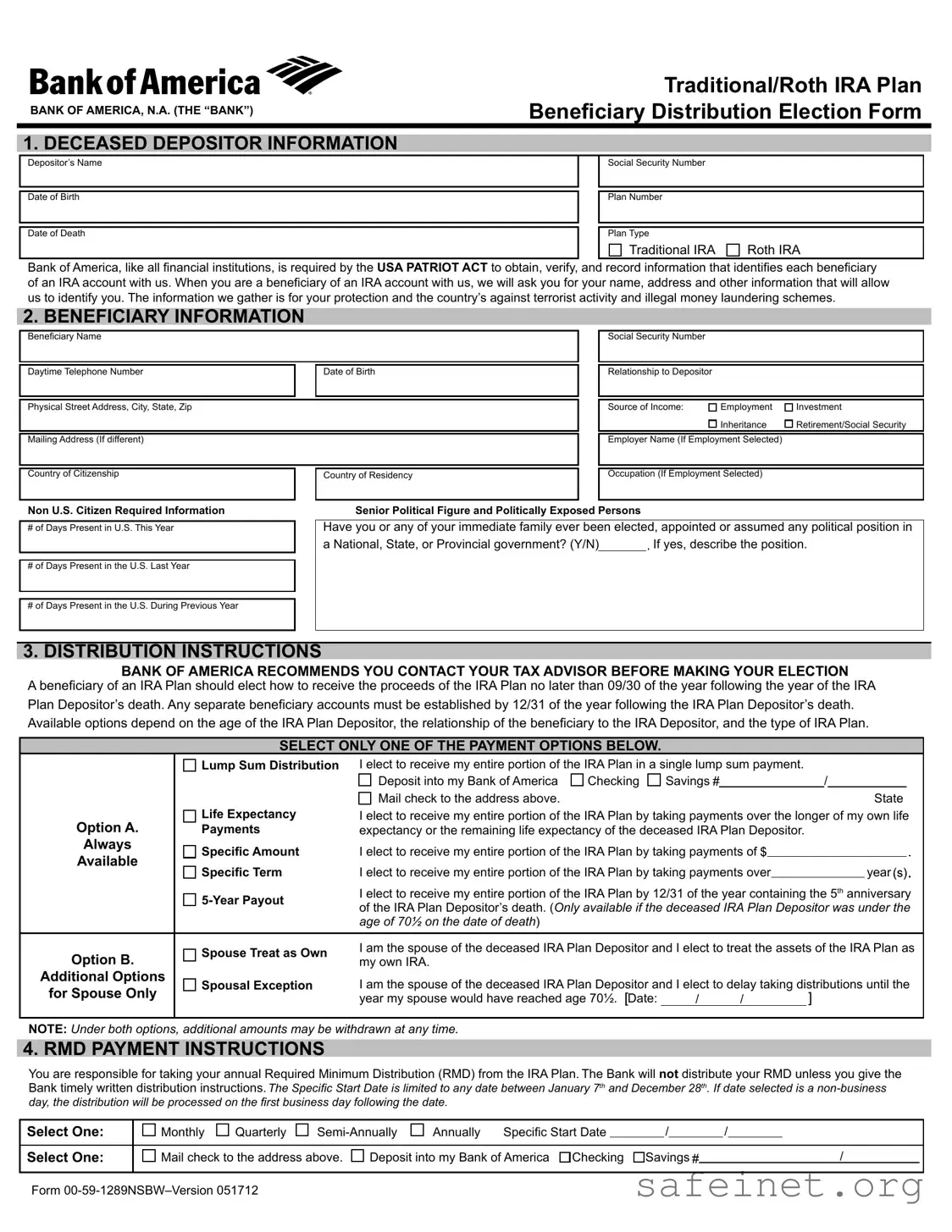
BANK OF AMERICA, N.A. (THE “BANK”)
Traditional/Roth IRA Plan
Beneciary Distribution Election Form
1. DECEASED DEPOSITOR INFORMATION
Depositor’s Name Social Security Number
Date of Birth Plan Number
Date of Death Plan Type
Traditional IRA Roth IRA
Bank of America, like all nancial institutions, is required by the USA PATRIOT ACT to obtain, verify, and record information that identies each beneciary
of an IRA account with us. When you are a beneciary of an IRA account with us, we will ask you for your name, address and other information that will allow
us to identify you. The information we gather is for your protection and the country’s against terrorist activity and illegal money laundering schemes.
2. BENEFICIARY INFORMATION
Beneciary Name Social Security Number
Daytime Telephone Number Date of Birth Relationship to Depositor
Physical Street Address, City, State, Zip Source of Income: Employment Investment
Inheritance Retirement/Social Security
Mailing Address (If different) Employer Name (If Employment Selected)
Country of Citizenship
Country of Residency
Occupation (If Employment Selected)
Non U.S. Citizen Required Information
# of Days Present in U.S. This Year
# of Days Present in the U.S. Last Year
# of Days Present in the U.S. During Previous Year
Senior Political Figure and Politically Exposed Persons
Have you or any of your immediate family ever been elected, appointed or assumed any political position in
a National, State, or Provincial government? (Y/N) If yes, describe the position.
3. DISTRIBUTION INSTRUCTIONS
BANK OF AMERICA RECOMMENDS YOU CONTACT YOUR TAX ADVISOR BEFORE MAKING YOUR ELECTION
A beneciary of an IRA Plan should elect how to receive the proceeds of the IRA Plan no later than 09/30 of the year following the year of the IRA
Plan Depositor’s death. Any separate beneciary accounts must be established by 12/31 of the year following the IRA Plan Depositor’s death.
Available options depend on the age of the IRA Plan Depositor, the relationship of the beneciary to the IRA Depositor, and the type of IRA Plan.
SELECT ONLY ONE OF THE PAYMENT OPTIONS BELOW.
Option A.
Always
Available
Lump Sum Distribution
I elect to receive my entire portion of the IRA Plan in a single lump sum payment.
Deposit into my Bank of America
Mail check to the address above.
Checking Savings
State
Life Expectancy
Payments
I elect to receive my entire portion of the IRA Plan by taking payments over the longer of my own life
expectancy or the remaining life expectancy of the deceased IRA Plan Depositor.
Specic Amount
I elect to receive my entire portion of the IRA Plan by taking payments of
Specic Term
I elect to receive my entire portion of the IRA Plan by taking payments over
year
5-Year Payout
I elect to receive my entire portion of the IRA Plan by 12/31 of the year containing the 5
th
anniversary
of the IRA Plan Depositor’s death. (Only available if the deceased IRA Plan Depositor was under the
age of 70½ on the date of death
Option B.
Additional Options
for Spouse Only
Spouse Treat as Own
I am the spouse of the deceased IRA Plan Depositor and I elect to treat the assets of the IRA Plan as
my own IRA.
Spousal Exception
I am the spouse of the deceased IRA Plan Depositor and I elect to delay taking distributions until the
year my spouse would have reached age 70½. Date:
NOTE: Under both options, additional amounts may be withdrawn at any time.
4. RMD PAYMENT INSTRUCTIONS
You are responsible for taking your annual Required Minimum Distribution (RMD) from the IRA Plan. The Bank will not distribute your RMD unless you give the
Bank timely written distribution instructions.
The Specic Start Date is limited to any date between January 7
th
and December 28
th
. If date selected is a non-business
day, the distribution will be processed on the rst business day following the date.
Select One:
Monthly Quarterly Semi-Annually Annually Specic Start Date
Select One:
Mail check to the address above. Deposit into my Bank of America Checking Savings
Form 00-59-1289NSBW–Version 051712
.
.
.
.
:
5. TAX WITHHOLDING ELECTION
Notice of Withholding Election: Distributions you receive from your Individual Retirement Account are subject to Federal income tax
withholding and may be subject to State income tax withholding and/or Local income tax withholding based on your state and municipality of
residence unless you elect not to have withholding apply.
You are liable for Federal, and applicable State and Local income taxes on the taxable portion of your distribution. If you elect not to have withholding
apply to your distribution, or if you do not have enough tax withheld from your distribution, you may be responsible for payment of estimated taxes.
You may also incur penalties under the estimated tax rules if your withholding and estimated tax payments are not sufcient.
Withholding Election: You MUST indicate your withholding election below.
Complete if you are providing a U.S. Address:
Federal Withholding:
Important: Please note that if you do not make a withholding election, federal income tax will be automatically withheld from your
distribution at a rate of 10%.
Do not withhold federal income tax from my distribution.
Withhold federal income tax from my distribution (check one)
At a rate of 10%
At a rate of
% (must be greater than 10%)
State Withholding:
Important: State withholding may also be required in certain states when you elect federal income tax withholding. North Carolina
residents are required to use form NC-4P (Withholding Certicate for Pension or Annuity Payments) for all North Carolina state
withholding elections.
The minimum required for the state of is
Do not withhold state income tax from my distribution.
Withhold state income tax for the state of
from my distribution at the rate of %, or amount of $
Local Withholding:
Important: Local withholding may also be required in certain states.
The minimum required for the municipality of
is
Do not withhold local income tax from my distribution.
Withhold local income tax for the municipality of from my distribution at the rate of %, or amount of $
Complete if you are providing a Foreign Address:
Important: If you are a U.S. citizen or a Resident Alien with a foreign address, you may not waive the Federal withholding requirement
and you must complete Form W-9. If you are a Non-Resident Alien, all IRA distributions are subject to a tax treaty rate or 30% tax
withholding and you must complete Form W-8BEN.
I am a U.S. Citizen or Resident Alien living abroad (check one)
Withhold: At a rate of 10% At a rate of % (must be greater than 10%)
6. BENEFICIARY’S ACKNOWLEDGMENT
I acknowledge that I have read and completed this Form. I further acknowledge that neither the Bank nor its agents or employees have made any
representations to me regarding tax or any other effects of my elections/instructions on this Form, and the Bank has advised me to speak to my tax
advisor regarding my elections/instructions. I direct the Bank to effect the elections/instructions I have made on this Form and agree that the Bank and its
agents and employees have no liability for any action or inaction taken by them in reliance upon such elections/instructions.
BENEFICIARY SIGNATURE (REQUIRED) DATE
Form 00-59-1289NSBW – Version 042412
BANK OF AMERICA, N.A. (THE “BANK”)
Traditional/Roth IRA Plan
Beneciary Distribution Election Form
Informational Sheet
BANK OF AMERICA RECOMMENDS YOU CONTACT YOUR TAX ADVISOR BEFORE MAKING YOUR ELECTION
A beneciary of an IRA Plan should elect how to receive the proceeds of the IRA Plan no later than 09/30 of the year following the year of the IRA
Plan Depositor’s death. Any separate beneciary accounts must be established by 12/31 of the year following the IRA Plan Depositor’s death.
Available options depend on the age of the IRA Plan Depositor, the relationship of the beneciary to the IRA Depositor, and the type of IRA Plan.
Complete, sign and send the distribution form:
To your Local Bank of America Banking Center
Or, mail to the following address
Bank of America, N.A.
Mail code: TX2-979-02-14
P.O. Box 619040
Dallas, TX 75261-9943
:
1. DECEASED DEPOSITOR INFORMATION
Depositor’s Name — Enter the deceased person’s name
Social Security Number — Enter the deceased person’s social security number
Date of Birth — Enter the deceased person’s Date of Birth
Plan Number — Enter the deceased person’s Plan Number that is being processed
Date of Death — Enter the date of death for the account owner (deceased person
Plan type — Select the plan type of the deceased account holder
2. BENEFICIARY INFORMATION
Bank of America, like all nancial institutions, is required by the USA PATRIOT ACT to obtain, verify, and record information that identies each
beneciary of an IRA account with us. When you are a beneciary of an IRA account with us, we will ask you for your name, address and other
information that will allow us to identify you. The information we gather is for your protection and the country’s against terrorist activity and
illegal money laundering schemes.
Beneciary Name — Enter the name of the beneciary for the plan identied in the Plan Number section
Social Security Number — Enter the Social Security Number for the beneciary listed in the Beneciary Name section. If the
beneciary is an entity, enter the Employer Identication Number (EIN)
Daytime Telephone Number — Enter the best contact number that you can be reach at during the day
Date of Birth — Date of birth for the person listed in the Beneciary Name section. If the beneciary is an Entity, please list the
Date of Birth for the decedent
Relationship to the Depositor — Example, Daughter, Mother, or Father. If the beneciary is an Entity please leave this eld blank
Physical Street Address, City, State, Zip — Enter the street address for the beneciary listed in the Beneciary Name section.
Please note: This must be a physical address to comply with the USA Patriot ACT.
Source of Income — Select the appropriate option from the list provided. If the beneciary is an Entity, please select Inheritance.
Mailing Address — Complete only if different from the Physical Address listed.
Employer Name — List the beneciarys current employer
Country of Citizenship — Enter the Country that the Beneciary is a citizen
Country of Residency — Enter the Country the Beneciary resides in
Occupation Enter the Beneciary’s current occupation or job ONLY if employment was selected as Source of Income
Non U. S. Citizen Required Information
of Days Present in the U.S. This Year — Enter the number of days that the beneciary has been present in the U. S. for the current year
of Days Present in the U.S. Last Year — Enter the number of days that the beneciary was in the U.S. during the last calendar year
of Days Present in the U.S. Prior to the Last Year — Enter the number of days that the beneciary was in the U.S. Prior to the
last full calendar year
Senior Political Figure and Politically Exposed Person
Indicate if you should be identied as a senior political gure or politically exposed person. Provide details on the position held
or relationship.
3. DISTRIBUTION INSTRUCTIONS
Please ensure that you select only one of the payment options from the list. Selecting multiple options can delay the processing of your request.
Option A:
Lump Sum Distribution — Available to all beneciaries. This option would be a single lump sum payment of the funds directly
to the beneciary
Life Expectancy — Payments would be made over the life expectancy of the beneciary list in the Beneciary Name section
Specic Amount — Payment amounts would be disbursed as specied by the beneciary (the beneciary will be responsible
to ensure that their disbursement amount meets IRS requirements **
Specic Term — Payments will be disbursed over a specied term as elected by the beneciary (the beneciary will be
responsible to ensure that their disbursement amount meets IRS requirements **
)
)
-
.
5 year Payout — Payments will be disbursed by 12/31 of the 5
th
year post the year of death of the IRA Plan holder**
Option B (Spousal Options):
Spouse Treat as Own — An IRA plan honoring the deceased depositor’s existing IRA Plan terms would be established for
the spouse, and the account would be treated as their own.
Spousal Exception — The spouse elects to delay taking distributions until the deceased account holder would have reached 70½
**Under these methods denoted above, additional amounts may be withdrawn at any time.
Please note: If you selected any option except Lump Sum, please ensure Section 4 is completed (if applicable).
4. RMD PAYMENT INSTRUCTIONS
The Beneciary is responsible for taking their annual Required Minimum Distribution (RMD) from the IRA Plan. The Specic Start Date is
limited to any date between January 7
th
and December 28
th
. If date selected is a non-business day, the distribution will be processed on the rst
business day following the date
Please review the options carefully and select the appropriate distribution for the beneciary.
5. TAX WITHHOLDING ELECTION
Notice of Withholding Election: Distributions you receive from your Individual Retirement Account are subject to Federal income tax
withholding and may be subject to State income tax withholding and/or Local income tax withholding based on your state and municipality of
residence unless you elect not to have withholding apply.
You are liable for Federal, and applicable State and Local income taxes on the taxable portion of your distribution. If you elect not to have
withholding apply to your distribution, or if you do not have enough tax withheld from your distribution, you may be responsible for payment of
estimated taxes. You may also incur penalties under the estimated tax rules if your withholding and estimated tax payments are not sufcient.
You MUST indicate your withholding election on the form provided.
Federal Withholding:
Important: Please note that if you do not make a withholding election, federal income tax will be automatically withheld
from your distribution at a rate of 10%.
State Withholding:
Important: State withholding may also be required in certain states when you elect federal income tax withholding.
Note that North Carolina residents must use Form NC-4P (Withholding Certicate for Pension or Annuity Payments)
to elect or waive North Carolina state withholding.
Local Withholding:
Important: Local withholding may also be required in certain states.
Complete denoted section if you are providing a Foreign Address:
Important: If you are a U.S. citizen or a Resident Alien with a foreign address, you may not waive the Federal withholding
requirement and you must complete Form W-9. If you are a Non-Resident Alien, all IRA distributions are subject to a tax treaty
rate or 30% tax withholding and you must complete Form W-8BEN.
For additional questions, please contact your local Bank of America Banking Center or our customer service associates are available toll-free
at 1.888.827.1812 to answer questions and provide additional information.

Document Specifications

Fact Name Description
Deceased Depositor Information This section requires details about the deceased, including name, date of birth, date of death, and Social Security number.
Beneficiary Identification Under the USA PATRIOT ACT, Bank of America must verify the identity of each beneficiary, collecting information such as name, address, and Social Security number.
Distribution Deadline Beneficiaries must elect how to receive IRA proceeds by September 30 of the year following the depositor's death.
Available Payment Options Beneficiaries can choose from several payment options, including lump sum, life expectancy payments, or specific term payments, depending on their relationship to the deceased.
Required Minimum Distribution (RMD) Beneficiaries are responsible for taking their annual RMD from the IRA Plan. Specific start dates for distributions can only be set between January 7 and December 28.
Tax Withholding Requirements Distributions are subject to federal income tax withholding, and state or local taxes may also apply based on the beneficiary's residence. North Carolina residents must use form NC-4P for state withholding.
Beneficiary Acknowledgment Beneficiaries must acknowledge that they have read and completed the form, and they are advised to consult a tax advisor regarding their elections.

Steps to Filling Out Bank Of America Beneficiary

Filling out the Bank of America Beneficiary form is an important step for beneficiaries of an IRA account. After completing the form, it should be submitted to the appropriate Bank of America location. This ensures that the financial institution has the necessary information to process the distribution according to the beneficiary's preferences.

  1. DECEASED DEPOSITOR INFORMATION: Enter the deceased person's name, date of birth, date of death, social security number, plan number, and select the plan type (Traditional IRA or Roth IRA).
  2. BENEFICIARY INFORMATION: Provide the beneficiary's name, daytime telephone number, date of birth, physical street address (including city, state, and zip), mailing address (if different), country of citizenship, country of residency, social security number, and relationship to the depositor. If applicable, include employer name and occupation.
  3. NON U.S. CITIZEN REQUIRED INFORMATION: If the beneficiary is not a U.S. citizen, fill in the number of days present in the U.S. for the current year, the last year, and the year prior. Indicate if the beneficiary or any immediate family member has held a political position.
  4. DISTRIBUTION INSTRUCTIONS: Select only one payment option from the list provided, such as Lump Sum Distribution, Life Expectancy, Specific Amount, Specific Term, or 5-Year Payout. If the beneficiary is a spouse, additional options are available.
  5. RMD PAYMENT INSTRUCTIONS: Indicate how often the beneficiary wants to receive their annual Required Minimum Distribution (RMD) and select a specific start date for the distribution.
  6. TAX WITHHOLDING ELECTION: Choose whether to withhold federal income tax from the distribution. Specify the withholding rate if applicable. If the beneficiary is a U.S. citizen or resident alien living abroad, complete the appropriate sections regarding withholding.
  7. BENEFICIARY’S ACKNOWLEDGMENT: Sign and date the form to acknowledge that all information has been provided accurately and that the beneficiary understands the implications of their selections.

Once the form is completed and signed, it should be submitted either in person at a local Bank of America Banking Center or mailed to the designated address provided in the form. This will initiate the processing of the beneficiary's election regarding the IRA account.

More About Bank Of America Beneficiary

What is the purpose of the Bank of America Beneficiary form?

The Bank of America Beneficiary form is designed to help beneficiaries of an IRA account make important decisions regarding the distribution of funds after the account holder's death. It collects essential information about both the deceased account holder and the beneficiary. This information is necessary for compliance with federal regulations, specifically the USA PATRIOT ACT, which aims to prevent illegal activities such as money laundering and terrorist financing.

What information do I need to provide as a beneficiary?

As a beneficiary, you will need to provide several pieces of information. This includes your name, Social Security number, date of birth, physical address, and relationship to the deceased account holder. Additionally, you may be asked about your source of income and whether you have been present in the U.S. for a certain number of days. This information helps the bank verify your identity and ensures compliance with legal requirements.

What are my distribution options as a beneficiary?

You have several options for how to receive the proceeds from the IRA. You can choose a lump sum distribution, which provides all funds at once. Alternatively, you might opt for payments based on your life expectancy or the deceased's life expectancy. Other options include specific term payments or a 5-year payout, which must be completed by December 31 of the fifth year following the account holder's death. If you are the spouse of the deceased, you can also treat the IRA as your own or delay distributions until you reach age 70½.

Are there any tax implications I should be aware of?

Yes, distributions from an IRA are generally subject to federal income tax withholding. You will need to indicate your withholding preference on the form. If you do not choose to have taxes withheld, you may be responsible for paying estimated taxes to avoid penalties. It is crucial to consult with a tax advisor to understand the implications of your distribution choice and to ensure compliance with tax obligations.

What happens if I miss the distribution deadline?

If you do not make your distribution election by September 30 of the year following the account holder's death, you may face penalties or limitations on how you can access the funds. It’s important to act promptly and ensure that all necessary forms are completed and submitted on time to avoid complications.

How do I submit the completed Beneficiary form?

You can submit your completed Beneficiary form in two ways: either by visiting your local Bank of America Banking Center or by mailing it to the designated address provided on the form. Make sure to double-check that all required information is filled out correctly to avoid delays in processing your request.

Common mistakes

  1. Incomplete Information: Many people forget to fill out all required fields, such as the deceased depositor’s social security number or date of death. Missing this information can delay processing.

  2. Incorrect Beneficiary Details: It's common to see mistakes in the beneficiary's name or social security number. Double-checking these details is crucial to avoid complications later.

  3. Choosing Multiple Distribution Options: Selecting more than one payment option can lead to confusion and delays. Stick to just one option to ensure a smoother process.

  4. Ignoring Tax Withholding Elections: Failing to indicate your tax withholding preferences can result in automatic deductions. Be sure to complete this section to avoid surprises.

  5. Missing Deadlines: Beneficiaries often overlook important deadlines, such as the requirement to elect how to receive proceeds by September 30 of the year after the depositor's death. Mark your calendar!

  6. Not Consulting a Tax Advisor: Many beneficiaries skip this step, which can lead to misunderstandings about tax implications. It's wise to seek advice before making decisions.

Documents used along the form

When dealing with the Bank of America Beneficiary form, several other forms and documents are often required to ensure a smooth process. Each of these documents serves a specific purpose in managing the distribution of an IRA account. Here’s a brief overview of these related documents.

  • Form W-9: This form is used by U.S. citizens or resident aliens to provide their taxpayer identification number to the bank. It is essential for tax reporting purposes.
  • Form W-8BEN: Non-resident aliens must complete this form to certify their foreign status and claim any applicable tax treaty benefits. It helps determine the correct withholding rate on distributions.
  • Form NC-4P: North Carolina residents use this form to elect or waive state income tax withholding on pension or annuity payments. It is necessary for compliance with state tax laws.
  • Beneficiary Designation Form: This document allows account holders to specify who will inherit their IRA assets. It is crucial for ensuring that the intended beneficiaries receive the funds.
  • Death Certificate: A certified copy of the deceased's death certificate is often required to process beneficiary claims. This document verifies the account holder's passing.
  • Tax Withholding Election Form: This form allows beneficiaries to indicate their preferences for federal and state tax withholding on distributions. It ensures that the correct amount is withheld for tax purposes.
  • Required Minimum Distribution (RMD) Request Form: Beneficiaries must use this form to request their annual RMD from the IRA. It is important for compliance with IRS rules regarding withdrawals.
  • Identification Documents: Beneficiaries may need to provide valid identification, such as a driver's license or passport, to verify their identity when claiming benefits.
  • Power of Attorney (if applicable): If a beneficiary is unable to manage their affairs, a power of attorney document may be required. This grants another person the authority to act on their behalf.

Gathering these documents can help streamline the process of claiming benefits from an IRA account. Each form plays a vital role in ensuring that the beneficiary's rights are protected and that all legal requirements are met. Proper preparation can make a challenging time a little easier.

Similar forms

The Bank of America Beneficiary form shares similarities with the Life Insurance Beneficiary Designation form. Both documents serve the purpose of identifying beneficiaries who will receive benefits upon the death of the account holder. In the case of life insurance, the policyholder designates one or more beneficiaries to receive the death benefit. Like the Bank of America form, the Life Insurance Beneficiary Designation requires personal information about the beneficiaries, including their names, addresses, and relationships to the policyholder. This information is essential for ensuring that the benefits are distributed correctly and in accordance with the policyholder's wishes.

Another document akin to the Bank of America Beneficiary form is the Retirement Account Beneficiary Designation form. This form is used by individuals to specify who will inherit their retirement accounts, such as 401(k) plans or IRAs, upon their death. Similar to the Bank of America form, it necessitates the collection of beneficiary information, including names, social security numbers, and relationships to the account holder. The primary function of both forms is to facilitate the transfer of assets to the designated beneficiaries, thereby ensuring a smooth transition of benefits in the event of the account holder's death.

The Will, a foundational legal document, also bears resemblance to the Bank of America Beneficiary form. A Will outlines how a person's assets, including financial accounts, should be distributed after their death. While the Bank of America form specifically addresses the distribution of IRA assets, a Will encompasses a broader range of assets and may include specific instructions for the handling of debts and taxes. Both documents require clear identification of beneficiaries, ensuring that the deceased's wishes are honored in the distribution of their estate.

Trust documents, particularly those that designate beneficiaries, are another comparable document. A Trust allows individuals to manage their assets during their lifetime and dictate how those assets will be distributed after their death. Similar to the Bank of America Beneficiary form, a Trust requires detailed information about beneficiaries. Both documents aim to ensure that the intended recipients receive their designated assets, but a Trust may also provide additional management and protection of assets during the grantor's lifetime.

Lastly, the Power of Attorney form can be likened to the Bank of America Beneficiary form in that both involve the designation of individuals who will act on behalf of another. While the Bank of America form focuses on the distribution of IRA assets after death, a Power of Attorney allows an individual to appoint someone to manage their financial affairs while they are still alive. Both documents necessitate the identification of individuals and their relationships to the principal, ensuring that the designated persons have the authority to act in accordance with the principal's wishes.

Dos and Don'ts

When filling out the Bank of America Beneficiary form, it's important to do it correctly to avoid delays. Here are seven things to keep in mind:

  • Do: Provide accurate information about the deceased depositor, including their name, date of birth, and social security number.
  • Don't: Skip any required fields. Every piece of information is necessary for processing your request.
  • Do: Double-check your beneficiary information. Make sure the name and social security number match official documents.
  • Don't: Use abbreviations or nicknames. Always use the full legal name of the beneficiary.
  • Do: Select only one payment option. Choosing multiple options can complicate the process.
  • Don't: Forget to sign and date the form. Your signature is essential for it to be valid.
  • Do: Contact your tax advisor if you have questions about tax implications. It's wise to understand the financial impact before making decisions.

Following these guidelines will help ensure your form is filled out correctly and processed in a timely manner.

Misconceptions

Here are some common misconceptions about the Bank of America Beneficiary form, along with clarifications for each:

  • It is not necessary to fill out the form promptly. Many people believe they can take their time with the form. However, beneficiaries must elect how to receive proceeds by September 30 of the year following the depositor's death.
  • All beneficiaries can receive funds in any way they choose. This is misleading. The options available depend on factors such as the age of the deceased and the relationship to the beneficiary.
  • Tax withholding is optional for all beneficiaries. While beneficiaries can choose whether to have taxes withheld, they must indicate their choice on the form. If they do not, a default rate of 10% will be withheld.
  • Only U.S. citizens need to provide extensive information. Non-U.S. citizens must also provide specific information, such as days present in the U.S. and their country of citizenship.
  • Beneficiaries can ignore the Required Minimum Distribution (RMD) rules. This is incorrect. Beneficiaries are responsible for taking their annual RMD from the IRA, and failure to do so can result in penalties.
  • The form can be submitted without a signature. A signature is required. Without it, the form is incomplete and cannot be processed.
  • There is no need for a tax advisor's input. Many assume they can make these decisions independently. However, consulting a tax advisor is recommended to understand the implications of their choices.
  • Beneficiaries can select multiple payment options. This is a misconception. Only one payment option can be selected, and choosing multiple options may delay processing.

Key takeaways

Filling out and using the Bank of America Beneficiary form can seem daunting, but understanding the key aspects can simplify the process significantly. Here are some essential takeaways:

  • Accurate Information is Crucial: Ensure that all details regarding the deceased depositor and the beneficiary are filled out correctly. This includes names, Social Security numbers, and dates of birth.
  • Compliance with Regulations: The Bank is required to collect specific information under the USA PATRIOT ACT. This is intended to protect against illegal activities, so be prepared to provide your citizenship and residency details.
  • Timely Elections are Necessary: Beneficiaries must make their distribution election by September 30 of the year following the depositor’s death. Failing to do so could lead to complications or delays.
  • Choose One Payment Option: When filling out the form, beneficiaries must select only one distribution option. Multiple selections can cause processing delays.
  • Understand Tax Implications: Distributions are subject to federal income tax withholding. Beneficiaries should consider consulting a tax advisor to understand their obligations and options for withholding.
  • Keep Copies of Your Submission: After completing the form, make sure to keep a copy for your records. This can be helpful for future reference or in case of any disputes.

By keeping these points in mind, beneficiaries can navigate the process more effectively and ensure their rights and responsibilities are clear.